Monthly Archives: January 2021

Navalny, political protest and opposition in Russia

(an uninformative blog title designed for bots).
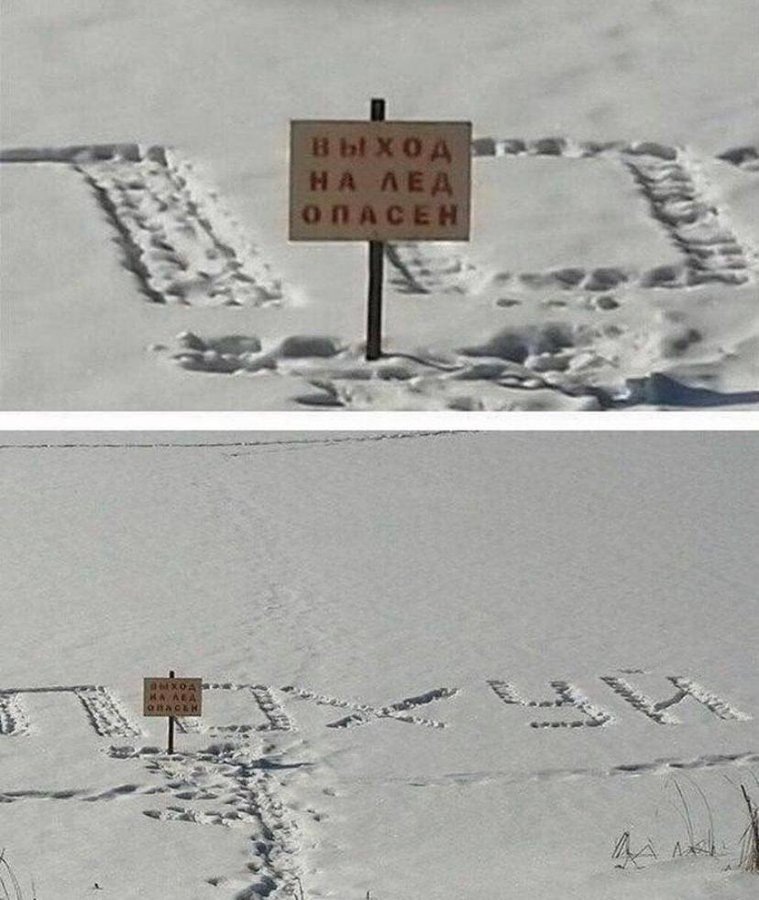
Sign: ‘Going out onto the ice is dangerous’. In snow-footprints: ‘couldn’t give a f*ck’.

We know from media coverage of the Bolotnaia protests nearly ten years ago that media representations of protest in Russia are often far from the reality. Researchers have shown that painting those protests as a ‘middle-class’ revolt was wide of the mark – in reality a broad age-range and social mix of Muscovites came out  ‘For Fair Elections’. Kalk writes of the creation of the myth of a dignified ‘creative class’ by the Russian media. I have written at length on the flipside of this discourse (and here for a more general audience)– an inability to even consider the class agency of those who are not educated metropolitans.   Bikbov shows that people’s reasons for coming out on the streets are very difficult to measure and are sometimes not even articulable by participants themselves. Misha Gabowitsch is also skeptical: “Expressions such as ‘middle class’, ‘generation’ or ‘pensioner’ suggest actually existing collective actors, but they only appear when their supposed members understand themselves as such and when there are institutions that maintain such constructs. […] In today’s Russia this is seldom the case.”

Nonetheless ‘indignation’ and shame that then translate into a burning desire to express publicly one’s anger and frustration are powerful motivators. Being part of a bigger movement acting for themselves in a country where public acts are usually orchestrated by cynical political considerations should also be considered. The feeling of participating in something bigger than one’s self is like a little spark of electricity, according to many who do not see themselves as ‘activists’. But then what has this to do with Navalny? I think another mistake of analysis of protests – last Saturday included – is to focus too much on the man. As I said in yesterday’s post – it’s more useful to think of him as channelling currents and forces that exist independent of his particular political profile, campaign even. As Bikbov wrote of the 2011-12 protests – we shouldn’t discount the importance of ‘individual self-construction’ (bourgeois self-building) as a motivation. And this is not about ‘dignity’ in a social solidarity sense (as it may be in other contexts), but about the individual. In those sense it does have a classed element, but not a class-consciousness one.

To avoid this turning into a mega post again, I will just summarise some observations based on talking to a genuinely wide range of Russians.

Socio-economic profile of protesters – a red herring. Moscow is diverse, so are its protests, but Moscow is not Russia and of course is magnitudes ‘better off’ than anywhere else. Were there many ‘new’ protesters? – maybe. Is that significant – probably not really. In reality these are quite small numbers (c. 20-40,000 in Moscow, and perhaps 150,000 across the country in 101 different cities) and anyone with personal experience of activism will know that cause-fatigue and turnover is high. Some interesting interpretation on how numbers of arrests have a ceiling irrespective of protester numbers which indicates limited capacity even of expanded Rosgvardiia – Putin’s loyal paramilitary (although others say that RG was held back intentionally).

Violence – very little of it – but nonetheless people standing their ground when clearly provoked by police. Police and participants clearly ‘learned’ from Belarus and from their own prior experience/knowledge. Tempting to draw class conclusions too from this – that a largely middle-class crowd. But, another reason not to rely too much on media of any stripe, which will always highlight the newsworthy violence.

Navalny’s arrest as focal point of the ‘miting’ (demonstration). It’s remarkable and no doubt a credit to Navalny as a genuinely charismatic and sincere opponent of the elite that so many (but again relative numbers is everything) came out for HIM. Nonetheless he is not the head of a party, and not the head of a movement. He is, like Putin, a mediated political figure, not a ‘politician’, even in an age where all politicians seek to mediatise themselves to stand out. The personalisation of politics can be a mobiliser, but in the longer term makes it harder to translate into a movement – indeed, quite a few protesters talked about their motivations being ‘more than just about helping a person’. Note that Navalny ended his video on Putin by returning to his campaign for smart voting, but this is not a viable strategy long-term.  

Other channelling that Navalny’s cause serves: ‘overcoming one’s personal fears in the dark days of my country’. This echoes what I mentioned above about how there can be very idiosyncratic, yet shared reasons for protest that are not really about the man or his message, but wider and longer-term currents in Russian society. I also heard about some very spontaneous acts of defiance from passersby who attempted, as in Belarus, to verbally or physically challenge law enforcement nonviolently – the video of the police kicking a woman in her 50s who was peacefully interceding was clearly not an isolated incident. Indeed – more telling than the kicking was the bragging reaction of one of the policemen that provoked widespread condemnation and a panic reaction from bosses.  ‘возмущение’ – indignation – it certainly does have a place here.

On the more pessimistic side, I have to reiterate the message of an old post on opposition politics I wrote here. Grumbling, resentment, even hatred of the elite does not mean people will support or even acknowledge Navalny as a legitimate opposition figure. If anything, Navalny’s more recent ‘smart voting’, while effective (to a limited extent), just reflects what people were trying in a disorganised way to do before. Similarly, his more recent focus on economic inequality also is ‘behind the curve’ of the needs and values of the majority of ordinary people in my research, who started to turn away from United Russia ten years ago. They were already ‘smart voting’ in their own way before for ‘anyone but United Russia’.

For me personally, this is where he reveals his narrow (classed) cosmopolitan appeal that does not translate into leadership of a genuine opposition front. Because it’s not as accessible or interesting to the Western press, people tend to forget that the far right and the conservative left (as far as these ersatz labels make sense) both have populist messaging that does cut through into electoral success in Russia (as far as they can in such a skewed system, and acknowledging that they often not considered a real opposition). Again, we don’t hear so much about this because it’s not in Moscow and it doesn’t fit the narrative (coverage of Khabarovsk’s LDPR governor was an exception proving the rule). Indeed, the fact that only now the Communists and the LDPR (Zhirinovsky being the original populist politician and that party’s leader) are whining like little girls (sorry about that) about Navalny, is another measure of how late to the party he is.

So what has changed since I wrote in 2016 about ‘smart voting from below’? Well, in the mid 2010s Navalny was starting to cut through to ordinary people in terms of name recognition, especially with his ‘On vam ne Dimon’ video about Medvedev from 2017.  However there remain formidable structural barriers – he’s still perceived as ‘one of them’ – a metropolitan elite. He’s correspondingly vulnerable to being painted as a stooge of the West, as a foreign agent – as part of the ‘fifth column’. And this is why he clearly calculated he had to come home from Germany.

The problem that his supporters and pretty much all my liberal Russian friends don’t like to admit is that the regime is just as capable of learning from its mistakes and changing its tune as Navalny – its current campaign of intensifying disinformation: that Navalny is funded by foreign powers and is corrupting Russia’s youth, is largely successful. Just because the state controlled TV can no longer ignore him completely doesn’t mean a victory for him.  Thus, for every person who went out to support him on Saturday there is a spouse, or more likely an older relative, or a sibling (likely a state worker), who more or less buys the idea that Navalny is a front of some kind – a ‘feik’ or a ‘frik’ (fake or freak). Sure, the elite are corrupt as hell, but he’s just too slick – he must be a CIA product! One of the most intelligent and wise of my research interlocutors sincerely believes that the Moscow protests are a result of western embassies paying disaffected youth and criminals, and where they can’t pay them, getting them drunk. And this is a person who uses the internet – and while there’s no ‘great firewall’ as in China, targeted oppositional political ads are pretty much banned from mainstream social media in Russia. The whole ‘brainwashing youth’ slander has really cut through – just as much as we should acknowledge that Navalny’s anti-corruption message cut through.

Then there is general demobilization due to the deteriorating economic situation – which pre-dates, but which is exacerbated by Covid. Unlike in 2011-12, one interlocutor reflects that the ‘middle-class’ is подавлен – depressed. We shouldn’t discount the psychological effect of the economic burden on people – they aren’t jobless, but they are struggling with high levels of consumer debt and insecure conditions, and this is not a situation where ‘someone feels they owe something political to people, that they are able to participate in protest and maybe lose their job’. Add to this the more effective post-truth campaign by the authorities aimed at demobilization and you get a toxic mix that can be effective in putting people off coming out. As I said, yesterday – even critical ‘thinking’ people are willing to be satisfied by the word of Putin and then are liable to turn on those close to them who would like to protest – ‘what do you owe that guy [Navalny]? Think about your family. You think you can make a difference?’ On this basis can Navalny’s supporters hope for more than the making of a martyr (another important vector of myth-making in Russia)? A dissident in the noble (?) intellectual tradition of USSR? It strikes me that dissidence is not a position he’d be willing to occupy, nor one that is really tenable in today’s Russia. But I will end on a more optimistic note – Navalny is not the only brave activist, there are opposition politicians, labour activists, and ‘organic’ intellectuals all over Russia making small contributions to change every day. They aren’t the focus of media interest in Russia, but they are probably just as important in the long term as Alexei Navalny. Right now I’m writing about labour organising among food couriers, and will soon write a post about that topic.  
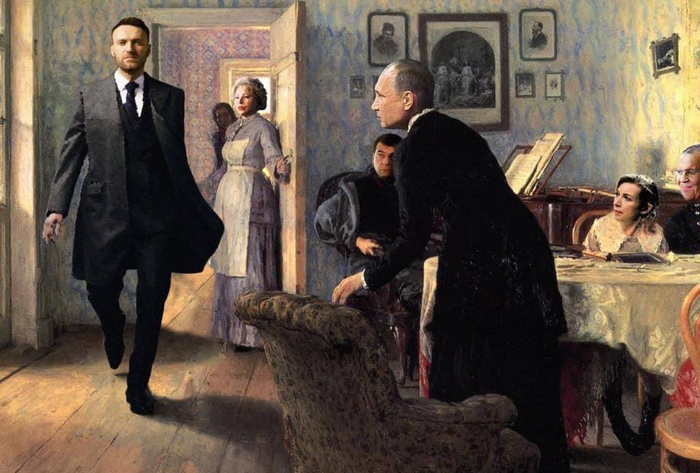
Putin and property – a ‘boss’ but not an owner

After Repin. ‘They weren’t expecting him’.

I was reluctant to write about Navalny’s return to Russia. Partly because so much attention devoted to this figure in the ‘West’ does neither him, nor the breadth of political opposition in Russia any real favours – witness some of the naval-gazing attempts to tie Russian protests to BLM and other issues in the US that really have little to do with the Russian context and even less to do with Navalny’s case. Anyway, what did catch my attention was Putin’s unprecedented response (in that normally he pretends that N. does not exist) after the YouTube expose of what is alleged is Putin’s Black Sea palace. Second, I thought it worth underlining a point I’ve made before in this blog – that Navalny still fails to cut through as a national political figure, even though his videos and campaigning have fundamentally changed the political atmosphere. Also, unlike even at the time of the Moscow mayoral election in 2013 (which he should have rightfully won), pretty much all my research participants (in deindustrializing Kaluga Region) are now aware of him.

So the post is in two parts –today, on the fickle meaning of ‘private property’ in Russia and later I will talk about some ‘on-the-ground’ responses to Navalny’s arrest and the 23rd January protests.

So, Oliver Carroll tweeted the strange phrase from the short interview Putin gave rebutting the allegations: ‘“Nothing described as my property belongs to or ever belonged to me or my close relatives. Ever” [ничего из того, что там указано в качестве моей собственности, ни мне, ни моим близким родственникам не принадлежит и никогда не принадлежало.]

Carroll commented: ‘A strange turn of phrase that doesn’t deny existence of palace resort or the fact that it was being guarded by the presidential security service.’ Then Timothy Frye responded that ‘Property rights are often seen as three separate rights: rights to use, to obtain income from, and to transfer an asset. Better to ask did you use the property or allow others use it than did you own it on paper.’ Frye has a book on property rights in Russia that I’m looking forward to reading. From a quick browse Frye asks the chicken and egg question about property rights – do people in developed economies abide by contracts because of social trust, social networks or effective courts? Interestingly he’s implying that our understanding of ‘good institutions’ in ‘the West’ is too simplistic and that social norms play more of a role than we would be comfortable admitting. Frye goes on to talk about the importance of informal institutions in Russia that provide their own ‘rules of the game’ in terms of widely understood sanctions for actions like reneging on informal agreements. In some business contexts, the rule of law can sometimes be a worthwhile recourse – legal dualism results. Later in the book I can see Frye has collected interesting survey data on the prevalent feelings of illegitimacy surrounding privatisation even 25 years on – particularly linked to perceptions about benefits to private individuals and the loss of public goods. “In a word, everyone hates privatization”, but not private property, write Frye.

My own research has not really looked much at property rights – only obliquely do I talk about corporate raiding (reiderstvo) and how its violence in Russia affects ordinary people. What was clear is that uncertainty and disputes of ownership of plant and land continues to create high levels of palpable risk even for ordinary people as it can result in catastrophic ‘externalities’ like pollution, violent crime, and the disruption of utility supply (p. 236 in the Conclusion linked above). It also results in a particular Russian anomaly – property that doesn’t belong to anyone. Famously the lack of ownership of graveyards has been widely discussed, but less well studied is the problem of roads and utility networks that jurisdictions fight over in order NOT to take responsibility for them. This was a running theme in my research on Izluchino in my book and many informal solutions of ‘devolved’ governance were found that would confound any traditional perspective on property relations.

In response to Carroll’s comment on Putin’s language – his disavowal of ownership of the palace – I was reminded of the literature on ‘private property’ in the USSR and in particular a discussion in a forthcoming book by Xenia Cherkaev that contains long discussion of ongoing significance of Soviet ‘property’. Usufruct looms large – ‘use’ stressed over ‘possession’ (vladenie) in the Soviet system where ‘private’ property was taboo, but still a reality, and thus had to be fudged in various ways. Putin is probably telling the truth that there isn’t a deed of property with his name on it. But that’s of course disingenuous because Navalny makes the point about endless intermediaries himself (and points out that they are quite revealing of the relative narrowness of Putin’s trust circle).  By relying on old acquaintances from St Petersburg, if anything Putin is shown in quite a sorry light – he doesn’t have very extensive social capital – revealing his rather parvenu origins and unimpressive career prior to the later 1990s!). But I guess the point here is, how much ‘capital’ does Navalny really have – in Russia? Maybe by his public act of self-sacrifice this will be his moment to become at least a powerful political symbol – if not political leader. Or will this gamble mean that he’ll eternally be known domestically as an ‘avantiurist’ or traitorous dupe. That’s for a later post.

Now, Cherkaev’s book is not in print yet and I don’t want to steal its thunder. However, some of the book’s arguments are visible in two articles – unpaywalled here  and here.

Cherkaev writes: “Coming from the study of Soviet civil law (see Cherkaev 2018 [Russian text]), I am especially interested in nonprivate ownership, in what happens to the idealized triad of full and complete ownership rights—usus (to manage), fructus (to benefit from), abusus (to dispose of)—when property is collectively held.” In the 2018 Russian article, Cherkaev discusses ‘dignity’ as personal property in the USSR. In the book, Cherkaev builds on the distinctions between personal and private to show how the former served as a substitute for the impossibility of the latter in the realm of ownership. The Soviet solution of “Personal property” posed no threat to the Soviet monopoly on property “because it was essentially usufruct: the right to use and benefit from a share of socialist property, without alienating it from the commons”. This led me to reflect further on another discussion – linked to ownership, that Cherkaev makes – that of ‘хозяйство’ – (khoziaistvo)  – which can translate economy, household, property, house, establishment.  Traditionally, ‘the economy’ in Russian is essentially ‘narodnoe khoziaistvo’ and more recently ‘natsionalnaia ekonomika’.

Cherkaev draws on Stephen Collier who notes that khoziaistvo actually refers to any nexus of production, so is not just ‘the economic’ – “as a noun, [it] can refer to a farm, a household, or virtually any nexus of production and need fulfilment—that is, to almost any unit of substantive economy. But khoziaistvo can not imply the formal meaning of ‘economic’” (Collier, 2011. Post-Soviet Social: Neoliberalism, Page 81). This led me to reflect about Putin as the ultimate ‘khoziain’ – an owner-in-charge contrasted to owner-as-possessor – and that this also captures his managerialism, as opposed to entrepreneurialism as leader. Russia’s economy is also easily seen as a khoziaistvo rather than a legal-contractual system of possessions exchanged. Khoziaistvo as dominion shows both the strengths and weaknesses of Russia’s ‘sistema’ (informal governance system) as it relates to the economic. From this meaning of khoziaistvo, Cherkaev marks Russia’s relationship to property as different to that of the ‘market economy’ . ‘Ekonomika’ is a formal space of circulation with equal and self-interested actors. But Putin as ‘khoziain’, shows the ‘substantive’ — in anthropological terms — meaning of his clientelist regime. We normally think ‘substantivism‘ as a ‘positive’ thing (after Polanyi), but why not avoid psychologising Putin as ‘avaricious’ (which may be true) and instead see him as product of a ‘self-provisioning’ system where actors are embedded (actually trapped) in a personalistic webs of mutual aid.

This is what Navalny’s vid shows very clearly – remarkably even – the same young-old faces at St Pete City Hall who start off writing bribe amounts in the 10s of thousands of dollars sheepishly on bits of paper and then – almost by accident – end up running a petro-economy where the opportunities for graft are endless. Ironically, Putin is entirely unremarkable and his ‘khoziaistvo’ also. What’s clear is that his version of ‘gosudarstvennost’ (stateness – building a strong state) is subordinate to his ‘feeding’ system (the devolved form of governance allowing levying tribute and keeping part of it inherited from the Mongols). In some respects he’s never evolved from Soviet manager mindset – his idea of ‘initiative’ is personalised negotiation and accumulation – not according to market utility maximisation or even profit motive, but as a defensive and even ‘ethical’ protection of the team (this self-justification of course is part of Alena Ledeneva’s explanation of how ‘connections’ known as ‘blat’ in Russia work – by misrecognition as part of one’s ethical self that helps others out – Cherkaev also discusses this at length).

Of course in 90s/2000s this ‘mindset’ (that trust is personalised, limited in scope, conditional, and that there is no alternative to embedding oneself in a chain of mutual ‘aid’) spirals out of control and creates obscene wealth and inequality. Nonetheless the tacit (or not so tacit) acknowledgement of Putin as ‘khoziain’ of Russia Inc. means even Navalny’s latest will not cut through quite as well as we might think. No one likes obscene wealth in Russia, but most people have lowered their expectations after 30 years of no one wealthy really getting their just deserts (Khodorkovsky excepted – in that most people do think he got what was coming to him). Envy-culture (hatred of real entrepreneurs) is real. But again, this plays to Putin – as he’s not an ‘oligarch’, but khoziain. Despite Navalny’s revelations, Putin is still implicitly compared (by ‘ordinary Russians’) to another ‘khoziain’ who famously lived frugally – Stalin. He too secured resources through formal and informal means, determined entitlements according to a different kind of ‘economy’. Now I don’t agree with these people, but you have to admit Putin is successful (for now) in projecting himself as the arbiter of national khoziaistvo. In part because most people’s individual wealth is derived from personalised networks of trust no less than Putin’s own.

Final points – the irony of the Kremlin today saying they cannot name the true owners of the palace as they are entrepreneurs and therefore their transactions in the sphere of private property are to be respected.

People are much more critical of the authorities than ever before. People are cynical. People – thanks to Navalny – cannot ignore the vast scale of corruption in their own country, BUT! They were really uncomfortable with the ultimate upping of the anti by Navalny – maybe it was true – that the corruption extended to Putin himself? However, Putin’s response reassured them. If he was denying it then it required less cognitive dissonance to believe stories about Navalny being a stooge of the West and the whole story as some kind of slander on Russia. From there it’s not so hard to believe the current propaganda – that ‘foreign elements’ are paying protesters, etc, etc, to explain the Saturday protests in support of Navalny. Interestingly here, the message coincides with another one – of protecting youth from bad influences – which also gets a very sympathetic hearing among a majority of Russians.

Next post will offer some wide-ranging reflections on Navalny by my research interlocutors – young, old, rich and poor. Has his time passed – ironically at the time of the greatest international attention to him? Does he have a message beyond anti-corruption that is wide enough to cut though? Is his ‘reach’ to ordinary Russians over-rated to the Twitterati? Can there really be an opposition leader in Russia while Putin is in charge – or is that to miss the point – that Navalny’s strength is to serve as a hybrid figure who can channel various political imaginations that have been repressed for so long?