Monthly Archives: December 2022

Political ethnography and Russian studies in a time of conflict

[condensed version of an article published in Post-Soviet Affairs]

Original article link: https://www.tandfonline.com/doi/full/10.1080/1060586X.2022.2151275

What has Russia’s invasion of Ukraine revealed about the state of Russian social science? Could scholars have better predicted – if not the regime’s decisions, then society’s likely responses? My argument is that while the war has significant implications for all disciplines and methods, the positive outcome for scholarship would be to use it to reflect on making new connections between researchers and ways of thinking about “entering the field.” I will focus only on useful exchanges between anthropology and political science, which have not had much impact on Russian studies.

Political ethnography, or an interpretive political science of Russia, is not just “ground-level techniques of data-gathering,” but a sensibility that considers “insider meanings and complex contextuality” (Schatz 2009, 316). The methodological shock may be the greatest: to the blunt and epistemologically unsatisfactory nature of a key instrument – survey methods. To put it mildly, surveying as a preferred entry-point to data collection – along with secondary analysis of publicly available datasets – has crowded out other approaches, even as more interpretive methods have become more widespread in political studies more generally. Polls – far from being a describing reality – are a “performative activity that uses representations strategically for the restructuring of the social field” (Yudin 2020, 5). The attention to polls indicating high levels of support leads to Western coverage of “bad and compliant Russians,” which in turn leads to a self-fulfilling prophesy of what I’ve called “defensive consolidation” – in contrast to “rally-round-the-flag” effects. As reliable and unfiltered access becomes a fraught issue, whether to survey responders, focus groups, or elite actors, the war presents scholars with an opportunity to reflect on questions of what data collection means, and on better communication between quantitative and qualitative scholars. Similarly, it forces us to confront the extractive and colonial nature of knowledge production; the war reveals how social science has always relied on, but not really acknowledged, the labor of native scholars, but can no longer ignore indigenously produced work, particularly qualitative research.

Rosenfeld (2023), comments that response rates to Levada have not changed since the war began. She cites Shen and Truex (2021), who examine non-response rates to sensitive questions transnationally and observe that authoritarian systems do not necessarily differ in response rate from democratic states. However, using the Levada data Rosenfeld refers to – the only publicly available data we have in Russia – response rates are only around 20–30%. Indeed, a recent report by Levada on survey methods during the war is itself a reactive publication, produced precisely because of widespread dissatisfaction with transparency in Russian polling, and the close relationship of most pollsters, even Levada, to the authorities. The point is that the war allows us to spotlight what have always been issues of representativeness and validity – the stubbornly low response rate: between 20% and 30% (a falling trend since the war began); that a significant majority refuse to participate (60%) in polls; that younger women are much more likely to refuse participation; and that nearly half of contacts would not even answer a poll about trust in the president prior to the war (Agapeeva and Volkov 2022). One could go on and examine the closed ecosystem of polling and academic survey administration and how it perpetuates a lack of transparency. Pollsters in Russia admit to tailoring results to client expectations (including, in academic contexts “data cleaning,” inconsistencies in panel composition). These issues are compounded by the dangers of organizational incest: all the big survey outfits contract out their work to a small set of field researchers whose field practices are open to criticism. Sub-subcontracting in data gathering for academic research whereby a commissioning academic takes on trust the collection and processing of raw data via an intermediary who in turn contracts out the work is a situation open to abuse and fakery for material gain.

The point of immersive “life-worlds” or “culturalist” approaches and methods is not to downplay or avoid theorization or generalization between cases, but instead anchor them to social reality. Can phenomena such as decisions to start aggressive wars and broad societal acquiescence to such decisions be explained by theories that are universally applicable? Are the mechanisms of consent and accommodation of a society to a ruling group possible to uncover using universal models of human behavior such as rational choice? These are the epistemological and ontological dimensions of studying Russia now that divide many political scientists from anthropologists. A version of this divide was described by Aronoff, Myron and Kubik (2013) in their call for a “convergent approach” between the two disciplines. Using the example of Homo Sovieticus, they demonstrated the value of ethnography to verify, or in their case reject, assumptions that sometimes guide entire research projects in political studies.

In justifying political ethnography, they drew attention to the need to balance materialist institutional perspectives with symbolic-cultural approaches – something that looks highly relevant to the current conjuncture. If politics is partly locally produced, requiring attention to concrete details of interaction, then political scientists, particularly positivist-oriented ones, should become “hungry” for more ethnography (Aronoff, Myron and Kubik 2013, 25) to triangulate their data. Process tracing – itself a positivist methodology – via long-term observation and immersion need not exclude the search for correlation; interpretation need not deny social modeling that accepts the existence of objective social facts. Ethnography is well suited as a bedfellow to game theory approaches, and the study of power and questions of structure and agency, but this requires political scientists to recalibrate some of their assumptions about the interplay between formal social structures and informal social organization (Aronoff, Myron and Kubik 2013, 33).

A sociological and anthropological imagination worth its name draws on the founding principles of embeddedness of observer and observation, but is not just “ground-level techniques of data-gathering,” but a sensibility that considers “insider meanings and complex contextuality” (Schatz 2009, 316). War and autocracy, along with the disturbing calls to “cancel” Russia, only intensify the need for the ethnographic study of her politics to avoid the simplistic condensation of polling artefacts we see translated into dangerous public discourse in the West about what Russians think about the war, Putin, and Russia’s place in the world.
Provincializing Area Studies of Ukraine, Belarus and Russia in wartime

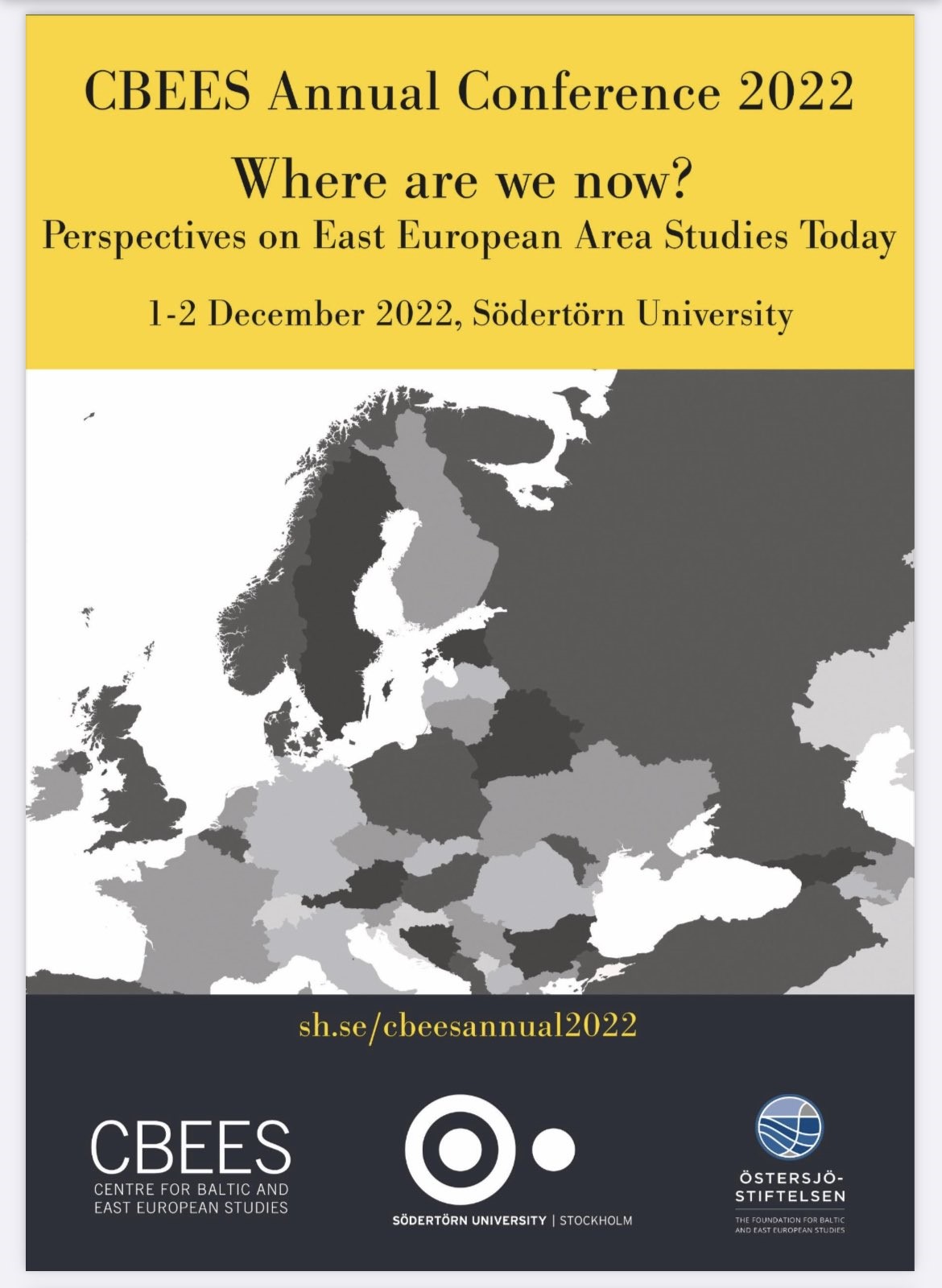
I just got back from CBEES conference – a really positive experience for me because I was part of a panel that was mainly about Ukraine and which was able to ‘provincialize’ Russia, and Russo-centric approaches to the war. This is the kind of academic practice that I feel scholars should be engaging with. So for example, while my own work remains focused on Russian society, I learnt a lot about civil society at war, authoritarianism, and activism by listening to my colleagues talk about Belarus and Ukraine.

Provincializing Area Studies is an idea from Dipesh Chakrabarty who made famous the concept of ‘provincializing Europe’. It doesn’t have to be the same thing as ‘decolonizing’, but certainly CBEES was successful in the former. Our own panel was called “Exaggerated Structure, Exalted Agency: What Russian and Ukrainian Studies Failed to See before the Invasion” and was planned and led by young Ukrainian scholars. Ukrainian sociologist Anastasiya Ryabchuk of INALCO Paris and Kyiv-Mohyla started us off with a critical view of International Development work on the frontline in Donbas. Among other questions, she asked: “How to continue fieldwork ethically when as researchers we are mainly in safety?” Some groups will be very much over-researched and others invisibilized and this risks doing more violence. It will also be a challenge to rebuilding solidarity after war given divergent experiences of it.

Finnish researcher Emma Rimpiläinen, now based at Uppsala, has done fieldwork with Russian and Ukrainian speakers in Donbas and elsewhere. Her paper was about knowledge production of the war since 2014 and the divergent experiences among IDPs and others. She was able to tracing different types of explanation for war that people use, depending on their experience and their locality: the geopolitical frame; perspectives on Ukraine’s internal politics; The economic frame about the importance of industry in Donbas; Seeing the conflict through a local elite frame; and finally using tropes of ‘purging’ of particular types of identity. Emma adds a new meta-level perspective on ‘conspiracy thinking’: everyone thinks it is others who are ‘zombified’ by propaganda, it is others who have a ‘vatnik‘, or ‘soviet mentality’. In Emma’s research these claims of zombification have classist overtones.

Denys Gorbach of Sciences Po’s Centre for European Studies and Comparative Politics in Paris spoke about the multiple positionings and negotiations of identity that labour activists in E Ukraine use vis-à-vis the now hegemonic ‘national-populist’ position. They both resist and manipulate it to serve their collective struggle for labour rights, for example by leveraging their status as veterans of 2014-15 flighting against Russia. Denys was forthright on the collective narcissism of Ukrainian liberal public sphere in self-mythologizing and how this projects an imaginary unified Ukrainian public. He asks: “What about those who are silenced in the public sphere? How do they relate to the world of the political in a Mouffian sense? In Denys’ view scholars need to challenge the stereotype of ‘apolitical’, ‘slavish’, ‘passive’ – forms of self-orientalizing discourse in East Ukraine when this was place of an immense strike in 2017 and the “fortress of the mobilized workers”. Denys uses a telling turn of phrase that many in Russia would recognize: “the facebook people” to characterize how some Eastern Ukraine unionists view the liberal metropolitan Ukrainians.

Taras Fedirko of Glasgow by way of St Andrews recounted some of his findings about informal and formal organization of armed groups in Ukraine. Once more he challenges the view that conflict and violence can be monolithically grasped. Violence is organised in hybrid ways and the role of nationalist civil society changes under conditions of militarization where once more, there is a divergence in expectations and understandings between ‘civil’ and ‘state’ actors. The nationalist forms do not replace the state, but supplement it resulting in formal-informal coordination in a manner that has long frustrated scholars who labour under a western-centric view of ‘state capacity’ and institution-building.

My paper combined various versions of things I’m writing at the moment. Based on my long-term fieldwork among union organizers and more recent work with socialist and eco-activists I reflected on how the war puts into perspective the nomadism of political activism in Russia and how networks are sustained when they come under different pressures, not least of which is the dispersal of activists away from Russia. Based on Charles Tilly’s use of the ‘catnet’ concept (categoriness = shared ideological framing, and netness = the density of networks). I argue that the ‘experiential entanglement’ of activists is much more ‘elastic’, which should prompt reevaluation of activism as a sociological phenomenon and bring us back to Tilly’s original problematic: what really are common objectives and interests? How to deal with the slippage between ‘collective action’ and ‘collective behaviour’ with regard to political contention?

Finally Volodymyr Artiukh of Oxford took the stage with a high-level analysis and survey of techniques of authoritarian control in Belarus and the new quality of postsocialist authoritarianism. He spoke of the LNR as Belarus’ Guantanamo and the Ryanair hijacking as examples. “Violence works and it is more efficient than we think it is”. Artiukh argues that we need to examine the ‘sociological imagination of reaction’: not casting the war in terms of Russia’s defensive geopolitical considerations based on delusions of elites, but on internal elite reaction that led to aggression. Artiukh’s research makes reference to Steve Reyna – who offered a model on how ‘delusions’ of small elite circle are spread in broader society. First elites talk themselves into war, then inject their delusions into circulating ideologies. ‘Sociological imagination of reaction’ is part of this spreading. This general observation can be extended to the post-socialist context where elites are both rational and irrational, capable of learning, but also burdened with a particular construction of reality. Lukashenka’s Caeserism via passive revolution and preemptive authoritarianism (after Vitaly Silitski) made him the pioneer of authoritarian populism and Putin learned from this. The “Special Military Operation” in his imaginary is exactly that: the suppression of an uprising for countries under ‘Putin’s protection’, hence the attempt to continue the fiction of partial mobilization, and paramilitary action as witnessed in the role, regardless of the reality, imputed to the Vagner Group rather than the Russian Armed Forces, for example.

Our 6-speaker, two part panel was very well attended and audience asked good questions. It was humbling to speak alongside some of the best sociological and anthropological researchers from Ukraine at this time. And also a reminder of why these researchers – now at Oxford, Glasgow, Paris, alongside other Ukrainian researchers, need sustainable sources of support for their work and more than just temporary funding.