In a series of narrowly-focused posts I will talk about three aspects of my new book – 1., the use of up-close methods of long immersion – I argue there’s analytical power in ethnography to show the broader significance of neglected aspects of Russian social and political reality, 2., the part of my argument where bring together three interacting concepts: ressentiment, defensive consolidation and social striving. And 3., the evidence in the book of deep and enduring political engagement and practices which are underappreciated in a lot of coverage on Russia. In the last four chapters of the book, but also in my coverage of municipal politicians earlier on, I make claims relating to the idea of micropolitical content as it emerges in articulations and actions on the ground, and largely aside electoral politics (in a parallel relationship). (The relationship to ‘the political’ of Chantal Mouffe’s work, I defer to the end of this post as most readers are less interested in the theory stuff).
This post, though, is mostly about ‘activists’ and broadly from around 2018 to the present.
One claim is about a particular form of learning and reorientation by self-consciously ‘politically-active’ people, but also by people who deny they are political, and yet engage in ‘civicness’ nonetheless. The continual reinvention and recasting of activism is like different forms of movement – movement from electoralism to environmentalism, from in-person to online, from parties and groups to cells. This is maybe one of the most interesting ‘lessons’ of the ‘Russian case’. Without longitudinal ethnography (which after all is just a form of immersive process tracing) it’s easy to accept the common sense that the centre has defeated nearly all forms of politically conscious actions not under its control. And I reject that. Why? Because in my book and elsewhere, I show that the gains of electoral organizing by people who were inspired by people like Navalny (but also by others) are not lost, but even now have been transformed several times over. This transformation occurs when they come into contact with new causes like environmental degradation, new conjunctural situations like military mobilization, and new situations of repressiveness, and that includes economic exploitation.
Just to unpack for a moment, I can give the example from my interviews of how Navalnyite electoral administrative ‘capacity’, for want of a better word, even after 2020, was partly resynthesized by people interested in more agitational orientation in labour activism: picketing tactics, political education through literature distribution and even just online ‘slacktivism’. People internalized lessons from one context and applied them in another. Or, more typically, the lessons ‘transmutated’ themselves. Another time this meant lessons drawn from ecological actions relating to tactical victories like Shiyes – the opposition of garbage transport to the north – were carried over into anti-war activism (decentered and devolved tasks with precautions taken to protect those on the edge and firewall them from hardcore activists).
This unpredictable and dynamic process was also shaped by the authoritarian push to remove activists from public space. As personal, but also semi-public Telegram channels and many group chats, became the only fora available for the discussion of causes, this repressive escalation actually did activists favours because it attracted a broader ‘insulted and injured’ audience, and enabled reflection and discussion on a wider range of political causes and possibilities. The irony is that ‘flattening’ the public sphere in Russia actually facilitated more intense and more fruitful sharing of experience among political actives – albeit online and in private.
But what is private? People I talked to often spoke of living the struggle as ‘more real’ even in the virtual sphere because it was experienced more intensely and with more solidarity and less loneliness. Over time this online response to repression then translated into better organized, more mobile, and more targeted and strategically-considered action – from the aforementioned Shiyes, to anti-war stickering, to small-cell sabotage (full disclosure – I have NO informants who do this nor knowledge of them).
Using my own fieldwork interviews with diverse activists, most of whom remain in Russia, I build on the empirical work by other researchers like Tereshina, Slabinski and Kuzmina. They emphasise how Shyies 2018-2020 heralded a shift towards more affective connection – catalysed by exclusion from electoral and public protest in cities. A mobilizational imperative that drew a broader group of activists together from across the country and across the political spectrum. Looser politics, yet affectively closer-knit, became a widely experienced paradox. I call this ‘experiential entanglement’ and I started to explore it in my previous co-edited book with Regina Smyth and Andrei Semenov.
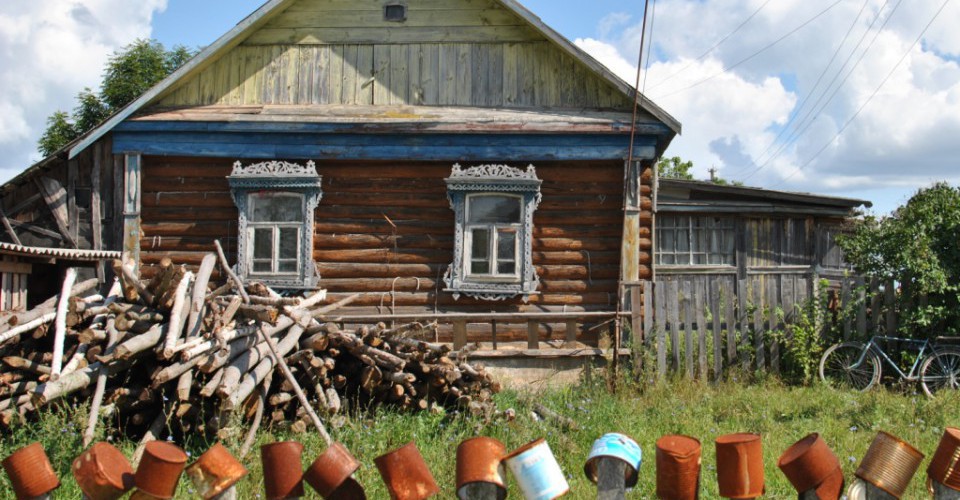
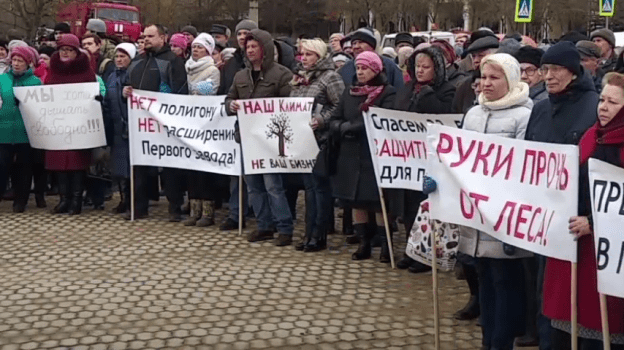
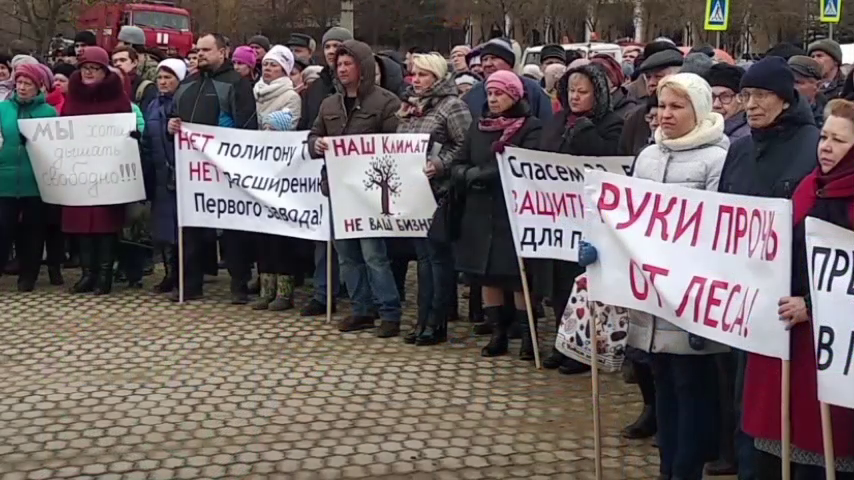
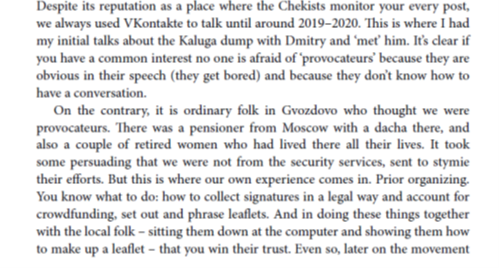
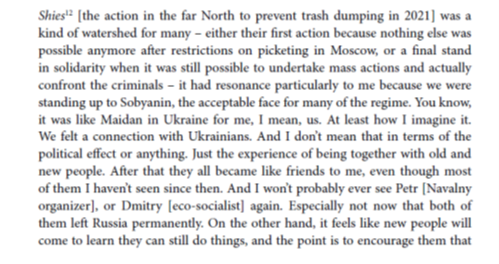
One of my own case studies relates to a modest campaign of opposition to rubbish dumping in Kaluga region. But in terms of organizing, and also in terms of affective connections between activists of different stripes, people reference the lessons of Shiyes, and of the success of Navalny’s electoral clusters to train and bring together activists. They even refer to Shiyes as a kind of Russian Maidan – but more narrowly in terms of how it showed to activists a glimpse of the horizontalist, accretionist, triangulatory forms of contention – and here I purposely avoid the normal terminology of political opportunity structure. At the same time, I remain mindful of the lessons from political science of how dynamic the mechanisms of contention can be. Activists are not just subjects of collective action, but the products of unpredictable combinations.
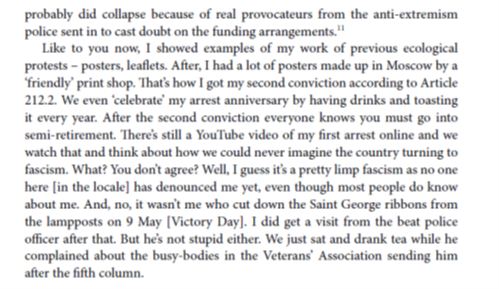
It’s worth quoting at length a rather rambling talk from the field to show the complexity of what I mean by unpredictably combinations. Polina is speaking in 2022:

As this post is already long, here I want to return to the use of the term ‘the political’. This term for me levels the ground to look at the political content of people’s lives as equal in significance to just ‘politics’. And how I use this term relates to Chantal Mouffe’s criticism of overly narrow conceptions of political relations. If ‘politics’ is institutional practices and discourses – realms from which almost all Russians are excluded, ‘the political’ is a dimension of antagonism inherent in all human society. The war on Ukraine only makes more intense Russians’ deliberations about what kind of ‘good’ society can be imagined. ‘Political’ discussions about the good are part of everyday experience, even in ‘post-democracies’, even in militarized dictatorships. Like Pierre Clastres’ (1977) classic critique of Western notions of politics, I insist that contention and negotiation, along with conflicts about the meaning of the ‘good’, can be grasped beyond the normative frames of formal politics in the public sphere. Politics exist beyond a narrow idea of ‘hierarchical subordination’ of the individual to power.
If you recall my recent review of Denys Gorbach’s work, I agree with him that an updating, or correction, of Mouffe’s concept needs to ground ‘everyday politics’ in material processes – like the experience of workplace exploitation, the broken infrastructure of towns, the way economic rents are now extracted directly from citizens via utility bills, the learning experience of people engaging with the state’s monetary offering for soldiers. From these experiences, many demands remain unsatisfied, and a chain of equivalence can be traced towards populist politics from everyday politics. Whether critical of Mouffe or not, most agree that her work should be read as a call to look more carefully and seriously at the construction of counter-hegemonic politics, and its potential for building left populism. Furthermore, Mouffe’s contribution should be a cornerstone of any critique of depoliticization, whether in the USA or Russia.
In the case of Russia, most scholars referencing Mouffe do so from the assumption that the hegemonic project of ‘strong Russia’ above all, is the successful culmination of the first two Putin terms. Nonetheless, even among those few who think seriously about the discursive construction of the new Russia note how ambiguous it is in practice: ‘shot through with intense doubts and misgivings about the very possibility of a strong Russia’ (Müller 2009). Olga Baysha implies (albeit indirectly) that discursive domination in Russia comes up against hard material limits in the miserable lived experience of so many millions of citizens and the ‘loyalty’ of citizens was mainly based of fear of losing minimal benefits rather than positive identification. In other words, like in Ukraine to 2014, the complete ‘normalization’ and naturalization of the regime remained quite weak. The liberal opposition undermined itself in 2012 when it pursued an exclusivist progressive discourse in the electoral protests against Putin (Baysha’s point, which I agree with). They were afraid of popular mobilization, not in favour of it. On the stability of the hegemonic order since 2012, people tend to forget that while the Russian constitutional arrangement has been successful in acting as if the interests and values of diverse parts of Russian society have been rationally reconciled, massive social conflicts simmer away on so many backburners that the roles of ‘chefs de partie’ (regional governors) are now a pretty thankless political posting in the Russian Federation. Too many pots are boiling over and the restaurant kitchen is open-plan. The point of my book is to say we should look at the various pots and why and how they’re simmering, rather than just looking at the rotating chefs.
 Postsocialism
Pingback: Everyday Politics in Russia 2: How do we know the ‘average wage’? Plus: the bits of the book that engage with social movement theories | Postsocialism