(A post that’s really about the value of academic book reviews in understanding why you don’t agree with someone)
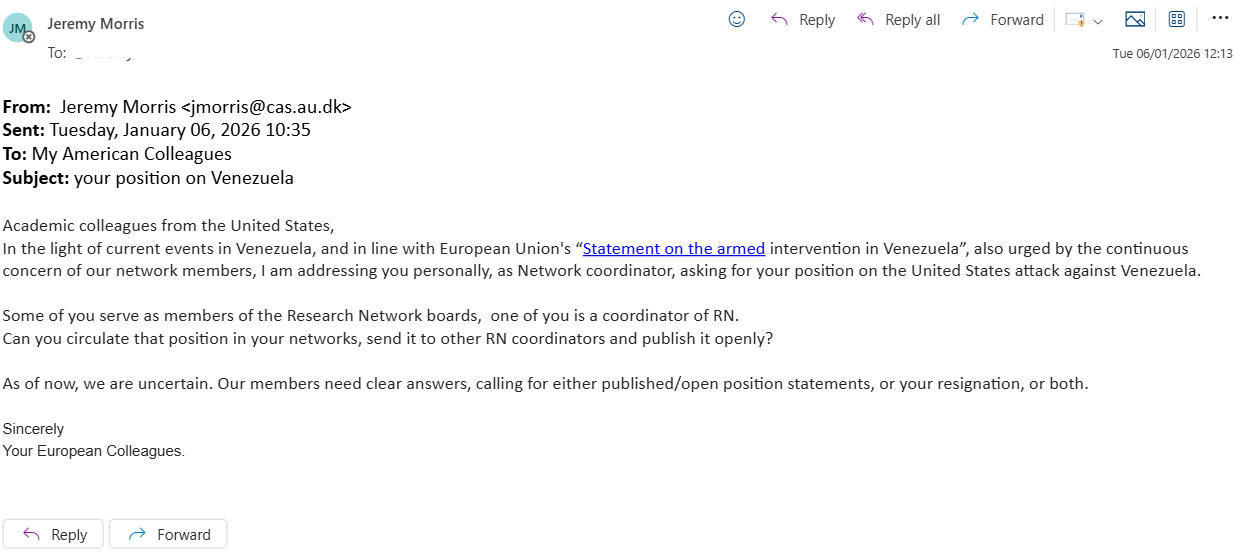
Various events recently reminded me of attempts in Euroacademia to adopt a kind of ‘cancel culture’ connected to views about the Russo-Ukraine war. When the US kidnapped Maduro I remembered an email that a colleague based at a Russian university had shared with me in March 2022. I imagined the ridicule that would ensue if someone sent a similar email today to an American academic – demanding they publicly state a position on the US military action and preferably resign their position. This is my almost word-for-word recreation.
Almost at the same time, I myself received a negative review from a mainstream academic journal partly on the grounds that I had cited Viacheslav Morozov’s book on Russia’s subaltern empire (Morozov was convicted of espionage by Estonia) and that my framing of Russian ‘everyday politics’ was flawed because in the view of the anonymous reviewer “a majority of the population supports the war and annexations”.
Now, recently I made the off the cuff comment that peer-review was not only in crisis but was actually dying, and getting this anonymous review only confirmed that feeling for me. For those that don’t know, reviews are supposed to evaluate the quality of the argument, the quality of engagement with sources considered reliable, and the soundness of the data collection and interpretation.
Anyway, this got me thinking about the relative lack of ‘cancel’ culture around people’s views or institutional positioning since the full-scale invasion of Ukraine in 2022. Just to state the obvious, I might grumble about getting reviews like the one above, or being held to a higher standard of evidence and scrutiny because my work is based on fieldwork and is critical of many mainstream approaches to Russia, but I still get a lot of invites, and can publish mostly what I like. Mostly.
The moments of ‘madness’ in 2022 are unlikely to be repeated: when lectures about removing Dostoevsky from academic libraries were received with rapturous applause from career academics in a certain centre for research on East European Studies not far from me. When career social researchers sincerely debated whether it was permissible to even study Russian society. Once again, I can’t help but visualize an imaginary symposium of ‘Americanist’ scholars disbanding their discipline because they found it morally repugnant to produce knowledge about the United States.
Then, a week ago I noticed that Richard Sakwa had taken part in a discussion with Volodymyr Ishchenko on ‘The Deep Roots of the Ukraine War’. Sakwa published a ‘hot take’ book on Ukraine in 2015 – which I discuss below. Sakwa is extremely prolific in his writing on Russia, and more recently Ukraine, and is emeritus professor at the University of Kent. He’s a household name in Russian political studies in the anglophone world and beyond. Why is Sakwa relevant to the question of permissibly public discourse on Ukraine?
Those listening to the interview might not really notice anything amiss immediately. But most would quickly pick up one thing though. Sakwa is asked whether he considers the 2022 invasion as illegal and he repeatedly asserts that if a state launches what is sees as a preventative war then that can’t be judged through a lens of legality. Without making clear his view beyond these observations, Sakwa keeps repeating the word ‘preventative’ war in the interview, giving various examples of why Russia would see it that way. Using the analogy of kindling for a fire, Sakwa makes mostly reference to Ukrainian belligerent actions since 2013, giving the impression he supports the view that Russian actions were justified in some way.
Now, the point of me relaying this here is not to take a position on the merits of Sakwa’s argument or his noticeable shift to a more active(ist) role in talking and writing about Ukraine and Russia since 2014. Instead, I summarise it here because Sakwa’s views are seen as exculpatory at best, and full-on apologetic for Russian foreign policy at worst by some of his colleagues in political studies. To be fair to him, there’s always a lot of things mixed in with what Sakwa says that many of his colleagues would agree with – like that it was not the fact of NATO expansion that was interpreted as counter to Russian interests, but the way it was carried out. By the way, in the discussion here, Volodymyr Ishchenko is much more circumspect in his talk.
The point is that European anglophone academic has plenty of space for dissenting-from-the-mainstream voices. Sakwa has around 500-600 citations per year according to google scholar, so no one could think he’s a marginal figure – he’s had a deep and broad influence on Russian and Soviet political studies – a pretty niche corner of the world, if you think about it. Moreover, many of his claims about Russia-Ukraine are close to interpretations such as those found in New Left Review (the topic of a future post).
But, and here’s the catch, his perspectives on the causes of the Ukraine war have been subject to detailed and repeated critique – proving, if not the adequacy of pre-publication peer review (which is not necessarily carried out very consistently by some book publishers), then the utility of looking at the dozen or so academic book reviews that a visible author is likely to attract after the fact of publication. This is a ‘hack’ we teach our students – before deciding on whether you want to engage with a particular scholar’s argument, or even their topic, go to the online university library and download a few reviews. You then don’t have to commit to reading two hundred pages of a book you might not need.
Unlike my students though, you, dear reader, might not have an academic library account. So here goes a quick summary of what some of Sakwa’s colleagues say about his 2015 book Frontline Ukraine. I focus on prominent reviews and criticisms here. Why focus on this book?- because it’s probably one of the most visible and publicly promoted books for a popular audience in English on Russia-Ukraine events up to 2015 that lays the blame largely with the ‘West’.
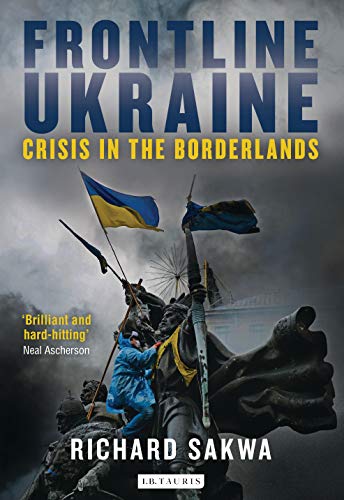
‘Those who have abhorred our worsening relationship with Russia will find it a source of wisdom and reinforcement; to those who have helped to frame today’s policy, Sakwa’s rigorous arguments will be about as welcome as a course of chemotherapy.’ Says James Sherr in his 2015 review. For Sherr, the ‘rigid schematic obscures the centre ground of any argument. Sakwa seems unable to engage with a point of view until he has labelled it. “Monists”, “Maidanists” and supporters of Ukraine’s Euro-Atlantic course are treated as if they are one and the same. Yet it was the candidate of the east, Leonid Kuchma, who built Ukraine’s “distinctive partnership”’ with NATO. All four presidents, including Viktor Yanukovych, set their sights on EU integration and resisted incorporation into Eurasian integration schemes.’
Peter Rutland similarly argues that Sakwa’s deployment of ‘monist’ Ukrainian nationalist statebuilding is a red herring. A more expert account would acknowledge that Ukrainianization was a result, not the cause of conflict after 2013. Sakwa treats Russian perspectives uncritically at times, and his perspective on Putin and Russian motives focusses too much on grievances and not at all on neo-imperialist perspectives or Ukrainian sovereignty. Furthermore, for a serious scholar there are sins of omission – on Russian intervention in fighting in the East and in largely eliding the evidence of deployment of Russian troops and weapons while ‘both-sides’-ing the Donbas (Ukrainian territory). ‘Sakwa downplays Putin’s agency, arguing that “developments in Ukraine represented a challenge that Putin felt he could not avoid” (119). He writes that “Russia was sucked into the Donbas conflict” (113), as if Russia’s invasion occurred against its will.’
Lisa Baglione in 2016 summarises Sakwa’s argument in these terms: ‘Russian pride and need for respect in the global arena is what Richard Sakwa would contend ultimately provoked the Ukrainian conflict that continues today. As Sakwa explains, Russia was denied what its citizens believe to be its appropriate place in the global hierarchy during the 1990s, both by its own failings and by the efforts of the West to treat the country as an unimportant, past-its-prime player’ … ‘Moreover, Sakwa argues that in those early post-Soviet days, the West embarked on policies to humiliate and weaken Russia. These policies could only provoke a great country (especially one with a spectacular recent past as a ‘‘superpower’’) to retaliate with efforts to secure its global position and protect itself from hostile others. Sakwa sees the security dilemma as a driving force in the transformation of the Russia-West relationship.’
However, as Baglione goes on to say, many scholars have a very different perspective on Russian intervention, citing Elizabeth Wood, Maxim Trudolyubov. These and other authors ‘undermine Sakwa’s ‘‘victim narrative’’ of Russia in its post-Cold War relations with the West and his claims about its legitimate power considerations in Ukraine. Rather, they contend that Russia and not the West abrogated the rules of contemporary global affairs by seeking to dominate its neighbors (E. Wayne Merry), treating trade as a mercantilist endeavor (William E. Pomeranz), and creating illegitimate security forces within Ukraine, a sovereign state (Wood).’
‘In sum, the evidence suggests that blame belongs on both sides of the current Russia-West divide. Sakwa’s inability to see Russia’s responsibility in provoking conflict and disinterest in seeking negotiated settlements undermines his analysis for some. To provide a more compelling overall assessment, Sakwa needs to convince many skeptical readers that Putin, his system, and his values were not centrally important in producing the current dangerous state in global affairs.’
These are the more sympathetic academic reviews. We can also give a flavour of the more critical ones. Taras Kuzio in 2018 rebukes Sakwa for using no Ukrainian sources in his analysis. For Kuzio, ‘Sakwa denies Russia ever sought “a return to spheres of influence,” quite unlike Mikhail Suslov (2018), who writes that “the idea of a sphere of influence” is hardwired into the “Russian World” imagery.’ Kuzio argues that Sakwa downplays Russian imperialism and presents Crimean annexation as a return to normality, while downplaying Russia’s support for the far right in Europe.
In his review from 2017, Paul D’Anieri critically highlights Sakwa’s vision of Russia as a ‘defensive, conservative, neo-revisionist power’, and made that way by forces beyond her control – Ukrainian nationalism and Western policy. ‘For Sakwa, even when Russia is arming fighters in eastern Ukraine, it is passive and powerless’. Noting that like many other books on the topic, Sakwa’s is not a work of social science, D’Anieri notes that many sources are from Russian government officials or analysts, commentary from the English press, and that this approach is ‘fraught’.
Let’s leave Sakwa alone for now; regardless of what you think of his Frontline Ukraine book, his reputation on Soviet and post-Soviet Russian politics is secure. But I do think the final points by D’Anieri are good ones to remember: a lot of what passes for scholarly work on the Russia-Ukraine conflict – and even more so since 2022 – fails to meet many scholarly standards due to the weaknesses he mentions, becoming all too often a rehash of media sources and stuck in a kind of ‘presentist’ and elite-focussed, geopolitics doom-loop, with scant interest in the societies, let alone the social science beneath this illusion of knowledge – be they Russian, Ukrainian or any other. There isn’t really a further point to this post, merely to remind that the loudest and most promoted voices of any political persuasion are rarely the most interesting. I don’t want to align Sakwa’s position with the ‘Western Left’s’ in general, but we will return to how work like it has influenced parts of ‘the Left’ in a future post.
 Postsocialism