Category Archives: Russia

Alexei Yurchak: The present moral catastrophe, the USSR, and Putin

This post is a shortened translation of an interview A. Yurchak gave in April 2023 to Radio Svoboda.* Any mistakes of translation are my own.

The original is here. I mainly cut the interviewer’s text

Interviewer: I was sure that the Soviet Union would stand for another thousand years, but I was not at all surprised when it disappeared. I kept thinking that during the years of Brezhnev’s stagnation, disbelief was universal, and people pretended to be serving a number at meetings, rallies and demonstrations. In fact, the entire nation was a dissident. But you have a more complex theory. What was it, if not a pretence?

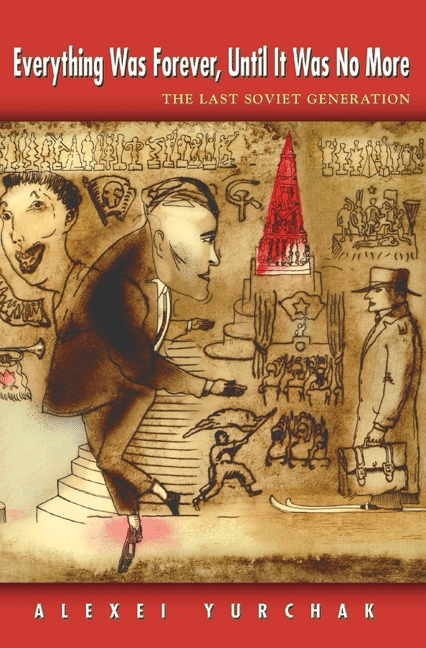
 Yurchak:  Let’s start with your term, “believe” or “do not believe.” As a social scientist, an anthropologist, it seems to me that, in principle, we should not start with this kind of description of the psychological attitude of a person: people do not believe in all this, everyone pretends. You yourself just described your family to me, which launched ships into space for the sake of all mankind. One doesn’t have to believe in the statements of the party, in communism, but some socialist ideas, values ​​- they were certainly important to them. The point here is not faith, but the fact that the ethical, philosophical fabric of this society was arranged in this way, where people worked as doctors, teachers, engineers, mechanics or in the space field. They didn’t do it because they were forced to. They might not have been listening at the meetings to particular resolutions they then voted for, but that didn’t mean the vote was meaningless. The very process of voting allowed them to then participate in the life that made sense to them. And often this life was filled with meanings that were not completely controlled by the state.

That is, to say that everyone was pretending is wrong. In general, the concept of “pretence” […] Is it possible to describe the structure of some society in such terms – “everyone pretends”? Basically no. Because, of course, in our daily behaviour we manifest ourselves differently in different contexts, we have many different masks. This does not mean that we are more real in some of them, in some less. You will not say to your friend after a serious illness: “How terrible you look!” Maybe you will say in one context, but in another it will be completely inadequate. Not because you are hiding the truth, but because the meaning of your statement is not just how a person really looks, but that you need to support a person, preserve your friendship, your social fabric, in which you are woven together.

The same during voting, for example. The meaning of this act, the voting ritual itself, remained important in many respects, because it allowed people to reproduce their subjectivity. They understood that the statements “We will all live under communism” do not make sense, in principle, it was not even expected from the state that everyone would believe in it, but it was important to participate in the ritual, because it allowed the entire fabric of socialist society to be reproduced. Including quite important meanings, which afterwards lost. […] Secondly, it is trivial and wrong to talk about a democratic “normal” society as a society of some kind of truth, and the Soviet one as a society of general pretence.

Let’s start with the term “nostalgia” […] People have a certain emotional relation to the past, to the memory of what was, and this cannot be described in terms of their attitude to the entire Soviet civilization in a general sense, with all its slogans, with all its lies. Much of it was due to the fact that people had solidarity, they believed that they were doing some important things, a doctor in a hospital or your relatives at the cosmodrome. Accordingly, for many, and not only in the 1990s, as they say now, but in general throughout the post-Soviet period, this solidarity, the idea that something important must be done together, was destroyed. Maybe this was sometimes in spite of the party, completely without thinking about the slogans about communism, but it was part of the socialist existence. There were important moral values ​​that people, when choosing their profession – maybe not all, but very many – really shared, without thinking too much about it. They reflected about it only in retrospect when they lost it.

What happened in the 1990s? It is often said that there was shock therapy, everything was privatized, everything collapsed – this is partially true, this is one feature, but at the same time there was the other side of the same coin – this is that there was a complete political deconstruction of what promised to be democracy. For the sake of not going back in time, let’s rig the 1996 elections. For the sake of not returning to the past, let’s shoot the Parliament. That is, your opinion is not important to us, it is important for us now to quickly pull some levers in order to simply create the impossibility of a rollback, and the mass shared agreement of people is not important. In fact, it was, of course, pure deconstruction, the dismantling of everything that was expected, of this entire democratic machine. Then Putin brought it to its climax with his centralization and verticality, but it started in the 1990s.

Accordingly, people can be nostalgic, perhaps without even realizing it for what exactly: for solidarity, for the community that existed after these Komsomol meetings were over. They then went back to work, had parties, they had normal institutes, laboratories, friends, and many of them did this, fully conscious of their existence as something important. Again, I can go back to your example of circles of shared interest and hobbies. The loss of this, the atomization of society, the loss of solidarity, the loss of an idea aimed at the future and that this was important for everyone, important for history. Someone was engaged in literature, space, physics, philology, someone, maybe, had other ideas. But then everyone was in a particular relation to moral and cultural values, which were not necessarily articulated by people on a daily basis. They could speak very cynically about “sovok” [typical Soviet person/way of living], but nevertheless, these values ​existed and there was solidarity. I call this in the book “communities of one’s own people.” There were a lot of such communities, I’m not saying that everyone, but a huge number of people. Accordingly, in the post-Soviet period, many of them were destroyed. And for people of the older generation, it is very difficult to recreate it.

We remember the 1990s very well. People lost friends, lost communication, lost economic and political opportunities, their world narrowed. For some, on the contrary, borders opened up, a cosmopolitan existence appeared, trips. And someone had such an emotion of some longing, directed to the past. This is not longing, as you put it, for “sovok”. By the way, I would also warn against this term, because it lets us know in advance that it was the wrong emotion, “sovok” is something bad, it’s not a positive term in principle, but something sneeringly bad. It’s best to approach this in a neutral way.

It seems to me there is not so much nostalgic for “sovok”, at least among the majority, but for those things that I described, which were lost by so many. And there was an idea that with the emergence of freedom and democracy, on the contrary, these things would flourish. But it turned out that the reforms in post-Soviet Russia were carried out in such a way that democracy was equated with a rather cynical version of the market. But they are not the same thing, often they are in conflict with each other. Accordingly, instead of blossoming, all these things were lost, crushed for many people. I think that’s where this longing came from, this emotion that we call nostalgia.

There are a lot of studies on nostalgia. Of course, I’m simplifying a little, because there are different types of nostalgia for the past, people have very different attitudes. In principle, I have described the general meaning of how to relate to this kind of memory. Nostalgia, in principle, does not mean a return to a specific past – it is a return to a past that you know and feel as impossible, you cannot return to it. This knowledge of the impossibility of returning in a certain way structures nostalgia. This is not a desire to return – this is a longing for what’s lost and for some elements of the lost that can no longer be recreated.

[…]

I have already spoken about social solidarity or about the idea that you are doing something that, in principle, has value in itself, because it has historical value. Not everyone will necessarily think in those terms, but it is a future-oriented value. For many, this has disappeared, business has appeared, for example, for people who are successful, but they are cynical about it. Some people like it, but for some it’s just a way to make money. They can be nostalgic for some philosophically global things, they can be nostalgic for communication until four in the morning in the kitchen with friends. That is, this emotion does not necessarily have to be manifested only in people who now live in the role of losers.

[…] one cannot reduce Soviet reality to pretence, and Soviet reality to ideological slogans. Soviet television, theater, all these performances – it was all part of the socialist project. Quite a paradoxical part. It often seemed that it did not coincide with what was happening at the political meetings, but in principle it was all part of the socialist project. Why didn’t I write about television? Because the task of my book was not and is not to create a portrait of late socialism. I wanted to find some changes within the system, some breaks, when you can participate in paradoxical things at the same time, change their meaning by such participation. Which ultimately led to the fact that, on the one hand, the collapse was unexpected, because it was impossible to describe such an expectation, there was no common language, there was no way to look at the system from the outside. On the other hand, it happened very quickly. In retrospect, it became clear why it happened.

I had to feel for the mutations within the system that were taking place before it began to collapse, which prepared this collapse in an invisible way. To do this, I had to collect a certain number of examples from different areas. I describe various circles there, I describe physicists, I describe Komsomol committees, I describe various official and unofficial artists, I describe various physical laboratories. Television is not important to me. You insist that it was an important part of everyday life, so I had to describe it. But I am not describing a portrait of socialism, I am groping for mutations inside it that prepared its collapse, but at the same time were invisible to those who participated. You can say the same about the theater, you can say: why don’t you describe mathematicians, and why don’t you describe the cosmos, why don’t you describe the kishlak in Kyrgyzstan? I do not describe, because I do not create an average portrait of a certain Soviet person. In general, I think that this is a completely absurd project – to draw some kind of portrait. It is not interesting for me, it is not my task. My task is to answer the question: why did no one expect a collapse, and yet everyone was ready for it, without realizing it?

You use the word “propaganda”. You understand it as some political statements: “we are building communism”, “they are rotting” and so on. Propaganda under socialism was a broader concept. It also included what you yourself are talking about – about the universal dimension. Let’s drop the term “believe” because it’s not about faith. This is also part of the socialist project. It’s not that other societies do not have this. But in socialism it was some very important part, it was talked about all the time. The comprehensively developed personality: one should have an interest in literature, one should have interest in science, one should have interest in space, and so on. Not everyone was interested, some were completely cynical about it, but a lot of people were doing it. Is this part of propaganda or not? Yes.

“Propaganda” is a bad word. If we discard the negative meaning of this word, then, of course, part of the propaganda worked well. It created a Soviet person […] who may have treated Leonid Brezhnev’s speeches on television cynically and with laughter, but this does not mean that they were not Soviet people. Therefore, if we talk about the language that I call “authoritative” in the book – the ideological language of editorials, slogans, speeches by various secretaries of the Komsomol, the party, and so on – indeed, it was transformed in the late period of the Soviet Union into a rather ritual language. It was necessary to reproduce it, and it was possible not to go into it too much, at least in most contexts, in the literal sense of these statements. So you could laugh at them. But at the same time, these ritual speeches, ritual elections, voting for some resolutions at meetings – these ritual actions allowed many other socialist things to continue to exist, which were also a part, a product of propaganda, but in a good sense.

All these little groups of yours that you went to, what you studied, the fact that your relatives launched ships into space, and so on – this is also part of the entire revolutionary project, which carries ethical values, this is not in spite of the party and Brezhnev. There was a huge distortion of everything through the party nomenclature, but to say that it was completely emasculated is also impossible. That is why these things were important to you.

The Putin system is fundamentally different from the Soviet one – in terms of the world order, the economic system, of course. It does not propose any ideology, it does not propose any project, it does not build any concrete future. Rather, it says that we must reconstruct something, return something, we must somehow feel offended. Even in this regard, if we start to understand, it turns out that it, this very large propaganda machine – television, telegram channels, a huge number of different other channels, various kinds of propagandists, various “troll factories” and so on – gives a lot of contradictory messages and meanings that are not built into one coherent ideologeme.

The task of Putin’s system is not to plant some coherent picture, but to create the impression that there is no truth at all, that any truth hides certain financial and power interests. In principle, it is impossible to believe in anything, it is impossible to fully understand anything. No wonder they keep throwing new versions of different events all the time. Remember the Malaysian “Boeing” in 2014. I was then amazed at how many versions there were of how he was shot down, and these versions contradicted each other. This is not a problem for such a propaganda machine, because here it is important not so much to describe what actually happened, but to give the impression that it is impossible to understand what actually happened. This is completely, radically different from the Soviet message, where there was a specific idea of ​​a specific classless society. We can talk about how it was all completely distorted, completely cynical, and so on, the entire Brezhnev nomenklatura class no longer believed in it, but nevertheless the propaganda was built around this, it had a specific message, a specific orientation towards the future. And here, on the contrary, there is no specific message, there are a lot of contradictory things. The only thing that unites them is that they all together must reproduce a specific vertical of the Putin regime. Because the only way to bring all these different versions together is to have a centralized vertical.

Not without reason, by the way, one of the main mechanisms of this propaganda can be called a “troll factory”. This is a metaphor. It is not the only mechanism, of course, there are still all these propagandists like Vladimir Solovyov on television. “Troll Factory” is a good metaphor. What are these trolls doing? They sit in social networks, pretending that they are ordinary participants in the discussion, they share some memes, write some comments. If you look at the whole array of what they do, you will see that they write contradictory things. As we now know, Prigozhin’s “troll factory” in St. Petersburg tried to influence the American elections. They wrote from the far right of the Republicans, and from the position of Democratic Socialists, and BLM, and from the pov of those who are their opponents. Again, the idea was not to promote some true description, but rather to confuse, create the impression that there is no single picture, it is impossible.

How does television work today ? You look at Solovyov – it’s basically a talk show where there are a bunch of screaming people, they have different opinions, they don’t necessarily agree with each other. This is not like an analytical broadcast of the Soviet era: they describe to you specifically how you need to understand what is happening. But here, with Solovyov, outwardly everything looks like a struggle of opinions, but the main idea is that nothing can be trusted. A very important effect of this propaganda is not that it is believed. I think that people who are not fools do not believe, moreover: qualitative sociological, anthropological studies show that the majority is not sure, they do not believe anything, they are not fooled at all, they are just trying to protect themselves from all this. This is the main effect – the feeling that nothing can be trusted. Let’s see how this propaganda describes what is happening today regarding the war in Ukraine: either this is a special limited military operation, then this is the salvation of Donbass, then this is denazification, then this is a fight against the West, then it’s not about Ukraine at all, then Ukraine does not even exist. There are many different versions, they are constantly changing. It is clear to everyone that there is no single truth. This is very important, this cacophony is the main principle of Putin’s propaganda. that there is no single truth. 

Now, moving on to the second part of your question: why are people fooled? They are not fooled by anything. I don’t know where we get this information from. If from some sources such as surveys, then I must tell you that these surveys are completely impossible to trust. Polls in which a person is asked a question that must be answered “yes” or “no” do not work well even in peacetime. It works well if you ask, “Who will you vote for tomorrow, this one or that one?” But when they ask: “How do you feel about the operation, do you support this war?”… Excuse me, first of all, today it is very dangerous. We know that recently the father of a girl who drew an anti-war picture was arrested, the girl was sent to an orphanage. Everyone knows about it, in all the news – “a traitor and agent.” That is, to answer the questions put by a person whom you do not know, who most likely represents a certain organization, and the results of the survey will then go to the media, to various bodies, and so on – how will you answer him? If you are not sure, you are more likely to say: yes, I support it. Interestingly, the vast majority of those approached say: sorry, I’m busy. They just don’t answer. And when they say “I am for”, it is very difficult to understand what it means. Most likely, this means: if I say that “I am for”, this is the same as voting “for” at the Komsomol meeting, then they will leave me alone, I will be able to exist inside the system and do things that are important to me, for my country the things that, thanks to this “I am for”, I am allowed to do. I can be quite independent of the state then. If I say that I am against it, I may become dependent on the state, I may be arrested, I may be exposed, who knows?

Second, people don’t really understand what’s going on. The vast majority of people are neither “for” nor “against”, they are somewhere “in between”. In principle, they do not really want to participate in thinking about how they should relate to this, because it is terrible for them. In principle, of course, they do not support the war, but it is difficult for them to say it out loud for various reasons. Firstly, fear, I have already said, and secondly, it does not lead to anything. People have been taught by long experience throughout the post-Soviet period, especially during Putin’s time, that any political activity does not lead to anything good. In addition, when you speak out against something, if you are alone, then this also does not give any result. If there was any opportunity to hear the opinion of others who are also against it, to come out with them, some kind of movement, then very many, who today say “I’m busy” or “I don’t know” would say “Yes, actually I’m against it.” But there is no opportunity to mobilize people for such an action, there are no mobilization channels, no people who would do it, no opportunity to be on the street – you will all be tied up and imprisoned. In such a situation, it is very difficult for a person standing in front of the one who asks him a question to answer “I am against it.”

In addition, everyone reads polls by the Levada Center and VTsIOM, which say: 80 percent of Russians, or 60 percent, support the war. Since they all support, if I now say that I am against it, then I am in the minority, no one will understand me. That is, polls carry a negative message in this sense – they support the system, they support Putin’s power, because people hear that everyone supports it, which is not true at all, but when they hear about it, they also don’t say “I am against”. By the way, the fact that Radio Liberty and all our independent media say that such a percentage of support the war is also bad. We need to be analytical, and not just repeat after them that everyone supports, because in this way we all pour water on the mill of the Putin regime, greatly simplifying the result. Social networks are not an independent platform where you can speak anonymously. You know very well that there is no anonymity there, you can be exposed in a jiffy. Therefore, it is also dumb to speak out there.

As for how to measure people’s feelings… Indeed, many, perhaps, in principle, support not a war with Ukraine, but the idea that NATO is trying to put pressure on us, that Russia has been surrounded, and so on. Thus, if you ask the question not “Do you support the war?”, but “Do you think that the West behaved incorrectly for a certain number of years?”, give examples, I think that the figure will be different. Many will say yes, I think so. If you ask the question: “Do you support the bombing of Ukrainian cities, the fact that Mariupol was razed to the ground, what happened in Bucha?”, the answers will be completely different, the vast majority will say no. In addition to these surveys, there are also so-called qualitative studies. They are also very difficult to carry out now, but there are people who do it, sociologists and anthropologists. I know two groups in Moscow and St. Petersburg. They have very interesting methods. They conduct hundreds of interviews. It is an interview where people simply begin to trust them, because they explain who they are and what they are. Not even an interview, but semi-structured conversations, not a “question and answer”, but a conversation with a person. And there are completely different numbers.

When a person can talk about what is happening, and not answer a question on the run in the street, the numbers turn out to be different, there is much less support for the war. There is a lot of confusion in these results, people are not sure what is happening, they just do not understand. Because no one can explain to them what is happening, I think that Putin himself does not know what is happening. He thought one thing, began to do another, today a third, and so on. The general idea of ​​ressentiment, that we should punish everyone, they do not support. With a long, long tirade, I try to answer the question of why everyone is so fooled. No one is fooled, people understand a lot more than we think. You just need to understand the context.

It’s not my job to comfort you. In fact, this is a catastrophe, including a moral one, we are all participating in a moral catastrophe. The catastrophe is not that everyone in Russia is fooled and supporting the war, but that people are simply powerless, they cannot mobilize against it, at least not yet. I will tell you more: if there are changes at the top, if there is an opportunity, as it was in 1985-1986, of a mass movement for reforms in the country, for democratization, real democratization, for the decentralization of the country, then this will be a huge movement, there will really be the support of the majority of people. Now they can’t do it – that’s the catastrophe. The problem is that people are powerless now, or feel they are.

I write in my book that the term “internal emigration” is not entirely correct, because it means leaving for a completely different reality. It is impossible inside the country, you still remain in it. Describing the Soviet way of slipping away from state control, while remaining inside a completely Soviet person, I use the term “vnenakhodimost” – [outsidedness/exotopy]. You seem to be both inside and not inside at the same time – this is somewhat different than emigration. Internal emigration is a metaphor. 

Of course, now the majority of people live in a state of outsidedness. The main message of today’s propaganda is: don’t interfere in anything, everything is incomprehensible anyway, they’ll figure it out up there. Accordingly, you need to take care of your life. The state has narrowed this field, before it was quite wide, you could go about your life, provided that you don’t delve into it, that you don’t go to any rallies, don’t participate in political movements. Not only is it possible – you are called upon to live like this today. This is a way to demobilize the population.

This way of living outside, inside and out at the same time, has political potential. Because it is precisely for this reason that if people do not fully understand the political agenda of the state then they don’t have to support it, and this is not required of them. They are required not to participate. They have the potential for political mobilization. When everything changes, it will turn out that this potential is very large, I think. It was the same during Perestroika: no one expected that the circulation of Ogonyok and other publications would grow a hundredfold in one year, that people would leave the Communist Party, that then there would be all these demonstrations, that people will participate in political discussion and so on. It seemed that it was such an amorphous mass, not interested in anything. But this was not the case at all. I think it will be the same now.

Alexey Yurchak. 11 April 2023

*At the time of the original’s publication I thought it was a really important contribution by an anthropologist to understanding Russia at war and thought it should be translated. In my commentary on Twitter I made a number of egregious mistakes and so this blogpost is in part my way of apologizing to Alexei.

Political ethnography and Russian studies in a time of conflict

[condensed version of an article published in Post-Soviet Affairs]

Original article link: https://www.tandfonline.com/doi/full/10.1080/1060586X.2022.2151275

What has Russia’s invasion of Ukraine revealed about the state of Russian social science? Could scholars have better predicted – if not the regime’s decisions, then society’s likely responses? My argument is that while the war has significant implications for all disciplines and methods, the positive outcome for scholarship would be to use it to reflect on making new connections between researchers and ways of thinking about “entering the field.” I will focus only on useful exchanges between anthropology and political science, which have not had much impact on Russian studies.

Political ethnography, or an interpretive political science of Russia, is not just “ground-level techniques of data-gathering,” but a sensibility that considers “insider meanings and complex contextuality” (Schatz 2009, 316). The methodological shock may be the greatest: to the blunt and epistemologically unsatisfactory nature of a key instrument – survey methods. To put it mildly, surveying as a preferred entry-point to data collection – along with secondary analysis of publicly available datasets – has crowded out other approaches, even as more interpretive methods have become more widespread in political studies more generally. Polls – far from being a describing reality – are a “performative activity that uses representations strategically for the restructuring of the social field” (Yudin 2020, 5). The attention to polls indicating high levels of support leads to Western coverage of “bad and compliant Russians,” which in turn leads to a self-fulfilling prophesy of what I’ve called “defensive consolidation” – in contrast to “rally-round-the-flag” effects. As reliable and unfiltered access becomes a fraught issue, whether to survey responders, focus groups, or elite actors, the war presents scholars with an opportunity to reflect on questions of what data collection means, and on better communication between quantitative and qualitative scholars. Similarly, it forces us to confront the extractive and colonial nature of knowledge production; the war reveals how social science has always relied on, but not really acknowledged, the labor of native scholars, but can no longer ignore indigenously produced work, particularly qualitative research.

Rosenfeld (2023), comments that response rates to Levada have not changed since the war began. She cites Shen and Truex (2021), who examine non-response rates to sensitive questions transnationally and observe that authoritarian systems do not necessarily differ in response rate from democratic states. However, using the Levada data Rosenfeld refers to – the only publicly available data we have in Russia – response rates are only around 20–30%. Indeed, a recent report by Levada on survey methods during the war is itself a reactive publication, produced precisely because of widespread dissatisfaction with transparency in Russian polling, and the close relationship of most pollsters, even Levada, to the authorities. The point is that the war allows us to spotlight what have always been issues of representativeness and validity – the stubbornly low response rate: between 20% and 30% (a falling trend since the war began); that a significant majority refuse to participate (60%) in polls; that younger women are much more likely to refuse participation; and that nearly half of contacts would not even answer a poll about trust in the president prior to the war (Agapeeva and Volkov 2022). One could go on and examine the closed ecosystem of polling and academic survey administration and how it perpetuates a lack of transparency. Pollsters in Russia admit to tailoring results to client expectations (including, in academic contexts “data cleaning,” inconsistencies in panel composition). These issues are compounded by the dangers of organizational incest: all the big survey outfits contract out their work to a small set of field researchers whose field practices are open to criticism. Sub-subcontracting in data gathering for academic research whereby a commissioning academic takes on trust the collection and processing of raw data via an intermediary who in turn contracts out the work is a situation open to abuse and fakery for material gain.

The point of immersive “life-worlds” or “culturalist” approaches and methods is not to downplay or avoid theorization or generalization between cases, but instead anchor them to social reality. Can phenomena such as decisions to start aggressive wars and broad societal acquiescence to such decisions be explained by theories that are universally applicable? Are the mechanisms of consent and accommodation of a society to a ruling group possible to uncover using universal models of human behavior such as rational choice? These are the epistemological and ontological dimensions of studying Russia now that divide many political scientists from anthropologists. A version of this divide was described by Aronoff, Myron and Kubik (2013) in their call for a “convergent approach” between the two disciplines. Using the example of Homo Sovieticus, they demonstrated the value of ethnography to verify, or in their case reject, assumptions that sometimes guide entire research projects in political studies.

In justifying political ethnography, they drew attention to the need to balance materialist institutional perspectives with symbolic-cultural approaches – something that looks highly relevant to the current conjuncture. If politics is partly locally produced, requiring attention to concrete details of interaction, then political scientists, particularly positivist-oriented ones, should become “hungry” for more ethnography (Aronoff, Myron and Kubik 2013, 25) to triangulate their data. Process tracing – itself a positivist methodology – via long-term observation and immersion need not exclude the search for correlation; interpretation need not deny social modeling that accepts the existence of objective social facts. Ethnography is well suited as a bedfellow to game theory approaches, and the study of power and questions of structure and agency, but this requires political scientists to recalibrate some of their assumptions about the interplay between formal social structures and informal social organization (Aronoff, Myron and Kubik 2013, 33).

A sociological and anthropological imagination worth its name draws on the founding principles of embeddedness of observer and observation, but is not just “ground-level techniques of data-gathering,” but a sensibility that considers “insider meanings and complex contextuality” (Schatz 2009, 316). War and autocracy, along with the disturbing calls to “cancel” Russia, only intensify the need for the ethnographic study of her politics to avoid the simplistic condensation of polling artefacts we see translated into dangerous public discourse in the West about what Russians think about the war, Putin, and Russia’s place in the world.

Russia: a natural experiment in the limits of decentralized resistance and activism

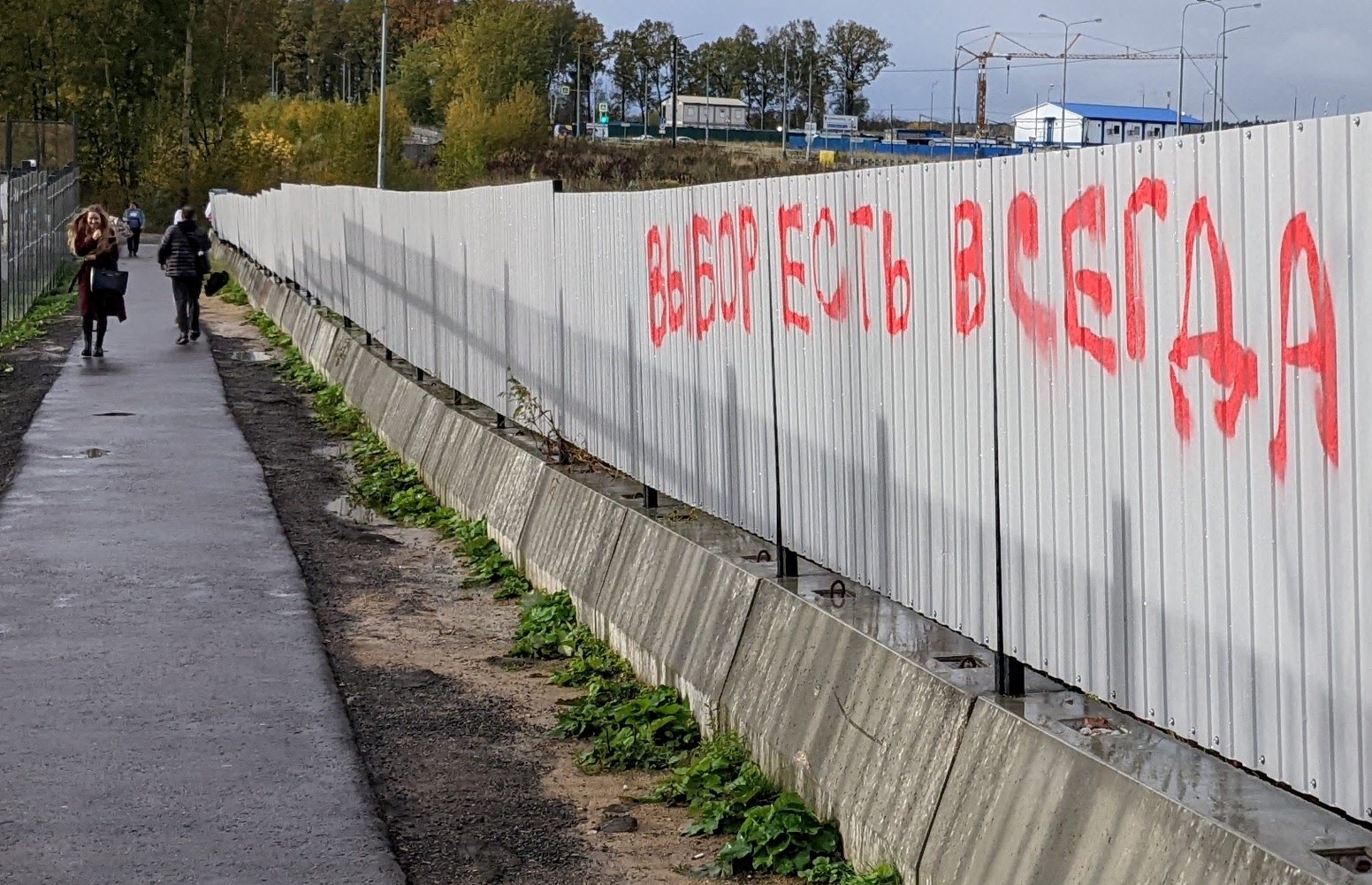
Moscow, October 2022. Graffiti on fence reads: 'There is always a choice'.

Moscow, October 2022. Graffiti on fence reads: ‘There is always a choice’.

A curious fact: the most demotivated and depressed of all those opposed to Putin’s regime are among the formerly most politically-engaged activists. These are the people who devoted their lives to causes like labour rights, environmentalism, and socialist alternatives. The people I talk to for my latest book project.

I talk to them, in person, or now more likely on Telegram and they say things like: ‘Russia is now a fascist, or proto-fascist state. The only option is emigration. We lost the country.’ Most of all they fear not mobilization, although there is evidence forced mobilization is happening of oppositionists and that it has a high chance of resulting in death. They most of all fear the long prison sentences for anti-war speech and see no point in sacrificing their lives futilely.

Why are they so pessimistic? They believe public space is completely closed off. They feel risks now are too high ‘we are being hunted’, one said, and deleted me from their contact list. Perhaps most significantly, they believe they lost their networks – built up over decades of nomadic opposition. So much has been written about the potential of internet and smart-phone technology to facilitate social movements and change, but with the fast learning of the Russian techno-security apparatus (partly thanks to Covid – Galina Orlova and I wrote about it here), activists are often so paranoid they break all electronic contact with each other.

Delicate webs? Easily broken? But until the invasion of Ukraine they had survived the depredations of Putin’s securitizing efforts to break them. The open war against activists can be traced back to the authorities’ abuse of Article 228 of Russia’s Criminal Code to imprison journalists and activists. This anti-narcotics law was an undisguised weapon to imprison opponents. It is even known as ‘the people’s article’ because so many young people are imprisoned under it. Some examples here. But before the war, threats like arrest on planted drugs charges did not break activists. In my experience is was only after repeated arrests for protests that some activists stepped back, but even then they carried on in other ways.

So people are scared and demotivated. But broken networks are actually a sign of the relative success previously of decentralized and horizontal connections between people opposed to Putin; people who maybe met in person once a year could successful collaborate in opposition despite being thousands of kilometres from each other in Nizhnii and Piter, for example. I write about one case like this in a forthcoming book on activism, co-edited with my colleagues Andrei Semenov and Regina Smyth. Also, ‘weak’ netness, but strong ‘catness’ (strongly shared opposition) can mean that, like in the brain after damage, connections can spontaneously repair and reform. Everyone strongly anti-regime knows the half-dozen activists who were active in the places I did my research. They can find each other again – if they didn’t leave Russia. If they can come back. If they won’t be sent to prison. It’s easier to imagine the end of the world right now, than the end of Putinism. But we have to try. These are some of the questions my book project on micropolitics engages with – what happens when everything except the most micro of politics is impossible? How does netness sustain itself? How and why are Russian activists ‘nomadic’? Yes the nod to Deleuze is intentional.

Gorbachev and Soviet workers – the relevance to Putinism

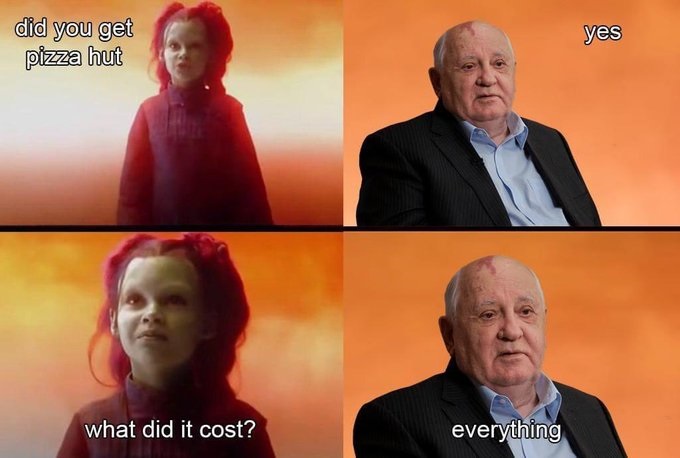
Somewhere a meme worker is putting in a shift for the sake of us all

openDemocracy asked me to write a little piece on Gorbachev. So many ‘takes’ about Gorbachev are made through a distorted Western lens, so I tried to domesticate the reflections a little. Obviously, there’s a hard word limit and I’d have liked to say more about his contradictory implementation of economic reform at enterprise-level which was probably inimical to the aims of Perestroika – things like meaningful work-place democracy.

What’s less understood is that reformers around Gorbachev were not just ‘marketeers’, they understood that productivity rises could only occur at the smallest unit of production the ‘nizovoe zveno’, or brigade team of workers/factory unit. This, as Maxim Lebsky points out in his book, was at the root of the failure of previous reforms – insufficient resources to stimulate productivity. The new experiments in ‘cost accounting’ from 1985 were supposed to focus on freeing up more resources for factory-units, or sub-units, to put into capital investment and differentiated labour rewards. According to some, the tragedy of enterprise reforms from 1987 lay in their belatedness: effectively they’d been sitting ‘on the shelf’ since 1965 for all to see. Thus, more critical voices of Gorbachev see nothing really new in his ‘new thinking’, at least in the economic sphere. Furthermore, the laws on Cooperatives (from 1988) undermined efforts within industry, because the latter even when freed to reward workers more for productivity, could not compete with the higher wages available in the newly created private small enterprises (the ‘Coops’). Massive inflationary pressures (still mainly expressed in terms of goods’ shortages) were released.

As I have written about previously in this blog, the most interesting part of Maxim Lebsky’s book on the Soviet working class is his chapter on the ill-fated political role of STKs under perestroika – Labour Collective Councils. These included workers , administration and management. In reality, the STKs turned out to be mainly one more Soviet-style instrument of management diktat. As one eye witness wrote: ‘In place of industrial democracy, we got industrial populism’ with factory directors’ interests controlling STKs. During the period, republican STKs were on the side of preserving the Soviet Union, while Russian STKs assisted its destruction. This was not so much because of ‘all-Union’ class consciousness, but more to do with the enterprise-identity of workers. Something many scholars have discussed, including me. The nascent workers movement, structurally powerful in the late Perestroika period, could have been an ally to Gorbachev’s efforts to save the Union. His blindness to the potential political power of STKs to defend the Union, despite their flaws, led to the working-class falling prey to easy manipulation by nationalist-populist entrepreneurs, the chief of whom was Yeltsin.

Lebsky starts his chapter on STKs with this quote from a speech by Gorbachev:

“We want workers to understand themselves as real masters of their enterprises, to elect their managers, from the foreman of a workshop to the enterprise director; for them all to be united in a council which solves the questions of planning, defines the future direction of development, which participates in the division of profit; so that they may solve social issues. This is the direction we want to move the process of democracy in, to deepen it and expand it”.

The deepest irony of Perestroika then is this idea to use worker self-government as a tool of destruction of the planned economy in the name of the market. The second irony is the effective manipulation of collectivist ideas by nascent national elites in the interests of capitalist restoration (these are Lebsky’s main arguments).

Why does any of this history matter now? There’s probably little Gorbachev could have done after 1987 to correct the unintended negative political consequences of Perestroika’s industrial democratizing policy. And in any case, his heart was in the right (Leninist) place – a renewed socialist project could only have succeeded through work-place democratization. Probably in the Opendemocracy piece, I’m a little too hard on him.

Well, while not going through system meltdown, Russia is undergoing ‘restructuring’ because of sanctions and the war. Inflationary pressures erode wages, enterprises that ‘make stuff’ lose workers to other sectors and to the war itself. More importantly, as the economic effects mount, workers will more acutely feel the complete discrediting of the political project of Putinism (corporatist ‘never-never’*), just as they deserted Gorbachev in his time.

The industrial geography of Russia has not changed much – meaning there is much to be gained from local political entrepreneurs siding with disgruntled worker collectives, just like Yeltsin did to destroy Union solidarity. Now, unlike Gorbachev, Putin has significant resources to throw at this. However, like in my piece on Gorbachev, it’s worth emphasizing the power of ideas (and biases) in motivating elites. Like in the UK at the moment, the power of groupthink to allow such elites to ignore the obvious and immediate problems of their countries can be overwhelming.

There’s no indication that Putin’s anti-worker instincts would soften sufficiently quickly in the face of a series of cascade strikes to prevent significant social unrest. His instinct would be to pick off individually each enterprise using ‘manual control’ and even personal intervention. This would be too little, too late. His next instinct would be mass coercion. I’m optimistic that this would be a total failure given the size and location of big industries like metallurgy and coal. Stephen Crowley is the real expert here. Worth checking out his recent Ridl post.

*Russian corporatism: “buckle down workers, shut the f-up and wear this St George Ribbon. You’ll get your rewards later”.

The tell-tale heart: “don’t mention the war!”

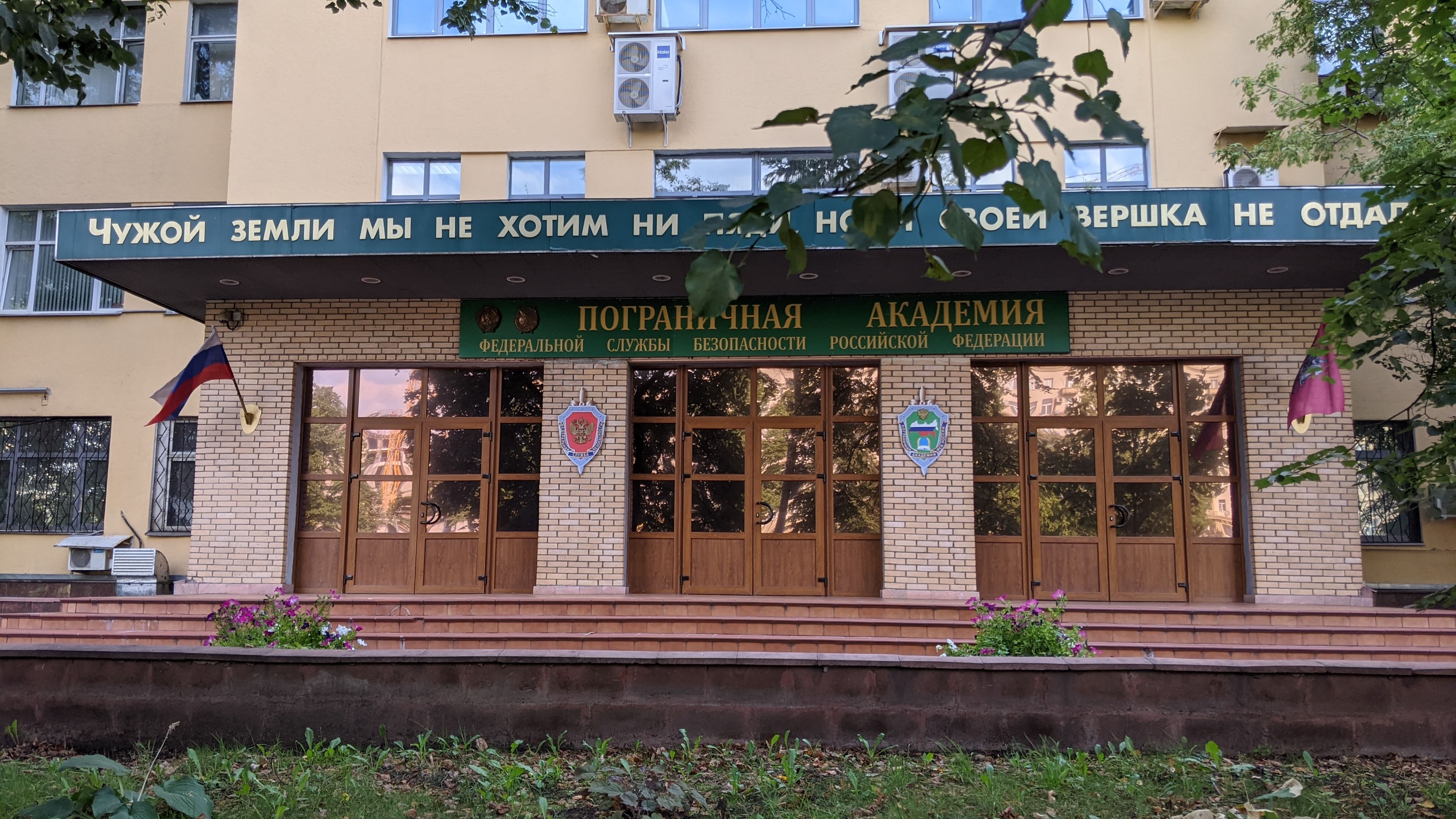
The Borderguard Academy in Moscow. It’s motto reads: “We do not want a hands-width of foreign land, / But we will not give up our own inch”

How can it be that the war elicits near universal unease and fear, but at the same time, Russians continue to perform all kind of cognitive contortions to persuade themselves that they are the victims? A short update on some blog themes from earlier in the war.

Here we have two eye-witness reports, so to speak, from sociologists recently returned from Russia.

Tanya’s stories:

People say they don’t want to talk about it, but talk – even in the local shop – inevitably turns to it and people reveals all kinds of extreme agitation, unprovoked. It’s reigniting all kinds of traumatic memories – from their families’ history of repression (“did you hear the Ukrainian family bugged out last night, just in time too”), to the downward mobility and precarious existence of the 90s (a successful businessman says, “I fully expect to lose everything and go back to the potato patch”), to the grandma, who “never really liked Putin before”, but now feels his “pain, his burden. I think about our poor president. He’s doing everything to protect the nuclear plant in Zaporozhe. Fascism really is the scourge of our age.”

In more intimate settings, there is certainly plenty of angry defensive denunciation, especially among older people who daily consume TV alone, and for whom propagandists are a comforting kind of para-kinship presence. Tanya didn’t raise the topic with her mother=in-law, but soon enough they came to the topic after talking about the ‘backstabbing’ of multi-companies leaving Russia.

Tanya: “you know the sanctions – it’s for a reason! You can’t expect differently after what’s happened.

“What do you mean, it is preventative. They talk about war crimes? Don’t be ridiculous. It’s all faked. It just can’t be [straining in the voice] that children are raped. [collecting herself after a long silence]… You know, there’s far more diversity in our media, even if it is state media – they always have all kinds of voices on, presenting different sides. I remember you telling me yourself how biased the Western media are…. How are your TV journalists any better? How can you believe them when they talk about hundreds of thousands of orphans being kidnapped. It’s ridiculous.”

What scholar Sam Greene calls Russians’ typical need for social and political ‘agreeableness’ exists, but is strained at the seams:

The typical village barbeque draws fewer visitors this year. Gosha has gone to “stay” in Turkey; his Ukrainian housekeeper is left tending his enormous country pile. Lyova’s family are in the States, they say they’re not coming back. Sasha has quit drinking. Usually he’s the life of the party. Borya – the district ‘minister of culture’, drops by with a bottle of cognac: “why the long faces? [turning to Tanya] “so, my dear, are your precious Europeans ready to freeze yet over there? You wait until the winter, eh”, he says in a jolly manner.

Sveta, a local business owner, looks taken aback and frowns. She’s usually half-cut by this time in the evening, but she is only drinking wine tonight. “Come on Sanya, why talk like that?”. Sanya, though, has a ‘professional question’: “So you’re a sociologist, right? Tell me, do they really judge us over there? Can it be they don’t know their own history, or ours for that matter? Destiny… A word those Europeans have long forgotten it seems.” Tanya answers calmly: “mainly people judge the Russian government, but not the Russian people…” Sveta is less calm: “Sanya, maybe you should attend to your own duties and ‘destiny’: the district children’s library is in a sorry state. My neighbor told me you laid off the two remaining cultural workers from the Linen District…”

Tell-tale overcompensation:

Later, Tanya is approached by the wife of a well-to-do customs officer. She is engaged in much visible organizing of relief efforts for the ‘orphans of Donbas’, though the sum of her efforts are a little sketchy:

“I hope you’ve been able to see that regardless of events, people cannot stop loving their motherland. We support the military operation, but we do not support war. Tell them that. Turning us into outcasts will only make us stronger. We can give up all those baubles, no problem…. What has Europe ever done for us? I hope you are considering and weighing up your own options. For sure things will get better and maybe even you’ll see your way to coming back to your own country.” The woman smiles a little sheepishly, blinking. It’s hard to know what to say in response to this unprompted onslaught.

Emotional pressure cookers:

At the Estonian border is a Siberian woman in her 70s. She’s travelling to her daughter in Belgium:


“You’re looking at my bag? Yes, I always bring some stewed fruit with me – my grandchildren need the vitamins – none of the processed stuff they have over there. Yes, this is frozen mince. I want to make Pel’meny for them when I get there, like when my daughter was a child.”

She starts sobbing silently…. “I don’t know what came over me. I feel dazed all the time. It’s a kind of shock I’ve been in these months.”

Tanya: “It seems to happen a lot now. I often feel like crying too.”

Finally. There’s both paranoia at ‘traitors in our midst’ as well as an acknowledgement that anti-war activism is stubbornly making itself visible.

Auntie Musya: “We reported back in May that someone had cut up all the flags celebrating Victory Day. The same person pushed over the memorial in the next village to fallen in WWII. Then the Ukrainian ribbons appeared at night. We’ve asked the elder to check his CCTV…. I hope they increase the penalty for such disrespect to the army and to veterans

Tanya: “Isn’t it about opposition to the war, not to veterans, Musya? They want to show not everyone consents?”

Vanya the pensioned off cop: “There have been a lot of cases of flags appearing and disappearing. But you know… it makes you think. Keep your head down and your trap shut is what I say.”

____

Veronika’s more fleeting observations on the compensatory and justificatory lines of thinking and reflection from a southern Russian region. Veronika compressed the lines of argumentation of the people she talked to.

You take a train from Ivano-Frankivsk in the 80s, hear the conductors speak Ukrainian. That’s nationalism, isn’t it? Then forty years later you have to believe that your son died defending the Motherland, otherwise what’s left to believe?

You grow up in the early 2000s Moscow, watching Friends. You speak English so at some point you start hanging out with some contrarian Western leftists enamored with Putin and you end up thinking that it’s all have got to be the Western fault, right? NATO!

You grew up in the Soviet Union: “there is no truth in Pravda and there is no news in Izvestia”. But then those 90s… it was bad, wasn’t it? And Putin came and fixed it, so we have to stick with him, right?

You think that the Soviet Union was not bad, “such a great country was broken”. You used to a job and an apartment from the state. Ice cream was so much better!  Why should we listen to the West now? This was part of their Dulles plan all along!

You are sure the Soviet Union was bad. Oh, the Russia that we lost after the Revolution. We need to go back to the Imperial times, maybe even bring the Romanovs back, but in the meantime let’s stick with Putin, he brought Crimea home.

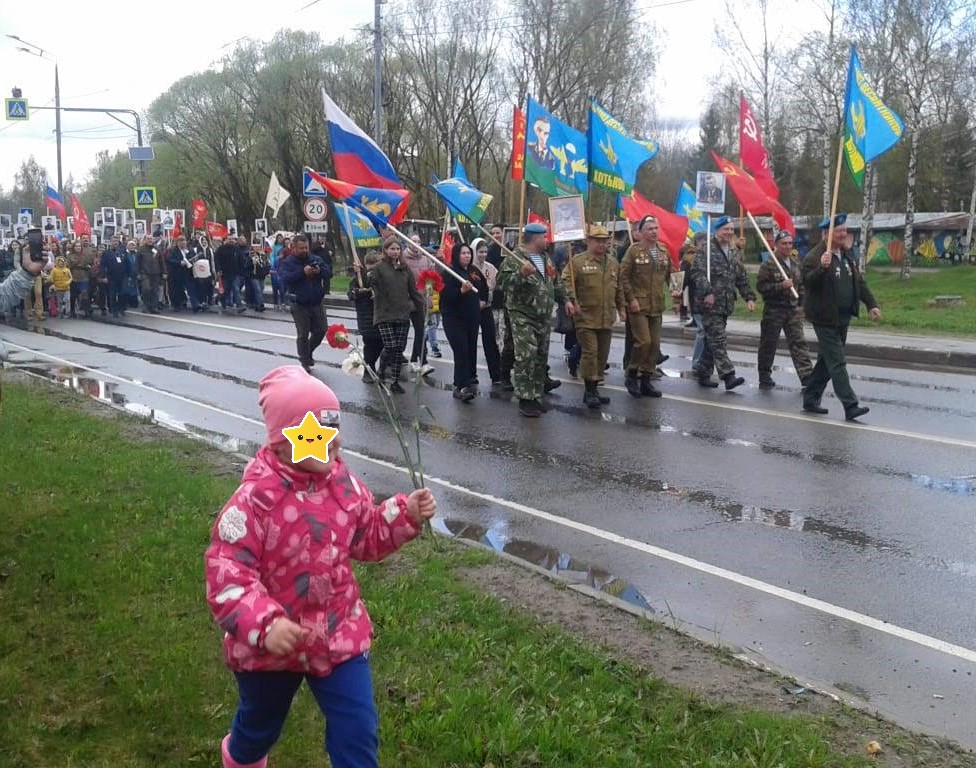
You have no doubt that the Soviet Union was bad, but we won the war and Stalin was an effective manager. You march with every Victory day in the immortal regiment, and they have Bandera in Ukraine, so we have to be the good guys, right?

Why an anti-Russian visa policy in the EU is morally wrong and counter-productive

American-Japanese children interned during WWII – “the most atrocious violations of American civil rights in the 20th century”

Yesterday the proposed visa ban on Russians to the EU was widely discussed. One Twitter user, responding to a criticism of it, wrote:

“But the proposals I’ve seen would only limit tourist visas. Doesn’t that mean that Russians would still be able to move to the EU for study and work, or to apply for asylum there?”

These kinds of responses reveal that people don’t seem to know that tourism visas are the only realistic and timely way of leaving Russia if you are at risk. What other possible visa would people be applying for – business? (Where’s your letter from your employer and permission for leave from them) Student? (see below). There really are very few grounds for Russians (and the majority of people on this planet) to claim the freedom of movement that we in Europe and NA take for granted.

Tl/dr – human rights orgs themselves highlight tourism visas as one of the most effective ways of getting to a safe place where claiming asylum is possible.

Asylum is not an option

Let’s quickly address asylum: you need a credible fear of persecution and this is almost impossible to prove or even document for the vast majority of even those who qualify. Just taking the US case, regardless of nationality 60-70% of asylum cases are denied outright. In recent years, Russians seeking asylum to the US via the southern border were more fortunate – only 30% were denied. In the US case, as in other jurisdictions, it may not be possible to even present oneself ‘non-adversarially’ to claim asylum (because of the Catch 22 that the border crossing to claim asylum from within the US was only possible to undertake ‘illegally’).

Once again, it still seems most people don’t understand that Russians cannot claim asylum by going to an embassy in Moscow and presenting themselves – a staple scene of many Cold War films. Other issues I won’t go into here: the shift to demanding written documentary evidence to support a claimant’s narrative; the disturbing cases of deportation (not extradition) of Russian nationals back to Russia from the EU even when they clearly documented high risk of harm (Chechen cases). In the one case of political asylum I was involved in (as a material witness) the case only moved forward because of written evidence from ‘figures of authority’ within the EU, and because of some institutional support from the EU colleagues – without an existing tourist visa (she previously had an academic one but it expired), this person would not have been able to claim asylum in the first place. Some good write ups here of the US process. Meduza wrote up here the sobering facts of how hard it is to get political asylum from Russia in the EU. It covers the case of trying to claim asylum without already having a visa (for example using a transit flight): in short there’s a high risk of rejection and deportation.

‘It won’t hurt genuine need for Russians to travel’

Again, this shows how little people understand. People travelling for non-tourist purposes make a lot of use of tourist visas for reasons that should be obvious, but clearly are not. You need to be in a privileged position in terms of professional network to qualify for an official invitation to get an academic visa – you need a cast-iron reason. A Russian scholar who wants to visit a UK archive to do ground-breaking research? Who’s your UK sponsoring institution? You don’t have one? Tough. You need a bilateral formal agreement between your Russian employer and the UK uni – things that are now largely impossible because of Russian rectors’ support for the war. Want to attend a conference to present important work? We will let you come – only you’ll have to pretend you’re not affiliated to a Russian university. However, without that official affiliation you won’t be able to prove to the embassy issuing the academic visa that you have a need to travel. You also will get in trouble with your Russian employer (who funded your research in the first place and expects you to acknowledge that support when you attend conferences – indeed it’s a condition of your employment) and won’t be able to get your trip funded (attending an international conference may cost over $1000 in out-of-pocket expenses). Finally, people seem to think ‘some kind of official visa’ would solve the problem of Russians fleeing – well again, even an official Schengen usually only covers 90 days. What about after that?

After the war started I followed the efforts of two colleagues who were openly anti-war, who were at risk of arrest and dismissal, and both of whom applied for academic visas to an EU country. One was able to get the visa, but only after pulling strings with the cultural institute attached to the embassy. The other, despite having all the necessary documentation, is still waiting for her application to be processed. ‘If I’d known, I would have just booked a hotel and got a tourism visa to Spain’, says that person.

What about student visas? Well yes, if you’ve got an unconditional university place (!) or you’re studying at a fee-paying private school, sure, no problem (we don’t want to upset those Rich Russians who already successfully laundered their cash through our banks). Oh, and you need to prove access to over £9000 cash.

Let’s be honest: this is about the enjoyment of punishment

So, of course to Ukrainians this sounds like ridiculous special pleading. By all means, if the EU or other states want to limit mobility of Russians they should make a blanket ban and just come clean – this is about collective punishment, not helping Ukraine, not security. Most of all, it is about making the handwringing majority feel better about themselves (‘our government is doing something’). I don’t want to resort to psychoanalysis, but those who propose such measures with gusto should reflect on how their need for fulfilment via punishment mirrors that of people engaging in hate speech – the frisson of hate, the jouissance that is more than satisfaction, but the erotic payoff element of aggression.

But surely governments could be doing something different – more constructive in aiding Ukraine and countering Russia? Indeed, the rush to impound yachts and immovable property owned by some of the most disgusting propagandists and two-bit thieves revealed that even after 2014, EU states were perfectly happy to allow these people to become residents and even citizens – as long as they laundered their money via local property markets.  

‘Be careful what you wish for’

Or rather: what you impose on others, sooner or later gets imposed on you. One of the characteristics of deglobalization, or rather global segregation, is that liberal and authoritarian states are great at learning from each other. Migration rules start off as merely reciprocal between states, but soon spiral out of proportion and become the plaything of the bureaucratic logic of information and accounting bloat. Once again, those with UK, EU or US ones can be forgiven for remaining largely ignorant.

For a long time, the main barrier to Russians visiting the UK was cost – not just of the visa which could cost many hundreds of pounds, but the necessity to prove significant means well in excess of average wages. More recently both Russians and British people have been subject to an arms war in information harvested from them and torture by application form. Here’s just some of the information needed for a Russian visa:

your employer’s address and telephone number and your employment history; your parents’ dates of birth, dates of death, and place of birth; the exact dates of your previous visits and their purpose; your social networking account IDs; all other countries you visited in the last 10 years (dates and purpose); name of your bank; your national insurance number (perfect for fraud); all your expired passport details [here I personally have to give information going back to 1990]; the employment status and details of your spouse if they work for the state; the usual declarations about criminal convictions, crimes against humanity, terrorism, extremism, offenses within Russia, psychiatric or mental disorders ‘dangerous to society’, drug-use; children’s passport numbers and data along with addresses and dates of birth; information about relatives in Russia.

I would stress, most of these demands from the Russian state are due to mirroring UK demands from Russian applicants.

‘Be careful what you wish for’ because tomorrow it may apply to you, and populist migration laws can quickly spiral out of control. By the end of the year I’m sure we’ll be discussing internment of anyone who held a Russian passport after 1991. I didn’t even mention the propaganda victory a visa ban would hand regime ideologues like Soloviev.

Let’s step back: what would an anti-Putin response from the West look like in immigration terms? Well, while I’m personally against discrimination on grounds of education, wealth, and skills, why not offer incentives for Russians with qualifications (perhaps especially skills that otherwise would support the war effort in Russia) to leave?

Finally, if you’d like to read an interesting write up of the important signaling effect of political emigration from Russia, this article by Laura Henry and Elizabeth Plantan is interesting.

‘Exit shows that the regime is vulnerable and that grievances are widespread, increasing “common knowledge” among citizens and setting off an “information cascade” that could increase protests. However, beyond a certain threshold, exit could drain the protest movement and depress voice…. Exit is anything but a “safety valve” for the regime.’  

Are Russians ‘collectively guilty’? Should they be punished as a national group?

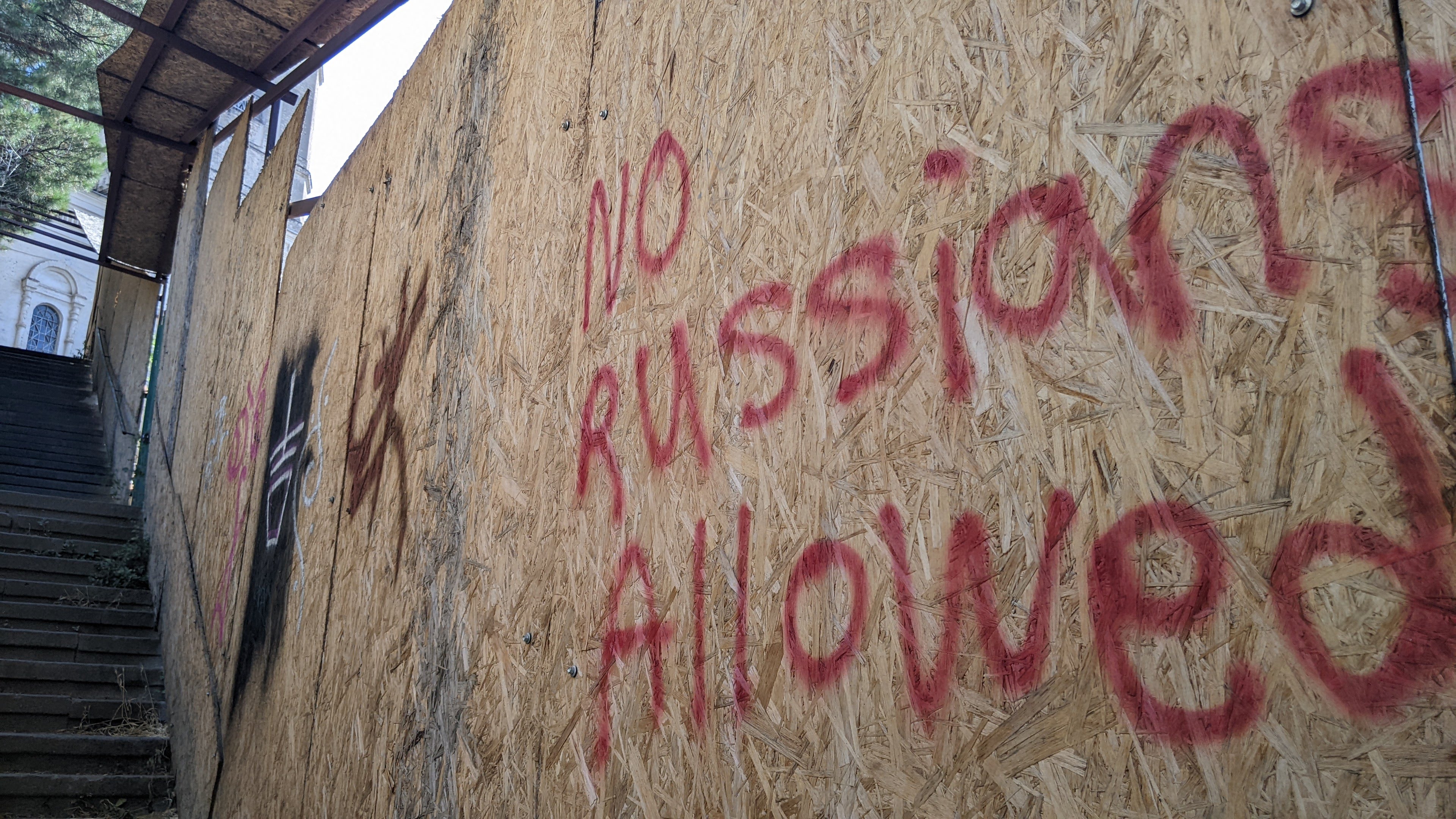
Alleyway in Tbilisi, Georgia, with graffiti saying ‘no Russians allowed’. August 2022

Even before the 2022 Russian invasion of Ukraine, people discussed the culpability of ordinary Russians for military aggression since 2014 (and in Georgia in 2008 too, presumably). Now today with the Estonian PM suggesting EU countries stop issuing tourist visas, the issue gains new visibility.

“when a new russia invasion of ukraine starts i will personally blame each and every russian citizen who is not on the streets right fucking now showing putin there are going to be severe consequences for his plans of a new ukrainian genocide. хватить молчать, гайз.”

Maksym Eristavi in January 2022

I criticized these comments, among other things saying, ‘individual people (who cannot influence politics or take decisions of state) cannot be held to account for state crimes. They can be held to account for their own crimes. Russian soldiers should desert and avoid service.’ To which an anonymous account on Twitter replied: ‘This is simply not true and you are well aware of this, if not, read some history. You are basically absolving everyone of any responsibility to promote change.’

If as a citizen of a country with a dictator you do nothing to change the situation but instead fulfil your part in society that allows the dictator to continue to build his power, are you partially culpable for the actions of the dictator?

Carl Jung’s writing popularized the term ‘collective guilt’ after 1945. Karl Jaspers thought that collective guilt applied to all Germans: not only those who actively participated in Hitler’s project, but also those who passively accepted their place in German society. A contrasting position is taken by Holocaust survivor Viktor E. Frankl. “I personally think that it is totally unjustified to hold one person responsible for the behavior of another person or a collective of persons.” Projection of guilt onto others as groups, according to humanistic thinkers like Frankl, is a barrier to our overcoming of suffering and may lead to ressentiment (suppressed feelings of hatred and revenge) – precisely the psycho-social state many accuse the Russians of. (Ironically, Frankl is central to the Russian psychology curriculum today.)

Jaspers would counter that only an acknowledgement of national guilt would allow victims of an aggressor to accept the moral and political rebirth of that nation. Moreover, the Jaspers argument would be that that no one escapes and that indeed, taking responsibility is part of moral growth. While those directly taking part in war crimes are morally guilty, those who offered no resistance are politically guilty – and share collective guilt.

So, what can we learn from the ‘global gold standard for guilt’: post-war Germany? Historians point out a more convoluted and complicated path – the political manipulation by both Israel and Germany itself of gradations of responsibility. Engert points to the long absence of public ‘confession’ in Germany even after 1951, about how political responsibility was questionably ‘decoupled’ from ordinary people, and how a reparations law took nearly 10 years to come to pass. Surprisingly, a full political ‘confession’ of German guilt, addressed to Israel, came only in 1979, and a plea for forgiveness only in 2000.

Other historians take issue with collective guilt on the grounds that resistance-collaboration is an impossible distinction to draw for the majority of citizens in an aggressor state or those occupied by it. Could Dutch railway workers have obstructed the transportation of Jews they knew were being sent to their deaths? What about actions where reprisals were out of all proportion (as they were in occupied territories in WWII)? Is the decision not to shoot a Nazi as good as collaboration?

Some would see further historical parallels: like in Germany, the active political opposition has already been destroyed and its leaders locked up or forced to leave. Nonetheless, like in Germany, many people of different political beliefs but united in opposition to the regime and war engage in small acts of defiance. Further, it is not enough to excuse the rest, who ‘did not keep their distance from the cheering masses’. While no one is free of scrutiny of the security services and coercion can be brought to bear at will, authoritarian ratcheting since 2018 does not explain the lack of active resistance today. We should not give anyone a free pass, the argument goes. ‘How can one imagine a “theory of small deeds,” say, in the Third Reich? All conscientious Germans left Germany in the 30s’.  And this latter comment from earlier in the war seems to be gaining traction, even among some Russians. It’s supposedly black and white. Active or passive consent is enough to keep a regime going, and a ‘functionalist’ account (Fritzsche) of dictatorship makes everyone complicit.

Alasdair MacIntyre, my favourite living philosopher, attacks individualism and defends collective accountability in terms of ‘debts and obligations’. He goes on to illustrate with the argument white Americans are often confronted by: ‘I didn’t own slaves, how can I be responsible?’ In other words there is a healthy irony towards the liberal assumption that guilt is voluntary and based on individual actions. We can’t escape living in states and bearing some responsibility for the actions of the societies we are members of. However, others find this inconsistent pointing to the weak ascriptions of (morally significant) collective identity today. If we accept that nations are political entities and not real collective identities, then shouldn’t we reject collective guilt? Indeed, isn’t collective guilt the expression of the spirit of European totalitarianism itself: from its scapegoating of Kulaks to Jews. Other identities make claims to ‘cancel out’ the national-historical. Such that even discussing ‘apologizing’ for the Russian invasion strikes socialist unionizers there today as absurd and even dangerously misguided. Their socialist activism in opposing the Russian state ‘trumps’ their identity as Russian citizens. Is this identity splicing self-defeating?

Now, one of the few visible forms of self-defining ‘resistance’ among Russians is to emigrate, something they are being actively discouraged to do.  Hence many people’s criticism of pronouncements like those of the Estonian PM (because tourism visas are the only realistic instrument for leaving permanently). Should collective responsibility be reserved for active collaboration with, and support for war-making regimes? Does signalling like that from the Estonian PM encourage Russians to reflect and resist, or does it make them ‘double-down’ on a victim narrative based on national identity as the ‘bad’ Europeans?

On the state of Russian anthropology and qualitative sociology

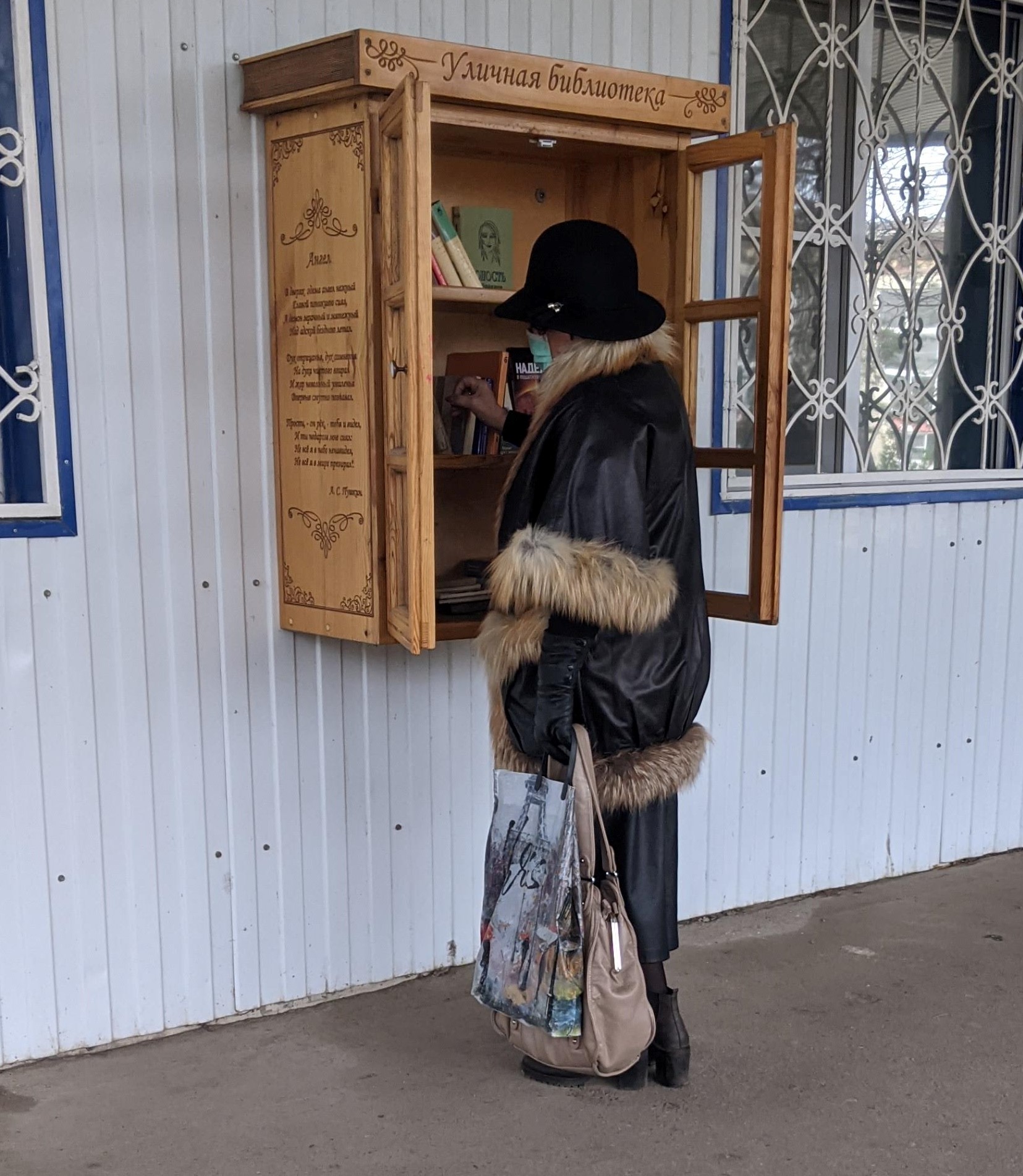
Street library, at a Kaluga bus station.

Jeanne Kormina wrote in March 2022 about how Russia’s invasion has forced anthropologists to rethink their work. Firstly, because the war makes sympathetic understanding of informants’ worldviews untenable. Secondly, because in Kormina’s view Russian anthropology has been politically apathetic – by which she means studies preferred to focus on what was reassuringly metropolitan and liberal in Russia.

When I read Kormina’s piece I identified strongly with her comment about the ‘class-squeamishness’ of scholars working on Russia. I’ve written about that many times on this blog and in my work. Many times in academic contexts I have been asked how I can study ‘monstrously alien people’, as Kormina puts it.

However, no sooner had I positively commented on Kormina’s piece, Sam Greene rightly took me to task. In his view, the problem is not a lack of social research that reflects the diversity of Russian society. Instead, Sam argued that there’s a gap between what is read and what is written; there has been plenty of qualitative sociological and anthro work well beyond Moscow and the middle class. Instead, Sam argued that there isn’t enough theorization that usefully incorporates non-elite people.  Tomila Lankina and Maria Sidorkina also had some things to say on these points. Tomila said that survey research has become the go to way of studying #Russia because of supposed “rigour”, but that surveys are more problematic than ever. Maria commented that the problem is that not enough Russian elites read this research and thus change the way they address/talk to people in the general public.

If you don’t know Sam’s work, you should check it out, including the up-coming re-publication in paperback of his book with Graeme Robertson. Their work on social conformity and agreeableness is very relevant to understanding pro-war sentiment now. It also points to how quickly things might change.  

Sam posted links to various recent publications; let’s review some of them.

First up is the Russian sociology journal Laboratorium. This journal is in good health, publishing many local researchers who employ qualitative methods like interviews and ethnography. Articles are in Russian with an extended summary in English, or vice versa.

A recent issue of Laboratorium is of interest to me because it was co-edited by Elena Bogdanova, the author of a recent book on complaint letters. Bogdanova and Olga Brednikova present seven pieces on neighbourness and civic action in contemporary Russia. The works feature research from beyond Moscow and St Petersburg and draw on/build on a variety of sociological theories.

Karine Clément, it’s fair to say, has been at the forefront of politically-engaged sociology about Russia. In the last years she’s published a lot on urban grassroots movements in Russia. She’s critiqued the idea of an ‘authoritarian personality’ among Russians and offered insights into the locally-rooted and everyday forms of civicness based on her reading of French pragmatic sociology. This has the potential to bring into dialogue different approaches – social psychology, political culture, and the phenomenological. Directly and indirectly the influence of Clément and others can be seen in the research agendas of two important young Russian sociologists Anna Zhelnina and Oleg Zhuravlev and their collaborators. Clément’s work is particularly important to me because she focuses on contexts of transformative experience that turn ordinary people into political subjects. She’s interested in how ordinary people learn, interact and invest themselves emotionally in civic and political causes.  Charles Tilly meets Goffman meets Thévenot.

Some other very recent pieces were pointed out by Sam. I just highlight two of them that were particularly interesting to me:

The Post-Soviet City as a Communal Apartment: Spatialized Belonging in Ulan-Ude by Kristina Jonutytė (2021) in Nationalities Papers. Extract:

“contentions over the city indeed seem to occur prominently in spatial forms such as sacred spaces, memorial statues, and public celebrations, and also discoursively in the city’s promotional materials and publications, as I outlined above. However, although the shifting political and cultural landscape likely played a part in the recent urban changes, I argue below that the seeming contestations should not be read as direct confrontations – or, as Breslavsky (2012a, 313] put it not as an “ethno-political” project – but should instead be seen in the local field of ideas and practices of coexistence.”

Perceptions of governance: state and non-state governance in the North Caucasus by Sasha Klyachkina (2021) in Post-Soviet Affairs. Extract:

“Using original interviews and household survey data collected over nine months of fieldwork, this article offers a nuanced and empirically driven comparative account of how governance works in Chechnya, Dagestan, and Ingushetia. Mitigating between accounts of a hegemonic state that has saturated public space and strong non-state actors that consistently organize parallel systems of governance, I demonstrate that residents identify a role for both state and ostensibly non-state authorities in governance…Following Ostrom’s (2010) call to examine the “wide diversity of institutional arrangements that humans craft to govern” at multiple scales, it highlights two main contributions. First, the paper demonstrates the need to interrogate the relationships between authorities when making inferences about governance rather than grouping them into dichotomous “state” and “non-state” categories. Second, the three cases demonstrate that conclusions about who governs and how are likely to be highly dependent on the domains of governance selected.”

Sam’s other comments were that “the problem, of course, is that most of this kind of stuff never makes it to Western journals, because it’s qualitative – and quantitative studies (despite attempts at representativeness) do tend to over-estimate the role of ‘elite’ constituencies. But that’s not because people aren’t doing the work. They are. It’s just that too few people outside Russia are reading it, and that the polisci establishment even in Russia is broadly not reading it.”

Does war mean making the case that – survey work aside – small-scale sociological work is more important than ever? Yes, it does. The kind of sociology that Clément proposes is useful because it helps understand that the politics of Russia – both ‘monstrous’ and mundane, find their origin in personal responses to, and forms of coping with, the big and imposing structures of society. These associated traumas and tragedies, resentments and revelations via a process of alignment with elite political expediency can crystalize into the forms we see before us today – among them, radicalized bitterness searching for political representation.

Is Russia Fascist?

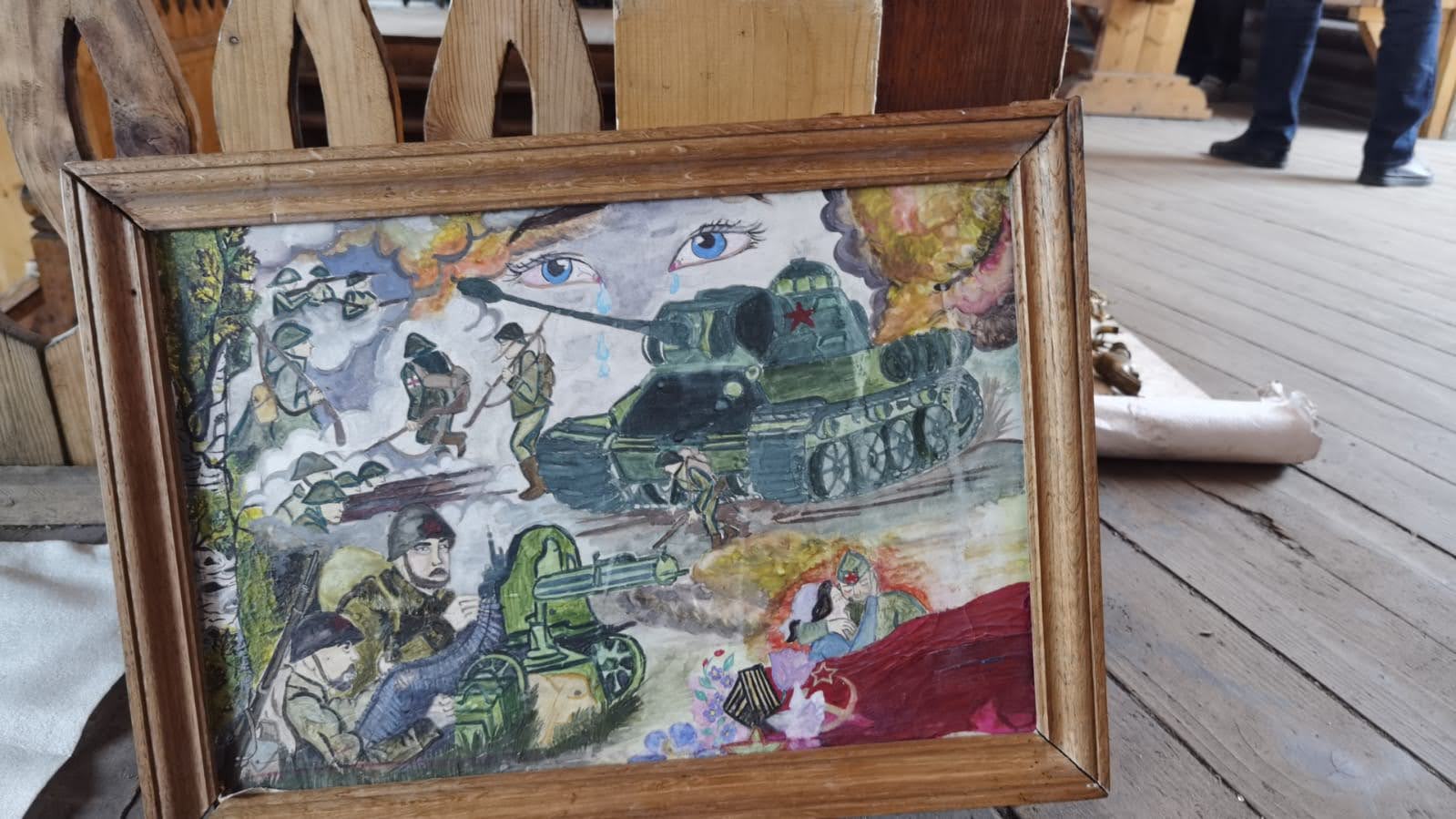
A painting depicting WWII through Russian ‘eyes’ at a Moscow market in 2022

The fact that I’m writing a blog post about this topic shows how detached from reality the commentary on Russia is. It’s understandable, I guess. But shoddy, media-ready ‘analysis’ from public intellectuals that does its best to ignore any sociological knowledge about the country is just really lame.

Tim Snyder’s NYT piece is a mishmash of historical analogism that focusses on Putin and sidesteps scholarship on Russian society. Snyder claims Russia (what, all Russians?) is fascist because it has a ‘leader cult’; celebrates a ‘cult of the dead’ via Victory Day; and is hostage to a myth of an imperial golden age. Very little of the essay, in fact almost nothing apart from a passing mention of Z people and rallies actually pertains to Russia beyond the Kremlin and some ideologists of questionable relevance (‘not Dugin again!’, said one of my undergraduate students).

All of these things are ‘true’, but they don’t really mean what Snyder says they mean.

At home, Putin has always been an ambivalent figure and never enjoyed unalloyed ‘enthusiasm’, even among his voting constituency. There’s loyalty and respect, even among the ‘morally opposed’. But that’s not a leader cult. The fact that so-called political technologists had to create so much PR for him, rather than let it naturally develop, proves the point. The guy never had an iota of charisma. He could never build a following like Trump.

A ‘cult of the dead’? There’s been a few pieces on this in the media. They tend towards a dangerous culturalism (the libel that Russians have a genetic ‘Asiatic’ predisposition to devalue human life and value violent domination). What Snyder ignores is the sociological research on the ‘Immortal Regiment’ marches, by scholars like Gabowitsch. Russians marching with placards of their ancestors who fought in the war is mainly not even a patriotic statement. It’s a rare permission to express personal loss, to experience connectedness, and to give voice to frustrated feelings of a need for communal activity.

The ‘Imperial Golden Age’? Well, this is true to an extent. I’ve written in this blog in the last 3 months that this does motivate some to support the war. But these people are a minority and in any case exist more visibly in societies like the US, France, and the UK. The irony here of Snyder’s comment is that it ignores the bigger golden age myth in Russia: the time people really pine for is the 1970s – the period of détente, peace, and the cementing of non-Russian elite power in the future independent republics of the USSR. Hardly imperial fare.

In reality, Snyder merely projects yet another US-centric take on what’s happening. This reflects liberal anxiety about Trumpism, real white supremacism in the US, and the militarization and securitization of US and Western societies.

Shall we actually look at some definitions of fascism?

I re-read Ian Kershaw recently and anyone who wants to understand pro-war sentiment in Russia should read his account of German society in WWII.

Kershaw’s is not the only definition, but it’s pretty simple. Fascism is based on hypernationalism that’s violently exclusionary and racial; It’s violent towards all political enemies; it’s macho, disciplined and militaristic.  Optional features: social ‘renewal’ based on romantic utopian thinking; irredentism/imperialism; anticapitalism; corporatism (people know their place in society)

On Kershaw’s definitions we do find some fascistic elements to the Russian regime. But this comes up against the contradictions in ethnicizing Ukrainians. The whole point of Putin’s irredentism is that in his view Ukrainians aren’t really Ukrainians, they’re frustrated and misguided Russians (actually he probably doesn’t even believe this). Yes, they are ‘incorrect’ and errant Eastern Slavs, but the whole racialized perspective on Russian attitudes towards Ukrainians is, once again, a US-centric projection. The dehumanization of the ‘other’ is present among Russians and Ukrainians since the start of the war (but of course the anti-Ukrainian rhetoric in Russia was strong for a time now). But this is nothing to do with race or racism. Against Kershaw’s set of features, Russia is an insipid and equivocal ‘fascistic’ regime. Some of these features do not fit at all.

What about recent scholarship on ideology in Russia? Here we must turn, as Snyder fails to do, to Marlene Laruelle’s painstaking research. Her book is called Is Russia Fascist? Snyder commits perhaps the worst possible academic snub in ignoring it in his piece.

I know Laruelle’s work and I read her articles with my students every year. But don’t trust me, we can turn to the excellent reviews of the book. For example, this one by Roger Chapman. This is a positive, but critical review that unpicks Laruelle’s argument that Russia is a kind of illiberal state: rejecting global institutions, promoting economic protectionism and revaluing multiculturalism. Chapman questions why we need the term illiberal when in his view Laruelle could have just written ‘authoritarian/totalitarian’. The reason Laruelle does not use these terms is that in her view ideological diversity is still permissible and that coercion has some hard limits within Russia (so far).  

Laruelle (in Chapman’s reading) makes use of a different historian’s definition of fascism – that of Roger Griffin. According to Griffin, fascism is a ‘revolutionary-utopian form of nationalism’. It requires an anti-modern myth of regeneration involving the violent destruction of enemies. Enemies are racialized through an ideological doctrine that catalyzes mass mobilization to ensure domination of those enemies both at home and abroad. So far, pretty similar to Kershaw. Laruelle notes that by these criteria, “not only is Putin neither Hitler nor Mussolini, he is not even Pinochet”.

In a late-2018 piece for PONARS, Laruelle picks apart similar arguments Snyder has made before. She says his approach is comparable to those of an observer who would extrapolate from Charlotteville riots to conclude that white supremacists had an iron grip on US society. “Simplistic reductionist techniques and invalid reasoning further confuse the analysis—and bias policy responses.”

….

In my view, the ‘Russia is fascist’ argument is so far from the reality of Russian society that it amounts to dangerous disinformation. What do actual political sociologists find?

Political and social demobilization at every turn – even incorporation through a ‘party of power’ does not serve ideological purposes or help mobilize. On the contrary, incorporation by the regime serves its stasis and the continuing enrichment and insulation of the elite. With some visible exceptions (who now get a lot of undeserved attention) the elite is uninterested in ideology and even governance (so an Eichmann could hardly be found). There isn’t a banality of evil. Just banality. In some senses the ‘mafia’ metaphor is better (though I criticise it here and reprise an analysis of corruption as a ‘thing’ that drives the regime here). ‘Ideology’ and ‘causes’ are dangerous to this regime.

In actual fact, most Russians’ lives are profoundly depoliticized to an unhealthy extent. Ironically, here is where Russia is open to a charge of fascism: the idea of fascism as a creeping erosion of citizenship and the achievement of the aims of totalitarianism by procedural means. The irony? The scholarship of this ‘post-fascist’ fascism is about our societies.  About the UK, European states and the United States.

So, what is Russia as a political regime? Well, my recent take is here: an authoritarian neoliberal regime of some complexity. I argue that elements of this are present in our own societies and that many states are hurtling into the precipice Russia already occupies.

In Russia there are many forces of prefigurative politics, resistance and renewal, stacked against the seemingly dominant authoritarian power (the topic of my current book project!). Russian society has its share of neo-Nazi far-right forces which are both feared and leveraged by the elite. Other formations are far more visible and make Russia look more like….. Ukraine. There’s a liberal mainstream that dominates the ‘discourse’ beyond the state-controlled media and a strong communitarian strand of political thinking. Takes like ‘Russia is fascist’ ultimately show, once again, the unhealthy focus on the current elite, an elite that’s more and more disconnected from the majority. The invasion of Ukraine itself illustrates the intellectual, political, and institutional exhaustion of ‘Putinism’. But it proves little beyond that.

Creeping Russian mobilization meets growing public knowledge of the horrors of war

2022’s 9th May Parade and Immortal Regiment procession just outside Moscow.

Ilya Matveev and I were invited to talk about Russian responses to the invasion by Russia of Ukraine. We decided to use our six minutes of this experimental podcast platform ‘conversation six’ to talk more about Defensive consolidation. I use this phrase (here’s another take on it) to characterize the majority reaction to the war at home in Russia and here are my notes for the talk:

Why it’s still not a rally

There a low level of active patriotic responses to war (beyond symbolic Zedtivism), a lack of declaration, or effective framing, of war as an ‘attack on us’ – this is not what most people are ready to internalize, despite what the media says. Indeed, there’s a lack of unconditional belief in Russian state media – it’s gone too far in the direction of open propaganda and post-truth that there are signs people’s trust in it is going down. Added to that there are realities that are hard to ignore: Ukraine as an obviously weaker state than Russia – so why is it a threat? Culturally, politically, socially it really was seen (rightly or wrongly) as a ‘brotherly nation’. Zelenskyy as a puppet and ‘ukrofascists’ of course have some traction, but this is all pretty superficial because it has low salience to most people. And the absence of a real casus belli means that overall there’s far too much cognitive dissonance around for a majority, or even a big minority, to ‘rally’.

So, defensive consolidation is this highly ambiguous and contingent set of responses – it includes finding excuses to justify to oneself what’s happening, but which are logically very tenuous and even self-contradictory. To me what is noticeable among a lot of anti-Putinists is a kind of sunk cost fallacy – “Putin was wrong, but now we’ve started we see the world is against us, but precisely because of that we must go on regardless to the bitter end, because to lose will mean a broader disaster”. And even this is not necessarily an immediate geopolitical way of thinking (i.e. about NATO as threat) but tied to longstanding feelings of being a periphery and ‘other’ of the West.

Why is it consolidating? Because it involves a cleaving to forms of immediate authority but I don’t think that’s sustainable over time. So for example, people ask their village ‘elder’ what to do and he answers – collect diapers to send to IDPs. People do this, but already a wave of solidarity is passing for refugees. We see this at every level – ‘what can I do’? People genuinely of course have a desire as part of a socius to do something, but as Ilya says in the talk, the logic of Putin’s Russia is demobilization because of fear of any independent action and civicness. And in fact, when people ‘cleave’ they often find zero leadership and zero answers – authority is so very hollow in Russia.

So, will defensive consolidation break down and under what conditions? The consolidation will partly morph into new and emerging forms of microcivicness, because there is this huge pent up desire to improve Russia. Ironically, the war shows this more clearly than ever. People know they live in a country that lacks many of the goods others, including Ukrainians, take for granted or are willing to strive for. This is not sustainable. Right now I am tracking individuals and micro-associations that search for new forms of activism – from environmentalism to covert anti-war actions. Could this turn into a coalescence of diverse forms of social mobilization with time? Maybe not. How will Russia change? Probably in the least predictable way – in the first Chechen war, people could not have predicted Soldiers’ mothers at the forefront of resistance and protest. Now, who knows what the future catalyst would be to push elites to end the war? Could it be ethnic minority religious groups? Could it be militant unpaid workers? Could it be a consumers’ protest against rising prices?

Creeping mobilization meets hard limits in Russian state capacity

Some brilliant investigative journalism from BBC Russian Service and others has laid bare that the invasion was even more poorly planned and executed than we previously thought. Many soldiers were barely ‘led’ at all (in fact misled). And there are striking details in this long piece, from a lack of night vision equipment to descriptions of soldiers fending for themselves. Later the piece gives a lot of detail about the growing resistance among soldiers to continuing military contracts. Elsewhere the same author has given a good explanation of the war crimes in Bucha as stemming from the same problems of leaderless, drunk, desperate and brutalized-brutalizing troops.  Add into the mix doubts about whether the state will actually honour payments to wounded and provide even basic medical treatment beyond emergency care (which is woefully inadequate anyway). My favourite topics of stunted state capacity and the incoherence of governance meet up in this shitshow of a war. Any creeping ‘mobilization’ will be similarly incoherent – enlistment officers face even more obstacles than before because no one really wants to die for Putin (illustrated well in the BBC piece). Urgency too is always the enemy of this state’s machine. You screw up and the boss asks for it ‘yesterday’, even though he didn’t give you the tools to get it done in the first place. As with so much else, we end up with something worse than the previous improvised solution. It seems clear now that the Great Russian Army was an ‘improvised’ solution to the problem of force projection in a massively corrupt and cronyism-ridden Military Industrial Complex. We had a Potemkin village of an army, now with creeping mobilization we will get something ragtag that doesn’t even resemble a modern army. Like the Russian meme about IT projects – instead of good planning, testing and development, in Russia it’s ‘slap shit together and deploy’. We could call this the revenge of a century of ‘avral’ (rushing production targets).

Putin clearly does not want to declare a state of war – it brings too many uncertainties, and even personal risks to him. He doesn’t like that. His whole career has been about making short term, usually conservative decisions to avoid immediate risks, but which bring a huge long-term tail risk. Michael Kofman just wrote about how mobilization is a complex topic; although he emphasizes high manpower capacities on paper, I would emphasize that the state lacks capacity, political will, and actual popular support to translate that into reality.