Category Archives: Uncategorized

The Russian Presidential Election of 2024 and the meaning of authoritarianism

People can tolerate autocracy, but they can’t tolerate the absence of hope in the future

The Russian presidential election presents us with a paradox that itself is something of a sea change for the meaning of politics today in that country. There was a pronounced shift. The election was likely no more unfair than before, but this time it’s almost as if the riggers had clear instructions – don’t even bother to try to make it look like you’re not rigging it. Just write in unbelievable numbers – unbelievable even for loyalists. At the same time, people I know who had long given up voting, and who more or less openly had admitted the disaster that had befallen their country since February 2022, almost with a sense of comfort went to the polls to cast a ballot for Putin. And thus, you have three likely truths of the electoral process – 20 to 30 million of the 64 million votes for Putin were just written in; the true turnout was pretty low because with electronic voting you don’t actually need physically coercion of voters; perhaps many more apolitical people than before voted for Putin. Why the last one?

Precisely because of fatigue, anxiety about the war and the knowledge that the decision was his alone but that the whole country is hostage to it. So, in my sample it was notable that while there is a hard core of Left Nationalists and Right Nationalist voters (let’s face it, the names of the parties are unimportant now), many switched for the first time since 2004 to Putin. For me, it’s just a bit unfortunate that few observers ever really go beyond the “falsification yet genuine popularity” framing of elections in Russia. This means that in 2024 they are not really prepared to unpack the genuine consolidating effect of the war on voting. Once again, I have to choose my words carefully, but let me offer an illustration:

My good friend Boris* is 40 years old. He’s a metal worker in Obninsk, a town an hour and half from Moscow. He has a degree in marketing but can’t find a ‘white collar job’ that’s worth the hassle. He took this job in an aluminium factory as a hedge against being drafted to the war. He has two dependents and a wife who works for the state. He likes reading American self-improvement literature: ‘how to think yourself into getting rich’, and he mainly talks to me about how to trade crypto currency and neuro-linguistic programming.

He, like many, had a kind of mini-breakdown in February 2022, saying things like ‘now the Americans will destroy us – what the fuck was the old-geezer thinking?’ But now he generally communicates in a highly ambivalent way – in memes that are not pro-war, but which always indicate the double-standards of the West. He approvingly notes the jailing of regional businessmen who have resisted the nationalization of factories important for the war effort. Like many interlocutors, he’s rather keen on any news stories, even obvious hatchet jobs, which paint the Ukrainian leadership as cruel, evil, or mad. One could say he’s ‘indignant’, rather than ‘resentful’.

He’s not upset though, that drones are falling close to his house. ‘What did people expect? It’s a war, you know?’ Later, he comments at length on the parade of religious icons to protect Moscow and about the satanism of the Ukrainian leadership: ‘It’s hard to tell whether they [propagandists] are telling on themselves with this or not. Certainly they are smoking a lot of good quality marijuana in the church these days’.

Or, reflecting on a TV programme about Ivan Ilyin as the ‘most popular Russian philosopher today’, notes that ‘as they say, the past really is unpredictable in this country. An openly fascist thinker [the favourite of the President] gets rammed down our throats. Who has the good fascists? Us, or the Ukrainians [despite what you read on Twitter, almost no one uses derogatory terms for Ukrainians in real life]?’

One of the underappreciated aspects of so-called ‘public opinion’ is not the capacity for people to hold contradictory opinions about it and the Russian leadership. There is very limited open talk among people with different opinions about the war and it’s quite varied: despair at destruction, ridicule of propaganda, anger at the incompetence of the army, disgust at the ignorance and indifference of most, resentment of the West’s support for Ukraine, longing about the end. But seemingly regardless, for most, their talk about the war itself is sublimated into a form of consolidation using double-meaning, humour and irony.

Boris never voted for Putin before. Like many younger people, he did not vote in 2004 (the first time anyone had the chance to judge at the ballot box the performance of Putin’s policies). He voted Right Nationalist as a kind of protest in 2008, because he liked the (duplicitous? distracting?) populist social messaging of Zhirinovsky, and because of the general dissatisfaction with the government that had made little to no progress on improving the prospects of younger people. We should note that both his parents – well educated Soviet technical intelligentsia are hardcore Putin voters – loyally they articulate that ‘there is no alternative’. However many such ‘loyalists’ are also an overdue disaggregation by observers. Some will break quite soon, I think. Many of Boris’ friends would vote Communist – or we should say ‘Left Nationalist’.

Boris didn’t vote in 2012 and observed from afar the For Fair Elections protests in Moscow. He did pay attention to things like local trash protests, strikes in the car factories locally. He signed petitions, he went to public meetings. He put up flyers made by a local group called the People’s Front that protested corruption in his town.

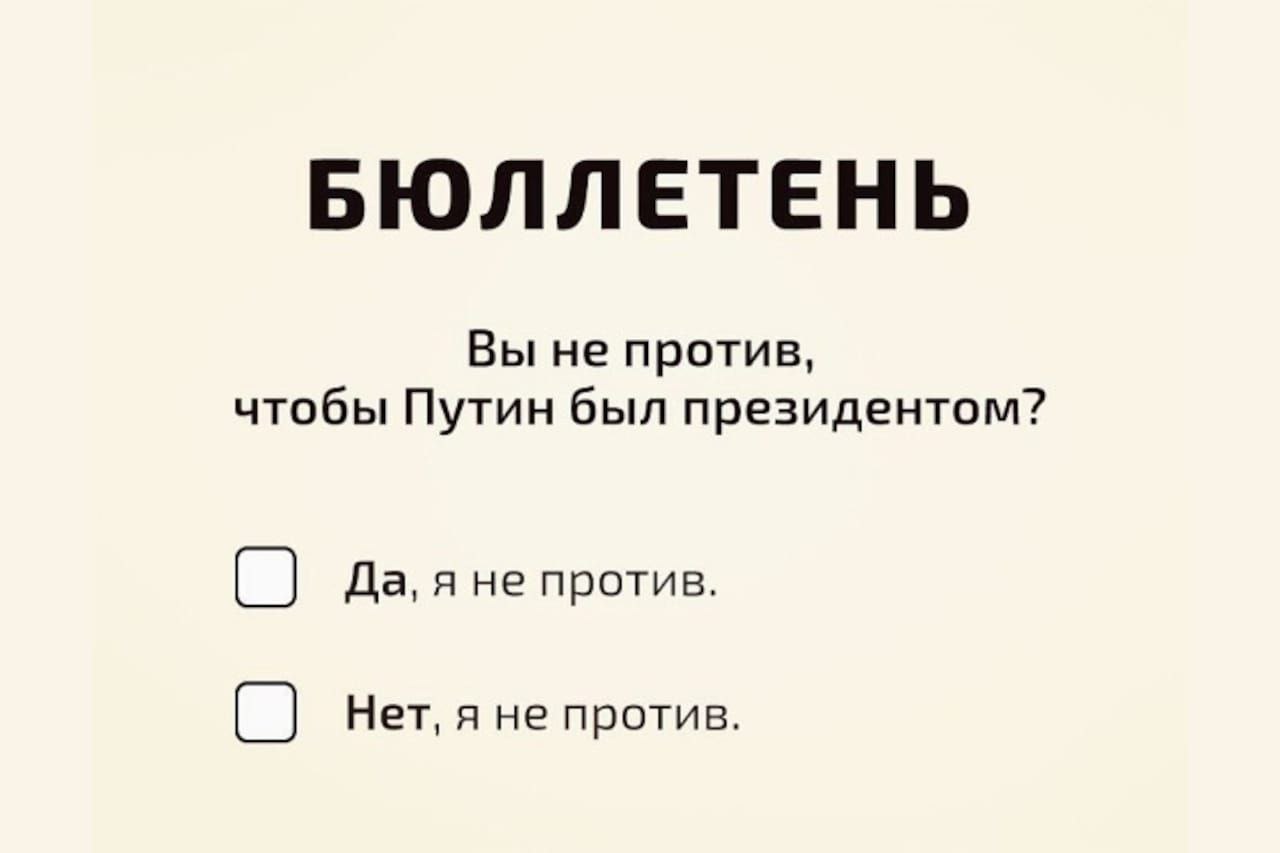
In 2018 he didn’t vote again ‘why would I? I’m not a stupid person’ – once again this ironic comment works on three levels – liberals are stupid, loyalists are stupid. Even the question reveals a tiring sense of naivety. But in 2024 he did, and for Putin. Why? Putin is the war candidate, but also the only peace candidate. Boris sent me a meme shortly after the election [actually it’s an old meme]: A ballot paper is depicted. There are two choices: ‘Are you not against Putin becoming President?’ The two boxes say: ‘Yes, I’m not against’. And ‘No, I’m not against’. There are multiple negative reasons not to be against voting for Putin.  

*** [academic parts incoming]

For me, the focus once again on electoral politics, and plebiscitary indicators more generally reveals a fundamental problem with the framing of the political in Russia, the misleadingness of the term ‘authoritarianism’, and other analytical terms to describe regime types. Karine Clément in 2018 wrote that the presence of authoritarianism in places like Russia, from the perspective of ordinary people is not so obvious and almost undetectable in everyday life. She pointed to the way that civil liberty restrictions and control over the media, undeniably harsher under such regimes than in other types of state, were way less important to most people than the legitimate grievances they had with social and economic policies. As Tom Pepinsky wrote about Malaysia – ordinary and everyday authoritarianism is ‘boring and tolerable’ to the vast majority. Does that mean these same people support authoritarian rule (in the sense of giving up voice)? Absolutely not.

The authoritarian personality type was strongly critiqued in sociology forty years ago. This is an idea from the 1950s that there’s a socially significant sadomasochistic disposition that emerged and thrived in authoritarian societies and which then maintained them. However, it’s still overlooked that the ‘original’ theory of authoritarian personality was developed to explain how people in capitalist societies in the West sustained a broad submission to authority, emotional identification with leadership, belief in the naturalness of hierarchy, esp. in organizations, the heredity of natural differences between persons, the fusing of legitimate authority and tradition, and so on.

Later in the 1970s, the ‘Western’ variant was refined to refer to ‘rigid conventionalism’, where different social anxieties can be overcome by conformity. However, even supporters of the ‘type’ complain that psychologization becomes meaningless without attending to the social conditions which would produce them. Indeed, the whole psychological basis of authoritarian values when tested experimentally, tends to fail when presented with groups who hold even mild political convictions. ‘Ideological’ belief itself serves to reduce anxiety – and these may be ‘right wing’ or ‘left wing’ values.  Furthermore, the development of authoritarian personality to talk about more or less ‘pathological’ types prey to demagoguery completely inverts the original concept, which, after all, was developed to explain why all of us, generally, are ‘normal’ and ‘well adjusted’ when we defer to authority, as this is how our (capitalist) society is structured and functions. Even today, to have a problem with legitimate authority is a sign of ‘maladjustment’ (Oppositional Defiant Disorder can be diagnosed in children who ‘are easily annoyed by others… excessively argue with adults’).

Back to Russia, Clément notes, perhaps even too mildly, that ‘Russians are quite critical thinkers’. She rejects stereotypical ideas about the ‘Putin majority’ and says this is partly an artefact of misinterpreting opinion polls where people answer as they are expected to. Like my own work using long-term and in-depth interviews, she finds that the vast majority are highly critical towards the state, in a sophisticated and reasoned way, in a way that connected from local and personal issues to broad social problems which affect all. ‘People make great claims against the state, and the first of them is its dependence on the oligarchy and independence from the people’.

Does the war change this? Hardly. Clément’s other point was that, by and large, people are able to exercise a sociological imagination about their own society – that it is not all about ‘Putin the tsar’. Indeed, one of the sources of support for the status quo is the realistic and relatively sophisticated conclusion that Russia is a pluralistic state with lots of competing interests and that if anything, Putin’s ability and power is quite circumscribed. And the war would only underline such a view. And this is not the same as the old saying ‘the king is good, the boyars are bad’. It’s a much more sober assessment. Clément concludes by saying that the most pertinent authoritarianism-from-below is the call for ‘more social state’, ‘a less rapacious financial elite’, and, we can add, today, ‘defence from the effects of war, and of ‘peace not on Ukrainian terms’, whether we think that is callous or not.

If there is not much ‘authoritarian’ in the values of Russians to distinguish them from the inhabitants of states where people have little access to power or voice to change things, then what is the value of the term?

***

Is Russia authoritarian because of the lack of accountability of the elite? Because elections don’t matter (actually, they do). Because the press is controlled by the regime and dissent harshly punished? Professional political scientists usually refer to the lack of free elections, but that does not generally extend to the evaluation of the responsiveness or not of leaders to populaces. This is Marlies Glasius’ argument (2018), to which he adds that the three main problems with “authoritarianism” is that

1., It’s overly focussed on elections

2., the term lacks a definition of its own subject at the same time as

3., it is narrowly attributed as a structural phenomenon of nation states.

Lack of accountability of bureaucracies, the lack of choice in elections, and the impact of globalization as a disciplining mechanism means that the differentiation between authoritarian and democratic states is overstated.

(sidebar: a Danish colleague the other day said: ‘where else but in Denmark is social conformity enforced more fiercely than by citizens themselves, with an internalized snitch culture?’ Where the state tax authority can use your mobile phone location data to check you’re paying tax right. Every day British newspapers run stories of women jailed for not paying TV licenses, disabled people forced into homelessness for being paid 30 pence too much through a state error, or, indeed, the complete untouchables that are state-sponsored corrupt oligarchs).

If Russia is now a personalized dictatorship, as many would assert, why is Putin so hesitant, distant (and even scared of being seen as responsible for) even from decision-making?  Why does he appear wracked by indecision and inconsistent in his war aims? Why is the state so poor at carrying out adequately even basic logistics in the war? Further, following Glasius, to really evaluate authoritarianism in Russia we would need to look at disaggregated practices of the state structures: social policy, the courts, regional authorities.

Is accountability in these milieux sabotaged in a way that sets them apart from democratic states?

Are authorities of any kind able to dominate without redress?

Is meaningful dialogue between actor and forum prevented by formal or informal rules?

To what degree are there patterns of action embedded in institutions which infringe on the autonomy of persons?

These are much clearer definitions of authoritarian and illiberal practices, consistent over time, and which are easily documented in the Russian case. However, as Glasius points out, free and fairly elected leaders, from Modi, to Trump, and also parliamentary governments in Europe, also engage systematically in such authoritarian practices and increasingly so over time as national authority is diluted by transnational forms of power.

To turn finally to a very recent critique of authoritarianism by Adam Przeworski, he complains that existing models ignore the provision under authoritarian regimes of material and symbolic goods that people value. Przeworski says that we should pay attention to ethnographic accounts such as that of Wedeen’s work on Syria where peoples strongly denied (in the 1990s) they lived in an authoritarian regime and deployed rationalizations that were not ‘duplicitous’. Further, Przeworski argues that:

autocrats can enjoy popular support

it is difficult to interpret elections

often internal repression enjoys broad support

actual performance of economies matters and provides a real base of support

manipulation of information is never sufficient to compensate for poor performance

propaganda is an instrument of rule in every regime (including democracies)

censorship does not fundamentally provide a test of whether preferences are genuine or not.

Further, the psychological processes of people in authoritarian regimes cannot be explained by game-theories about belief.  Enforced public dissimulation presents a challenge to both the regime but also to scientists in discovering ‘real’ attitudes. Further, a lá Wedeen, performance of belief might become a comfortable and natural disposition to the degree that deviance from this norm is socially disruptive but without implications for the ‘real’ attitudes of persons engaging in ritualistic performance. We get a sign here of what’s missing, the social life of authoritarianism may be more relevant and powerful than the cognitive feedback by people to all the signals around them. Many critical assessments of society and processes in Russia, as Clément notes, are not visible at all in the public sphere, and yet are universals in interviews, especially when there is less or no prompting from the researcher. The social prerequisites for positive change are always there, and people are ‘keyed’ to respond to them by human (social) nature. By the same token the desire to cleave to authority is characteristic of the most ‘democratic’ and liberal groups throughout history. The resort to social psychology models of dispositions according to a legacy of regime types is as open to criticism as it ever was.

*Obviously Boris is not a real person, but an ethnographic composite of real interlocutors.

Russia lost its greatest, and most naïve optimist*. A curmudgeon’s obituary of Alexei Navalny

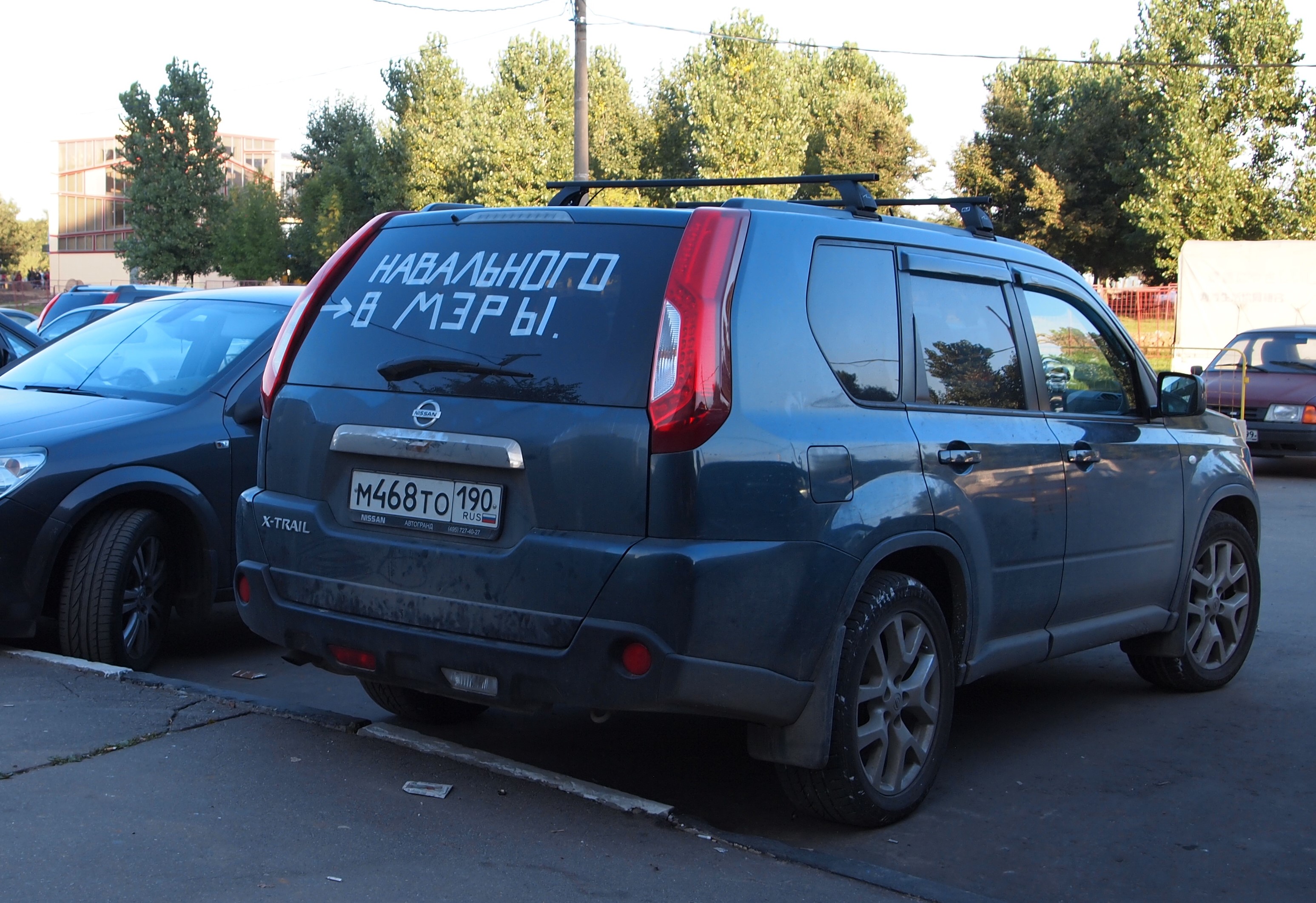
Navalny for mayor (2013)

Charismatic and intelligent. But too keenly aware of himself as both these things. Angry, frustrated – for good reason. Perhaps reckless, lacking strategic thinking. Narrow-minded and naïve. Who could better represent an entire group? The bright and irrepressible liberal middle-class.

Yes, more than all the other things, Navalny was a talisman – he had magical powers over his people, but was hardly stimulating to others. To some he represented hope for a different Russia. He represented incarnate individual responsibility, competition (‘fair’ elections are ‘competitive’ ones), self-actualization. A personal antidote to apathy. He was in earnest, fired up – something to aspire to. An anachronism ( ‘out of time’) in a system designed to disempower and demotivate, close ranks and watch your back… in the end he transcended his actual views to become a symbol of Russia’s inability to find a way out of personalist politics.

Martyrdom was a choice. People won’t say it – but he would have been better off saving himself. His was a stance both more principled than many others, but which also reveals the personalized nature of his appeal and his politics – he was ‘anti-Putin’ and positioned himself that way on purpose. And clearly Putin felt personally challenged on some level – hence his refusal to even name him.

But the anti-Putin contains many ingredients of Putin himself – as numerous people point out (privately, of course) even now. The style over substance. The cultivated charisma which stems from a rather overweening masculine pitch to authority (very, very few feminists are given any airtime to express their deep-seated discomfort with his language). The temporary and fickle try-out of different ideas and slogans. The super-narrow political imagination – one might even say ‘anti-political’ imagination (anti-corruption is not politics).  

After building his career as a blogger and activist, in 2013 Navalny stood for mayor in Moscow (he could have won in a fair fight). Less internet savvy Russians were barely aware of him at this point, beyond a name. A measure of how the ratcheting up of repression makes time elastic in Russia is that it feels as though 2013-2020 (to his poisoning) was a short period, but that an absolute age elapsed between his return to Russia in Jan 2021 and his death nearly exactly 3 years later.

People in the West paid oversized attention to Navalny because they believed he captured a kind of Russian ‘zeitgeist’ in the 2010s. But the true zeitgeist was a general misrecognition on the part of that liberal middle-class: they were just as invested in maintaining the unequal system of crony networked capitalism as the elite. Navalny campaigned against electoral and political corruption and his fatal success was investigating the personal self-enrichment beyond measure of the leaders. But his most ardent supporters were also among the main beneficiaries of the system.

It is a misunderstanding to think that his (anyone’s) ‘liberal opposition’ excluded nationalism, chauvinism even. A model of individualism in a hostile environment, a self-made man who believe in the invisible justice of the market makes one myopic and prone to blame others for their misfortune. Here in Russia, liberalism is about protection from the rapacious state and personal responsibility for one’s actions. But being for ‘fair competition’ can also code as protecting ‘ethnic’  Russians from ‘immigrants’.

Navalny was pointedly hostile to people who have every right to live and work anywhere they like in Russia – Russian citizens in fact, who happen to be Muslim and racialized as such. It’s mistaken to see him as ‘cannily’ channelling nationalist sentiment in an acceptable way to urban Russians. Instead, we should read this as an essential script of liberal failure; in a country with millions of Muslims and rich diversity – and where inequality and ethnicity go hand-in-hand – playing the race card shows political immaturity at best and was ominous.

Thirdly, he was lauded for his supposed turn to ‘social issues’ (sic) in 2018 as if this was a smart pivot. In fact, it was years too late, and because it was too late it failed to resonate. The ‘social sphere’ for Navalny was hardly visible except in a negative sense – that corruption makes the state and the individual poor. He represented everything that is naïve about liberals in Russia – ‘if only we could just get on with being a normal country like the USA, everything else will fall into place’. In a sense, he traces an ideological line back to the Komsomol boys who privatized opportunity in the late Soviet Union and deluded themselves they were building a market where all would prosper.

His honest and principled disgust with corruption never led to diagnosis of root causes. Corruption was a byproduct of total social transformation that the elite and a large part of the Soviet nomenklatura had actively chosen and supported since 1990. Corruption exacerbated inequality, but the original sin of economic looting and wholesale destruction required more radical politics to mend. Way back in 2009-11, I did many political interviews with ordinary voters. They really disliked Navalny because of his naivety and smugness (seeing the problem as merely replacing ‘crooks and thieves’ with ‘honest’ representatives). His achievement in mobilizing the middle class to actually try to do politics was laudable but also doomed to failure. It should be seen in the light of similarly well-meaning people in democratic societies who think they can break cartel politics from the inside, through the ballot box or a more appealing offering in electoral politics.

Navalny as a political phenomenon is a warning. Like any charismatic project it shows that without a movement that can connect different kinds of people and show them that they have common material interests, clever slogans, social media, and urban youth organizing isn’t enough. The media write ups (just like the exaggeratedly glowing scholarly accounts) showed what an exceptional individual he was and how an individual can become symbolic of change for many people… but exceptional people do not really change history – despite what a popularized view of “great men” pretends to show. Churchills, Stalins, Trumps are ultimately just part of the structures of feeling that dictate their eras. Navalny was, despite everything, an anachronism not so different to Putin: out of step with what most Russian people want.

*title partly stolen from the genuinely great A.A.

A tale of two wartime punishments. Plus: who gets targeted by spies?

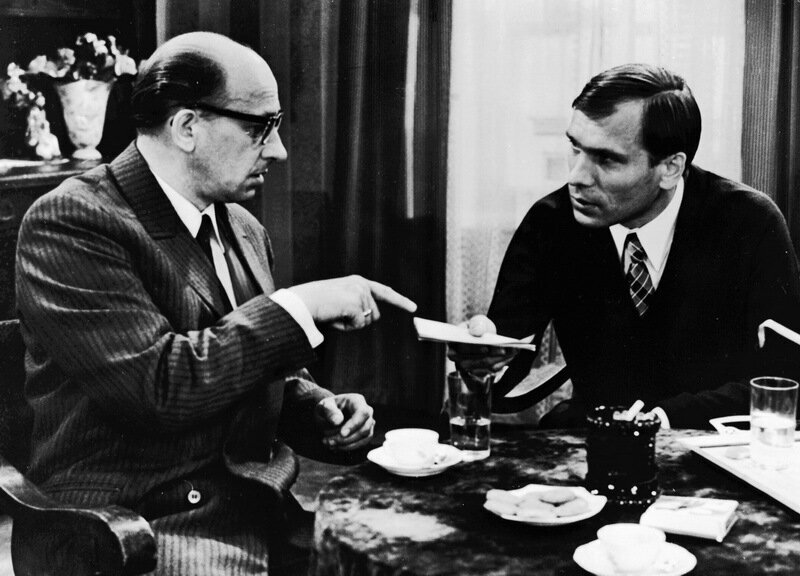
Professor Pleishner from Seventeen Moments of Spring. https://dzen.ru/a/XftF3Oz7gFdE6Xbz?experiment=948512

Igor “Strelkov” Girkin, a military reenactor, monarchist, and probable ex-security officer held by many to be responsible for escalating the Donbas war in 2014 was sentenced to 4 years imprisonment today, not for shooting down the Malaysian airliner MH17 but for “extremism” (specifically, for complaining about incompetent Russian military and political leadership).

Unlike the ever-increasing numbers of political prisoners serving time for actions against the regime, Girkin will have quite a lot of freedom in the so-called ‘zona‘ as an inmate in the ‘general’ category of prison. In fact he is not going to prison, more like a guarded dorm/hall of residence in a kind of camp. He will get lots of time outside the shared dorm, walking around in the grounds and he will probably get nearly unlimited access to postal services and relatively unrestricted ability to spend money. I would take a bet that he could be transferred to a ‘colony-settlement’ where he’s effectively free to leave during the day. Some of my informants from my 2016 book were ‘colonists’ – i.e. on day release from prison. Formal and informal rules meant they could in reality spend loads of time in my little town of Izluchino. They used to ask us to buy them vodka and some of them were harmless while others scared the life out of me.

Meanwhile, the hapless Daria Trepova gets 27 years for the bomb murder (‘terror attack’) of blogger and pro-war activist ”Vladlen Tatarsky” (a name originally coined by author Pelevin). If you don’t know the case, Trepova bought a statuette as a gift to Tatarsky at an event in a cafe. It blew up and killed him. She will go to a stricter regime of prison colony than Girkin, as one would expect given the more serious charge.

I am still baffled by this case and whatever explanation you choose to believe is just bizarro-land. Estonian sim cards, the video of her close to the blast, the networks of people involved…. it’s just a gift to conspiracy theorists the world over. You can comfortably subscribe to a set up by the Ukrainians or the Russians. Then there’s the narrative account heard in the courtroom: that Trepova was very nervous herself, and that she and Tatarsky had a joke about a bomb (Tatarsky’s venue security had halted the statuette in the cloakroom)!

But the version of her knowingly bringing the bomb is then undermined – pretty comprehensively – by her own actions then and since. In the video she’s a few metres away from the bomb!

If you believe the version heard in court in Russia – Trepova is instructed by journo-cum-revolutionary cosplayer (coincidental link to Girkin!) now in Kyiv, but he in turn is linked with a pretty non-descript Ukrainian operative. It’s ironic that while the Girkin case gets some coverage today in Ukrainian media, Trepova gets none (which is only partly understandable given the Belgorod Ilyushin shootdown, which Russia alleged killed Ukrainian service personnel).

BBC Russian Service have a good write up. There’s no coverage on BBC Ukrainian service, despite them covering Girkin. Anyway, one take-away is: if you’re an antiwar liberal in Russia, be careful and don’t be naïve! Trepova might have gravitated to ‘anti-war’ action because of her sympathy with the liberal cause and then been exploited for it.

Why draw attention to Trepova case? Because it does rhyme with some allegations about the academic spying case in Estonia (inadvertent recruitment, exploitation for other purposes). I commented a few days ago on the generalities of that case and the missing links – I will write these up when we have more information. There are also big differences of course. The take-away from Trepova case, and also recent Insider interview with Bellingcat associate Grozev is that the Russian security services (and Ukrainian side, it would seem) are more likely to target the liberal-activist universe, not academics. These are largely separable spheres, even if individuals straddle them.

Once more, I’m not (yet) commenting on the Estonian case, but if you look at the logic of recruitment it is connected to accessing networks that are of immediate relevance to the aims of Ukraine/Russia and using ideological commitment of dupes as leverage.

Does that mean academics are not useful? No, I’m not saying that. Does that mean academics cannot be dupes or even willing accomplices. No, of course not. But it indicates the relative priority of targets. Academics are low down on that… Except, perhaps when intel services actually misunderstand the academic world (as having more influence and access than in reality) – as is clear from the Estonian interview from a few days ago. Perhaps the majority of academics even (outside tech/mil) are targeted in “error” (considered more useful than they could ever be).

Christo Grozev shows how much more useful/interesting is the activist diaspora community. He says that of 70 operatives, one targeted Russian human rights diaspora orgs, including the Sakharov Centre and Free Russia Foundation. The operative had been invited and attended many of their events. Grozev: ‘he had infiltrated and attended one of the important committees of these organizations on sanctions’…And was particularly interested in G. Kasparov. In that interview Grozev emphasises that, yes Russian foreign operations are still stupid (their documents are easily tracked), but so are Western organizations – allowing Russian agents unfettered access to the West on fake passports for years and years. It’s hard not to see the enthusiastic McCarthyite attacks on my colleagues in the past week as absurdly misplaced given the complacency of Western states in the face of what they now acknowledge as a major security threat – actual operatives bent on infiltrating and killing ‘enemies’.

Anecdotalizing Ourselves To Death: Or, How Do We Know What Russians Think?

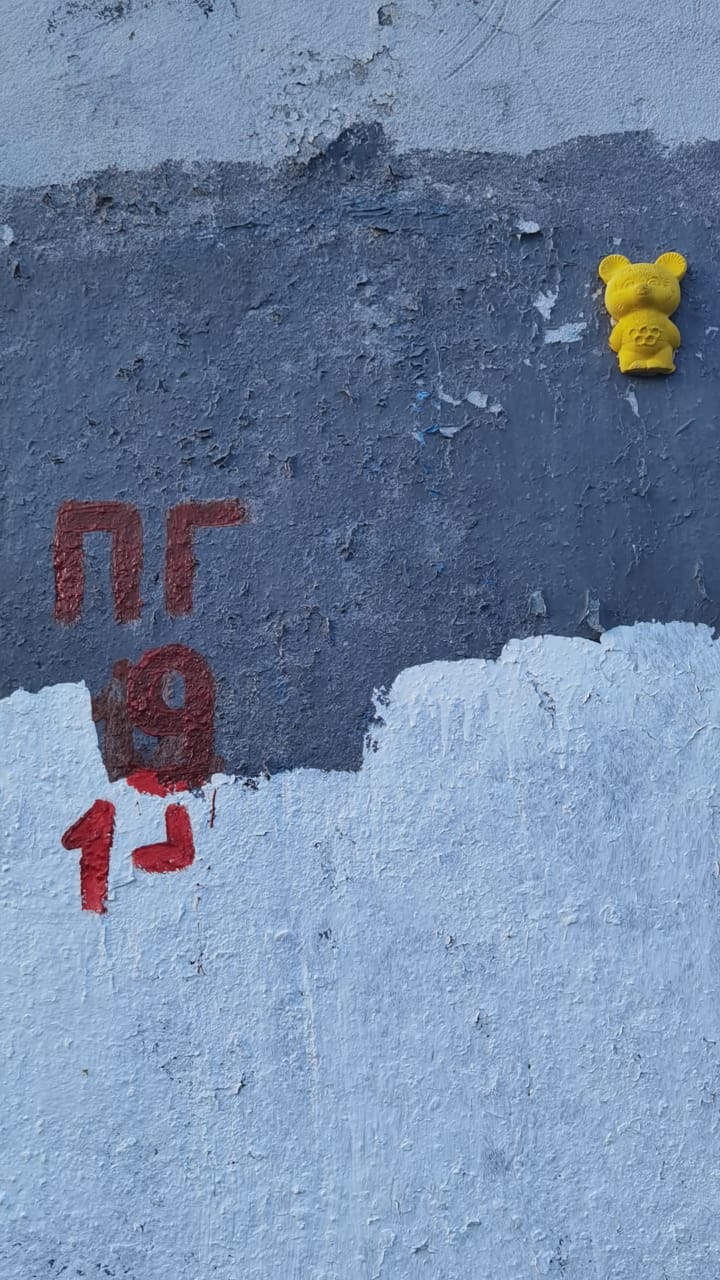
A Moscow wall

This is a follow-up post to my complaints about some ‘eyewitness’ testimony on what’s going on in Russia.

Russia.Post invited me to write up my thoughts and the original was kindly published by them a few days ago here.

What do Russians really want? It seems that the less in-depth interviewing is carried out with Russians, the firmer people’s opinions get about them. As with many sources of animus, whether Trump voters, Brexit supporters, ‘the Russian public’ is now an object of sociological reductionism to an absurd degree. It goes like this: ‘sure there are some antiwar Russians, but the majority are if not active supporters, then callously passive supporters of Putin’. The next step is this: if the majority are deplorables, we don’t need to inquire any further. We can write them off and feel both intellectual and emotional satisfaction. Some things are just bad. Or like Hilary Clinton mused aloud in a recent interview: the best we can hope for is a ‘formal deprogramming of the cult members’ (CNN interview 6 October 2023).

So why should be care about what Russians think? In a recent piece for Russia.Post, Karine Clément posed the problem well: Putin and the West agree on one thing, the irrelevance of the Russian people – ‘infinitely manipulable, cannon fodder’. While we might not agree with her that people power will end the war, two things are certain: the war will end, and Russian society in many ways will not change so much. Inquiring into what social mechanisms end up sorting them into groups with sometimes distinct characteristics such as those who willingly choose to fight and those who actively resist is surely important. Especially if we want to gauge the chances for the recovery of a post-war society.

Of course, that too is a simplification. In reality scholars and observers alike should be reflecting on the ever shifting and quite diverse currents in Russian society which remains as diverse as any other. Russian Field and the Public Sociology Lab have made impressive strides in showing how stratified and ‘divided’ Russian society is in relation to the war. On the basis of interviews, they highlight differences based on geography, income, education and professional identity. In my own ethnographic research, I trace all kinds of dispositions towards the government and towards the war on Ukraine. Without interrogating complexity we can only offer simplistic answers which will then end up disappointing us, and policy communities too. But the fact is, these kind of interpretative approaches get little traction in the wider scholarly and media spheres. People prefer to look at opinion polling data from organizations like Levada, despite the many valid methodological and other criticisms leveled at them.

The broad dissemination of polling data indicating support for the war does not exist in a vacuum. In the Western press polling data is inevitably accompanied by academic or other commentary which reinforces the validity of such data, without any attempt to educate the reader about epistemological limitations. And Levada itself is often careful to curate its own polls in the media – as Lev Gudkov did for this important poll in January 2023 in an interview with Spiegel International. He chose to press home his interpretation of mass moral nihilism among Russians, while his poll actually provided startling evidence of a deeply morally divided populace.

Furthermore, in an insidious way, polling results gain spectacular power in concert with two deeply flawed phenomena: the vox pop from Russia and the ‘cultural’ history piece. I’ll deal with the latter first. Time after time broadsheet media have rolled out their favourite columnists to hold forth on the violent or slavish nature of the Russia soul. They might put a scholarly historically-determinist veneer on it. But let’s be clear that it is not analysis and would not pass a smell test if we (in the West) were on the receiving end of similar. It is a short trip to imputing almost genetically inherited imperialist mindsets and murderous drives. But the vox pop is what particularly exercises those of us who do long-term field-work based research.

As most journalists have left Russia, those few individuals doing street interviews about the war now gain greater visibility. Just like polling, regardless of the intentions of those doing vox pops they suffer from the same fatal flaws as polling does. Sergei Chernyshov’s first-hand account about life in ‘provincial’ Russia won fulsome praise from many experts for its attempt to shine a light on the effects of the war far away from the cosseted metropolises. He was  writing about his family and the place where he came from.It is not a vox pop, to be sure but it is an example of the ‘Facebookization’ of liberal Russian commentary. In it he drew attention to the money brought back to marginal spaces by Wagner fighters and local people’s pride in such veterans. Chernyshov’s is a welcome reminder of the limited impact of sanctions on ordinary people in far-flung places. But in my reading it suffers from many of the same prejudices, flaws, and misunderstandings that polling and vox pops reproduce. While sympathetic to structural causes of poverty which make a few desperate people join the war effort, Chernyshov is guilty of a common sin when the privileged take the time to enquire into the lifeworlds of society’s least fortunate. He argues that if people are brutalized and poor they give in to the basest of instincts and are fatalistic. Except there’s no real evidence for this generalization, which was in any case subject to strong critique even fifty years ago by sociologists. The anecdotalization of observations about Russian society is of course inevitable given the circumstances, but the vulgarization of knowledge should be resisted by serious observers and social scientists. And indeed, anyone interested in more than simplistic answers to difficult questions.

This isn’t a call to police the borders of inquiry, quite the opposite. I want to draw attention to how much knowledge is produced about Russia from highly situated, we can even say, biased perspectives. This was true before the war and will be true afterwards. So what can we do? Admit that interactions, from polling, through to focus groups and vox pops are highly artificial situations. They are at best refracted forms of knowledge creation. The light produced is bent in the process and can change in intensity and colour depending on the lens the observer is using. Now I’m not saying my own method – long term immersion and ethnographic triangulation – is free of bias. I would freely admit that it took me time to come to terms with those of my informants who clearly do delight in the destruction of Ukraine, however tiny a share they represent. For a better example of careful eye-witness reportage, here is a report from Mother Jones on mobilization.

From around the 1920s, field researchers distinguished themselves from social scientists who sought to ape the natural sciences through applying the principles of positivism. They emphasised that the researcher must first experience what their research subjects experienced before being able to take a more ‘objective’ or ‘detached’ view. This emphasises retaining the context of the social phenomenon under study. As a result, ethnographers tend to relinquish claims to repeatability [‘reliability’]. But they try to overcome this by repeatedly revisiting the field. They go to other field sites to compare results there, and they ‘triangulate’ – cross-checking accounts in the same place, with other external observers, and by observing what people actually do, alongside their speech. The point about going beyond ‘logocentrism’ – focussing too much on talk – is really important. Embedded field researchers may end up with a quite robust level of case study ‘saturation’, have spoken to and observed at length many dozens, if not hundreds of people. And in terms of ‘representativeness’, if not generalizability, their findings might be more valid than those of other methods.

Reflecting on what that means in the context of Russia’s war, I keep returning to the roots of Cold War knowledge production and even earlier scholarship about ‘the enemy’. History shows that some of the most highly influential studies led to deeply flawed and counterproductive ideas which then influenced not only policy but the wider society in which they were produced. Two famous examples are Ruth Benedict’s The Chrysanthemum and the Sword: Patterns of Japanese Culture (first published in 1946 it proposed that Japanese have no concept of freedom, only conformism and shame) or Margaret Mead’s Swaddling Hypothesis (published in 1951, it suggested that Russians are hateful yet dependent on external authority because they are tightly bound in bedclothes as infants). We should seek to resist the mysterious power of highly refracted takes from whatever source.

The parallels are ominous. Benedict ended up imputing ruling class ideology (refracted through newspapers) to the whole of society. She relied on one informant without reflecting on the highly specific circumstances of that person’s life. Like Benedict, Mead had access only to narrow or biased sources of information. In both cases neither had access to the actual country they were researching. I wish I could offer a more satisfying conclusion, but without acknowledging complexity and accounting more for biases, we will end up repeating the mistakes of the past. This will help neither Ukrainians nor Russians. And will leave our understanding impoverished and faulty. The best work we have on Russian publics shows strong centrifugal tendencies despite desires for social consolidation. Ideological or ‘hegemonic’ explanations fall flat in the face of evidence of a lack understanding about the reasons for the war. Further military mobilization, if attempted, may provoke even deeper fissures to propagate up to the surface. Prolonged intensity of the conflict will lead to the same, not least because, unlike the impression given in Chernyshov’s piece, ordinary Russians are paying a terrible economic and social price for the invasion, and most importantly, most of them know it.

The Majority Never Had It So Bad

Recruitment poster in the Russian Far East

Russia.Post is an expert journalism platform that has published many interesting and important articles about the war. Sergei Chernyshov recently wrote an article there called ‘The Majority Never Had it So Good’. It’s a shorter English version of this Russian article. Chernyshov gives an ‘eye witness’ account of the beneficiaries of the war in Russia – poor people who got a sudden windfall from participating as soldiers. The article sets up a number of generalizations smuggled in via anecdote: that the underclass is happy at the prospect of fighting and dying for money. Second, that Wagner veterans are everywhere and lording it. A windfall means return soldiers are blowing it all on conspicuous consumption. The veterans feel part of something and are prowar; they are revealed as fascistic. They are somehow so inured to everything they are unreachable. Magically even, the author knows that it is precisely these rural and feckless folk who actually voted for Putin. (Wait, I thought the author lived in a city?)

Chernyshov is billed as a historian, but people are loving this piece because they crave ‘eyewitness’ accounts that confirm their dark prejudices. The war has made us all go a bit mad.

For me there are many problems with this piece which indicate the dangers of how knowledge about the war is framed. Without generalizing, it’s indicative of what might become a trend. High-minded yet misguided liberal people with no real claim to unbiased and socially scientific knowledge make some grand claims. Not only that, but the personalistic ties of Russian journalism via Facebook mean outlandish stuff gets promoted because some very detached emigres in Washington DC see it on their feed. Perhaps unintentionally such people project onto the Western audience their own deep-seated fears and misgivings about Russia. What’s wrong with that? Well, it’s not even good journalism and it’s just plain wrong. I’ve been writing about this for years and it never gets old.

I wouldn’t have bothered writing about it here if I hadn’t encountered broad incredulity when I criticised the piece. Sure, as you, dear reader, know, I’m a bit snarky. But I think in this case it’s entirely justified. I have no doubt in the sincerity of the author. But I do think he lacks the capacity to reflect on how his interpretation of the confused anecdotes reveals more about him, and not any social reality.

But let’s do some quick fact checking. A very small number of people got temporarily a relatively larger amount of cash money than they could earn outside of the war. Not a lot of people. This is why this kind of article is dangerous. First, there are not so many surviving Wagnerites, but the author gives the impression that his Russia is being taken over by militarised thugs. Nothing could be further from the truth. Veterans of any kind are a drop in the ocean – something less than 1% of the working-age population. And that’s a generous calculation, not counting the lots of dead people who stop earning when they come home in a coffin.

And even in ‘provincial’ Russia, not to mention Novosibirsk (?), which the author is writing about, the money is not going to go far. It is ten times a poverty wage. But only ten times. It is somewhere approximately what a good white-collar manager earns in a big city in Russia, or a middle-rank academic in a good Moscow university. The article writes off inflation and other economic effects in a disturbing way: ‘Russians live like animals and so it doesn’t matter to them’ (my paraphrase, but it’s really what he seems to think). Nothing could be further from the truth: absolutely people do know that living standards are precipitously declining because of war, and have been deteriorating for many years. This has political effects, if only the author wasn’t so detached from life to see them.

What is the result of this ‘windfall’ when it comes? Widows and survivors tend to pay of debts (author does mention this, to be fair). If they’re lucky, they tend to buy apartments (or rather put down deposits on them – does the author not know how expensive housing is?). What else is missing? The author doesn’t even seem to realise how socially divisive the war ‘dividend’ is. How many, if not the majority of working-class Russians look very askance, if not with derision on the people the author sees as the ‘majority’.

Next up, the ‘sociological’ thesis of the piece is this: Russians always lived in poverty so thinking that material privation from sanctions will change things is naïve. They are inward looking and prone to swearing and shouting. This is the ‘two-thirds’ of Russians the author mentions. Neat, huh? Sounds like a basket of deplorables to me. Now, I’m with the author when he draws attention to socio-economic despair. This is absolutely the biggest problem in Russia today. But he falls completely for a kind of ‘cultural essentialization of poverty’, a sociological idea debunked in the 1970s, but somehow allowed in the case of Russia. Orientalizing, isn’t it? To be fair to the author, he does mention how it is the regime which stole all the cash, but to him, these lumpen don’t really care. I would say even that the piece veers pretty close to a racialized view of the subjects the author so obviously fears and loathes.

The other tone of the piece is about soldiers embracing neoimperialism and militarism. The underclass prone to violence and crime are living their dreams. Where is the evidence? It is one thing to say the war selects the people with fewer social ties and those with little to lose. But this piece would be laughed out of town if it were suggested as explanatory of a ‘veteran mindset’ in any other societies with aggressive foreign policy.  Let’s just say a piece like this could not, for good reasons, be written about US service-personnel. And need I remind, the vast majority of people in Russia fighting are from all walks of life, not from prisons. And they fight for many different reasons because they feel powerless, because of social sanctions, and, yes, to overcome a sense of powerlessness. Oh, and by the way, any serious piece employing the word ‘mindset’ in the first sentence like this one does, should set off all kinds of alarm bells. (Admittedly that’s the editor’s frame).

The purpose of the piece seems to be to say that there are ‘winners’ and that they are a desperate lot. And that perhaps Putin can buy these bad people off. Some people who commented said it was a wake up to those who thought war fatigue had set in, and that sanctions had started to wake people up in Russia. The ‘military Keynesianism’ argument has been bandied about without much evidence about effects on real incomes at the aggregate level. In short, the impact on incomes of ramping up weapons production and mobilization is small because capacity is small and demography in crisis. The ‘negative shock’ to the economy as Nick Trickett call it, including to all Russians’ income apart from a tiny number, is real and highly palpable.

Even more surprising to me, some colleagues whom I respect, wrote that it seemed to show support for war aligns with being less affluent. The evidence we have says that there’s a strong correlation with war support and being comfortably off. Whether it is polling, or ethnographic work like my own the people precisely least enthusiastic for the war are the socio-economically vulnerable of working age.

Finally, the tabloid framing doesn’t help ‘The Majority Never Had it So Good’. What does that even mean? The accompanying picture is typical ‘ruin porn’ – a depressing yard with some déclassé types drinking. It this the majority? Hardly.  

This piece and the response to it frightens me. It makes me think that we are already entering a Cold War 2.0 space for social science. The reason articles like this are published is because actual Russian sociologists and anthropologists are in exile, or cannot safely counter such caricatured and distorting pictures for fear of repression. Furthermore the academic boycott of Russia means there are no ways for the professional remaining scientists in Russia to speak out either. The ground is then left to people who are not professional scientists but who are in a precarious or desperate position and choose for unknown reasons to write this kind of thing. We should sympathize with them, but not take his emotive impressions as sociologically representative. In the first Cold War emigres and dissidents often gave an equally distorted impression of life in the Soviet Union. Even giants like Solzhenitsyn were obviously politically motivated to present a particular version of reality, even as they told themselves they served a higher truth. In some senses things are different – we have access to lots and lots of Russians and some still can travel. But we should not lose sight of the fact that they, by and large, represent a much more coherent and real class (an educated metropolitan upper-middle class, in fact) than the mythical one the author describes. And with them they bring a particular set of class interests and phobias.

Putin’s true revenge: that the regime prefers to fight itself than confront failure

[this is a longer version of a piece I wrote for openDemocracy]

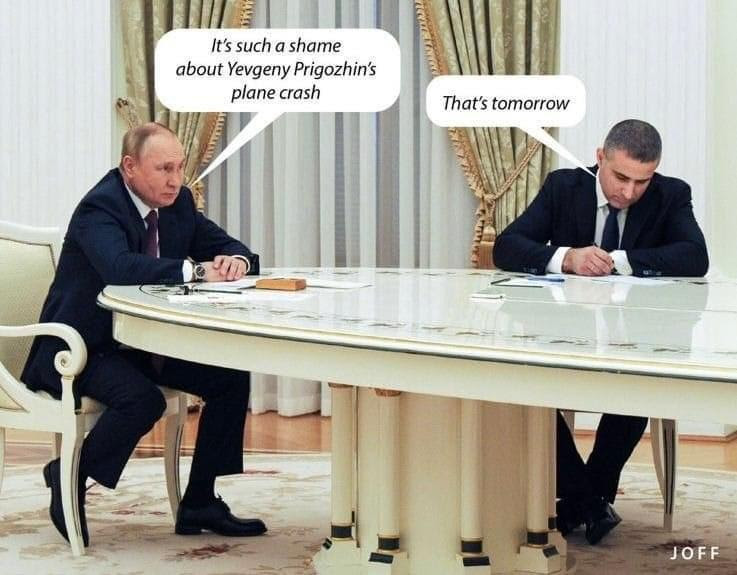
I was one of few observers who thought the fallout over Prigozhin’s ‘mutiny’ in June 2023 might take a while to occur. I guess I was half right. Many seem surprised it took so long for the consequences of Prigozhin’s march on Moscow to catch up with him. Others immediately focused on the implications for the Ukraine conflict: that his demise proved that it had been worth Ukraine fighting for every inch of Bakhmut, or that his violent death showed that agreements with Putin are futile. Like one of the most carefully balanced observers, political sociologist Samuel Greene, I think these takes largely miss the point. And like him, I think ‘unresolvable whodunits’ are fruitless. Instead, ‘we should be focusing on understanding how the story develops within Russia itself, how people understand and interpret it, and what they do with those understandings and interpretations’, Greene comments.

As with any violent event in fraught circumstances, some will look for the simplest explanation while others will entertain elaborate conspiracy theories. The point is that every person’s preference for interpretation reveals a lot about how they view the conduct of the war and the effectiveness of the state. But for me, the main take aways are the increasing fractious state of Russia’s internal politics and the usefulness to quite different people (to Putin, to the FSB, to Ukraine) of the ambiguity over the sources and reasons for violence. And indeed, that is the meaning of Prigozhin’s death, just as that was the meaning of his march: inter-elite ‘political communication’ by violent means – as I wrote in June for Open Democracy and discussed in more detail here. Communication doesn’t have to be unambiguous: sometimes its advantageous to let others unpack the message, or read more into it than was there in the first place.

So, Greene’s points are useful to jump off into a few reminders. The fact that prominent political figures who are a potential threat to the stability of the regime are killed should not lead to simplistic arguments about ensuing anarchy, or a break down in the rule of law. And it doesn’t mean ordinary Russians are just passive bystanders. They also will act based on their different interpretations of Prigozhin’s death. Experts on the Russian security services, courts and police have long noted – not the inconsistency in the ‘monopoly on violence’ exercised by the state – but how messiness serves political and material ends. So, of relevance is the obvious point that the shocking death of Prigozhin serves disseminate broadly the message that the regime does not like the communication it received in June – regardless of whether it carried out the assassination or not. Prigozhin said what no one else inside Russia dared say: that the war has been waged incompetently and unjustly to Russians themselves (let alone Ukrainians), and that the reasons for it were entirely bogus. This, it turns out, was the message from Prigozhin that couldn’t be stomached, but the question of by whom is not so important. Searching for which part of the ‘regime’ responded and trying to trace a chain of decisions back to Putin is fruitless.

This is because decision making in the Russian regime is never linear or clear. An unfortunate effect of scholars and journalists who propose that Russia is a ‘mafia state’ is the image this conjures about a ‘boss’ handing out the tasks of enforcement to his capos. That the military and other security agencies had it in for Prigozhin is neither here nor there. That Putin may have felt personally threatened like never before is also no reason to trace immediate and direct causes back to the Kremlin. The point is that there’s no necessary proximal cause or even a specific ‘order’ to get rid of him, just that his death expresses the immovable violence of the state when the regime, as a paradoxically fractured totality, faces the truth. In other words, Prigozhin had to be put out of the way. But this could have been done in any one of a dozen ways, including by him leaving to exile. Assassination was never a certainty until perhaps the last moment. It was never inevitable. The point is that political communication in Russia, even violence, is ambiguous and contingent – one event does not inevitably lead to another. A possible alternate reality: Let’s say Prigozhin’s plane was destroyed without him in it. The ‘message’ would still be received. Prigozhin goes to live in his beloved Africa, or perhaps Switzerland, which has been perfectly happy to continue to host the relatives of war criminals with dual Russian and European passports. He becomes an effective podcaster on the war and makes lots of money that way. More outlandish variants are also possible to imagine.  And on contingency, the fate of Prigozhin reminds us that while we think of Putin and Putinism as inevitable, they too were the result of chance shuffling in the elite in the dog days of the 1990s. By a recent account, the domestic terrorism in Russia in 1999 which many thought were orchestrated by the FSB, were in fact an attempt to delay elections, declare a state of emergency and prolong Yeltsin’s rule. This might sound outlandish, but it is a good example of how many events from the last 25 years are still pretty opaque to us.

Many people have motives to carry out extreme acts like the killing of Prigozhin, and it turns out that many have also the means. This means, instead of looking to conspiracy theories, we should just remain open to new evidence. Only a year ago almost everyone thought the US or Russia had bombed the Nord Stream near Bornholm. In Denmark fingers were pointed at Russia and but according to German sources it now looks like Ukrainian secret services were responsible. Here too we should not underestimate their increasing effectiveness at carrying out covert and violence actions in Russia. Recent drone strikes on military and other infrastructure in Russia were likely only possible because of Ukrainian covert presence in Russia itself. The strike on a military airbase far north of Ukraine was particularly spectacular.

To return to the Prigozhin case, there is plenty of ‘agency’ outside the Kremlin’s gates to carry out sophisticated and targeted actions. And while people think of the Russian ‘deep state’ as hierarchical and focussed on continuity and loyalty, agencies are well known to pursue their own interests – even to the point of engaging in gun battles with rivals. In short, many actions are possible which are in the narrow interests of an organization (including protecting the sources of corrupt money), but which many be politically justified to higher-ups as carried out in the service of the state. ‘My service to the state is what I justify to myself as actions for the state’, could be the slogan of many a self-described patriot in epaulets. Once again, the absence of a monopoly on violence, or loose rule of law is because they serve themselves and the state at the same time. This is true at all levels. The lowly district Prosecutor sends the boys round to the local factory to pressgang workers into the army because she wants to hit a quota but also extract bribes. The FSB lieutenant in the provinces angles for a promotion to Moscow and that is why he’s on the lookout for an antiwar activist to arrest. The military intelligence colonel ensconced in disturbingly quiet Moscow offices ponders how to get one over on a competing agency by staging a ‘provokatsia’ (a false flag operation) of some kind by pro-Ukraine actors who do not know they are in the pay of the state.

Putin could not rely on a coherent response from security agencies in June. There are indications that agencies were in disarray, and most actions to counter the march were undertaken by regional authorities and even local people – such as those commandeering diggers to block highways. It is perfectly understandable that the state now is in a mode of chasing its own tail. Agencies in a crisis are meant to communicate and work with each other in an emergency, especially a security one. But Putin’s way of governing has been to encourage agencies to hinder each other and undermine each other while paying lip service to how technocratically effective the state it. This was very visible when it became clear how few specific elements of the security services were willing to get ready to defend Moscow using their weapons. As I’ve written many times, on the basis of my research, Russia’s state is as incoherent internally as it is purposive and effective. The war from the Russian perspective maps on to this – in unpredictable aspects (defence in depth in Zaporozhia region, use of mines and artillery) Russia has outperformed expectations, but in others it remains woefully behind (the armed forces still cannot supply basic equipment to new troops, leadership and training almost zero). Let us not forget the real lack of predictive power displayed by almost all experts and observers – even if they got lucky once (like me in predicting that Prigozhin would not precipitate a bloody showdown in Moscow). Or unlucky (like most people I didn’t think an invasion likely).

Since the war began, observers have imputed feelings and desires to Russians without much evidence: whether it was the view that their bloodlust was easily stoked by promises of a lightening victory and glory in Kyiv, or that sanctions would quickly break the spell, or that faced with a united Western front Russians would rally round the flag and stick with the devil they know. I early on tried to tread a path to a more sociologically balanced perspective. After initial shock and nausea at the hawkish elites mad and rash decision to invade, most people, while privately expressing immense disquiet, neither actively supported nor opposed the war. I used the term ‘defensive consolidation’ to express Russians’ sensitivity to the looming catastrophe and their search for ways to make sense of the senseless. The killing of Prigozhin merely accentuates once more the conflicting centrifugal and centripetal social forces at work: many people are further alienated and indeed disgusted by the elite and what they believe it is capable off, despairing of any material improvement to their precarious economic existence, with scant attention paid to the actual war itself beyond growing fear at the security state and knowledge of the precarious situation at the front.

At the same time, they look for sources of genuine political and social authority and leadership that might look to their immediate and longer-term material interests. These range from a village elder to the Moscow Mayor. The pensioner class and some other groups still think of Putin as their saviour, but support overall has collapsed. Russia’s leading political pundit in exile is the ebullient Ekaterina Schumann.  In a recent public talk in Germany she said that preparations for 2024’s Presidential elections in Russia show widespread dislike for militaristic and jingoistic messaging by candidates. She noted that Western journalists, including Russian émigrés, should wake up to the evidence that the war is unpopular, despite what survey polling appears to show. Already there is widespread criticism of the state benefits promised to the families of service-personnel. For example, in Higher Education, far from increasing spending to accommodate the right of veteran’s children to study in universities, rectors are looking to ordinary students and their families to subsidize these ‘Special Military Operation’ students by charging higher accommodation fees to the non-veteran families. Many elites welcome the way the war seems to help a project of neo-feudal state capital (noting the incongruity of such a hybrid) – with juicy appropriated foreign assets distributed to them in return for loyalty, like Kadyrov’s nephew being gifted Danone’s factories, and Carlsberg’s assets similarly ‘redistributed’.

The regime also tries to link entitlements for ordinary people to loyalty and service in the war. But as the example of university places shows, this is very divisive and unpopular. Furthermore, this is unlikely to substitute for a genuine social ‘deal’ in the face of the severe demographic and economic costs of the war. In any case, people are long used to the state making it as hard as possible to claim entitlements and breaking its promises. 

Political anthropologist Volodia Artiukh, in a recent post, argues that those who see domestic events in Russia as having implications for how we interpret the situation around the war in Ukraine have it the wrong way round: Putin’s international strategy is turning (we could say caving) inward. A kind of boomerang effect is occurring. Martial law and a cowed society in fear, open use of terror, removal of elite figures – these were things Putin intended to happen in Ukraine, not Russia. I similarly wrote a while back that the main logic of this war was revenge of the colonial periphery on the metropole. Donbas and then the whole of Ukraine was meant to keep at arm’s length ‘disturbing’ aspects of authoritarian militarism from the cosseted Russian middle class and even the rest of the country. Instead, every step of the way the ‘Special Military Operation’ has become a term of irony or bitterness because it has brought these things closer to home.

When is a coup not a coup? Or, political communication in the absence of politics

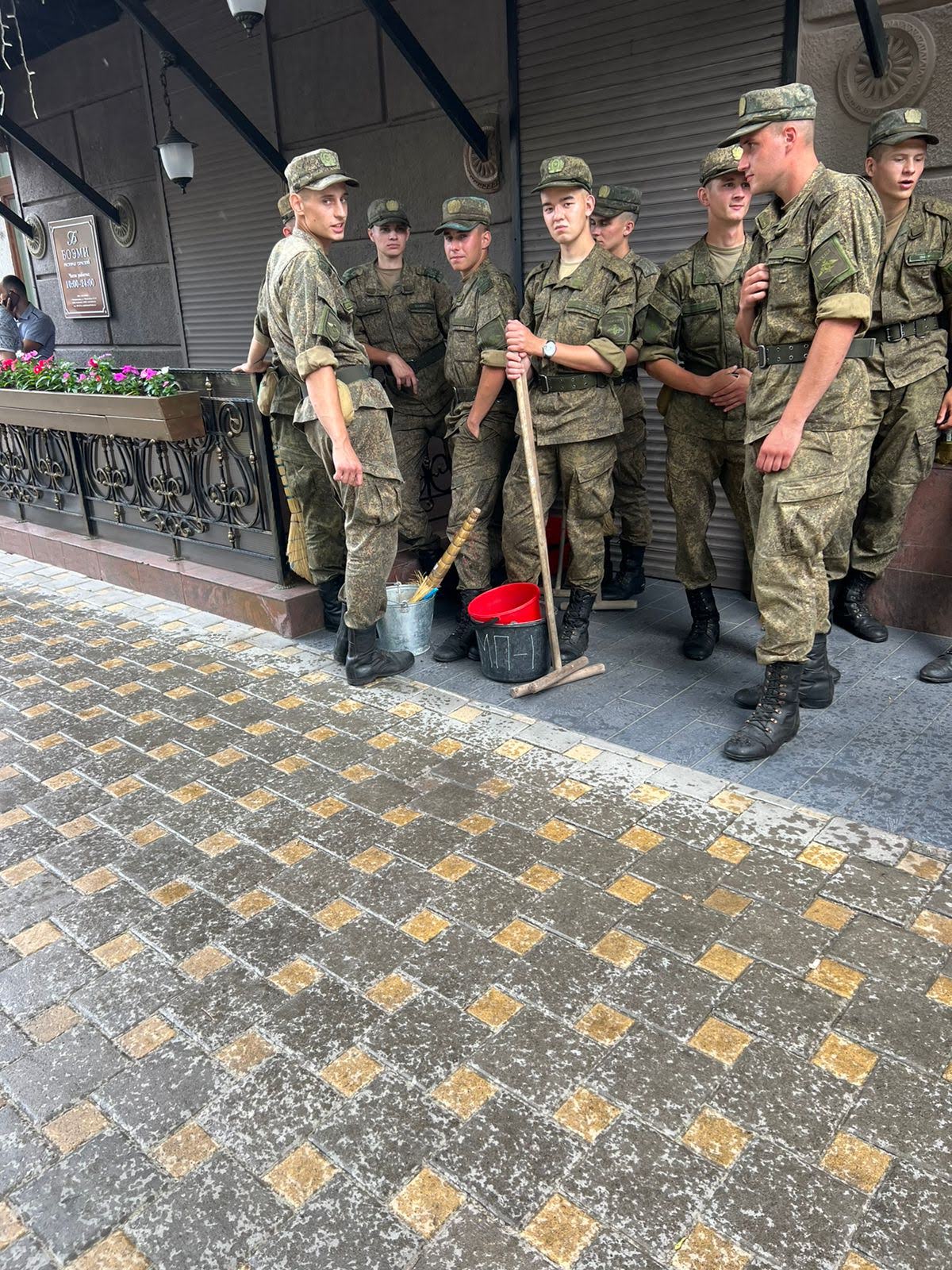
conscripts in Rostov clean up after Wagner has left. June 25, 2023.

I just wrote a piece on the Prigozhin farce for oD [link to article]. There, I talk a little about how frustrated I am with how social media is ‘event captured’ leading to people uncritically echoing grifter takes and no-nothing hacks. I also say a little about how the ‘march of justice’ on Moscow shows how easily we are pushed off balance. People immediately assumed a coup and the collapse of the hyperventilating paper-bag that the Kremlin appears to be at the moment. I am writing in my book right now about how difficult it is to separate the regime as a political constellation of players and interests from the ‘state’. The state is often seen through a rather narrow lens of complete dysfunction, or narrow coercion, or just incompetence and infighting. And sure, all those things are there. In my book I detail many examples of improvised governance that belie a simplistic framing based on notions of ‘state effectiveness’ and ‘state capacity’ – both of which are actually much harder to clearly define than you would think.

Of course there’s a lot going on that is opaque, but on one level Rob Lee best summarised things: this was a ‘factional dispute’ that became a public challenge and which gained a temporary solution (Prigozhin goes into internal exile in Belarus and his motley crew are somehow subordinated to the army). Joshua Yaffa wrote that Putin’s rule rests on cynicism and detachment – hence Yaffa saying that many were sitting on the sidelines. I argued that focussing on factional elite conflicts leads to those aspects overdetermining the picture. In simpler terms, sure, ‘politics in the absence of politics’ matters, but so do institutions, even in Russia. And my gut turned out to be right – institutions of state, in a lacklustre manner, still have a shape and an agency of their own. I pondered whether this was more than just Prigozhin versus Shoigu as a political conflict. In reality it saw the army as an institution ‘win’ in terms of who is running the war. Ultimately this means Putin backtracking on a major decision to dangerously flirt with allowing a suspension of the idea that the state is the only legitimate monopoly on violence. And I noted that this is entirely of a piece with Russian history – with the army as a trusted institution that balances between extremes. This seems perverse. People don’t trust their kids to the army because it is corrupt and brutal. But they do trust it as an institution because, as we saw in Gorbachev and Yeltsin’s time, it correctly perceived which faction had broad legitimacy. Under Putin the promises of genuine military reform gave way to more cronyism and corruption. The army is a shadow of its former self under Shoigu which should give more than pause for thought about the nature of his political identity. Despite that, it’s remarkable how little attention is paid to the army as a genuine institution with its own identity, history, and preferences. It still is a world apart from the security services. And by ‘institution’, I am mainly talking about how many rules, shared-assumptions and agreements persist and reproduce themselves informally within the shell of the formal institution – a state of affairs that needs much more attention in all social science on the Russian state.

Similarly, it seems we have it all the wrong way around with thinking of Prigozhin as this widely popular populist warlord. Sure, there’s a constituency that would like him as one in a long line of outsider extremists (although he’s consciously playing a part there too). These are, frighteningly, the war supporters – that minority who genuinely believe in a fated and fatal mission. Yesterday though, Prigozhin was little more than a chthonic Karen, driven to shooting down some defenceless aircraft and bleating at two extremely experienced and integrated elite military figures that they were ‘dissing’ him. He was, by the way, armed and in his usual cosplay fatigues, while they, not needing to try to appear something they were not, were in loose military office attire, disarmed, but merely mildly discombobulated and a bit embarrassed. For me this showed that Prigozhin remains that wannabe capo not quite in the mob. He’s carried out a series of murders and the boss smiles at him from time to time, but he’ll never be a made man, let alone sit in the poker game with them. And these, rather non-descript military men knew that, even as he made a theatrical flourish of holding a gun to their heads. Prigozhin is a buttonman and a bagman needed for the emergency stage in the war, but probably no longer. And while he verbalized his Karen complaint to the authorities, because he can’t get through to the boss, he really understood the writing on the wall and quickly acceded to the offer of internal exile. No one will forget he was just a petty crook and hotdog seller, stirring up mustard in his mother’s apartment.

We know that the army did not want this war. We know that before the war less than 10% had any enthusiasm for military action, let alone invasion. We know that the war is at best seen as a massive challenge by the military. At worst it’s privately acknowledged as a mistake and even a disaster. The regime insists, but the state persists. This of course is highly disturbing to the vocal Anglophone war bros, hence the enthusiasm among them for a coup. Short-sighted and highly counterproductive to Ukrainian interests, that outcome was never likely. Even now, looking at this as weakening the regime is misplaced. It might hasten the departure of Putin himself, but that may not change very much at all.  This was the classic Russian bunt [mutiny], or miatezh [insurrection]; spectacular (but not necessarily extensive) violence as a form of political communication. As a ‘complaint to the authorities’ in a land where politics has to take place without Politics. Everyone knows they up-there are largely indifferent, but there is always a dirty protest one can make and who knows, it might have an effect.

If Prigozhin served as the Chthonic Karen, the war machine nomad who wants to undo the state to keep on moving through smooth space and break all the rules, then what is the regime? The Chthonic flip-flopper who doesn’t really know what to do but knows it wants to survive? Meanwhile the real plasticity and improvisation is observed in the institutions of state – they have their own agendas, their own interests in continuing the charade. They see that Prigozhin type figures are a threat to the continuous state-formation, its sedimentation – as Deleuze and Guattari characterise it. And what about the people waiting for selfies with the main character of the hour? Observers mistakenly seemed to think there was broad support for a potential populist replacement for Putin. On the contrary, there’s little enthusiasm for Prigozhin. Here again we have a great example of the problem of online punditry and social media analysis. There were scenes of jubilation and the greeting of Wagnerites, but others with local knowledge tell a more convincing story – of widespread fear and the understanding that Rostov was now ‘hostage’. But there was a kind of ecstatic discharge of tension, as it became clear that Rostovians were not going to have to share the fate of Mariuopolitans. After all, Russians are well aware of what their state is capable of. Whether it acts coherently or not.    

Remember kids – Russians are just bad. How do I know? Freud told me. Or: A guide to make sure the Guardian will never, ever publish you

Me on my way home, pondering the deep insights of the latest Pomerantsev piece

Peter Pomerantsev wrote a piece in the Observer (Guardian) about Russia and Russians. As readers will know, this kind of thing triggers me.

Here’s some things he wrote. He starts with some incisive and original political analysis:

“The Kremlin [is] like a loser smearing their faeces over life.”

“senselessness seems to be the sense”

“To Russian genocide add ecocide”

Then he quickly moves on to historical destiny:

“Russia is [not] driven by some theory of rational choice – century after century the opposite appears to be the case.”

“Few have captured the Russian cycle of self-destruction and the destruction”

Citing Tetyana Ogarkova and Volodymyr Yermolenko [yes, that guy who deleted an infamous tweet on how Russians are the new Asiatic hordes that Ukraine defends Europe against], Pomerantsev talks about

“Russia [as] a culture where you have crime without punishment, and punishment without crime”… “while Nazis had some rules about who they punished (non-Aryans; communists) in Stalin’s terror anyone could be a victim at any moment. Random violence runs through Russian history.”

Maybe someone should remind Peter that this kind of speech is considered by many to be Holocaust trivialization and a gateway drug to antisemitism.

After a left-field lurch into psychoanalysis of the death drive (Did the author pinch this from Etkind? He doesn’t appear to really understand it), he writes:

“In a culture such as Russia’s, where avoiding facing up to the dark past with all its complex webs of guilt and responsibility is commonplace, such oblivion can be especially seductive.”

The author ends on the confident note:

“Pushing the strange lure of death, oblivion and just giving up is the Russian gambit.”

***

The Observer asks people to send comments to their op-eds. I wrote one and sent it off immediately, but curiously, for this piece there are no published comments. By contrast, a piece about Elizabeth Gilbert pulling her novel set in Siberia garnered 150 published comments almost immediately.

I won’t bore you with my short unpublished response as anyone reading my blog would already know what I would say. Instead here are some comments from Twitter accounts:

“Alright, since everyone is commenting on it one way or another… I suppose yesterday was the day of the week when The Observer publishes some Nazi apologetics. To say that, at least, “Nazis had some rules about whom they punished” is a woeful thing to write.” [Legal Scholar]

“This exercise in psychoanalytical cultural relativism is a gift to the Kremlin. By locating the origins of Putin’s genocidal war in Russian culture and history, it exonerates the leaders who ordered it and the security forces and mercenaries that implemented it. 1/6” [renown scholar of nationalism, sanctioned by Russian government]

“it’s understandable why some Ukrainians would react to the invasion by lashing out with cultural essentialism, but less understandable why the guardian would endorse it”[anon account]

“Russians worship death, Russians hate life, etc. This stuff has been written about Palestinians & Arabs more generally since the 60s. It’s racist dehumanisation. In the case of its original targets it said everything about the authors of this propaganda than those targeted by it.” [anon account]

“Maybe I’m being unreasonable here but I really think that “Russians have a culturally innate psychosexual death urge” isn’t the sort of thing that ought to be acceptable to say in the pages of mainstream newspapers” [anon account]

“stupid icing on a stupid cake.” [anon account – specifically about Pomerantsev’s grasp of Russian literature]

Of course, most responses were not like this. They were fulsome praise. Often from respected academics and journalists.

***

Anyway, today we observed what is surely now the bandwagon effect. Czech president Petr Pavel citing US concentration camps for ethnically-Japanese US citizens during WWII as good practice applicable to Russians residing in the EU today.

Maybe I’m completely jaded, but I do think this could happen. Not for political reasons (there is no public ‘demand’, nor law-enforcement logic), but because it would be a great new post-Covid scam for siphoning money to cronies (the PPE scandal in UK): a new frontier for the carceral state-capital matrix.

Channeling the Testimony of John L. DeWitt, April 13, 1943, House Naval Affairs Subcommittee to Investigate Congested Areas, who almost said: “I don’t want any of them here. They are dangerous elements. Their loyalty is in doubt… It makes no difference whether they’re citizens, a Russian is a Russian. Citizenship does not determine loyalty… We must worry about the Russian until he is wiped off the map.”

At a stroke all our Brexit problems would disappear. Make them pick strawberries for example. “Many Japanese detainees were temporarily released from their camps – for instance, to harvest Western beet crops – to address this wartime labor shortage”. Later on, we could even use it to address the cost of living crisis. Sponsor a Russian and get extra Nectar points: “Eventually, some were authorized to return to their hometowns in the exclusion zone under supervision of a sponsoring American family”

However, we now know, thanks to the progressive press, that Russians are psychoanalytically predisposed to morbid feelings and a tendency to ‘sink back into inorganic matter’ (thanks, Peter). Therefore they should be paired carefully to suitable locales. Perhaps the Fens and Norfolk? In WWII it was the Isle of Man. After all, the Russians are likely to be more or less ‘normal for Norfolk’.

Nonetheless this being UK/EU we should also make this process as bureaucratically painful and opaque as possible. Therefore instead of WWII’s three categories of Enemy Alien, we should have at least 7. Category A, privatized prison; B, tagged at own cost ; C, exempt on basis of writing for the Guardian; D, fruit and veg pickers; E, Bexhill-on-Sea internment (Alfonso Cuarón scheme); F, Dancing on Ice posted worker; G, Normal for Norfolk scheme.

Once more, all this will increase GDP and help struggling companies like Capita – not content with hounding disabled people to their death – could be contracted to do the RIP assessments. Russian Ideal Person assessment. Just like in 1940, I’m sure the very smart people who write those clever columns at the Observer, who write about the ‘seduction of oblivion in Russian culture’, will sail through such assessments.

Although there remains the tricky topic of racial purity laws. Like that pioneer, the government of Germany in the 1930s, we need a judicial body to work out where to draw the line – 1/16 Russian, like in the US? Or only 3/8 “Mischling ersten Grades”? Again, I foresee a new legal industry. We could even get a bright young legal mind to come up with this: “A mixed-race child originating from forbidden extramarital sexual intercourse with a Russian that is born out of wedlock after 31 July 2025 will be classified as a Russian.”

But, before you object, no, I’m not trivializing the Holocaust because I’m making comparisons which the Guardian says are ok! “while Nazis had some rules* about who they punished (non-Aryans; communists) in Stalin’s terror anyone could be a victim at any moment.”

*patently and pretty disgustingly wrong

Russia’s victoryless day

Antiwar sticker, Moscow

I was fortunate to be asked to write a piece for openDemocracy about Russia, one year after the invasion of Ukraine.

https://www.opendemocracy.net/en/odr/russia-ukraine-war-misconceptions-victory-day/

In the piece I talk about four ‘misconceptions’ about Russian society. I won’t repeat the full piece here. And really they’re not quite misconceptions, more assumptions that get wide coverage online and in the media. The first is passive and active war approval. I’ve written about this often.

Second, I question the simplistic views about mobilization as a ‘success’ and about how people relate to it. I presented on this topic at a conference in Glasgow last month. That paper will serve as material for two book chapters I’m working on now.

Third, I saw some pieces about how there’s a new economic compact between Putin and the people. And even a long post about how the government has bought off Russians. I disagree. Anyone reading this blog will remember I frequently write about the parlous economic situation. War hasn’t changed that. We’re fortunate that Nick B-T is posting again. My piece relied on some of his recent political economy writings.

Fourth, general war salience is low. This is hard to write about. People cannot imagine the way others’ filter information and media – that’s why ‘connective ethnography’ is a thing – actually observing how people use the internet! War is both normalized out of mind, at the same time it is ever present. If I want to say anything in this piece is that dissociation is a ‘normal’ part of normalizing war. Once again, its an unpalatable message, but it’s important to be honest about it. And really, dissociation is something we all do, all the time – when we walk past homeless people, when we watch the news.

Having said that, when forced to confront the bigger picture, some people continue to consolidate ‘defensively’ around feelings (not really coherent ideas) that justify or explain the invasion and which allow them to continue their lives in as mundane a way as possible – that it’s the West who is the aggressor, or that Ukrainians are dupes of their ‘fascist regime’. Some of these feelings are based on internally-coherent reasoning, others are not. Once again, my main point is that defensiveness is ‘sticky’. Just like everyone is liable to prejudice, most people are subject to irrational defensiveness of their homeland, their world-views, their way of life. This is not the same thing as ‘imperialmindedness’, although it correlate or cohabite with it. I discuss this briefly in the piece, and at at length in the book.

[Hi publishers out there, it would be great to hear from you!]

+++

Before the war started, I spent time trying to answer the question of how war would change Russia. My hunch was ‘the same, but worse’. As a researcher I continually ask that question, both of myself and my many interlocutors (obligatory doffing of cap to the work of Public Sociology Lab who do similar, but distinct forms of fieldwork). I am a researcher with long-term contacts from all walks of life who can get credible responses and avoid many, if not all biases those studying Russia are unavoidably subject to.*

My job as an ethnographer is to observe, record, and interpret, hopefully seeing through people’s guile and denial. This applies to perspectives in the West too, where often we have as many biases as those in Russia. I don’t pretend to complete objectivity, but I do have confidence in my sources and in the parlance of social science, their ‘reliability’ and ‘validity’. So much of what we see about the war is filtered heavily. What we see among ‘Russia watchers’ is almost always ‘secondary’ data, manipulated, whether consciously or unconsciously – this is true of surveys, focus groups, and social media research. 

*Unusually, oD allowed me to include a word on methodology in the piece. The more I write about Russians in wartime (and my view is not exactly controversial among scholars), the more pushback I get – often on methods. I keep coming back to this very old but gold piece on the reliability, validity and credibility of ethnographic research – what it does and does not do. It’s hard to have a conversation with other approaches when so often ethnographers are dismissed as using ‘journalistic’ methods. When it comes to validity of research in wartime, there’s a decent argument to say embedded ethnography has more going for it than any other way of getting to people’s feelings and opinions.

Cultural Production as Activism: National Theaters, Philharmonics, and Cultural Organizations in Russia’s Regional Capitals

Kazan’s Day of Slavic Writing celebration on the steps of the Kamal Tatar State Academic Theater, which puts on performances in Tatar and other languages. (May 24, 2014)

Guest post by Katie Stewart

In Varieties of Russian Activism, my chapter starts off the section on “The Building Blocks of Everyday Activism: Identity, Networks, and Social Trust.” Cultural spaces and events like national theaters and concerts, can serve as ideal spaces for fostering these building blocks. As the Russian political space for electoral politics and protesting closes, the cultural sphere remains a viable space for activism, especially concerning politics related to language and identity. Although government engagement with and management of cultural activity has been increasing, such as through the 2022 executive order on the “preservation and strengthening of traditional Russian spiritual and moral values” and the ensuing creation of Cultural Front of Russia divisions in Russia’s regions, it is not possible to entirely shut down the use of culture for alternative identity and political community building. Doing so would delegitimize the use of these venues and cultural forms for pro-regime activity.

In the chapter, I examine how regime supporters and anti-regime activists both utilize these cultural spaces in the capital cities of three of Russia’s ethnic republics, Karelia, Tatarstan, and Buryatia. Like that of many other authors in this book, this work contributes to the decentering of Moscow and the Kremlin in our approach to understanding Russian politics. People experience politics, and especially policies and activities aimed at nation-building, close to home. My comparative regional approach examines variation and similarities in how people engage with national theaters, concert halls, and other venues using observations from fieldwork and interviews conducted in 2014 and 2015-2016.

Some of the venues and activities I examine are connected to Soviet-era legacies. For example, the regional capitals, Petrozavodsk, Kazan, and Ulan-Ude, each have national theaters that were utilized in the early 20th century to promote regional language and culture as a means for bringing people across the USSR into the socialist project. Today, these theaters still receive government funding and support to put on plays and other activities in minority languages. When people come together to watch a play in the Karelian, Tatar, or Buryat language, they are supporting those languages at a time when their promotion is challenged through restrictive educational policies and clamp downs on language activist protest (see Guzel Yusupova’s contribution to this volume). While this activity does fall within the boundaries of permissible engagement with minority languages set by the government, it can still provide opportunities for those “building blocks of everyday activism” to form.

Cultural activities can serve multiple purposes that are both activism in their own right and can provide the foundation for future activism in other forms. First, they can promote and construct an identity linked to the particular language, dance form, composer, etc. featured at the event. Minority language learners can use a play for practice, or non-ethnic Russian cultural figures can gain a larger following, for example. Second, they are an opportunity for bonding over a shared experience of that identity, potentially strengthening community ties and revealing preferences. Audience members see others attending, cheering, and showing interest in the same language or topic that may be counter to the pro-regime line. Third, they are sites for Scott’s (1990) infrapolitics, or hidden politics that don’t appear political or threatening to government censors and officials, but that can convey messages intelligible to the opposition, pushing back against centralizing nation-building policies.  

As the government tightens controls on language, culture, and values, it differentiates treatment of cultural activities. Promotion of Karelian language is okay within the bounds of the National Theater of the Republic of Karelia, but its promotion is not permitted through granting it official language status or through Nuori Karjala’s UN funding and engagement with Finnish groups, which resulted in a “foreign agent” label in 2015. Still, even the government funded cultural spaces can be sites for contestation over national identity and language politics. In the chapter, I demonstrate how the degree of this contestation varies across the capital cities and is shaped by regional contexts related to history, international ties, and intergroup relations..