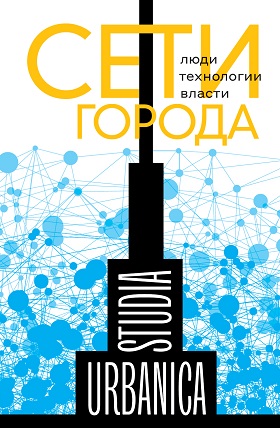
Moscow’s pandemic in the not-so-smart city. Part 1

As I promised, here is the first of four posts that summarise in English the Russian-language chapter Galina Orlova and I wrote for this book. A draft of the chapter in Russian can be downloaded here. This post also picks up the story after the series of posts I wrote last year about Covid in Moscow and Russia.

Сети города: Люди. Технологии. Власти: Под редакцией Екатерины Лапиной-Кратасюк, Оксаны Запорожец, Андрея Возьянова

…In spring 2020 Moscow implemented a ‘regime of heightened readiness’ – a heterogeneous approach to the pandemic which combined partial quarantine (karantin) with self-isolation regimes and targeted state financial support that conformed largely to a neoliberal logic of delegated responsibility.  We also pay attention to the technocratic ‘fix’ attempted which was highly ambitious and at first disastrous.

One aspect worth highlighting is that electronic ‘nadzor’ – ‘surveillance’ was built into the Moscow-city government’s response from the start. Over 65-year-olds’ transport cards were blocked and individual housing blocks were assigned set times for exercise.

At the same time we trace the evolution of Moscow’s Smart City 2030 plan. This plan was fundamentally affected by Covid and the previous version removed from еру web in May 2020 (prompting various characteristic of Covid conspiracy theories). In our book chapter we discuss the glaring disparity between the smart city goals about ‘quality of life’ and the Covid reality, which was about enrolling new agents (human and otherwise) of police control via the smart city. Similarly, the low quality of so-called ‘algorithmic’ solutions was laid bare for all to see. Our chapter is called the ‘not-so-smart city’ in English, which loses the pun of the Russian title – (bez)umnyi gorod: the ‘(de)mented city’. Crazy/mad/demented as a noun is derived from the root word ‘mind’, or ‘clever’.

So how did the Mayoralty change their plan for smartification? If anything they doubled down with the help of the decree signed by the president in June 2020: Moscow becomes an experimental juridical regime where aggregated use of personal data is no longer constrained by law. More prosaic is the full commitment to fully digitize city-citizen services. Of note are experiments with automating 5G cleaning vehicles and – now the stuff of internet memes – ‘smart’ face-recognition door locks to communal entry-ways. Even without drunk old men headbutting HAL-like video-locks that refuse them access to their own homes, the naïve technoutopianism is evident in proposals like those to replace wheelchairs with smart exoskeletons (yes this is a real proposal) in a country whose hostility to the disabled is literally built into urban design.

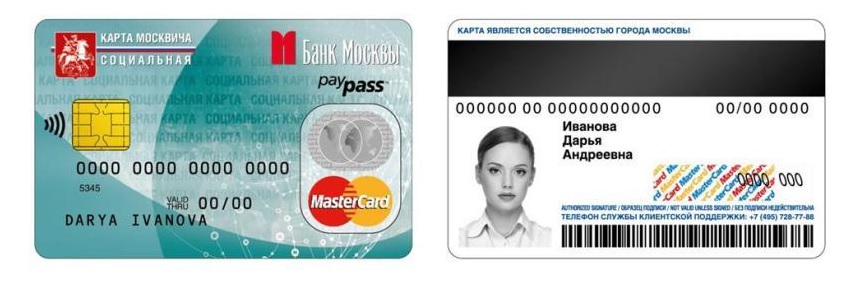
Now, that’s not to say that Moscow isn’t already a leader in smart-city affordances for its exclusive citizenry. There are well developed projects for a single electronic system for doctor’s appointments, school timetabling and public Wi-Fi coverage that put many European and N. American cities to shame. Smart City 2030 is only one of three stages, two of which are already complete. For this stage, the blockchain, AI, and the internet of things are highlighted areas. The Muscovite (Social Services) Card has been around a while (2001). This is a combined bank, travel, cultural services, and medical services plastic contactless chip card. In a city that continues to provide very generous social benefits to large numbers of residents this card is highly valuable. This is evidenced by the city government wanting to making it a criminal offence for a person other than the owner to make use of the card. The card – characteristically – is also vulnerable to hacking, and contains sensitive personal data beyond that which is necessary for its use. In 2018 there were 5 million cards in use.

Annalisa Cocchia has made a systematic literature review of the differences in understanding the use of the words: ‘digital’ and ‘smart’ cities. She finds the latter to focus on a move away from technological determinism and towards decentralization. In practice we can’t really talk about even an ‘actually-existing’ smart city. There are plenty of examples of reality falling far short of rhetoric, from Songdo in Korea, to Toronto in Canada. Nonetheless, Moscow really is a leader – top in the world for carsharing apps, top-10 for internet speed, a UN-recognised leader in electronic services, and top for video surveillance for a city outside China. Characteristic of Moscow is the retention of techno-deterministic aspects and a centralizing logic and this is in contrast to the original ‘electronic Moscow’ plans from the early 2000s. There’s definite echoes detectable in the plan of Soviet ‘atomic powered communist’ technoutopianism (see Josephson 1996). 2030 is envisioned as a ‘city governed by data’, where aggregated biometric data is fed to AI, even via clothing to monitor the habits of its owner that can then be used by insurance companies. Automation of decision makers will obviate the need for citizen involvement. The thing is, there are always real choices to make in which systems to expand: free Wi-Fi, or face-recognition? Access, or Control. Covid accelerates the choice for the latter. Free Wi-Fi hotspots appeared in Moscow in 2012. I well remember getting high-speed free Wi-Fi for a while even in my apartment there! There is free Wi-Fi of varying quality in the Metro and buses. There are over 150,000 security cameras and 175,000 devices feed data to a ‘unified centre’).

In 2020 the Tholons city-rating of ‘smartness’ saw Moscow make massive gains against other world cities. Moscow scored very high, but only thanks to a change in weighting that emphasised digitization over liveability and intellectual development. In our book chapter we ask the question – is Moscow anticipating an ‘anti-humanist’ trend away from smartness as emphasising human development and towards control? Find out in the next post.

Russia’s Covid civil disobedience

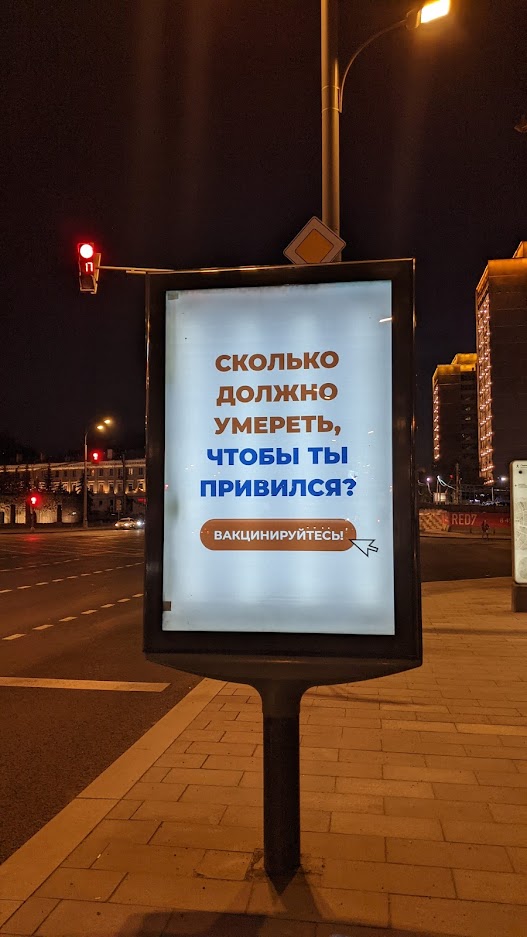
‘How many have to die before you get vaccinated? Vaccinate!’. Central Moscow mid-2021.

Last week, András Tóth-Czifra wrote a nice post summarising the weaknesses of Russia’s emerging digital authoritarianism. I have a lot more to say on that topic next week at a roundtable on a book that is coming out – Networks of the City: People, Technology and Power. [upcoming blogposts will summarise]

In the meantime, András inspired me to revisit the political angle of Covid in Russia. His post looks at the small scale protests against QR codes and the potential for further ‘contagion’, populist moves like those of Bondarenko in Saratov last week, the large trade in fake certificates, etc. I want to come at this with a different take – on what all this tells us about ‘politics from below’ – a recurring theme in these blog posts.

It starts with a provocation. Why aren’t the usual suspects (the cold-warriors 2.0 and democracy bros) celebrating the mass civil disobedience going on in Russia? I mean, sure it’s prolonging mass suffering and death, but it’s not as if they care about that kind of thing. ‘No, no. Not that kind of civil disobedience! Give us more kids on snowy Moscow streets getting beaten in the head. Not your nurses, conniving with people to pour vaccines down the drain.’

Kimberley Brownlee, a legal philosopher, wrote a book in 2012 called Conscience and Conviction, making a case for civil disobedience. However, she takes the perspective of people living in pluralistic democratic states. There are two elements she emphasises – non-evasion and dialogue. A person who has a conscientious moral conviction has to be willing to articulate it to others openly and accept the costs of it. Disobedience needs to be visible in the public sphere to qualify for Brownlee and cannot be ‘evasive’. This is partly based on Rawlsian civility (non-violence, acceptance of consequences, publicity). ‘Conscientious conviction’ is contrasted with conscience as a moral and possibly private quality. Brownlee attempts to recover civil disobedience from stand liberal views that see its costs as not worth bearing and that there is not a moral right to public and ‘communicative’ civil disobedience – witness the current broad rejection of climate protestors in the UK. Their disruption of transport is viewed through a liberal prism as unacceptable and their arrest on criminal charges and lengthy jail sentences justified. Brownlee’s view is that civil disobedience is more conscientious than personal disobedience. She bases this argument on a conception of ‘moral rights’ to engage in constrained communicative breaches of law in defence of causes.

Now this argument might fly in 2012 when her book was published, but even in ‘democratic’ countries we have witnessed the criminalisation of protests and formerly civilly-disobedient actions – notoriously in the UK’s case the proposal to criminalise protests that are a ‘nuisance’. Brownlee says that civil disobedience is about preparing to risk punishment.  Because that in itself is part of the communicative process: that one has moral convictions and commitments. This runs into even more problems in a punitive authoritarian state that uses harsh punishment against even wholly peaceful protest, and even short of that – expressions of dissent, such as the poor souls punished for making posts online in Russia.

***

As Galina Orlova and I argue in our book chapter (I will blog about this in English next week), Russia is rapidly developing a model ‘European’ version of digital authoritarianism and people are resisting it any way they can.  The QR battle is unfolding right before us and may follow the less visible battle – now lost by the government – for vaccination. People will go to extraordinary lengths to resist? So is this not disobedience? Yes, it is. Is it not conscientious? Not in Brownlee’s terms, because it is semi-hidden. But it’s not ‘passive’, and it’s not completely individualized. András is one of few who notes the ‘ideological’ objection to vaccination and QR codes, and shows that people can think of the Covid measures in a wider political context. Even a lot of Russian analysis in Russia cannot grasp this, in a now classic denial of complexity and of the possibility of ‘révoltes logiques’ in ordinary people’s reflection (Jacques Rancière’s term). This article, for example  https://holod.media/2021/11/25/immune-response/ talks about an ‘disproportionate’ enraged protest response and spends a long time linking the Covid protestors with homophobia and the so-called ‘family rights’ movement (about which I’ve written at length here), only at the very end covering the ‘civil society’ angle. (The organisers of the Immune Response protests, call themselves civil society activists). For my part I’d emphasise the not disproportionate rage, but the calculating connective capacities and reflective–affective discontent in Russia that acts as a motor for activating the ‘political’.

Again, I use Rancière’s term: the political is a ‘deviation from the normal order of things’ as a precondition for the appearance of a (political) subject. Unlike András though, I would emphasise the social indignity aspect of the political here, rather than just the civil liberty objections of Russians. Surprisingly, I find support in some unusual places, Ekaterina Shulman’s coverage of Covid has been very good – having herself fallen foul of targeted repression via ‘digital authoritarianism’ last year. Shulman talks about Covid-measures ‘fatigue’, but also disgust and an alarming fall in trust in the president since 2018. She uses other affective terms like ‘alienation’ from the authorities not seen since 1990. She cites the latest ‘Russians’ Fears’ poll, that shows that 58% people are afraid of the ‘lawlessness’ of the state. (The polls also show high levels of fear of ‘a return to repression’ but a more mixed picture for the question: ‘tightening of the political regime’). Finally, she also notes the ‘quiet sabotage’ of the vaccine/QR measures by their ‘enforcers’. But sabotage implies complicity and conspiracy. I wrote about vaccine hesitancy in an earlier post, and there gave the floor to my research participants. With the QR code fiasco unfolding, the Russian state decides once again that it is the ‘sole European’ (Pushkin’s famous phrase) in a country where the people need a firm hand and an internal passport. Do we want to hear what the subaltern has to say? I again let my research participants speak for themselves.

“It’s not resistance to the vaccine. My wife was informed with no warning that from 15th November she couldn’t go to work until she got jabbed. But now she has to sit at home until vaccine becomes available in Gosuslugi [unified citizen portal]. As you know in early 2021, we were ill and have antibodies – we paid to get tested. There’s no sense in getting a vaccine. Why such a pressure [nazhim] from every side… And then there’s statistics about how even with the vaccine things didn’t turn out well when people got the disease later. Sure, it’s not a large risk but even in our circle of acquaintances it’s enough to see the problems of after-effects. This is based on our personal experience. Another not insignificant fact is the split in opinion among medical professionals. And there are people there who are not necessarily anti-vax, but are loyal to the idea of personal choice and freedom and so that’s why we travelled to X and we asked the doctor ‘do the vaccine, but don’t do it and pour it down the drain’. And the sum is not fixed – you give them what you want. The Doctors’ support it and not because of money.

We’re not Moscow or even Kaluga, QR doesn’t scare us. Apart from masks in the shops you don’t need anything. We need to look at the root of this, at the general tendency, where it’s going. This is about the digitization of the population and that’s always about control. And control of movement which takes us back to the USSR. A huge degree of distrust towards the authorities is what we’ve got. The more the media ramp up the necessity to ‘protect’ by getting vaccinated the more people are suspicious and know that that is not true because it’s the people who actually got ill who have the antibodies, not the vaccinated in many cases. This is really the meaning of protest – it’s a rational response. If you want to get vaxed no one’s stopping you. The President on TV said that it’s ‘by choice’, but that’s just not true. There’s no ‘by choice’ now. This is what makes us indignant [vozmushaet].

We have to recognise reality – in my age group – (30-40) fifty percent got the vaccine and 50% bought certificates, paying from 3-7 thousand roubles for them. Another interesting fact – while I was at the hospital in X in the queue for the vaccine –  that I didn’t take. And the people I talked to in the queue who were genuinely intending to get the vaccine, and I mean they’d come there with that intention, they are very clear that they ‘consciously’ [soznatelno] don’t want Sputnik V and instead do CoviVac, but when they get to the hospital there’s a shortage of the latter and lots of Sputnik V. And there were a lot of Muscovites there in this small provincial hospital for some reason and they all were waiting for CoviVac and we knew that the doctors were throwing away a lot of the Sputnik because there’s simply no demand for it.

But there’s a different problem. Lots of people get sick with Covid and then do a PCR and get a negative result. A friend of my mother (65) did three tests when she got sick and only the third was positive. And this was when she got to hospital after spending some time with symptoms at home. And she couldn’t get the right treatment because of the initial two negative tests. And then I’ve got a comrade in Moscow who’s been sick for three weeks already and got a negative result. What to do in this situation is really unclear.

And then there’s something else I really want to say: there’s a huge quantity of disinformation, as ‘information’ and as ‘disinformation’. TV, internet, all these scientific experts, but one set say one things and the others another. We don’t know who to pay attention to, where the truth is. And even the same people contradicting themselves. There’s no authoritativeness, or authoritative person whom one could believe. A load of doctors lie with statistics… and the pieces of the puzzle just don’t fit together. But every family has been touched by Covid by now in one way or another. And so there’s a negative pattern – someone’s relative died, someone got seriously ill, or had a reaction to the vaccine. And this is two years now that it’s, well, really screwed up.”

Russian public memory of Gulag and Terror will never be adequate. But that’s not forgetting

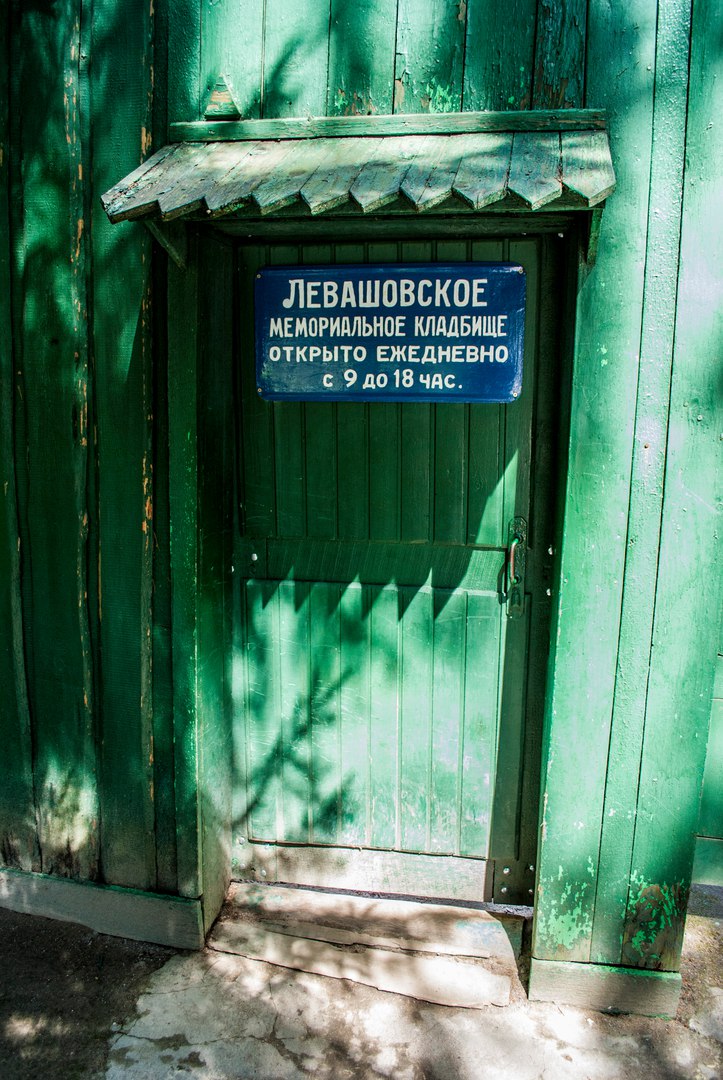
The entrance to Levashovo memorial site to a mass grave. Source: https://pilgrim-spb.livejournal.com/7887.html

People are mourning the imminent closure of the Russian NGO Memorial today and so am I. Yes it is a symbolic blow to a symbolic human rights organization. Yes, it does important work on Terror and Gulag victims and perpetrators as well as other work. It is best known for collecting copies of state documents about the Gulag that were first publically available in the early 1990s. However, it’s work was only every a drop in the ocean and could never substitute for a truth and reconciliation commission from the top, or even lustration, as was carried out in some other former communist countries.

For years, Memorial has been losing ground to other groups, including the Church. On the topic of the Terror, Putin even seems out of step with public opinion in his comments by calling it a ‘tragic period’. For most Russians today the operative word would be ignorance. Cultural practices of memory ‘are inadequate to these losses’, as Alexander Etkind writes [opens as pdf]. But are they anywhere? Indeed, in his next sentence Etkind remarks that in contrast to an ‘amnesia’ thesis, Russians remember Soviet terror all too well. One of the reasons being the enormous and expanding arbitrary punitive power of the state today. Something I wrote about in relation to cultural politics recently.

What has happened is that the Russian Foreign Agents Law has enabled the prosecution of any organisation that takes grants from abroad on paper-work reporting technicalities – a bit like if you’re late with your tax return, but with rather more serious results. Once on the statute book these laws take on a life of their own in a country where there are political entrepreneurs at all levels aiming to show ‘loyalty’, find enemies of the regime and root out foreign influence. They might not even be ‘political’ in reality – instead getting a Foreign Agent punished could get you a nice promotion or a posting in Moscow. And here is also part of the truth of the Stalinist Terror – some of it was about social mobility and the rise of a security ‘middle-class’.

But it’s exaggerating to argue, as Tanya Lokshina does today in the Moscow Times, that Memorial is the country’s moral conscience and the backbone of the human rights community. That might have been true in the past, but this view does not do justice to the many lawyers and activists who are not affiliated with any human rights org, but who defend individuals and organisations, sometimes at significant personal risk. These are often professional (and paid) services but they’re still human rights work (For example the Military Bar Association). And then there’s the new ‘political’ society actors that Regina Smyth and I are writing about along with Russian authors (book comes out next year). These actors make claims about entitlements and worthiness to the Russian state and engage in dialogue and pressure, as much as they articulate a ‘rights’ dialogue. This relates to a scholarly take on activism and contention that is suspicious of the ‘civil’ in ‘civil society’, especially outside of Europe and the US. It’s partly inspired by approaches like that of Partha Chatterjee on ‘popular politics’  in the most of the non-Euro-American world.

Similarly, Lokshina’s view perpetuates a dangerous misinterpretation about Russia – that there is an intellectual class in opposition to authoritarianism. This is obviously false on two counts. As I frequently remark in this blog, there’s nothing particularly progressive about Russian self-appointed ‘intellectuals’ or ‘intelligenty’, just as there’s nothing particularly progressive or liberal about the metropolitan bourgeoisie in Russia. By the same token, much ‘activism’, ‘resistance’, and indeed, thinking about a different future for Russia (even if only a little-bit-different) comes to me from ordinary people and organic intellectuals.

When it comes to the Terror, there is shameful ignorance, for sure. ‘They didn’t kill people that didn’t deserve it.’ Is something I hear all the time.  But when it comes to the Gulag, I don’t think this is something that’s in danger of being forgotten, nor of being instrumentalized by the Russian state. There’s so many millions of living Russians whose ancestors were arrested that it’s still a ‘living’ traumatic memory and an important part of oral history. There’s an excellent book edited by Khanenko-Friesen and Grinchenko on how oral history in Russia has made important contributions to the ‘pluralisation’ of society – providing different accounts of traumatic experience, including of the Gulag. In my experience, oral history is in no danger of failing to pass on the horror and injustice of Gulag victims. But with pluralization comes fracturing of meaning. Many times it remains personal, or is politicized in unpredictable ways. It’s perhaps naïve to think there could ever be a socially-shared meaning of these events and comparisons to Germany ignore how shallow the public discourse there remains, perhaps precisely because it is an ‘officially sanctioned’ form of remembering and ascribing blame and victimhood.

Maybe Putin is aligned with public opinion after all. Most people I talk to agree with his comments, perhaps more sincerely than they were intended. Remembering ‘does not mean settling scores. We cannot push society to a dangerous line of confrontation yet again. Now, it is important for all of us to build on the values of trust and stability.’ Legal recognition and symbolic compensation to the victims of political repression remains, if not more substantial recompense. A good primer on the issue of public memory is here, by Elisabeth Anstett and there are other important scholarly and documentary works by the SciencesPo Paris Mass Violence and Resistance Research Network.

EDIT: A Facebook commenter makes a valuable counter argument: “Memorial is an important piece of civic infrastructure, and one that has been much more welcoming to all sorts of political opinions and trends (inc on the left) than hardcore liberals. I am also not a fan of the moral conscience language, personally, but I worry that we miss Memorial’s contribution, too, here.

They have also collected info on what happened to the Left Opposition (https://socialist.memo.ru/) and as Ilya Budraitsksis mentioned, they were one of the only orgs to really try and investigate what happened in Oct 93 (and have held exhibitions on the topic which are fantastic). They host events where democratic left folk appear AFAIR, and obvs on human rights issues collaborated with people like Stanislav Markelov, too. That’s very brief and someone more knowledgable could jump in to give a fuller picture I’m sure, but I guess I have always appreciated that lack of dogmatism. I also think they have been incubators, in effect, of so many important initiatives – though your point in the article on those actors that don’t fit into this paradigm is well taken.

How to start a gender transition in Russia

This is a short post ‘answering’ my own question on Twitter: What is life really like in Russia for transgender people seeking to transition when they interact with the very ‘medical gaze’ of the state?

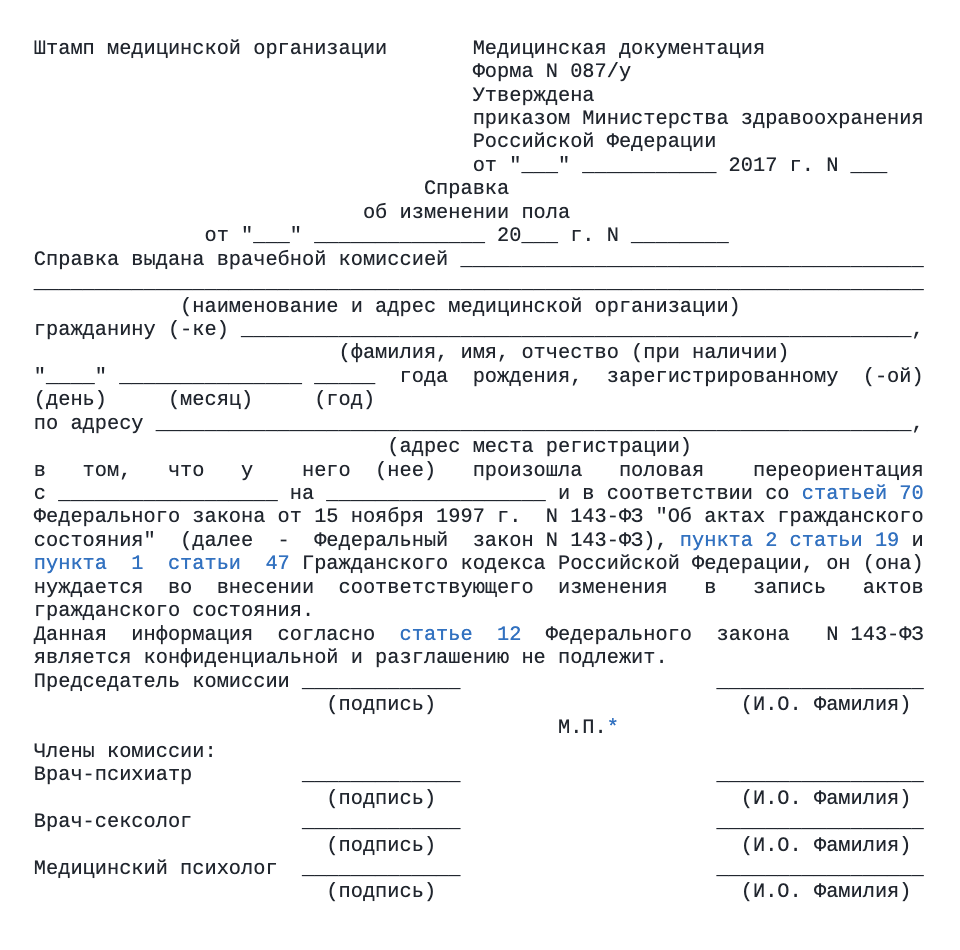
A medical commission certificate allowing an individual to proceed with ‘changing their sex’ [sic].

I didn’t get any answer on Twitter so I found out for myself (as far as possible). This is pertinent to my research for three reasons – one, I struggle to explain to my students the nuances of the gender-sexuality reality in Russia. Two, I have a research participant in Russia who wishes to transition. Three, I am writing a follow-up to a piece published this year on ‘everyday homophobia’ [opens as PDF – publisher version here]. That piece got some negative and positive feedback for obvious reasons. See two recent posts I made on this site about homophobia here and here from 2021. The original one from 2019 is here. My follow-up article will touch on the case of my research participant (though in a heavily anonymized and obscured way for ethical reasons).

A key reference point is the ICD standards, published by the WHO. The International Classification of Disease 11th edition is the latest health standard in effect from January 2021 (though unevenly adopted). This ‘update’ in defining disease is important because the 10th edition is 28 years old (though it was revised up to 2016). For a good sociology of science article on how the ICD works in relations to defining sexual health and disease (whose definition is wider than lay people normally use), see this article by Steven Epstein.

Why is this important? Because in the 10th edition of ICD, the diagnosis of ‘transexualism’ (including severe ‘gender identity disorder’ and ‘gender dysphoria’) was defined as a psychological disorder. In the 11th edition transgender identity is described in a separate section and not defined in psychiatric terms, although ‘gender incongruence’ is still a ‘diagnosis’ that a practitioner can make, albeit only in combination with another disorder. In Russia at present even the 10th edition is not consistently applied.

A resource in Russian is this article from Tinkoff journal that talks about the accepted terminology of ‘transition’, versus ‘sex change’. “Переход” not “смена пола”, and associated discussion. This article is useful because it outlines the various things one could do in Russia to transition, pointing out that not all are necessary for varieties of переход. 1. Psychiatric consultation, 2. Medical commission examination (пройти – to undergo) 3. Hormone therapy, 4. Storage of reproductive tissues, 5. Surgery, 6. Change of documents. The standard pathway in Russia at present is to get a medical professional to diagnose ‘transexualism’ under the 10th edition standard. This gives the person a ‘spravka’ – that all-important official document of Russian bureaucracy.

Now ‘spravka’ deserves to be left in Russian because while ‘official’ in some senses, these documents also contain within them the sense of an ex-officio judgement on a case where potentially more than one outcome is possible. In today’s Russia they are often equal to a clarification in a point of dispute/incoherence in a citizen’s encounter with some machinery of state. This summer I sought and obtained a spravka from my village administration head to clarify a legal question. My neighbour also applied (‘supplicated’ would be a better word). He did not get his spravka. No one can clearly define in terms of laws and regulations why. It’s a matter of ‘injustice’ for him. On the unclear boundaries between moral entitlements and legal rights in Russia, see Elena Bogdanova’s new book on complaints [academics among you – tune in our discussion of this book 2 December], or a book I just finished by Mark B Smith on Soviet housing.

It’s possible that the state clinic psychiatrist will not issue a spravka (for multiple reasons including ignorance (those living with lesser known/accepted chronic and psychiatric disorders outside Russia will find little difference here between their own experience and that in Russia), The article gives the following commentary:

“Previously, when more scientific medical ideas about transgenderness трансгендерность had not yet been formulated, a person was often refused help due to the fact that the patient did not outwardly resemble the person of the gender in which he positioned himself. It would be funny if it were not sad, because it is precisely because of this discrepancy that people with gender dysphoria suffer.”

So the recommended pathway is to pay for a private consultation. The cost of this is likely to be only a little more expensive than the state ‘spravka’ – between 25-75 Euros. This spravka in theory gives a person access to hormone treatment and/or the possibility of surgery

A next step is satisfying a medical commission: this is necessary to get a SECOND spravka – in order to get one’s legal documents amended. Interestingly, this second spravka can allow the legal ‘change of pol [sex]’ without undergoing actual medical/hormone intervention. [interestingly, in the article there’s some use of language that indicates ‘pol’ is not only used to mean biological sex, perhaps indicating the incomplete adoption of ‘gender’ as a word. Elsewhere the authors use the term ‘gender-marker’ in place of ‘pol’]. This second spravka is needed in order to approach ZAGS – the civil registration service that can then amend a birth certificate. You need four signatures on the second spravka (see the image above).

The short version: the coverage is patchy in Russia and typically blurs the boundaries between state and private sector: medical commissions may operate within private clinics. Commissions with sexologists don’t exist in some regions and even then are mainly in large towns.  As a private service, the commission may charge a very large fee – up to 600 Euro.

Moving on, we get to one of the most painful experiences of any Russian citizen – renewal of official documents. An interesting point here is that you can simply ditch your patronymic name – which of course inevitably marks gender. I’ve noticed that recently online forms have started to move away from obligatory use of patronymics, even for Russians. Another point is that you might need the services of lawyer to persuade ZAGS to allow you to change your name to a gender neutral one.

Meduza also have a useful article in Russian on this topic, including a description of the term ‘TERF’. There is a Moscow-based legal support project on VKontakte and Facebook in support of transgender people that seems active as of November 2021. They also carried out research on transgender people in Russia in 2016 and 2017. [opens as a pdf]. A more detailed link to case studies of transgender Russians who successfully and unsuccessfully ‘passed through’ medcommissions and so on is here.

Russia as vanguard: authoritarian governance in symbiosis with rent-seeking (final part VI in the series)

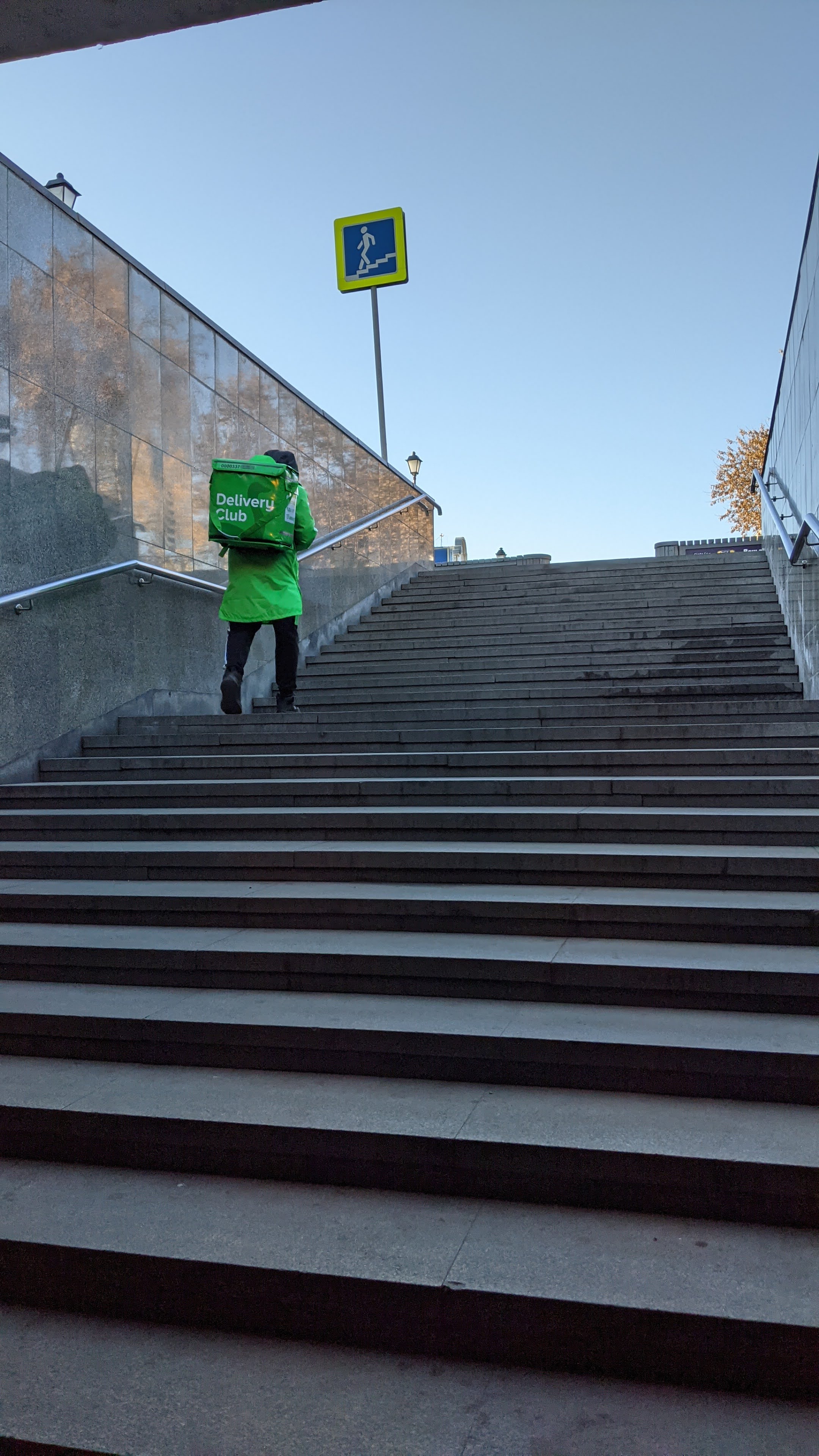
A lonesome food courier in demand during Moscow’s autumn 2021 lockdown

In the previous post I started to discuss the Russian experience of Covid and how it shows authoritarian governance as contributing to the accelerating implementation of surveillance practices.

What we often miss in this equation is a mutual benefit for states and corporations, including state-owned enterprises .  Using the control society, further pressures are brought to conform or internalize behaviours, practices and mindsets that entrench neoliberal thinking and allow the biopolitical to undermine any alternative ‘mechanisms of accounting’ (Hardt and Negri 2004: 148). Local researchers like David Hurma are right at the heart of Russian research that opens up this contradiction – we are supposed to internalize discipline, but this goes hand in hand with increased surveillance of work processes. This conjunction of state and capital power can be observed everywhere, but I want to end with two further brief examples of Russia as ‘vanguard’.

Russia offers a good example of the broad and deep roll-out of the surveillance state due to its particularly fruitful experience since the 2000s of aligned state and capital interests in extracting economic rents from populations. In just the most obvious example, the peppering of public (and increasingly private) highways with revenue-generating traffic enforcement cameras should be seen for what it is: an authoritarian technical solution to overcome limits on rent-seeking elsewhere. The plethora of these cameras puts every other developed country’s efforts to shame.[1] Truly, in linking the control society to rent-seeking it is as pure a public-private partnership you can wish for. A part of the proceeds goes to regional budgets, but the ‘take’ from private companies supporting the cameras’ operation is 15-times greater than their real cost.[2]

And of course, in case there’s any doubt, petty corruption by police does not end because of the camerification of roads, it just metastatizes into preying on goods vehicles and taxi-drivers instead of ‘ordinary’ motorists who are caught by the cameras alone (like me – I pay around 3-4 fines a year for road infractions that are almost impossible to avoid). I personally saw three bribes extorted from such drivers in just a dozen trips last month.

To move to a different scale – that of the individual, a similar process can be observed in the microproletarianization of workers such as food couriers and taxi-drivers. They, as elsewhere, are subject to algorithmic control for maximum extraction of surplus value within shadow corporations – see Andrey Shevchuk’s work on this concept [opens as pdf]. This happens of their own ‘volition’, via internalization of the demands of maximal self-exploitation and the delegation of all externalities to the individual and wider society (health costs, accidents, insurance, pollution) by the platforms themselves. However, here again we observe the imbrication of state (which owns bonds in such companies, allows them to operate as quasi-monopolies, and sustains anti-labour legal environments) and financial and political elites who own such companies. The scaling effect of microproletarianization of swathes of economic activity in Russia via concentration of market share is unprecedented outside of China.[3]

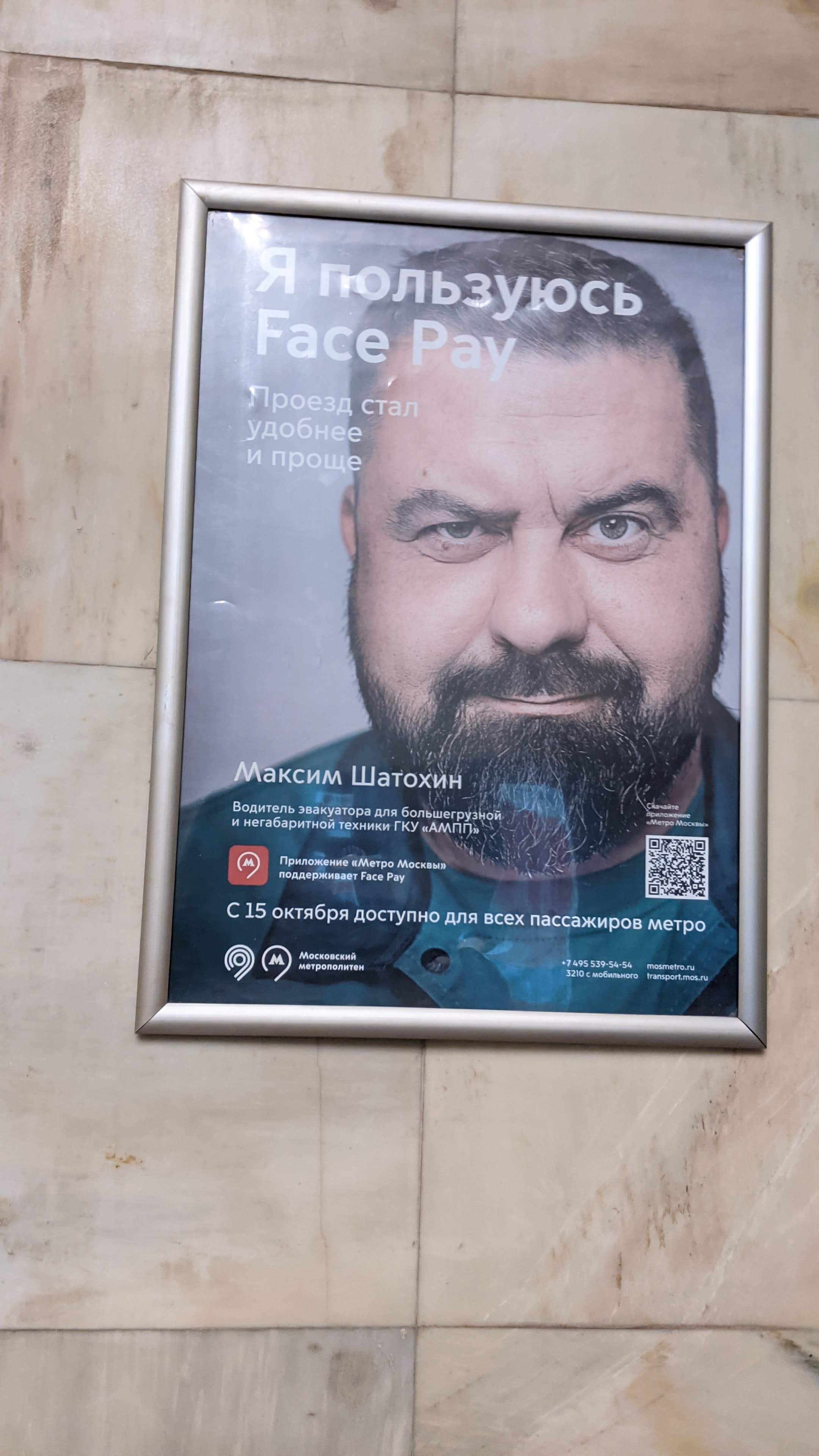
“I use Face Pay. Travel became more convenient and simpler”

In conclusion, we should view Russia as just another ’‘normal’ country, just not in the optimistic sense Daniel Treisman and Andrei Shleifer (2005) predicted: a middle-income country facing typical developmental challenges. Instead, I would contend that Russia is ‘normal’ in a ways that reflect its peripheral-as-vanguard authoritarian neoliberalism. Its characteristics are the dominant politics of “austerity” (the phobia of fiscal expansion, a continuously residualizing social state) accompanied by the other disciplining factor of real incomes falling over protracted time periods;  limited social mobility and the privatizing of educational opportunity leading to a small plutocratic class or caste; the expansion of indebtedness and precarity in the population; social reproduction as largely responsibilized and privatized; the expansion of the horizons of the rentier alliance between state and capital interests and a modest cementing of multinational corporations’ clout and the intensification of their role in the economy (a process actually accelerated by sanctions; see Gurkov and Saidov 2017). All watched over by the nascent digital control society.

Doug Rogers in his book The Depths of Oil (2016) cautions against ‘uniting things under the theoretical sign of the “neoliberal”’, but at the same time agrees with the need for a more serious ethnographic examination of how flexible labour regimes, SOEs and the neo-authoritarian state are linked. As I argue here these linkages intensify the politics of resignation on the part of ordinary people, at the same time as they are further incorporated into neoliberal (self)governmentality. The only limits on incorporation are certain incoherences of the state-capital accommodation-assemblage. As Rogers (2016) noted in his study of the oil and gas industry in the Urals, capitalist ‘incorporation’ via privatisation after communism does not necessarily mean coherence or coordination in governance and corporate identity. In addition, the term ‘incoherence’ is distinct from ‘hybrid assemblages’ (Ong 2006) or ‘parasitical co-presences’ (Peck 2004). ‘Deregulatory’ governance (in the sense that it lacks finality or fixity) inevitably and often unintentionally opens up holes in the fabric of economic and social relations.

Emergent practices both reinforce but also undermine economistic and bureaucratic rationality (Molyarenko 2016, Morris 2019) in what Ananya Roy (2009: 80) calls ‘law as social process’. Conjuncturally, Russia is notable for the continuing expansion of the informal economy in tension with state and capital surveillance – even though, as I have argued before, informality entails in part internalisation of neoliberal governmentality (Morris 2019). As a space for autonomism, non-market orientated exchange and labour its potential is limited. Nonetheless for imagining non-capitalist alternatives, its sheer size means informality is important. Informality in Russia should be seen as offering similar counter-hegemonic potential as that of models that derive from ‘deregulated’ and informal systems from below in other global contexts – such as horizontalism (Sitrin 2012), baroque economics (Gago 2017), and ‘insurgent’ citizenship practices. These are beyond the scope of my essay, but deserve equal attention in any approach that proposes an everyday political economy with a view to uncovering space for the emergence of ‘commons’ beyond state and market (Caffentzis and Federici 2014, Fournier 2013).


[1] The world speed camera database records 15,000 control devices in Russia – likely an undercount – the GIBDD counts nearly 19,000 devices in 2020. This is 9000 more than the next highest European state and four times the number in the USA and 20 times the number in Canada.   https://www.scdb.info/en/stats/

[2] http://lse-ikb.com/activities/blog/201-kuda-idut-shtrafy-gibdd. See  also https://www.rbc.ru/rbcfreenews/60334c9f9a79475eb6162883?from=from_main_9.

The road tax system known as Platon has some similar characteristics https://www.forbes.ru/kompanii/344145-platon-mne-drug-no-istina-dorozhe-kuda-uhodyat-vznosy

[3] For example, the most popular search engine in Russia also owns the main social network, the most popular email service, and controls both the main ride-hailing app and an increasing share of the food courier business.

From authoritarian neoliberalism via the control society to surveillance capitalism? (Part V in a series)

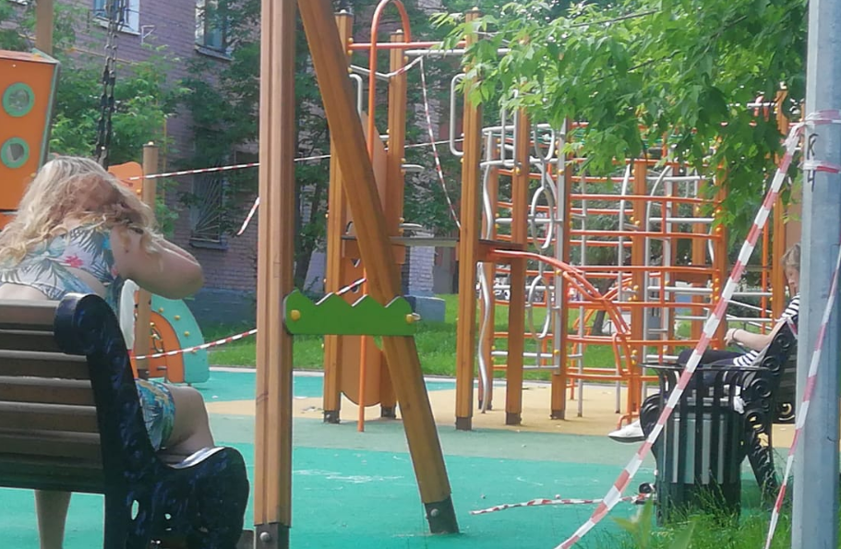
taped off play area in Moscow in spring 2020

This is the penultimate in a series of posts on ‘everyday’ political economy. The long read is now published here.

I ended the last post by talking about a long-term and ongoing phenomenon – the way SEZ’s offer a devils bargain to Russians and how they burn through labour. Another finding from my work that is as true today as 10 years ago is that many workers who ‘fail’ in the SEZs, more often end up in the ranks of lumpen, surplus populations undertaking everyday ‘microproletarian economies’ (Gago 2017:19). In this sense, the most marginal part of the Russian population takes on the task of maintaining the dynamism of what Verónica Gago has called  ‘neoliberalism from below’. There may be a space within this dynamic to resist exploitation and dispossession but this itself becomes a ‘foundation for an intensification of that exploitation and dispossession’ (Gago 2017: 11).

Ovsyannikova (2016) criticizes Matveev for using the term neoliberalism to Russia in part because she believes the social state trumps any deregulatory momentum. She cites labour protections and (from the perspective of 2016) lack of pension reform as examples. However, empirical evidence shows that employment protection in Russia is ‘poorly observed’ (Gimpelson et al. 2010) to put it mildly. Pension reform did go head, despite enormous opposition and prior commitments to indexation were diluted to the point that in the future it is likely the universal element will be replaced by means-testing. Ovsyannikova argues that ‘monetisation of welfare benefits’ was overdue because of underfunding and piecemeal in execution.  However she ignores how monetisation closely matches patterns of welfare residualization elsewhere which are key to the austerity politics of the World Bank and other international institutions (see Wengle and Rasell 2008: 749).[1] Monetisation also contains within itself the key logic of ‘choosing’ deserving groups and making them ‘responsible’ citizens (Kourachanis 2020).

As Simon Shields (2019: 657) notes in the Polish case, family-focussed welfare reform can act as a form of ‘neoliberal social innovation’ by appropriating the micro-scale of social reproduction as a further space of responsibilization (of benefits linked to parenthood, upbringing, domestic work) and privatization (of former entitlements such as pre-school childcare). In addition, the diffusion through welfare states of conditionality is a key plank in neoliberal reform because it realises a critique of social rights on both a discursive and structural level (Pieterse 2003, in Bindman 2017). Eleanor Bindman also reminds us of the genealogy of responsibilization in social policy stretching back to Soviet ideas around welfare provision.[2] Julie Hemment (2009) points out that in the Russian case rhetorical concessions to a social state are not matched by policy – if anything, they serve as a cover for accelerating change. Even a generous interpretation of the remnants of the social state reveals extreme conditionality, narrow and patchy coverage, and tokenistic, piecemeal provision in cases of extreme social distress.[3]

The retreat of the social state is nothing new and not peculiar to post-socialist states. However, as the thesis of authoritarian neoliberalism proposes, during periods of crisis contingent necessity results in incoherence or heterogeneity of the state bureaucratic function. This merely underlines its punitive or delegative relations to the individual. The state’s response to Covid-19 in Russia and its similarities and differences to core states are instructive. First, a knee-jerk authoritarian lock-down followed by a hurry to delegate responsibility back to the individual and downplay both the social costs and state responsibility. Russia, like other neoliberal developed economies, offered very limited income support for livelihoods, especially among the self-employed and poor. This affected not only lumpenized informal workers like taxi-drivers and construction workers, but also the burgeoning ‘freelancer’-precariat white-collar workers – an important category in Russia, as elsewhere where there is high ‘human capital’[4] but structural barriers to SMEs beyond micro-entrepreneurialism. As Andrey Shevchuk (2020) points out – labour processes that are negotiated via digital platforms in the ‘gig’ economy emphasise tight algorithmic control and a loss of autonomy because the platforms actually disguise incorporation of workers into ‘shadow’ corporations. This also divides up labour into small parcels which has a wider influence via spillover into other domains of work. For the purposes of our argument, work for ‘shadow corporations’ intensifies both punitive monitoring and self-exploitation at the point of production.

Covid-19 only accelerates this aspect of neoliberal authoritarianism; digital transformation enables a ‘control society’, long predicted by Gilles Deleuze (1990). Alone among European nations, in early 2020, Moscow’s government pioneered a technological system of surveillance quarantine (Orlova and Morris 2021) [pdf in Russian. I will blog this Russian article later].  While ultimately unsuccessful, and quickly giving way to broader (neoliberal) pressures to re-open the economy regardless of public health risks, the Moscow experiment illustrated the tendency of control to shift from a focus on the disciplined, directly observed body, to a new order of domination. Personal data processing as a semi-autonomous system entails both the deactivation of agency and its reactivation through incorporation of the person in their own data flows (where choices about what images we view online and what products we buy are then fed back to us to reinforce existing behaviour).

Of course digital governance apriori assumes a set of political values to be ‘inputted’ into any algorithm which can then make judgements of value as to the conduct and movement of real individuals, just as the data attached to persons themselves can become another ‘fictitious commodity’ to further marketize social domains that previously resisted incorporation (Haggart 2018). The term ‘surveillance capitalism’ (Zuboff 2015) is often focussed on individual privacy rights, and monopoly capitalism in general, rather than the implications of data commodification for individual behaviours observable via the everyday political economy, hence my preference for the broader term authoritarian neoliberalism.

The nascent Russian control society (which will possibly develop along the lines of the Chinese ‘social credit’ system) illustrates the potential further reinforcement of self-monitoring and inscription in one’s micro-social actions of neoliberal logics. Moscow serves as a suitable test bed for the further expansion of such technologically integrated systems of governmentality in the ‘democratic’ countries – for example Face Pay is being enthusiastically rolled out in the metro. Micropayment systems via phone are almost more obligatory among the immigrant and marginal populations than among the Moscow middle-class. I could entertain with a long anecdote of how a few days ago I tried in vain to pay in cash for a 3-hour taxi ride (five thousand rubles, or around £50). The Kyrgyz driver really didn’t want the cash because it was so much easier to facilitate remittances and ‘store’ of value electronically for him within his ethnic community… in the end I had to give the cash to an aquaintance who then transferred money to my Rakhimon. But, let’s end it there for now.

Next week I will post the conclusion to this series.


[1] It should be acknowledged that there is more diversity in the World Bank’s thinking nowadays.

[2] See also Bockman and Eyal 2002 for a discussion of East Europe as its own ‘author’ of neoliberal policies.

[3] For example, the one-time payments for families in 2020 and 2021 during the Covid pandemic, and the varying levels of prenatal payments have not addressed Russians’ unwillingness to plug the demographic gap – itself a symptom of precarization. An example of the perniciousness of the logic of means-testing is the evidence that a third of Russians do not know they are entitled to benefit payments of some kind. https://www.gazeta.ru/social/2021/02/18/13483658.shtml

[4] Noting that the very concept is an elision of ‘labour processes’ and relations in service to neoliberal ideology (Mirowski 2019: 14). Freelancers as a proportion of working-age population in Russia is high by European standards at 14% compared to 4% in the UK.  https://www.kommersant.ru/doc/4730809.

Russian State Capitalism Part IV: Special Economic Zones in Russia (Kaluga Region)

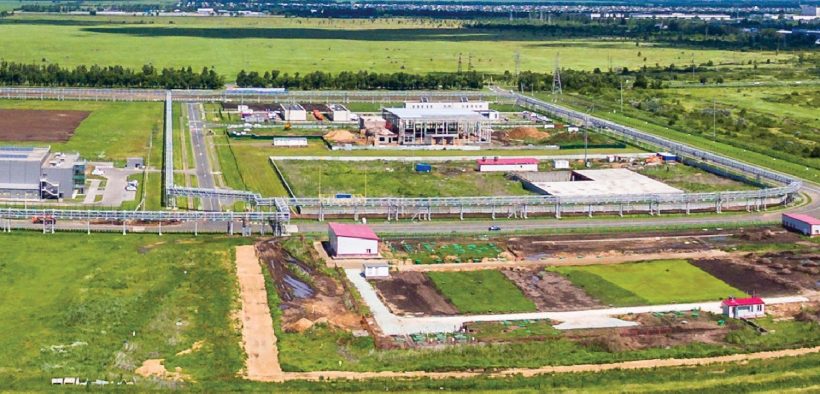
unnamed greenfield site in Russia

This is the fourth in a series of posts on ‘everyday’ political economy. The long read is now published here.

Special Economic Zones have interested me for a long time because so many of my research participants moved directly from ‘dying Soviet’ factories to shiny new Japanese, Korean, and European intensive productionscapes in the 2000s and 2010s. I write a little bit about this in my book, [opens as a Pdf] but its only recently that I’ve tried to triangulate my ideas with the literature on SEZs.

SEZs (and the related geographical-juridical space of ‘Industrial Parks’) — were created supposedly to kick start diversification and higher-tech production — in reality they serve primarily as accelerated laboratories in deregulation, offering lower corporate taxes, more liberal juridical regulations, ease of transnational movement of goods, and lean ‘sweated’ labour regimes (on the latter see [Morris and Hinz 2017]) [opens as a Pdf]

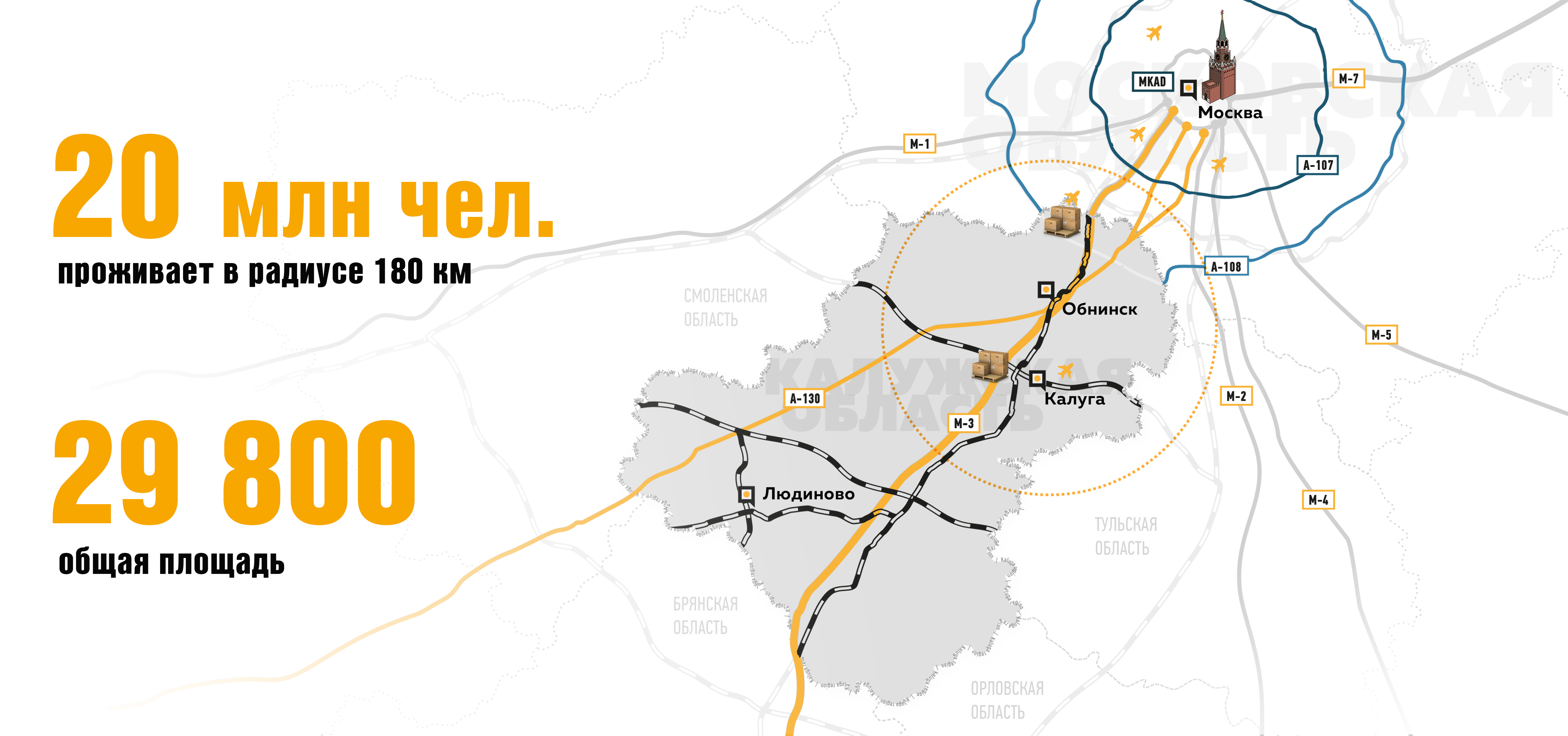
Taking Kaluga region as an example, SEZs’ success has been in socializing blue-collar locals in accepting downgraded labour terms and conditions and training white-collar workers in more effective coercive surveillance-managerialist methods. In terms of transnational state-capital collaboration to increase productivity, global connectivity (notably with the Silk Road rail system), and in providing a relatively low-tech domestic manufacturing base, SEZs are an outstanding success. For a site selling the benefits of SEZs in Russia see this link.

My main argument is that these effects are not contained by the zonal boundary — they ‘scale’ via further expansion of ‘lean’ enterprises beyond the zone as transnational corporate infrastructure and human capital investment has an effect on the whole region. Indeed, the ‘zone’ is not a spatially contained territory, but an elastic administrative state of exception that has expanded throughout the region to encompass many clusters containing dozens of diverse foreign and domestic firms in urban, brownfield and greenfield sites. In terms of ‘register’ too, the SEZs exercise a strong discursive effect, making new working relations ‘common sense’ beyond the zones themselves, affecting local politicians, employers and workers in other enterprises. Overall the ‘register’ effect multiplier is more important than any administrative-legal deregulation, or should be seen as part of neoliberal scaling itself. Patrick Neveling, writing on India, analyses examples of similar zones a bit differently, as “exemplary for the structured contingencies in global capitalism as these neoliberal regimes were established long before neoliberalism became the defining ideology in global policymaking under the Washington Consensus.” In the Russian case, SEZs are a very recent phenomenon, and their success in register’ and ‘scaling’ is somewhat in contrast to what we think of as typically more dirigiste movements. I guess my point here is that a strong (neo)liberal strain remains, regardless of what happens ‘at the top’ of Russian economic policy. This story also should make us hesitate about too quickly assuming further ‘decoupling’ of Russia from the global economy.

My prior research has documented the ‘burn through’ of the local labour force by the new SEZ companies, [opens as Pdf] and the devil’s bargain facing blue-collar Russians in particular. In the face of societal opposition, libertarian market ideologues need to ‘naturalize’ what is in fact a carefully constructed view of human economies in a set of epistemological precepts that serve politics [Mirowksi 2019]. SEZs in the European Russian context beyond big cities, are important in drawing in new labour to discipline and socialize it. As I was doing my long-term fieldwork in 2010 a remarkable divide opened up before my eyes between those young men who ’embraced’ the SEZ work and went on to get mortgages and foreign cars, and those who ‘rejected’ it for the precarious informal economy [Pdf] and decaying paternalism of the old factories. However, it’s not so simple. Over the longer term, expectations of a social contract, enterprise paternalism don’t completely disappear. Similarly, it’s ironic that the ‘entrepreneurial’ possibilities of the informal economy (as an electrician, welder, builder, trader, etc) actual serve as a limiter to the diffusion I describe of ‘neoliberal governmentality’. I wrote about that indirectly in this summer’s posts about ‘homo sovieticus’ values. Maybe Hillel Ticktin had a point after all, when he proposed that the reality of the pace of work being dictated by the shopfloor itself was an enduring and profound characteristic of the USSR and an impediment to the transition to fully commodified labour. The ‘escape’ to the informal economy often looks like a way to try to retain that ‘autonomy’ in some form.

‘I’m looking for an unobjectionable face to vote for’: on Russian voters going, or not going to the polls in 2021

One of many examples of invisible electioneering in a local newspaper. The candidate gets many stories printed about her in 2021 in her ‘official capacity’ as the Children’s Ombudsman of the Region, even visiting factories and parks with no real connection to her job.

A belated reflection on the Duma elections of 2021. I’d hoped to get this out before the vote itself….

How useful is political polling in Russia? Can we really talk about political preferences in a system where massive manipulation is an open secret to everyone? What does it mean to measure voters’ ‘interests’ in such a system? This looks even more of an issue after the failure of smart voting.

There are other problems too. As Greg Yudin, the public sociologist has repeatedly pointed out, the three dominant pollsters in Russia repeatedly conduct surveys with questions worded in such a way to reproduce their own political biases and those of their funders.

But what if the problem with measuring public opinion were far worse than methodological? What if polling completely fails at really capturing the worldviews of Russians, who are, in social or economic terms, quite distant from the institutions that collect opinions? What if a more important question relating to the current election was about why people don’t vote, despite a lot of pressure in the Russian case. Or if they do vote, but don’t really identify with their political party of choice, what would that tell us? And if they voted against all (by spoiling their ballot paper), or against the ruling party of United Russia, what could that tell us about Putin’s legitimacy and the prospects for change in Russia?

As a sometimes political ethnographer my job is to try to get beyond superficial measurements of party preferences and get inside people’s understanding of the political – if they have one. Many political phenomena lend themselves poorly to quantitative, or polling analysis, and Russia – where opposition and dissent has been expelled from the public sphere, is a case in point. Like the ‘shy’ Conservative voter, those voting for the ruling party in Russia or against it might have many reasons for concealing their preferences, even to friends and relatives. Similarly, polling even when longitudinal, still struggles with the gradations and contingency of opinion – how it is a process, and not a fixed end point. Talking to people at length and taking their worldviews seriously is an important supplement to polling. Before and after the previous parliamentary election in 2016, I asked my long-term research participants about how they’d vote. Remember this is when United Russia got a stonking constitutional majority and everyone knew this would happen before the fact.

The little commented elephant in the room in 2016 was collapsing turnout, officially less than 50% and a record low. Official turnout this time was 51%. Probably it was substantially less than that, even in places where politics was still viewed as partially competitive such as Moscow – perhaps 38%. Certainly, most of my long-term participants had long given up voting even then. Now, voting is largely confined to two groups – pensioners in Moscow supporting the status quo that has insulated them from the economic weakness of the Russian economy since 2014, and those in state service who are effectively forced to vote.  Beyond Moscow there is a sea of indifference. Only that’s not quite true – there is resentment, disappointment, tristesse. Tristesse is a term – listlessness and cynicism as symptoms of a loss of political faith – that some sociologists view as a harbinger of internal collapse of authoritarian regimes. But let’s not be so naïve, the parallels with the late Soviet period are limited.

There is a core vote of loyalty, and it’s genuine. There are enough people – the minority of 20% – who materially have done well, whether by moving up the ranks of state service, or in business. In fact the only public political talk among people that I hear is quite divided. On the one hand heartfelt praise of Putin – ‘he’s done so much for the country. He’s doing his best!’ is the ambivalent summary of one neighbour. I point out that her relative’s business was forced into bankruptcy – doesn’t she link that with the economy? ‘Oh, no, it’s because of the enemies that Russia has – because they envy Putin.’ Being surrounded by enemies, real and imagined, internal and external requires visible and symbolic acts of loyalty, and voting is one of the only ones possible. And it’s not only pensioners – there are many others whose material circumstances demand that to avoid cognitive dissonance they make sure their consumption of news and current affairs is suitably hygienic – ‘no, no, don’t talk to me about that thief and fascist Navalny!’ As if the very name could summon an army of LGBT Ukrainians to the Spassky Gates. They voted for UR with gusto. On the other hand, there are small business owners, crushed by Covid and the general economic malaise who blame Putin directly. For me, open and public condemnation of the government in the last couple of years is still surprising and noteworthy.

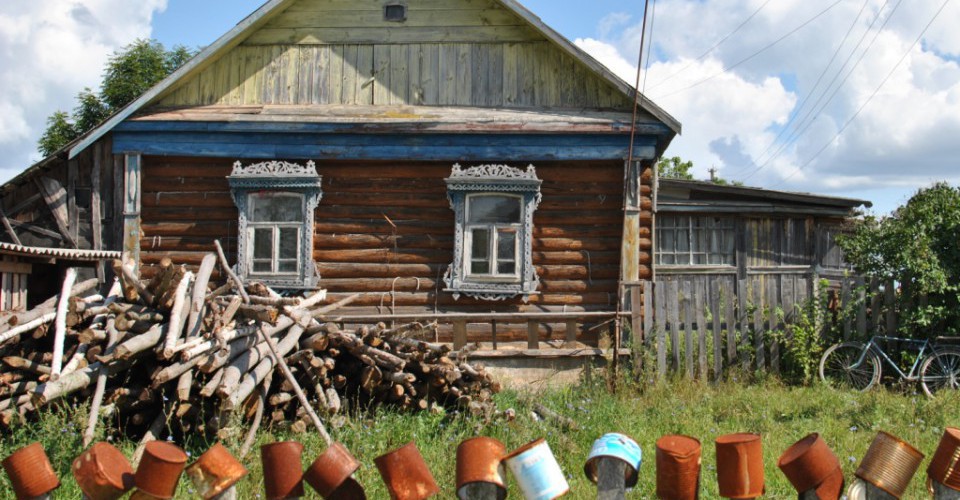
In 2016 in the sleepy deindustrializing corner of Kaluga region where most of my research takes place I discovered a political conspiracy. ‘Smart voting’ avante la lettre. Of course this ‘discovery’ merely revealed my blindspot – in reality Russia’s turn to authoritarianism has not spelled the death of politics. Just because popular representation does not exist, doesn’t mean even the most marginalised snatch hold of the political wherever they can find it. Mostly it reveals itself in ecological and municipal activism. But to my surprise in 2016, I only had to ask and the most apolitical of people would suddenly reveal that they’d weighed up with their trusted circle – usually in a smart-phone messaging app – the pros and cons, and they were going to vote KPRF. To stop UR. These were mainly young people – but from all walks of life. Older people and some of the more stark losers of the postcommunist transformation were always sympathetic to the carnivalesque national populism of LDPR, but again, for the first time in 2016 they were making a rational choice for Zhirinovsky’s party, for his more populist social policies, and to stop the constitutional majority forming for UR.

So what has changed since 2016? In some respects, Navalny’s smart voting tactics are late to the party (pun intended). Those groups he needs for a broad anti-Putin coalition – the kind of disaffected younger people at the heart of my research, are now largely demobilized. It’s true as this report shows, that smart voting could (without the fix we observed) have a measurable effect in large cities. And, as Felix Light observes, the communists were making something of a comeback – but the real noteworthy shift was already taking place five years ago online, with dissenting political personalities cutting through on Instagram clips shared in the safety of Whatsapp and Viber. This re-activated interest. Vlogs and blogs from people like KPRF’s Nikolai Bondarenko – regardless of his political affiliation – convinced people that political voice was still meaningful. Navalny in this world was almost nowhere in sight. Bondarenko has one and a half million subscribers in YouTube, but his Instagram videos were already going viral – under the radar of most Moscow observers – years ago. However, in the best traditions of Muscovites noticing transformations in the wider Russia after they’ve already happened, this brief moment of political activation is on the wane now. For the most part, people are realists – ‘we’re stuck with this system till the end’, a young security guard and former ER, turned 2016-KPRF voter told me. ‘Why should I waste my time voting, now?’

As I found in 2016, the main response is ‘we would vote KPRF, or LDPR if it made a difference, but it doesn’t. We’re not stupid, why would we vote?’ Others go further in their perfectly rational reasoning about voting or not voting: ‘I would vote against all on principle. We have an artificial system and it’s not right, but why vote if the result is a foregone conclusion’. This was from a formerly loyal UR voter and even today a big Putin fan. Another pensioner, also a big fan of Putin, says she’ll not vote UR anymore. She pauses, looks a little sheepish and then breaks into a broad grin and whispers: ‘L-D-P-R!’ More pensioners: this time a couple who worked at the local factory. ‘We don’t know who to vote for. Putin is smart and knows how to talk, but other parties have more interesting policies. The Duma should be diverse. You need real discussion and debate. Maybe KPRF is the answer, but I’ve never voted for them before and they say some bad things about them on the TV.’

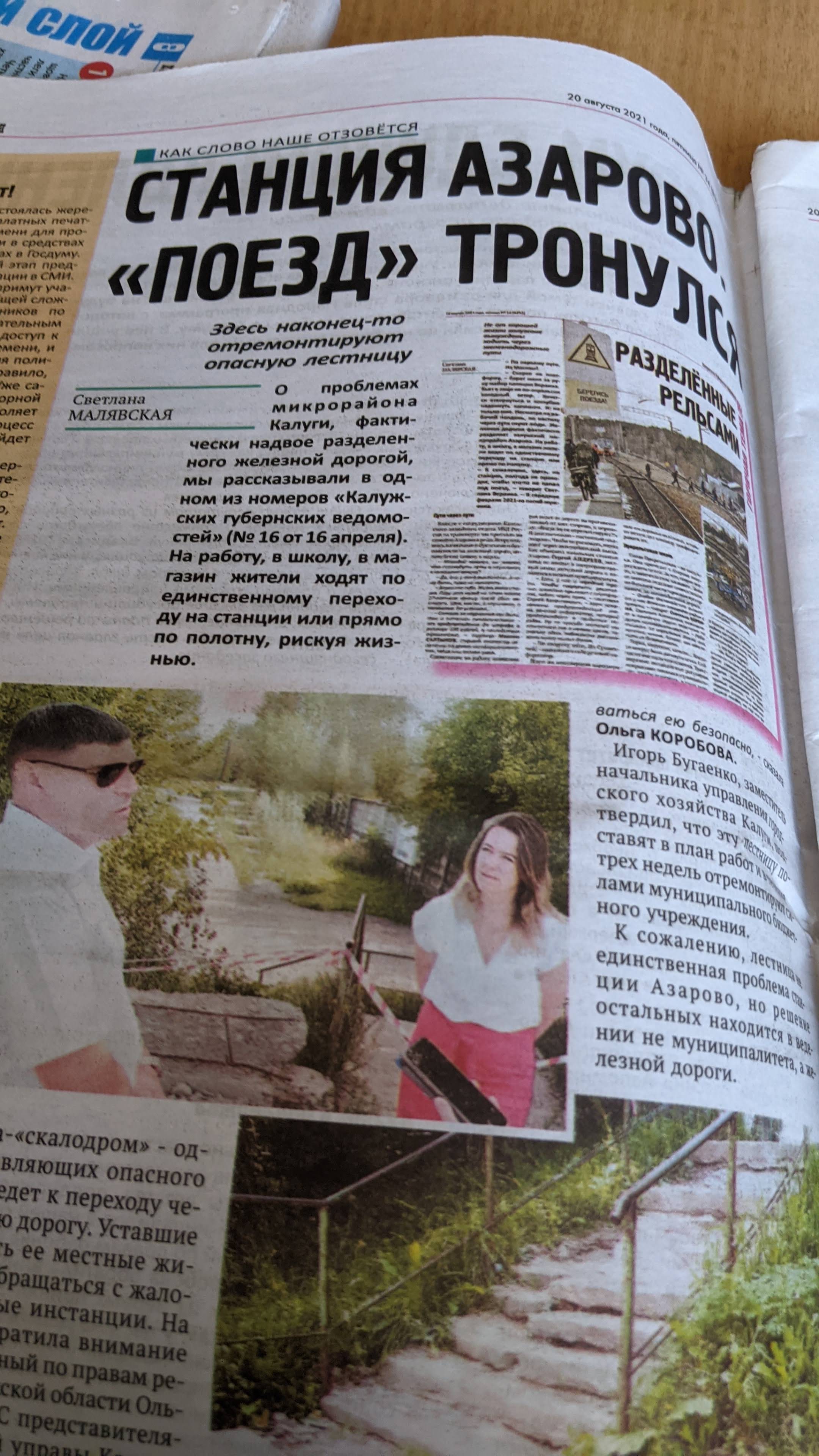
We focus so much on the national press and TV, but the local newspapers are still important outside Moscow and St Petersburg. This summer I noticed that in every single issue of the local paper there was some random story about the Kaluga Children’s Ombudsman visiting this or that place – often with no real connection to youth matters, and with a prominent photo of her at the head of the article. It took me a while to work out that this was the UR single-mandate candidate for this part of Kaluga Region – of course the newspaper mentioned her candidacy or even the elections. On the Ombudsman’s VK pages some noted with cynicism: ‘it’s a month to the elections, people, make the most of this chance to get your local playground fixed, or your school roof replaced!’ However, this invisible campaigning tactic is likely to be more successful than not. One of my professedly apolitical research participants is a municipal office worker. She tells me: ‘I didn’t ever vote before. I always reasoned: it doesn’t matter how you vote.’ I point out that she’ll be effectively forced to vote because of her job. But she objects: ‘well you can always spoil your ballot. I even know people who photoshopped their ballot when the boss asked people to prove they’d voted… I’d vote for a face that isn’t objectionable to me though – I’d just go purely on appearance now, as there’s no other way to judge.’ 

Russian State Capitalism Part III: How can Russia be neoliberal and dirigiste at the same time?

coexistence of the old, not so old, and the new in downtown Moscow

This is the third in a series of posts on ‘everyday’ political economy. The long read is now published here.

In a post back in May, I outlined the usefulness of Ilya Matveev’s work on state capitalism. To recap: Matveev sees 2004-8 as the pendulum in Russia swinging back to incomplete state domination of the Russian economy. Despite this, Russia maintains strong orthodox neoliberal policies. In the previous post my departure from Matveev was to start thinking about how neoliberalism as a form of governmentalizing ideology, is imposed on ordinary Russians, even in ‘state’ companies. I ended that post by pointing out that neoliberal subjectiviation is not lessened as a result of the Covid pandemic….

Neoliberalism refers to a way of thinking about organising social relations. It emphasizes ‘market competition [as] the basis of economic coordination, social distribution, and personal motivation’ (Sparke 2013: 454-5). Economic neoliberalism is a form of market rationality. Colin Hay (2004) provides a seven-point definition:

  1. the desirability of free capital mobility
  2. the ‘market’ as an efficient mechanism for allocation
  3. limited role for the state
  4. supply-side economics
  5. labour-market flexibility
  6. conditionality of welfare based on incentivizing market participation
  7. private finance seen as more allocatively efficient in provision of public goods

Governmentality is key to the maintenance of these relations as it links social life to the logic of what Foucault called the ‘enterprise society’. Governmentality is a process whereby subjectivity becomes increasingly dominated by discourses of self-regulation – inducing people to ‘work upon themselves’ to become ever more flexible to the demands of post-Fordism. This is not a simple top-down process of domination, however. Social control is produced though the active participation of individuals and groups in the regimentation of their own discipline. We have already seen how Matveev argues that the neoliberalism in Russia entails state involvement in supporting highly exploitative relations between individuals, firms and sectors. Stephen Collier (2011) adds to the perspective by returning to Foucault’s lectures on biopolitics to argue that rather than a focus on freeing markets per se, neoliberalism is about rethinking government according to an over-determined form of economistic reasoning.

The social state remains, but its governance ‘styles’ are influenced by ‘khoziaistvo’ – the legacy of Soviet integration of politics and economy based on a narrow, managerial conception of need fulfilment. For Collier, the present moment sees governmentality as a ‘formal rationality’ that privileges market thinking. He adopts the term ‘assemblage’ to trace the genealogy of Russian reform in the 1990s back to core neoliberal thinkers from the US. Moreover, the idea of biopolitics from which governmentality emerges has deep roots in Soviet planning – in ‘incentivisation’ at different scales of labour and production (Bockman and Eyal 2002).[1] Collier elsewhere (2012: 190) proposes synergy between activist states and marketized relations, underlining how neoliberalism as distinct from classical liberalism imagines a key role for governments ‘in creating the conditions for diffusion of markets and market-like mechanisms’ and may contain highly illiberal measures.

Peck and Theodore (2007) trace the debates on ‘global neoliberalism’ via diffusion through institutions, financial markets and foreign competition in the early twenty-first century. This approach anticipated a profound erosion of the nation state as adequate coordinator of the economic sphere. It focussed on the strategic interaction of mechanisms of routinized regulation at trans- and sub-national levels of analysis: ‘corporate governance, education and training, labor-market regulation’ (Peck and Theodore 2007: 744). Firm level and sector scales replace an overly broad-brush macroeconomic institutional framing but are themselves prone to functionalism. In the final analysis, the ‘varieties of capitalism’ approach, in seeking to acknowledge real geographical differences, supposes an unrealistic coherence that closer analysis does not justify. For example it is problematic to clump together as ‘coordinated’, models those market economies often synonymous with northern-European ordo-liberal types. Indeed, since the turn of the century, this criticism has been justified, as ‘coordinated’ models moved sharply towards their Anglo-Saxon ‘liberal’ brethren – especially in the spheres of labour market liberalization, and its corollary – welfare state residualization and retrenchment, two areas of interest in the Russian case (Oorschot and Gugushvili 2019). Variegated neoliberal convergence has in part replaced the ‘varieties’ approach. 

Peck and Theodore (2007: 755) anticipate a tide rising over all developed economies as relative institutional weaknesses fail to moderate or mitigate waves of neoliberal reforms when coordinated states face the entry of multilateral institutions who brought with them modes of rationalization and audit, self-monitoring and surveillance. These techniques are as important as any legislative or coherent ideological diktat. They then diffuse into new territories (such as state bureaucracies) via true ideologies such as New Public Management (NPM) (see Romanov 2008 for a summary of its implementation in Russia [pdf opens automatically]).

Today, international institutions themselves, ironically, cannot find a reverse gear when they need to because of their immanent neoliberal logic. For example the IMF stresses the need for slower adjustment and more progressive taxation in Russia because of Covid-19, but immediately reverts to ‘neoliberal type’ to suggest VAT rises and reduced payroll taxes as well as the need to ‘reduce the footprint of the state’ (IMF 2021). Peck and Theodore (2007) are a scholarly bellwether of the need for more thorough acknowledgement of the multi-scalar and multi-register insinuation of neoliberal governmentality and rationality into the political-economic fabric of societies.

I move on in the next post to Special Economic Zones in Russia as showing us evidence of just how pervasive neoliberal governmentality is in Russia, despite the relatively small penetration of transnational companies there.


[1] While Rupprecht (2020) agrees that Russian neoliberal thought has indigenous roots, he disagrees that the 1990s saw its implementation in any meaningful degree there.

Russian vaccine hesitancy and the paradox of state-society relations

Vaccine poster in a Moscow citizen service centre – ‘The Risk of Infection Remains: make an informed decision and get vaccinated’

Russia will likely maintain its statistically dubious plateau of around 800 deaths a day for some time. This will mean that Russia will become the world ‘leader’ in deaths per million people (around six). The other leaders are Mexico and South Africa with similar figures. The USA is rapidly increasing from over three deaths per million at the moment. Most large European countries have fewer than two deaths per million at the moment. Germany and Denmark have 0.2 deaths/million. It might even be much worse – Demographer Rakshasaid at the beginning of August that perhaps 2400 people a day were dying of Covid in Russia.

I’ve been meaning to come back to the topic of Covid for some time. I wrote two posts on it early on in 2020. One asking whether social solidarity and state mobilization would help ameliorate the pandemic in Russia.  And another in May 2020 about the need to avoid over-simplifying public attitudes and ‘lay normativity’. I didn’t mention vaccine hesitancy there, but it’s clearly the major issue now in terms of public health in Russia. [See also this great BBC article for an anthropological take on distrust]

Here’s my quick take based on two months of being around people – both vaccinated and unvaccinated – in Moscow and Kaluga region.

  1. Russians are no different from anyone else: hesitancy ‘decays’ once people encounter others (usually family, friends and colleagues) who don’t turn zombie/alien/corpses/infertile after getting a jab. However, because of lower generalized social trust in Russia, this decay might be slower than elsewhere.
  2. Unlike elsewhere, there is an occupational and employment vaccine ‘divide’ in Russia – many people in jobs that don’t force them to get a jab continue to resist – a lot of the time as much due to ‘principle’ than fear (more on that below). These are homemakers (women score higher on hesitancy), pensioners, people working in the informal economy, but also workers in smaller companies – many of which are afraid of using duress on employees.
  3. Getting a high threshold of vaccinated people will be hard because of both 1 and 2. That, and the dominance of Delta variant in Russia and the coming ‘fourth wave’, means the demographic hit will continue: more than half a million people will have died of Covid by the end of 2021 in Russia. Many others will have died because of a lack of access to medical care for other conditions (I personally know of two people in this category in 2021 already). As Nick Trickett points out, demographic effects have economic and social implications.

While I telegraphed in earlier posts that the main thing in Russia was the (in)coherence of the state’s response to Covid, what I failed to account for was the very thing I’m working on in a side project: the complex nature of trust and distrust among Russians towards the state. Now, as I said, hesitancy is decaying strongly everywhere, and Russia is like in France in that respect – high initial hesitancy now falling. However, when people tell me they won’t get jabbed, they all say different things, but digging down and pressing them, they all express a desire to make their own choices, avoid being forced into doing something that might be risky/unnecessary/a hassle.

I quote (nenormativnaia leksika!):

‘The Russian state gives me nothing. If it suddenly wants me to do something: fuck them on principle!’

‘The state cannot organise an adequate response to basic things like potholes and recycling. Suddenly in a short time they made a safe vaccine? There must be something dodgy about the jab.’

‘I don’t want any shit in my arm that comes from god-knows-where – some shithole [mukhosransk] beyond the Urals and tested in a hurry on monkeys.’

‘You know, when I try to get something simple done like a passport renew it’s such a pain in the arse. Just the thought of interacting with a vaccine centre reminds me of all the crap one has to go through with our state. I don’t want to do it. Why should I have to! I don’t want to have anything to do with them if I can help it’

‘The boss wants us all to get it, but he’s afraid of us quiting. I’m not going to do it. We all got sick last winter and have anti-bodies. Why the hell should I do something that’s unnecessary like that?’

I know I am like a stuck record on this, but vaccine hesitancy at least partly reflects one of my core themes – the paradox of Russians’ view of the state: on the one hand, many want a socially interventionist state that protects them from harm (and protects them from the more coercive parts of the state itself!). On the other, they know its limitations, and moreover, they know too well the potential dangers of interacting with what is a fickle and rather callous bureaucratic machine (perhaps no more so than many Western states, if we’re honest).

To wrap up, here’s an interesting study that among other things compares hesitancy between the USA and Russia. Some things of note: hesitancy was higher in Russia (to January 2021) than the USA, and higher than in some other middle-income countries. Russian women especially were hesitant in comparison with US women (so were Russian men, but the baseline hesitancy for women was worse). Educated Russians were just as hesitant as others, whereas in the US there’s a pronounced difference depending on education.

Perhaps even more interestingly, when we get to survey data explaining the hesitancy, it’s noticeable that there is a lack of data in the data about ‘why’ people are hesitant. In contrast to the USA, where side effects are feared, Russians fail to give an unequivocal ‘why’ response. As readers will know, I would argue this is an artefact of the methodological shortcomings of surveys themselves. But it’s also about how rejection (not hesitancy) of the vaccine reflects complex feelings and rationalisations that are hard to articulate and which have multiple causes.  Even for the US, rejection in 50% of cases is due to ‘other issues’. On the other hand, for Russians, “family and friends” are key positive motivators for moving from rejection to acceptance.

What’s not captured in this survey data is the problem of hesitancy among health workers being transmitted to lay persons – a clear problem in Russia. High uptake requires the continual maintenance of ‘social proof’ of vaccine safety and efficacy. At the moment, some health workers as well as the ordinary ‘rejecters’ make the achievement of a high threshold of take-up a far from foregone conclusion.