I had put off watching the documentary Mr. Nobody against Putin. Partly because of the feeling that I would find it annoyingly kliukva (sensational distortion of Russian reality for a Western audience that doesn’t know any better), and partly because it felt like taking a busman’s holiday – my ‘day’ job is talking to Russian people in ordinary circumstances, observing them, and then communicating a sense of the everyday experience to Western audiences.
Then I made the mistake of reading a load of long-form blogs in Russian that really tore into it. Basically, those thousands of words boiled down to two objections. One: people in the film, especially the underage school pupils, were not treated ethically because Pavel Talankin, the teacher shooting most of the footage, did not have permission to use his footage in this way. Two: the director (American David Borestein) manipulated the footage and narration, and even got Talankin to stage some awkward and unlikely ‘political’ scenes that Western audiences would like for dramatic effect. As a result of the second point, the charge is that the film distorts Russian reality to such a degree that one cannot take the overall intention seriously. Positive reviews among public intellectuals invested in Russia – on the contrary – argued that the film faithfully showed the heavy weight of state indoctrination on children but also the value of everyday resistance against it (in the form of Mr. Nobody – Talankin’s efforts).
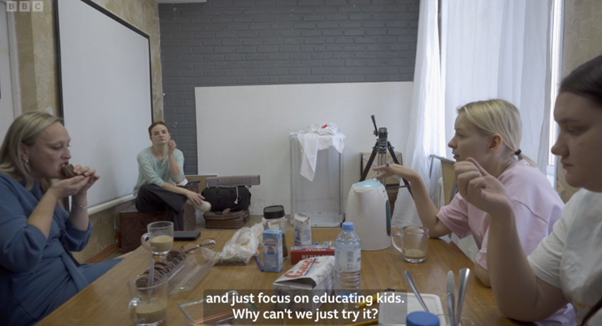
But what is the intention of the film? Leaving aside the ‘blurb’ and the pronouncements of the film makers and critics, my fellow podcasters and I discussed this at length [link coming] but even we couldn’t quite agree. Jonny’s point I think was strongest – that the ethical issue is really about how school children get exposed to unethical and manipulative behaviour by politicians and that’s the tragedy. In my view, the film is not really about ‘everyday resistance’, however much people would like it to be. It’s also not really about indoctrination. The best and ‘truest’-to-life parts of the film are about the difficult relationship between Talankin – who is unhappy about the war and the direction of the country – and his mother, colleagues and pupils. It’s a classic setting: the bloody-minded ‘free thinker’ unwilling to go along with the absurdity of the stupid system that is beyond his control.
One Flew Over the Cuckoo’s Nest comes to mind on the dangers of institutional ‘violence’ to the individual. There are many precursors in Russian and Soviet cultural production too – which I’m not going to go into here. The façade of patriotic education lessons increasingly dominate in a system which demands absurd rituals. This distracts (and emotionally is harmful) from the purpose of education – particularly the strong Russian tradition of whole-person ‘vospitanie’ – upbringing as an intersubjective experience which helps develop the moral, socially responsible, and intellectually curious-critical and knowledge-rounded person. This is a very Russian-Soviet version of the German idea of Bildung.
In a sense then, the film is meant to be about competing versions of political socialization through formal education. But the footage clearly is not enough to answer the question about the success or otherwise about the heavy-footed ‘patriotic’ and nationalist shaping of young minds. What’s good about the film is that there is enough to show how despite the best attempts of the state to deprofessionalize teaching, there remain adults dedicated to guiding and mentoring young people through the formal education experience in a status-quo-critical manner.
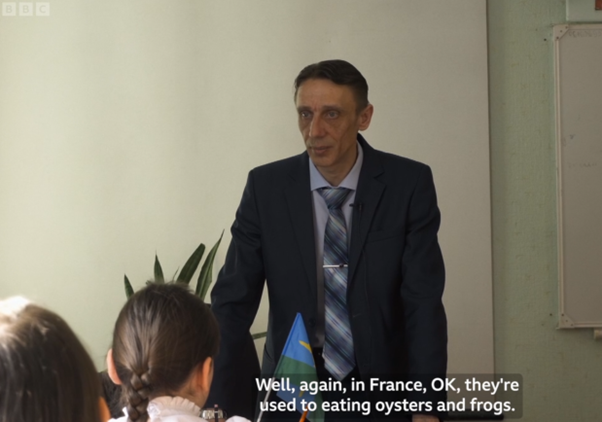
So for me, I could look over the clumsy attempts to make the film relevant and legible to a US audience (after all, how else is a film going to get an Oscar and festival showings?). The scenes with Talankin’s mother are an absolutely perfect encapsulation of the ‘anti-war’, versus ‘defensive consolidation’ difficulty inherent to the intersubjective situation in Russia. The scenes with the one-and-only absurd and caricatured ‘villain’ are perfect in showing the hollowness and intellectual bankruptcy of nationalist ideologues.
The person of Talankin himself (as a character) is perfect as a critically-thinking, professional, yet patriotic and caring person – a model of what a citizen should be.
People might object – why so positive when, after all, the teachers do comply with the patriotic education directives. The true-believer-teacher Abdulmanov does seem to get rewarded for his sycophantic transmission of regime messages to the kids. And this is a problem with a cursory analysis. That’s where the footage of the kids comes in and why it is so important. What the film actually shows is that there is no measurable effect of patriotic indoctrination. That the teachers don’t even understand what they’re being asked to do. The majority of the patriotic education reminds us more of Communist Pioneer marching and flagwaving for the hell of it, rather than having nationalist ‘content’. And Abdulmanov is not rewarded for his bizarre behaviour (even by nationalist pedagogue standards) in class.
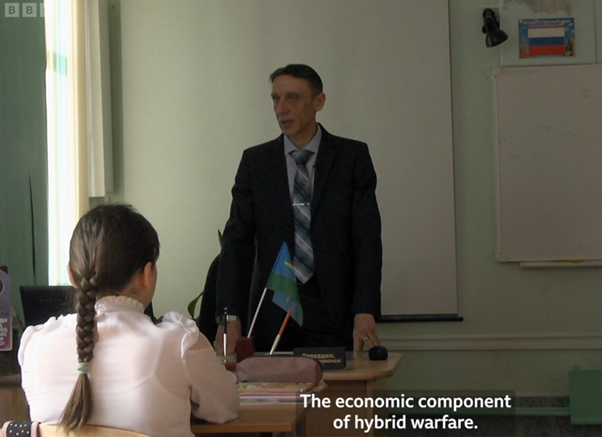
Overall however, the question of ‘indoctrination’ is the biggest weakness of the production and editing because any actual effect isn’t spelled out or illustrated. There is also a bit of cheating here – as has been pointed out, the scenes about former students becoming soldiers are manipulated to conflate ‘ordinary’ conscription with being sent to fight in Ukraine. We’re left with narrative lacunae. There’s also obfuscation of the topic of patriotic education itself. We discuss this in the podcast, but essentially the editing and narration give a false impression that the nationalistic agenda has taken over the school (in terms of time devoted to it), when in reality it’s a small part of the curriculum. Even so, we do witness teachers push back against it. A nice touch that might make you think, is the lesson on the historical destiny of Crimea as part of Russia. If even this is having to be drummed into kids in the most egregiously ham-fisted manner, one wonders about the enduring strength of ideology.
The boys who had no sense of a future and who subscribed to traditional ideas about masculinity (a man must go to the army first) would have allowed themselves to be mobilized/conscripted/contracted anyway. The girls must suffer their boys to be sent to the meatgrinder. The mother-librarian must swallow her misgivings and tell her non-conformist teacher-son to be quiet or face the consequences. Essentially this is the story. Coming of age in a time of war.
It could be a very American film by just changing a few small circumstances (maybe it tells the future there too). Ideologies that the people in the film internalize are hardly to do with the Ukraine war itself, or the ‘regime’, or Russia’s Great Power status. They are much more insidious (you are powerless against the ‘system’). I wouldn’t want to push it too far, but essentially, a lot of the film is about the ‘idiocy’ of small-town and rural life – to paraphrase and misunderstand Marx at the same time. The ‘idiocy’ of having no choice other than exit (there being no possibility of ‘voice’ or ‘loyalty’), is compounded by the extractive, exploitative, and Darwinist nature of Russia’s political economy. But here you can see I’m talking my own book – if you’ll excuse the pun.
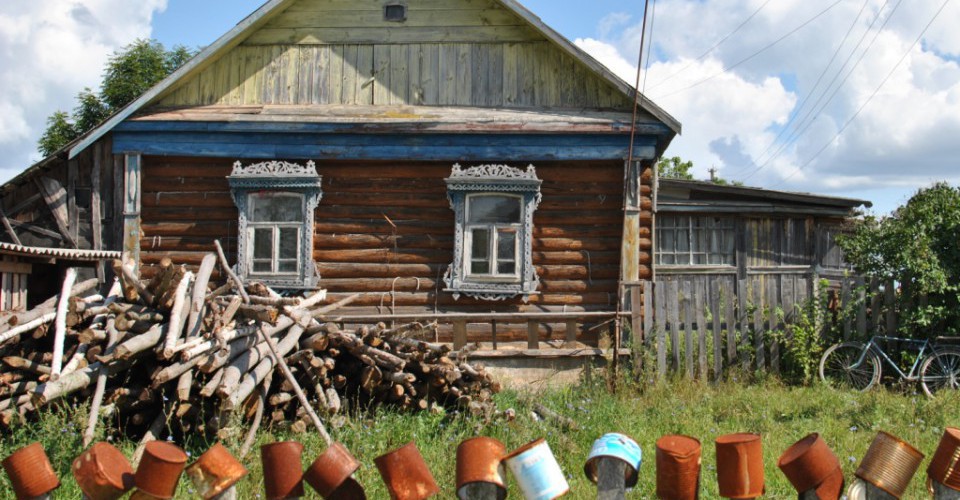
And the social context of the film once again should give pause for a more positive take – this is a tiny town 20 hours from Moscow (including plane journey). Yet it produced a ‘high cultural level of schooling’ that allowed Talankin’s mother to raise him. The kids, despite the reality they face are future-orientated and full of hope. It’s a human portrait –really of Talankin who is depicted as loving his job, his wards, and in turn is valued as a trusted adult of those who are coming of age. The school resembles a total social institution of the kind anthropologists described in Soviet times – but with as much ‘good’ going on in it, as ‘bad’. As such, it’s part of a bigger ‘island’, as Finn Sivert Nielsen described Soviet factory towns in the 1980s. There’s safety and some danger in the island. Now, as then, the island is also under siege from the other pressures in society. Eventually you must leave such islands and, if you’re like Talankin, become a nomad, even if such places offered you more good than evil.
 Postsocialism