Tag Archives: public opinion

Is Russian society ready for a ceasefire?

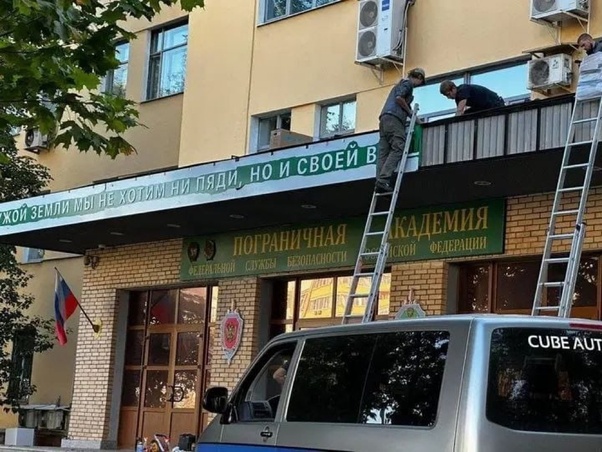
workers dismantle the motto of the Russian Borderguards Academy which reads ‘We do not desire even an inch of another’s land’

Tl/dr: yes, Russian society wants an end to war, but the core hawkish elite craves recognition, at least for Crimea and thinks maximalist extraction from Ukraine via Trump is possible.

Firstly, it’s important reiterate a point I’ve made many times: treat public opinion measurements in Russia by Levada, Vtsiom and others with a healthy dose of skepticism. They of course, do give us a picture of what most Russians perceive to be the politically correct answers to the questions they are being asked. Even Vtsiom admits that only a small minority of people polled believe that their participation in surveys allows them to express their opinion. This figure is 22%. And only 18% of people believe that the authorities are interested in their opinion. This has significant implications for how seriously we should treat surveys as a reliable barometer of public sentiment.

What’s more helpful is tracking over time the proportion of people who answer that they would support withdrawal from Ukraine without reaching Moscow’s military goals. Especially important are those findings, such as those of Chronicles, which recently show a higher percentage who say they would support a ceasefire without achieving these goals than the percentage who oppose such a decision – Chronicles recently measured this as 40% versus 33%. Significantly, the latter figure has fallen quite quickly from 47% previously. Chronicles overall thinks that the implacable pro-war cohort, or ‘maximalists’, is only 12% of the population. I would agree overall.

We can compare these kind of findings to research undertaken by American political scientists on the structure of Russian society in terms of types of popular conservatism. In a recent article, Dekalchuk and her coauthors argue that there are four clusters of non-conservatives in Russian society and five clusters of distinctly conservative groups. The latter are a majority of the population at 60%. The number of ‘die-hard’ conservatives who align with cultural and military patriotism is 15%, whereas the number of loyal and agreeable authoritarians is around 25% combined. Now, I should say I have some criticism of the overly complex methods of Dekalchuk’s study, but it serves as a complement to other approaches. Importantly, it shows that a similar number c.20% of ‘conservatives’ are not aligned with the authorities, or are even opposed to them, or have interests diametrically opposed to the elite.

At the same time  there is a big core of people who are essentially liberally-minded – perhaps 40% (and in reality if the winds changed, this number would easily be a majority). Thus, if we discount liberals from consideration the die-hard conservatives who are highly trusting in the authorities but not even particularly xenophobic, and then count them together with the group of agreeable authoritarians at 25% we can see that any decision about ending the war is not likely to have any problems justifying itself to these cohorts. Indeed, the paper in question argues that the core conservative groups have relatively weak value systems and can quickly adapt to new geopolitical circumstances.

I would add to this my own observation from polling done before the war on the salience of Ukraine to most Russians. It was very low to be almost statistically insignificant – meaning that if the elite want to drop Ukraine down the agenda this could be achieved almost without political costs among the Putin constituency. Finally, I would mention longitudinal monitoring carried out by Levashov and others at the Russian Academy of Sciences. This shows aggressive forms of patriotism to be extremely low in the general population: ‘patriotism’ as meaning the readiness to take up weapons is measured at only 25% by his team in 2023. A remarkably low number if we consider that this polling was conducted a year after the beginning of the full-scale invasion. In the same survey conducted in June 2023, only 4% of respondents named ‘patriotism’ as a source of national pride in Russia. 13% named the army. And 27% could not answer the question. The highest scoring answer was ‘The Russian People’ at 16%.

Economic imperatives

Deteriorating macro-economic situation is a major factor which will become more salient in the course of 2025 and 2026 regardless of any decision about a ceasefire. The increasing economic costs of the war for ordinary Russians was possible to offset or hide for much of 2022 and 2023, but the cumulative effect of inflation on basic foodstuffs has been relentless. Even where workers have received indexed pay increases, if we take a longer-term view, living standards for the majority have stagnated since at least 2013. It is important to remember that regime legitimacy has been primarily based on economic stability. Defence spending rose by 30% in 2022. For 2024 military spending was nearly 7% of GDP which accompanied the first serious deficit spending by the state of around 2-3%.

Wartime spending has boosted the apparent size of Russia’s GDP relative to other economies but what many observes fail to account for is that most of this spending has little multiplier effect in the economy outside military cities (which are small and isolated) and that given the grave infrastructural deficiencies in the economy and poor level of social protection spending, the decision to cut budgets that would actually improve life for Russians is an increasingly visible political choice by the elite that cannot be hidden even from notionally loyal citizens. The majority of people are less than enthusiastic about seeing a further reduction in living standards like that experienced after the integration of Crimea in 2014. People have economic ‘memories’. People often talk about their grievances about paying pensions to people in Crimea and now in the occupied territories of E. Ukraine to people who did not contribute to the Russian economy and so have not ‘paid their way’. This sense of undeservingness among new Russian citizens is a factor few have discussed.

To reiterate, one of the current major failings in analysis is the attention paid to the apparent growth and robustness of the Russian economy. With or without a ceasefire – the shift to military spending stored up major pain down the line for the main Putin constituency – state workers – in the forms of eroded purchasing power, deterioration in the quality of public services and reduced state capacity. (I will post later on the much commented-upon findings about a rise in life satisfaction among Russians)*.

Furthermore poor choices will only become more apparent as part of a conscious zero-sum policy choice as things like water infrastructure and public transport are characterized by breakdowns which are impossible to hide. Coupled with the plan to abolish the lowest level of municipal governance in favour of clusters of urban forms and the accompanying pressure this will bring on the performance of regional governors, it is highly likely that social strife will be an ever present political risk outside the 10 biggest cities – particularly in the rust belt and secondary cities, even in cities that have been the beneficiaries of military spending like Nizhnyi Tagil.

This is because the multiplier from higher military industrial salaries is much less than people in the West appreciate. If you go from earning 40,000 roubles to 100,000 roubles, that is still a drop in the ocean, especially when the real level of inflation is around 20% for wage-earners. For Russian military spending on soldiers salaries to have a significant impact it would have to change the share of national income accruing to labour. And Russia remains a country where despite very high human development, the share is around 10% less than in other highly developed countries. Consequently while there is an inflation shock, this is not primarily due to increased discretionary spending, which remains low even by East European standards. Similarly, soldiers salaries certainly have an impact on the family fortunes in the short term of the 500,000 -plus service personnel who have received them or who have received injury payouts or death benefits, but again, in the perspective of an economy of 140 million people, this impact does not scale, while it certainly does act as a drain on spending on other social priorities like child benefits, school budgets and hospital maintenance.

Elite opinion on ceasefire

What about elite attitudes? We can take a metalevel perspective on the information they receive about social mood. Likely, because of the ideological positioning of sociologists working for the regime, they get relatively good answers to questions they might ask. But we should be cautious about the quality of the questions they are willing to ask. We see the problem with this in wording of questions that sociologists ask in opinion polls: these are generally quite narrowly worded and focussed on identifying consent among people for decisions already taken or likely. Furthermore, we should recall that there is evidence of conspiracy theory belief and mindsets focussed on the possibility of betrayal by Western interlocutors.

As many have pointed out, the Russian leadership craves, almost pathologically recognition by the West more than anything else, and in the Trump leadership, it is clear they believe it may be possible to get some kind of recognition for Russia’s Great Power status and also carve out at least most of the territorial gains they have captured from Ukraine. It was interesting to observe the recent comments by Trump concerning American recognition of Russian sovereignty over Crimea. It’s quite possible to imagine that this is a kind of psychological priming or imprinting originating from the Russian side. Recognition of Crimea by the US would be a significant win worth having in exchange for even a relatively long ceasefire commitment. It would also be more realistic than trying to get acceptance of recognition of 2022-2025 territorial gains.

It seems very unlikely that any Ukraine government would agree to giving up more territory that would include the other parts of the regions partly occupied by Russia. The only other area under almost complete control is Luhansk region. Thinking back to how unworkable Minsk Agreements proved to be for both sides, it’s not likely that even after a prolonged ceasefire that the Ukrainian side would agree to any withdrawals. This means a frozen contact line and militarization of the existing contact line as a new border for Ukraine. This is far short of the maximalist aims of Russia, but Crimean recognition would easily compensate for this in terms of justifying a long-term ceasefire to the population. After all, there is significant war weariness, economic fatigue, a lack of belief that Russia can win in the long term, a lack of interest in the territories of Donbas, in comparison to broad and strong belief that Crimea is historically part of Russia.

This kind of ceasefire could easily be sold to the population along with the narrative that Russia can now rearm and regroup – take a breather, so to speak, that Russia has effectively held off the combined power of the collective West, and that it has saved those “Russians” who were in Donbas. Furthermore regime intellectuals can spin a tale of how this agreement effectively means recognition of Russia as one of the three great powers and having surpassed her European peers.

*I’ve been asked multiple times to write about rises in life satisfaction and will do when time permits. In short, the war has led to people focussing on small things of satisfaction and fragility of existence. Furthermore, people express satisfaction with less, as if they are ‘grateful’ the state has protected them from the dire prognoses of ‘blockade’. I would also say that the coverage of the report in question tends to gloss over the fact that the life satisfaction levels are still not that great! Where do they define happiness? What does it mean, cross-culturally, ‘to be happy’? There’s a massive anthropological lit on this, and I’ll unpack that in a future post, but one thing to consider is the extent that cross-cultural ‘contentedness’ derives from the ability to adapt to disappointment and frustration.


Public opinion, disinformation and moral disengagement: social media and the Russian invasion of Ukraine

Guest post by Dr Charlie Walker of Southampton University

Many thousands of Russians have protested against the war in Ukraine, and have been imprisoned for doing so. However, the available public opinion data suggest that we should not expect hundreds of thousands of people to take to the streets anytime soon. This is not only because of the obvious dangers of social protest in an increasingly authoritarian state, but because a large proportion of the broad mass of the Russian population either supports the war or, at least, does not object to or condemn it. Given that Russian media has acted as a propaganda tool for Putin’s regime for more than twenty years now, and that there is very little independent media, we should not be surprised that many will be following the disinformation directed from the Kremlin, especially those who watch television, which Russians have long referred to as the ‘zombie box’.

A campaign to break through the wall of disinformation that surrounds many ordinary Russians, the CallRussia initiative, was recently launched in the UK, and involves Russian speakers randomly telephoning Russian citizens, working on the assumption that many are simply starved of alternative viewpoints to those pushed by the Kremlin. However, if we look at Russian social media such as VKontakte.ru it becomes clear that providing alternative forms of information about the war is unlikely to break down the wall of disinformation, not least because ordinary Russians themselves (sometimes bots and trolls, but often real) are busily engaged in reinforcing it.

Responses to war-related posts on social media replicate what social psychologists refer to as mechanisms of moral disengagement. As McAlister et al. (2006) argue, in order for a country to go to war, it must create conditions that enable both soldiers and publics to suspend the moral evaluations and self-sanctions they would ordinarily undergo in the face of inhumane conduct. The psychosocial manoeuvres that enable moral disengagement take a number of different forms, all of which are amply demonstrated in responses to the present conflict amongst Russian social media users…

Continue reading the full post on Charlie’s page:

Public opinion, disinformation and moral disengagement in the Russo-Ukrainian War: evidence from social media – Charlie walker (cwsociology.com)

Russian Cultural Conservatism Critiqued: Translating the Tropes of ‘Gayropa’ and ‘Juvenile Justice’

My article on homophobia and juvenile justice finally came out in Europe-Asia Studies. You can get a pre-print copy here. I’ll do a quick summary and reflection in this post.

The article started as a series of dissatisfactions about the way ‘culture war’ and conservative turn were extended from application to the Russian elite and big politics to ordinary people. As if to say, that as the media propagate intolerance, people blindly and automatically follow. Now, sure, I’m not saying there isn’t a strong effect when the media consistently demonises a group – just look at the xenophobic British press. However, my argument is that there is never a neat translation into everyday life of a trope like gayropa. I started thinking about this in a post from 2019.

Another prompt for my article was Greg Yudin’s demolition of a notorious poll on attitudes to Stalin and the problematic preconceived ideas that shape much Russian polling. Greg was writing around the same time Levada’s latest poll on ‘attitudes to LGBT people’ came out. I commented then that more methodologically robust studies find that while Russia is ‘medium-high’ in terms of preference for ‘traditional’ values in comparison to other European countries, there are big long-term shifts towards ‘tolerance’ in general, and away from extreme attitudes towards LGBT people in particular.  

This week we see something similar with disproportionate attention and interpretation afforded to a Levada poll showing a fall in people answering ‘yes’ to the question: “do you consider Russia a European country” (from 52% in 2008 to 29% today). I pointed out that at the very least this is a very slippery question that tells us nothing about the substantive meaning of people’s answers – whether they say yes or no.

In my article I bring out the many conversations I have had with my long-term research participants about homosexuality, childrearing, corporal punishment and so on. Certainly there is some reflection of ‘official’ values in talk, but these are overshadowed by longer-term ‘structures of feeling’ – some of which do emphasise ‘traditional’ values. I also engage with Chantel Mouffe,  Michael Herzfeld’s work on ‘cultural intimacy’ and similar work by Alexander Kiossev. They critique an unsophisticated version of cultural hegemony. This allows a space for ‘everyday politics’ to emerge in talk, even in what might appear as unambiguously intolerant or conservative attitudes.

Some things I didn’t have space for in the article – how some perspectives on intolerance in places like Russia are a form of psychological projection; I highly recommend this piece by Katharina Wiedlack on the ‘Western gaze on Russian homophobia’. There’s a long discussion about cultural attitudes to childhood in the article; with the effect of Covid and various other things, I more and more tend to the conclusion that British people utterly despise children

In Chechnya and elsewhere in Russia, men are murdered for being gay, and official homophobia causes untold suffering and the perpetuation of intolerance. But as Wiedlack argues, there are ways of criticising and condemning prejudice and violence without perpetuating notions of western hegemony and counterproductive ‘leveraged pedagogy’ (Kulpa 2014) around sexuality and gender.

Conference Groundhog Day – Russian self-stigmatisation and more public opinion problems

Groundhog-Day_Louis_113503d

‘Hey that coffee is for the whole conference panel!’

This post is ‘inspired’ by the Groundhog Day I experience when visiting international conferences. On the one hand we have intellectuals focusing on elite discourses and the exaggeration of their effects – a depressing fact that tends to trammel the terms of the debate (and the views of anyone listening) on what is happening in Russia. Carine Clement put this well when she similarly lamented:  “a conference where a small group of intellectuals [discuss] the “people” without ever mentioning any empirical arguments other than the speeches of leaders and/or intellectual elites.”

On the other hand we have the problem of ‘self-orientalisation’ (the very topic of my own paper at the conference) writ large in the presentations of respected Russian contributors. Recently, my own experience of the uncanny was a panel which looked like one of the outstanding events of the conference, devoted to language, society and state discourses. This is something of a churlish post and therefore I’m not going to name the conference or presenters. Of course it would be easy to work it out.  Call me a ‘sub-blogger’ if you like, but my motives are partly ethical. I went to this panel because I respect the work of both the scholars concerned and the main discussant. Their work elsewhere is really good (perhaps there’s a lesson here about presenting only your best stuff to international colleagues).

One participant presented a polished paper investigating whether the ‘rally round the flag’ effect in Russia was sustainable. The presenter argued that it was possible to ‘move’ opinion  by presenting information on how sanctions negatively or positively affected the economy and asking people about ‘preferences’ between Great Power status and economic well-being (can you see the parallels with Brexit yet?).

I understand that experimental survey design is really exciting to political scientists (yes, you can read sarcasm). However, the methodological assumptions of the entire thing are a bit obscure, like when somebody combines steak with ice cream on the basis that steaks are good, ice creams are good, let’s eat them together. For a start the ‘rally round the flag’ and preferences things seem so crude and, well, artificially distant from how (most) human beings really think. (This is what relates this post to the idea of nuance and context being lost when we talk about measuring public opinion on artificially ‘curated’ topics – the point of my last post). For example, sensible (real, non-neoclassical) people might understand the Keynesian nature of the military industrial complex and that it is not necessarily a trade-off between it and the rest of the economy. I.e. butter might be dependent on guns. In addition, this might be true not just in the underdeveloped rest but also in the ‘cradle of civilisation’, see Cypher, 2015: https://www.tandfonline.com/doi/full/10.1080/01603477.2015.1076704

The paper argues that Russians increasingly favour ‘butter’ over ‘guns’ under economic distress. And here is the novelty of the study –  it tries to causally grasp this question. But there is a reason that others do not attempt this kind of tweezing of causality, because circumstantial evidence cannot really be translated into anything meaningful other than a lot of variables. This leads to bigger standard deviation, smaller significance level, small explanatory power. Not only that, but what are the confounders? Everything I guess is a ‘lurking variable’ here. What if any observed changes in the experimental group were not due to the intervention but were merely a Hawthorne bias? I think this is really an underappreciated issue in survey-based research generally in Russia – even that which is supposedly ‘anonymous’. What the Hawthorne effect means, is that people modify their behaviour in response to their awareness of being observed – and not just in terms of the immediate context of the poll. There’s an even more mundane objection: that people’s ‘immediate’ response to a bad or good news story tells us little or nothing about their deeper or more enduring political ‘preferences’, if they have them at all.

We also are presented with a black box of the execution of the study – nothing on completion rates of the survey (similar criticisms of the big opinion pollers I discussed in the previous post). After the attrition rate are the groups still representative? Was a little bit of imputation involved maybe? If so, did it remain under 10%? In what sense was the study ‘representative of the Russian population’ when it was performed in white-collar offices in Moscow? The answers are not marginal to the research question. How did the study avoid the cart and horse problem of questionnaire design? ‘Could it be that the methodological standards are much lower in Polsci than in sociology, let alone epidemiology or medicine?’ mused my colleague (whom I thank for his help in thinking through these issues).

For a long time when I first got exposed to quantitative papers in social science, I felt some awe in front of these wizards of the regression. Especially when I was usually next up to present my extreme qual musings on what Russians ‘really thought’ based on ‘conversations’ (participant observation) with around 50 research participants. ‘Your ‘n’ was what? 52?…. ok….’ Or this priceless comments from a dear colleague with significant interdisciplinary experience and sensitivity: ‘So your research is like a form of journalism, right?’

bill.murray.groundhog.day_.story

Steak AND ice-cream in one paper? Just tell me your attrition rate, ffs!


¤¤¤

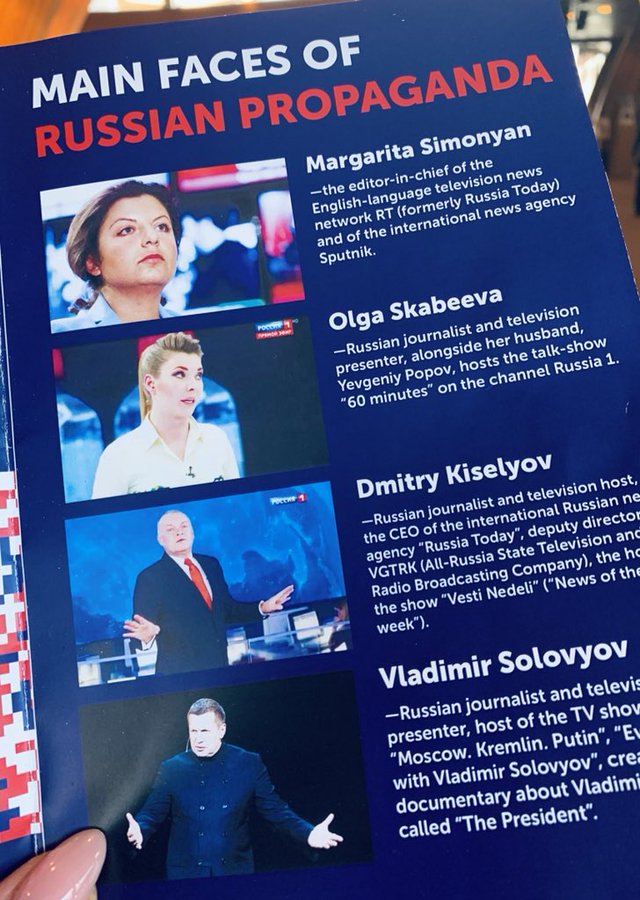
The following paper on the panel was on propaganda and resorted to a framing now subject to increasing critique – including in this blog. The ‘Soviet person’ was deprived of a ‘restraining notion of culture’ and therefore has (what, still?) not learned the ‘lessons of modernity’. This provides fertile ground for the ‘mythological propaganda language’ of journalists like Dmitry Kiselyov who successfully propagate a kind of T.I.N.A perspective: ‘Progress’ in the form of western-style modernisation is to be feared in all its guises. Society suffers from a kind of ‘moral degradation’. I think, though I’m not sure, that at one point the speaker mentioned the ‘catacomb’ existence of contemporary Russia.

D90gwn6XYAEU94w

The discussant (the person supposed to read and respond to the written versions of the papers and tie them together) was critical, drawing attention to the problem of studying public opinion in Russia in the same way it is studied in more pluralist societies. Talking to him afterwards, I mentioned how the whole idea of ‘political preferences’ was so difficult to impute to research participants in these kind of studies. That’s not to say they are unthinkingly loyal or ‘know the script’, on the contrary, it is because they themselves know that ‘preferences’ are less meaningful, so their ‘answers’, are not necessarily very meaningful either.

Similarly, in response to the second paper, the discussant pointed out that it might be more useful to look at the experience of ‘liberal’ journalism compromising with its own principles in the 1990s as the root for a decay in public discourse (it’s only partly relevant here, but it’s worth reading Sean Guillory’s piece on the 1996 re-election of Yeltsin in these terms). The Russian intelligentsia would be as much to blame for the failure to develop a ‘critical’ perspective more generally of how all discourses are political, including their own. He also made some excellent points about the ritualization of media discourse and consumption having more of a religious quality than necessarily indicating the malleability of opinion.

All of which reminded me of a number of things. Firstly, having seen the kind of performance provided by the second speaker I have to admit I was reminded of the idea of the ‘self-hating Jew’. Okay, bear with me, I know this is a much critiqued idea and that it’s not comparable to the situation of Russian intellectuals towards Russianness. However, these kind of approaches do qualify as a form of ‘extreme vilification’ of not only one’s own state and society, but attributing a kind of sustained moral failing to the nation. Is this not also an internalised form (self-stigmatizing) of some Western essentializing ideas about Russia and Russians?

The talk reminds me of the debate on ‘Soviet man’ as a ‘methodologically contestable’ category – that ignores diversity and compresses time. (Sergei Abashin here also makes some great points about areas where it might be worth researching what makes a person ‘Soviet’ – hinting at an approach on embodied experience and the everyday – his words remind me of Mauss on body techniques). Oleg Kharkhordin’s work also came to mind on how ‘Russia lacks a public language’. It’s not that Kharkhordin is wrong, or that our second speaker doesn’t have a point. It’s that so often these perspectives fall into an idealisation of non-Russian models. In turn this has the effect, intentional or not of a totalizing rejection of indigenous possibilities. For example, Kharkhordin proposes adopting parliamentary procedure to promote civil society – as if ‘Robert’s Rules of Order’ were ever practically applied outside a few narrow examples of associational life in the ‘West’. In turn, this reminds me of the way Putnam-inspired approaches fetishize a version of civil society (not even one that really approximates to the ‘real’ US) that sets up a hierarchy of societies – with Russia obviously being ‘backward’.

download (3)

In my own contribution to the conference I examined the so-called conservative turn in attitudes and critiqued the idea that the transmission from elite or political entrepreneurs to ordinary people is quite so direct or simple. Using Michael Herzfeld’s idea of ‘cultural intimacy’  (an aspect of ‘social poetics of the nation state’) I try to show that any ‘self-orientalizing’ by ordinary people (‘we’re Orthodox and we’re proud to be intolerant’) serves locally salient political and social purposes that are at variance with the conservative rhetoric from on high. But that paper is a work in progress and a topic for another blog post.

Russian ‘notorious’ homophobia? The perils of measuring intolerance (and making cross-cultural comparisons)

LGBT right activists protest Russia

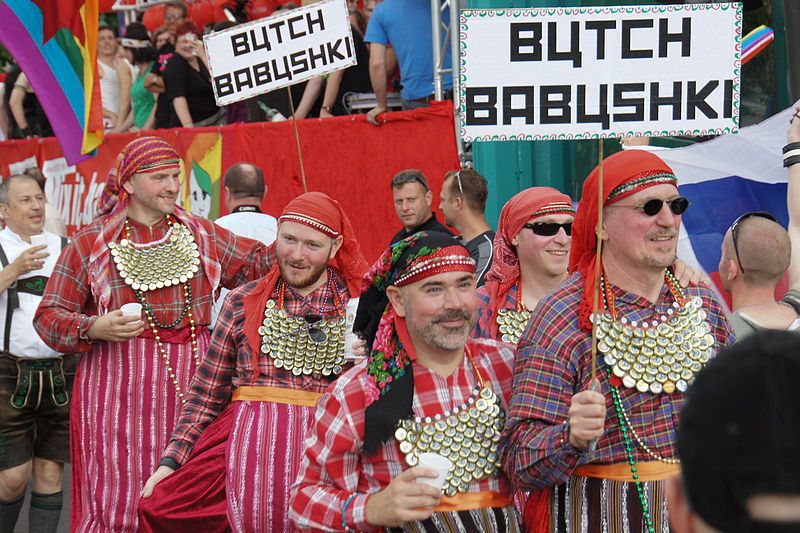
Activists in Berlin protest LGBT rights violations in Russia, including egregious abuse of Cyrillic and a large dose of Orientalism to boot.

I’m reading a lot at the moment about ‘culture war’, the conservative turn’ and things like historical homophobia in Russia. This is to prepare a paper and, hopefully, publication on this topic for a special issue in Europe-Asia Studies that a colleague proposed. So immediately I thought, well, what about looking at this from the ground up? Instead of taking it as read that where conservative entrepreneurs like Yelena Mizulina lead (‘prohibition is freedom’), ordinary people ‘follow’, my hunch was that actual penetration into society of ‘Gayropa’ tropes is weak. That’s not to say there is some fertile ground, and of course a long history of different types of intolerance, some of which are ingrained.

And so I was lucky enough to be able to do some focused interviews with some of the long-term contacts I have and surprisingly was able to get quite a (small) cross-section of people talking about this in my fieldwork last year. My rather banal conclusion is that while homophobia (like antisemitism) is sometimes talked about as if it were a national pastime (hey don’t troll me; more than one Russian friend has made this ‘joke’), Russia is not the ‘intolerant’, socially conservative place it is so often presented to be, when observers assume an active response to elite-led rhetoric about the malign influence of a degenerate western ideology of permissiveness. Take up and ordinary use of ‘Gayropa’ is the exception, not the rule around ‘everyday homophobia’. Although, having said that more than of my close friends in the field is a very big consumer of the Juvenile Justice narrative and there certainly is a susceptibility to the paedophilia-homosexuality linkage slur (Tova Höjdestrand has done good work on this and ‘grass-roots conservatism’ in general). This was brought home to me because when I moved from the UK to Denmark, it became a hot topic – Scandinavia being the blank canvas of permissiveness onto which some people project their fantasies (no I’m not going to talk about the story about the brothel for animals in Denmark – get your own browsing history tagged).

Danish Porn and Art Warning Sign

One of a collection in the series ‘You know you’re in ultra-laid back Denmark when…’ Porn (including some hardcore and violent films!) ‘might not’ be suitable for children?

Anyway, I will get back to those topics in a later post, perhaps when my article it better developed. In this post I want to focus in on the recent polling on homophobia (an ‘emblematic’ topic for measuring intolerance of others), in the light of the equally topical debate on the perils of opinion polling, and the homo soveticus debate. These three issues are now linked in my mind. What follows is my rather rough working draft of my deep suspicion of public opinion polling as evidenced by that done in Russia on homophobia (okay, I only looked at Levada).

Let’s take the recent Levada poll on ‘Attitudes towards LGBT people’. Radio Echo Moskvy presents these as: ‘More than half of Russians are negative towards sexual minorities’. This is accurate. However, without longitudinal context (conspicuously absent in coverage of the poll), things look different. While the headline ‘disapproval’ of homosexuality (56%) is presented with no time series to compare it to, other longitudinal data shows an ebb and flow from 51% approval in 2005, to a low of 39% in 2013, and back to 47% in 2019. Similarly, instead of ‘disapproval’, one could highlight the volatility of the ‘strong approval’ rating of equal rights: from 17% in 2005, down to 7% in 2013 and now 20%. In any case, psychology of survey data shows that people are more likely to respond with a ‘strong’ answer to items they interpret as politically topical and are presented with (compare the critique of ‘push polling’) – Brexit and migration is a good example of this.

Looking at the question of survey data and public opinion more generally, a major problem of interpretive comparability over time (among many others) is the tweaking of question wording that inevitably happens and the difficulty in formulating open questions. Levada recently came in for criticism on this very issue with their controversial survey on Stalin and Stalinism.  Here too, on homosexuality, the same problem is evident; it is very difficult to compare longitudinally a much more interesting question about ‘nature versus nurture’ in the creation of sexuality. In the 2019 poll, the question is, ‘Do you think sexual orientation can be changed under the influence of external circumstances or is it an innate characteristic?’ Leaving aside the clumsy and potentially confusing wording of this question that many respondents might struggle to understand, this question is quite different from the one in 2013: ‘Do you think sexual orientation can change under the influence of propaganda?’ Interestingly, Russians gave a resounding ‘no’ to this answer in 2013. In the 2019 version 46% agreed that sexual identity is malleable, while 27% thought sexuality was innate. I would argue that both question forms are methodologically ‘leading’ and that pollsters could have chosen a more neutral or open form of questioning.

There appears to be more interpretive value in more modest aggregate longitudinal comparisons. On ‘family values’ and the civilizational differences between Russians and ‘Europeans’ this has been attempted through integrating survey data going back to 1989. These show a relatively rapid movement from harsh intolerance of homosexuality towards a slightly less intolerant mindset by 2011. For example, Fabrykant and Magun (2011) present data showing a sharp fall in people wanting to exterminate homosexuals (from 31% to 5%) while ‘toleration’ nearly doubles to around 25% of respondents. The authors are optimistic about changes to normative values given that even the highly stigmatised meaning of homosexuality shows moderation over time. On the other hand, their comparative results show that in 2013, 70% of respondents still gave answers indicating they thought homosexuality was pathological in some way. (Big thanks to Marharyta Fabrykant for making me aware of these materials – you can check out her work here).

More recently, the same authors have pointed out that Russia is among on the ‘medium-high’ end of tradition-normative values in comparison to other European countries (Fabrykant and Magun 2018: 82) [opens as a PDF]. They base this evaluation on the work of Viktoriia Sakevich (2014) who analysed Pew Research Center data on ‘moral’ values.  When these findings are broken down by category, Russia differs little from Western European countries on issues such as extra-marital and premarital sex, divorce, abortion, contraception. In some cases Russia is more ‘liberal’ than both Anglo-Saxon and some Southern or Eastern European countries. Homosexuality is the outlier, with Russia more similar to Asian and African countries.

However, we should again exercise caution, because so much depends on how questions are phrased. If we return to the important question of nature-nurture and homosexuality, Russians do not look so much like outliers. A recent UK poll, for example, records 34% of respondents as believing that gays are not born, but made, with much internal variation in the sample (YouGov 2017 – Opens as a PDF). As recently as 1998 a majority (62%) of British people thought homosexuality was always, mostly, or sometimes ‘wrong’ (Clements and Field 2014). One could even take a contrarian view and argue that based on attitudes towards adoption of children by homosexuals, British and Russian people are pretty similar when it comes to the question of equal rights: British people are strongly against gay men adopting (actually, like Russians they are very inconsistent and answer differently depending on how the question is asked!). Edwin Bacon makes a similar argument, highlighting similar levels of nationalism in Russia and some Western countries today, and reminding us that attitudes towards homosexuality only changed (but did they?) in recent living memory in the West, and that on some measures, Russia is arguably more socially ‘liberal’ (immigration). Finally, as I write this, open hatred of gay people is in the news in the UK with two violent attacks in public given widespread coverage (in Southampton and in ‘tolerant’ London) this week and the ongoing standoff over the teaching’ of LGBT issues in Birmingham.