Author Archives: Jeremy Morris

Unknown's avatar

About Jeremy Morris

I write about Russia as an academic. But don't let that put you off.

Why do 66% of Russians regret the collapse of the USSR?

2018-05-11 18.52.56

I was asked today to answer this question by a journalist, so I thought I’d share my responses. Thanks to Jesper Hasseriis Gormsen for asking it. And check out his [Danish language] podcasts on Russia http://intetnytfravestfronten.dk/

This is a really tricky question, but what I want to stress is two things – like many other polls, the answer might not be telling us what we think it is. The answer might be to a different buried question in the mind of the answerer. That question (among others) might really be ‘why do so many people live so badly now, when in the USSR they did not (or at least everyone was in the same boat, more or less)?’  Thus eliciting the answer: ‘Yes, I do regret the collapse of the USSR.’

Note (and I guess it needs saying), that this is not my opinion of what the USSR was like (as if there can be a single ‘reality’ of lived experience of an incredibly diverse state that existed for 70 years), just an interpretation that might well be ‘real’ to the person who is asked the question.

The second thing is that poll answers are overly and frustratingly simplistic answers that actually express (or, as I have just said, obscure) very complex feelings and values of the people they are asked of. It is amazing that when I talk to political scientists, they often don’t really believe this in their heart of hearts. Take for instance Brexit or Trump. These ‘answers’ are not merely, or even mainly, about ‘immigration’ or ‘racism’.

Thirdly, the devil is in the detail of the question. It’s well known that survey questions can be phrased and ‘hacked’ to significantly change the result – and pollsters know this (or should do). I don’t think that’s the case here. However, Levada, by using the term ‘collapse’ [raspad] does set out a particular ‘framing’ inadvertently, of the ‘ending’ of the state called the USSR in 1991. One that sets up in the mind of the person answering it, even if they are too young to experience it themselves, the trauma of postcommunist transition. Here we might add – why wouldn’t someone sensitive to the past, or lacking clear ideological support for ‘actually-existing capitalism’ answer: ‘Yes, I do “regret” the passing of the USSR, the state I was born in, or that my suffering parents were born in and worked hard all their lives for.’

Let’s turn the phrasing around. If Levada asked: ‘Do you regret the founding of the Russian Federation in 1991?’ I’m pretty sure the majority would say ‘no’ and so the poll would in a way be reversed.

Here’s the poll in question.

https://www.levada.ru/2018/12/19/nostalgiya-po-sssr-2/

Note the fluctuation since 1999 of around 20 % of the ‘regret’ vote (however, most ‘regrets’ are in a band between 53% and 65% since 2005). (Don’t look at the graph, look at the table). This fluctuation could be to do with people with direct experience of the USSR (positive or negative) dying along with people with no personal experience thinking in more rosy terms about the period – hence a kind of up and down wave effect.  But, you would also expect nostalgia to rise according to periods of crisis. When people feel their lives are not going to plan they might well look back to a ‘simpler’, more ‘stable’ time with nostalgia.  That’s plausible for the figures in 1999, 2000, and 2001 when people took a massive cut in living standards due to the Defolt. However, that is not borne out by the data here when taken in terms of trends over time since then. So perhaps there is not clear answer as to ‘why’ the numbers fluctuate. Here we could have an aside about polling most often telling us ‘nothing’ directly related to the question.

Now to the question of the meaning of nostalgia.

In her wide-ranging book The Future of Nostalgia, the wonderful Svetlana Boym identifies two distinct types of nostalgia: ‘restorative’ nostalgia and ‘reflective’ nostalgia.  Restorative nostalgia, “puts emphasis on nostos (returning home) and proposes to rebuild the lost home and patch up the memory gaps.”  Reflective nostalgia, on the other hand, “dwells in algia(aching), in longing and loss, the imperfect process of remembrance.”

Boym was first and foremost a Russian cultural scientist with a deep commitment to the personal insights lived experience provides for research. We can ‘read through’ her descriptions to suppose that both forms could be operative for nostalgia towards the Soviet Union. And as their psychology origins suggest, nostalgias can be personal quirks, irrationally warm ‘affective’ feelings, passing infatuations, or indeed pathologies bordering on madness. I suggest that all these are operative in different people at different times in the last three decades.

Lastly, we can break down nostalgia into a scale of more ‘rational’ interpretations by people. I rank these not in order of importance, but in terms of macro-to-micro social scale. All, some or one may be simultaneously operative in a person’s mind when they answer the pollster’s phone call – in fact none of them might be operative and the person getting the call might just want to get the pollster off the line!

  1. Nostalgia for Great Power status (empire and the respect for the geopolitical might of the USSR). See Mazur below (and Kustarev) on the ‘myth of achievement’ and the ‘myth of power’.
  2. Political order (totalitarian as a system that ensures a lack of political and civil strife, that obviates the need for the citizen to perform any political roll – relief at this and thankfulness – particularly effective in those that see the 1990s as ‘chaos’). See for example, ‘We grew up in a normal time’ – the title of a chapter in a book by Don Raleigh on Soviet baby boomers.
  3. Social order (“to each according to his needs”) – the Soviet social contract (which Linda Cook shows was failing in large part by the 1980s). Related to this, as in the West, a period of sustained social mobility. See, for example, Liudmila Mazur’s ‘Golden age mythology and the nostalgia of catastrophes in post-Soviet Russia’, although her polling data paints a more complicated picture of the ‘myth of prosperity’.
  4. An emphasis on the sincerity in personal relations, the intensity of personal trust and reciprocity given the ‘heartless system’ of the USSR – note how this is contradictory to point 3, yet perfectly possible to hold this belief at the same time as number 3. People are like that.
  5. Nostalgia for the time of one’s youth (probably universal – hey, I think the early 1980s in the UK were great, but ask a miner or other person from the North that). Nostalgia for personal and more widespread idealism (the BAM-romanticism factor) that accompanied this. See Mazur on the ‘myth of achievement’.
  6. Recognition of Labour(due recognition given to labour as the primary factor of production). Not that I am not saying that work was more ‘dignified’ or better paid than in the West during the Fordist period after WWII. Merely, and this is what most of my research interrogates, many working-class people feel nostalgia for what they perceive as a better time before the present. They highlight particularly, relative lower inequality (everyone was paid badly!), relative degrees of social compensation for labour (the social wage and labour paternalism included subsidised childcare, faster routes to social housing for workers, subsidised food), the team-level autonomy of work given the dysfunctional industrial system – bottle-necks, old equipment, distant management, shortages – all these led to a large degree of control over work, as enterprises looked to individuals and teams to find quick and dirty hacks to solve these otherwise intractable structural problems with the Soviet economy. Another way of looking at this is to say that workers had little or no political or associational power in the USSR, but they did have structural (work-place bargaining, or ‘contingent’ power).

Also operative are the answers that regret ‘loss of homeland’, ‘destruction of kinship and other ties’ – these are offered as options in the more detailed poll question. However, I think my 6 are more heuristically persuasive than the dry promptings of Levada, including the most important one: ‘the destruction of a united economic system’, although my points 2, 3, and 6 could be version of that.

Note that nowhere do I find it persuasive that there is nostalgia for the overly abstract notion of ‘communism’ as a system or the ‘communists’ as a ruling party… I intended to reference this piece on the mythology of the Soviet Past by Kustarev, but didn’t have time in the end. I highly recommend it. Александр Кустарев, Мифология советского прошлого «Неприкосновенный запас» 2013, №3(89)

People as the New Oil. Or, ‘как жить дальше’ in Russia? Part I

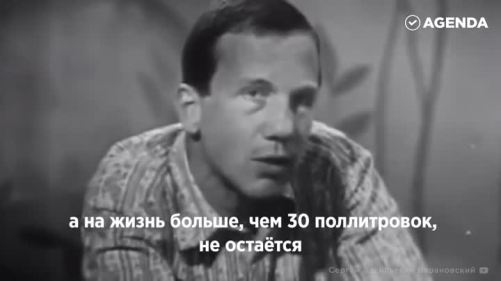
Savelii Kramarov - 'I have more than thirty half-litres of vodka left to live on'

Savelii Kramarov in a satirical sketch on the cost of living in 1971. It has become a viral meme in the last year.

Phrases on the variation: ‘people are Russia’s replacement oil’ represent a new extractive and punitive turn in domestic politics, a shift to harvesting economic rents in more intensive ways focused on the daily doings of ordinary Russians. The interpretation goes like this: consistent oil prices over $70 – not seen since 2014 – are needed to maintain Russia’s state budget. After four years of expensive foreign policy adventures and a longer term lack of progress in creating a diversified economy at home, the government has resorted to ‘farming’ the ordinary population in earnest. This is the corollary of the ‘intense struggle access to budget money’ among the elite since 2016 that [paywall] Svetlana Barsukova details. Since most Russians have seen stagnating income levels for the last decade, and witness a noticeable deterioration in state-provision in general (in health and education and importantly the entitlements connected to them – these were the top ‘concerns’ of Russians in 2018), they can’t help but feel acute injustice at the sudden zeal for extracting fines and increasing taxes on unavoidable expenses like transport and utilities, even non-existent land holdings.

While the increase in pension age gets a lot of attention, it is worth mentioning what are more pressing issues, like the price of petrol and the raise in VAT from 18 to 20 percent, and not least inflation on staples, which is likely understated by a factor of three in official statistics. Indirect taxes hit the poorest most, and VAT is levied on utility bills, which already take up around half the income of a person on the ‘minimal income’ ($170) and are now adjusted more frequently for inflation. A second issue is largely untaxed income from self-employment which cuts across classes, from nannies and tutors to taxi drivers and  tradesmen. The government declaring ‘war on the nannies’ was a recent headline. However, most people see these incomes as topping up their meagre primary incomes and interpret the state’s renewed interest in personal taxation as profoundly unjust. Third is the more general ratcheting up of the punitive tax potential of fines on motorists, late payers of utilities, and other minor law breakers. Russian roads are densely covered by enforcement cameras in comparison to most European countries.  Moscow Region alone quadrupled its count in 2018 with 1300 cameras garnering $150m in fines (this is as many active cameras as in the whole of the UK).  400 more are on the way in Moscow in 2019. But the most telling indicator for me was a national park suddenly deciding in 2017 levy a ‘user fee’ of 400 rubles a year from hikers, anglers and even villagers whose abodes happen to lie within the park, the only interest shown in the park by the ministry of natural resources since 1995. It is as if suddenly a player in the ministry decided that previous milking of the parks (through lumber harvesting and guided tours) was now insufficient.

Therefore it is of no surprise to me that a recent Levada poll showed that while Russians’ pessimism is not as bad as it was even as recently as 2013, 46% of Russians cannot plan for even the immediate future. This was published at the same time as another poll that saw presidential ratings fall back to below 2014 levels. Furthermore, the unpopularity of the government and the Prime Minister is as high as it has ever been in the post-2000 world (a record high for the Prime Minister). Perhaps more importantly, for the first time since 2013 more surveyed people respond that the country is ‘moving in the wrong direction’ than the right one (45% versus 42%).


Making impossible ends meet

Bear with me here but it’s really unavoidable that we dig down into the reality of existence for the majority of Russians – poorly paid and already highly taxed before these changes. Indeed, it’s bordering on the irresponsible that the ‘human face’ of working poverty is largely absent from much discussion (which I’ll discuss in the follow-up post). To do this, let’s look at a portrait based on a real research participant I have worked with for the last ten years.

‘Dima’ worked as a loader in a brick factory in his small industrial town for the last ten years, but there his wage was static and never rose above 18,000 rubles a month. His wife works in a food shop part time and takes home 8000 rb. They have a pre-school-age child. The household income was recently therefore less than $400 a month (26,000 rb). Dima thought he’d got lucky, in 2018 he got a job at the Samsung washing machine assembly, on the road between Moscow and Kaluga. This gave him 24,000 rb a month, a 30% pay increase. However, he needed to use a car to commute to work, the costs swallowing a lot of the wage increase. With petrol going up, now he’s earning less than he used to. Before the new tax increases come into effect these were the outgoings of the family: 7000 on utilities, and 15,000 on food, which is skimping on all but the essentials. The family relies on relatives who work a garden plot for fresh fruit and vegetables, as well as jars of preserves in the winter. 5000 a month goes on petrol, just to get to work and back (there are better paid jobs, but they’re further afield). That’s already 27,000 gone, not accounting for clothes, medicine, other motoring costs, or anything for the child. What’s left is 5000 rb – or $75.

download

When trying to measure relative poverty a robust measure is how much a family spends on food and other essentials. In the bitter current debate on how to quantify poverty, a frequently cited level is an income of least 8 dollars a day to maintain survival, and at least 15 dollars for any kind of dignified existence (especially in a ‘middle’ income country). It’s interesting to note that these two figures map closely the lower and upper range of blue collar wages a man like Dima can expect to earn. These kind of figures are criticised for not taking into account local prices (purchasing power), but as you can see, while wages are very low, living costs are relatively high and even bear comparison with many EU countries.

Just to take the example of the occasional treat of eating fast food, an example that resonates because of the supposed utility of the BigMac Index, for Dima to treat his child to a Happy Meal once a month will cost him more in dollar terms than either the UK or US! Indeed it will cost him 5% of his disposable income for the whole month. [And I can’t resist the personal aside here: my own family of four cooks its own meals and drinks little alcohol. When in Russia we make local-style meals. But our outgoings on food are significantly higher in Russia than in W. Europe]. A more ‘traditional’ measure of one’s finances could be in vodka ‘halflitres’.  Dima can afford 18 bottles of vodka with his 5000 rubles. In the classic routine of Savelii Kramarov from 1971, he complains of only having 30 bottles a month left over after all his expenses! Our real Russia example shows how even with two earners and only one child, no kind of dignified existence is possible. And that is before the significant increases expected in 2019. I often put it like this, Russia is a ‘middle income country without middle-incomes’. And of course Dima is substantially better off than pensioners or the many in much lower-paid work.

In the next post I will try to unpack some of the conclusions observers like Valerii Solovei and Vladislav Inozemtsev draw about what I will call the ‘extractive turn’. Overall they reveal a deep pessimism about alternative futures. Most of all though they continue to view their own countrymen as passive and lacking any agency (beyond a destructive ‘buntovat’ mentality), despite the obvious evidence to the contrary – the massive informal economy that sustains livelihoods and habitability above the bare subsistence level.

On the hegemony of the marketized university and the anglocentric view of knowledge production

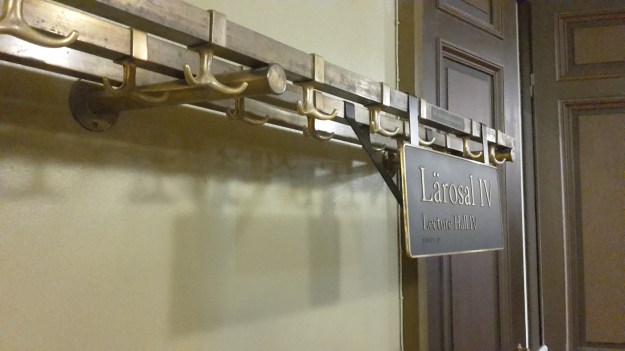
Uppsala Lecture Hall

Lecture hall in the illustrious Uppsala Universitetshuset, next to what is thought to be the oldest university building in Scandinavia: the Gustavianum

It’s cold and dark (and that’s just inside the academy). And this post kinda reflects that January feeling of doom.

This piece in Aeon by David Labaree, ‘Gold among the dross’, has much to offer in helping non-insiders understand US academia, and the perverse incentives pertaining to an academic job more generally (that academics are driven less by fear and greed and more by ‘token’ marks of ‘glory’). But it raises more questions than it answers when it comes to comparing the merits of the US (and similar UK) system and other ways of organising universities.

And that’s to ignore what in my view is the untenable, but widespread view, that scholarship is an ‘internal good‘ a lá Alisdair MacIntyre. (An ‘internal good’ is the result of a practice within an ‘institution’ – i.e. where there are understood rules of the game – where that practice is undertaken according to a moral principle of excellence. One pursues excellence for its own sake – hence being ‘internal’ to that practice).

I’ve been thinking about the ‘internal good’ element of certain social practices for a long time, particularly via Russell Keat’s interpretations of MacIntyre’s ideas. In my research, I examined how Russian blue-collar workers engaged in DIY activities in ‘competition’ with each other for ‘sport’. The internal good is ‘expert’ peer recognition of the skill and excellence performed in constructing DIY-decorative-but-useful domestic pieces, such as fish tanks and metal furniture. Crucially, there is no ‘prize’ beyond that recognition, in marked contrast to how an academic career operates. (actually there’s a bit of a wobble here in defining the ‘good’ as it could be seen as both/either the value in the practice itself ‘means’, rather than ‘ends’, or/and the peer recognition in a community of practitioners – Keat does address this problem in his reading of MacIntyre).

Thinking about academic institutions in this way, many subscribe to a view of the ‘nobility’ of intellectual work,  They do so in a way that recalls the idea of MacIntyrian practices and goods. Perhaps because I’m not quite smart enough, I’ve always found it very surprising that smart people could think in this unsociological way. I can’t quite disassociate this belief with other ‘hegemonic’ yet flawed ideas. And not least this is because of the deep and pervasive anti-intellectualism I perceive that underpins so much academic practice (actually that’s the initial bee I had in my bonnet, but will have to wait for another time).

To be fair to Labaree, he argues that academics are motivated more by ‘fame’ than intellectual curiosity or the belief in furthering understanding. What I think he underplays is that the very pursuit of academic prestige is inseparable from other motivation such as vanity, greed, or fear. Possibly all of them at the same time!

His topline argument (in favour of the US system) is this: ‘Maybe it’s worth tolerating the gross inefficiency of a university system that is charging off in all directions, with each institution trying to advance itself in competition with the others. The result is a system that is the envy of the world, a world where higher education is normally framed as a pure state function under the direct control of the state education ministry.’

I can’t help but reflect on this in comparison with my own institution in Scandinavia, which more or less is described using Labaree’s phrase: ‘under direct control of the state education ministry’. The author assumes that where there are purer market incentives, like in the US, then entrepreneurial academics lead to the best outcomes (albeit with a lot of waste).

Leaving aside whether this it is really true that market incentives rule, I think it underplays how different (and diverse) non-US contexts are. This in turn illuminates the problem with the piece’s argument: that the ‘market’ is best (of all possible worlds) even if it is wasteful and pernicious in large part. My main problem then with the piece is another kind of hegemonic logic – almost a self-congratulatory social darwinism. A good reposte to this sort of thing was recently published by some Finns who reflected on the experience of publishing with British colleagues. They found their findings were relegated somewhat upon publishing as less relevant. They framed their argument in this way: “Drawing on Laclau and Mouffe’s (1985) political theory of discourse, we argue that institutions of academic publishing are constantly reproduced through hegemonic practices that serve to maintain and reinforce core-periphery relations.”

Perhaps the hegemony of the “university-as-market” idea is just one of a number of Anglophone-world assumptions. Another might be that ‘tenure’ in Europe works like in the US and I think inattentive readers of the Aeon piece might also make that assumption (because the piece begins by talking about endowed chairs). A fundamental difference is that ‘tenure’ in the non-US is largely linked to the institution’s, or ministry’s evaluation of the utility of the subject taught (not researched) by the academic in question. Thus in some places even ‘full’ professors can lose their jobs (as they have done even in the UK in less research-active universities).

Overall though, I think the Aeon article (and those who share its sunny perspective, particularly within academia itself) wilfully ignores the hidden ‘network’ of clientalism and patronage. Especially when Labaree resorts to statements like this: ‘As a grad student, you need to write your way to an academic job.’ Hmmm, can we really say that’s true, now or in any period? This is not a market based on merit. This is, like so much of the global moment, about hidden cartels, backhanders and networks of ingratiation (not grace) and favour.

(Aside)

Also, is it really true, as Labaree states based on a previous study, that Liberal Arts (economics) academics only publish 5 peer-reviewed article in their entire careers? (Is this a misrepresentation because they’re more likely to publish books and chapters?) And then there’s this: “lowest end of this top sliver of US universities has faculty who are publishing less than one article every five years. The other 80 per cent are presumably publishing even more rarely than this.” Perhaps I’m only surprised because I know little of the US system.

If that’s the case then what’s interesting is now metric-led requirements have invaded even less research-intensive universities in Europe in comparison to the Liberal Arts system in the US. Or is this just an artefact of the huge number of small LA institutions in the US versus the vast majority of state unis in Europe that have to show ‘value for money’ in research? It’s ironic that many of my UK colleagues think that I have fewer research pressures in Denmark than under the REF regime in the UK, and largely that is true. However, if looked at purely through the lens of ‘quantity’, a Danish academic in Humanities or Social Sciences is expected to produce two ‘higher-tier’ outputs a year, which is more than the average a UK academic is likely to produce for consideration in the REF cycle. And this is in an institutional environment where research time (whether as annual number of hours or as a percentage of time) is not officially counted. Food for thought.

(Aside ends)

Okay, let me get back to the essence of my gripe. Articles of this type ignore the broader question of power. In my (humanities/social science restricted, though diverse) experience of academia, the pursuit of power (institutional, financial, situational) motivates many (tenured or middle- to high-ranking academics). I would not put the ‘practice’ of the pursuit of knowledge even in the top three motivations. Autonomy in work, financial security, sure. Name whatever you like as a third.

Of course, personally I am bound to argue that I am ‘not like that’. I.e. driven more by the intellectual ‘practice’ that results in ‘internal goods’ – recognition of a contribution to knowledge, some new, some old, some wrong, some right (after all, only in the long term is it possible to say with any certainty). But it’s not for me to judge myself. What I will say, and what motivated this post, is the long-term observation that one meets few people so lacking in intellectual curiosity as career academics. And this is not just a question of overspecialisation – as is sometimes argued. Many are disturbingly uninformed not only about the world ‘in general’ and even basic social facts, but also about related disciplines that should have purchase on their thinking. (One colleague often points out that this is generally not so much the case in the former Eastern Bloc where the idea of the rounded intellectual worker remains). And this is despite the language of ‘interdisciplinarity’ gaining ground if not substantive meaningfulness. Then there are the snake-oil scholars, the empty echo equation solvers (where social or humanist knowledge is divorced from the world, is it knowledge?), not to mention the types one finds in all organisations – office-holders.

This brings us back to the ‘institutional design’ of universities. No one should be under the illusion that they actively foster ‘internal goods’ such as the pursuit and peer-recognition of intellectual excellence (MacIntyre scholars here may say I stretch the meaning of internal goods too far, but the point should be clear). These are at best happy coincidences and thanks to the minority – those naïve souls, often never getting tenure or even institutional recognition. While you may say this is too pessimistic I would argue that only by acknowledging this can we start to change it. All the more so because, As Keat observes:

“internal goods, are not only virtue- (or morality-) dependent; they also depend on institutions, and hence on the use of external goods such as money, status and power. [… ] External goods must serve the integrity of practices and their internal goods; internal goods must not be subordinated to external goods, but the latter to the former.”

Of course my criticism of marketised hegemony in the university is nothing new. Keat references Jerome Revetz’s work from the early 1970s. His Scientific Knowledge and Its Social Problems examined issues of the ‘industrialization’ of science and the need to reinvigorate the idea of ‘critical science’. The risk with increasing specialisation in science is of course the difficulty in detecting in a timely manner various kinds of ‘degeneration’, or shoddy science. We can see this at the root of the mistargeted ‘grievance studies hoax’. (See my brief response to this weasel defence of the bad faith fraud) By all accounts, fake science and flawed science is fundamentally the problem in much heftier disciplines than gender studies and queer theory (where the fraudsters have uncovered weak peer review and the failure to call out poor argumentation). As Craig Pirrong points out, the reproducibility crisis in psychological research is acute (50 percent of psychological studies being non-replicable). And most involve relatively simple experiments.

As Revetz might argue, the ‘cleaning up’ and outright falsification of data is partly the result of a relentless focus on entrepreneurial science, “where a scientist becomes more concerned with research grants and power than with the quality of his scientific research”.[2] The wiki for Revetz’s book continues in MacIntyrian fashion: “The need for ‘good morale’, i.e. for an ethos of science upheld by a community of peers is mentioned in relation to the danger that such an ethos may not survive ‘industrialized science’.”

To ground this in reality I offer my example of Russian working-class men making fish tanks. They were pursuing ‘internal goods’ – the recognition of excellence in practice. These practices were wholly divorced from power, money or fame (beyond the institution of the practice – their social circle of confreres). By contrast, the university sees internal goods (the production of knowledge) subordinated to more ‘worldly’ ones. This isn’t any answer to the problem, just a call to think more about how one’s own research (in places as distant as former Soviet factories) can inform an understanding of the institutional world that academics inhabit.

What’s Driving Russia? Fools and Bad Roads?

2017-08-07 18.47.26a

Low-speed prang in the village. Much shouting ensues.

Let’s talk about Russian roads and drivers! No really! Attentive readers may note I wrote about the experience of driving in an earlier post.

That post was related to a chapter in my book about men and cars in Russia and a subsequent article related to it. There was a wonderful tension in some friendships between those that bought ‘bangers’ – oldish Russian Lada cars, and those that took credit out to buy (usually secondhand imports of) German marques, SUVs, etc. Each ‘wore’ their purchase like a badge of honour. For me, car ownership was symbolic of men’s approach to their class positioning and their conscious and unconscious attitude towards the ‘brave new world’ of work. Some were ‘happy’ with the low pay, slower paced, yet dangerous and dirty work in old workshops – firing bricks, making lime, extruding plastic. They ‘nursed’ their old bangers like invalid wives – with affection. Others ‘risked’ the new factories, particularly the higher-paid work in places like Samsung’s monitor assembly. Risky because the work is hard, demeaning, demanding in terms of what academics call ‘biopolitics’ – one has to ‘perform’ being a good worker – turn up neat and visibly sober. Kow-tow to the lower middle-managers. For me this is one meaning of ‘neoliberalism’ in the working-class Russian context (the intrusion of the market into spaces where it was previously absent or moderated by other imperatives). [I know some people object to people bandying around the term ‘neoliberalism’. Case in point. In a recent article, an editor asked me to define what I meant by neoliberalism: for my longer answer, see the footnote on p. 13.]

But talking in general about Russian roads and driving is a really tricky, as indicated by a recent exchange on Twitter. I had mentioned that increasingly punitive traffic laws were designed not to increase safety, but to raise revenue. A point that is often made the world over, not only about Russia. However, as a twitterer pointed out to me, anything that does improve safety has got to be positive, right?

This got me thinking about an ethnographic dilemma that I’ve been trying to solve in a piece I’m writing for publication at the moment. It boils down to this: How, when writing about places that from time immemorial have been presented as somehow backward, lacking ‘culture’, or just plain unpleasant environments, do scholars avoid contributing to those one-sided perspectives?

And this goes for ‘roads’ and ‘road culture’ too. Russians are guilty of this – the famous Gogol aphorism: ‘Fools and Bad Road’. His summary of what was wrong with nineteenth-century Russia is as true today. By any measure, Russia is an outlier in terms of road deaths in highly industrialised countries. 53 deaths per 100,000 vehicles in 2013. Canada is around 9 / 100,000. (The UK is 5, but it too is an outlier – in the other direction).

In the article I’m presently writing, I try (and probably fail) to balance a perspective that says, yes, Russian roads are objectively unsafe (poor design, maintenance, climatic factors), and Russian driving culture is poor because of the way that many drivers did not meaningfully ‘learn’ to drive or ‘pass’ a test. Alcohol use, poor car maintenance and safety are also important. Another truism is the risk-taking culture that is prevalent, especially among men. (I don’t think age is a factor here, some of the craziest are older blokes).

However, these culturally essentialist ‘explanations’ of risk-taking (pofigism), and aversion to rules, are too easy (some would even call them forms of Orientalism). ‘Culture’ is a small part of the problem, in reality. Much more important is a state that does little or nothing to improve safety, and safety culture. Even more significantly, through its daily and longer-term policies, pronouncements and even small actions (like tinkering with the status and rules about what Road Police can do), the state and its representatives show that they values human life so little. Indeed, a great article on this topic (victim blaming) from nearly ten years ago calls this a kind of ‘misdirection’ by an incompetent, uncaring elite.

Such articles, such as this similar one from the Economist, suggest a technocratic/technological fix. As an American journalist put it in 2012: ‘roads reflect a government’s ability to project power and to harness bureaucracy for the common good’. But what if the state has no, or at least a very incoherent conception, of the ‘common good’? Effectively, the common good in Russia is ‘delegated’ to atomised individuals, or only occasionally tolerated NGOs and grassroots organisations. This informal mode of delegated governance is something I’m thinking about a lot at the moment and the ‘incoherent state’ is my working definition of this, but I’d like to improve on it.

However, things do change for the better, and Russia is quite astounding on this account. Responding to delegation (or abdication of the state’s responsibility), driving standards among new drivers are subjectively better now than ten years ago. It’s unclear whether this is partly because of better ‘testing’ while learners. Very rarely in the last decade have I witnessed drink-driving (I did previously see this quite a lot). Similarly, about 6 years ago drivers started spontaneously using a ‘language’ of courtesy – flashing their hazards when you let them overtake you; people do wear seatbelts and use child-seats. I’ve had trouble getting used to cars stopping for me while I’m waiting to cross a pedestrian zebra crossing. Last time I broke down, a motorist stopped to ask whether he could lend a hand. While I don’t enjoy driving on highways in Russia any more than I did twenty years ago, driving culture has certainly improved a lot.

The neoliberal compact and the loss of autonomy for Russia’s middle class

milton

Milton: “…I used to be over by the window, and I could see the squirrels, and they were married, but then, they switched from the Swingline to the Boston stapler, but I kept my Swingline stapler because it didn’t bind up as much, and I kept the staples for the Swingline stapler and it’s not okay because if they take my stapler then I’ll set the building on fire… “

This is my third and final post about the papers presented as part of a panel on Class formation in Russia at the BASEES Uppsala conference, Regimes and Societies in Conflict: Eastern Europe and Russia since 1956.

The third paper in this troika is by Mikhail Chernysh on ‘The structure of the Russian middle class’. Chernysh begins by examining the Russian government’s development programme “On the concept of the social and economic development 2008-2020” which aims to increase “the intensity of growth of the human capital and the middle class”. The policy paper is useful to get an idea of the government’s way of defining a middle class. These are individuals with incomes over six times the minimum. On this measure the ‘middle’ rises from 30% in 2010 to 52-55% by 2020. Chernysh remarks that it is symptomatic that the self-employed or small and medium entrepreneurs don’t really figure in this equation. The middle class is defined mainly by improved consumption linked to income.

It is striking here how modest this definition is in money terms. If ‘minimum income’ here refers to the МРОТ, then a ‘middle-class’ income equates to around 60,000 Rubles per month or 750 Euros a month. Here’s a discussion of the ‘minimum’: https://www.gazeta-unp.ru/articles/51943-mrot-v-rossii-s-1-yanvarya-2018-goda-qqq-17-m08. Going back to Markku Kivinen’s paper on linking middle-class to the classical idea of a propertied bourgeoisie, it is interesting that this amount is not enough to build assets over any meaningful period in most circumstances in Russia. People (including dual-income couples with no, or one, child) on this income typically resort to micro and meso short-term loans and mortgages. There are many stories of bad debt, ruined relationships and moonlighting among this segment of the so-called ‘middle-class’. In this income bracket I see people give up or downgrade their automobiles (to Russian or second-hand models bought for cash), whereas in the ‘noughties’ they bought new on credit. Similarly, while people nudging 1000 Euros, or so, could previously holiday now and then in Europe, now they are turning to domestic destinations, or those in the CIS (witness the boom in Armenia/Georgia tourism).

Chernysh then reports on an interesting discourse analysis by E. Balobanova which examines how Russian presidents have used the phrase ‘middle-class’. [E. Balobanova 2011.  Analiz ponyaita “srednii klass” v poslaniakh presidenta Federalnomu sobraniu RF. Political Linguistics. 2(36). For Yeltsin this phrase meant primarily ‘the bureaucracy’, echoing discussion in other papers about the ‘state’-focus of class and caste. Under Putin and Medvedev there was rather inconsistent rhetoric about raising what we might call the neglected technical intelligentsia up to the middle class. It’s interesting that again, entrepreneurs are nowhere in sight and neither are the ‘core’ intelligentsia of teachers and lecturers.

work

Chernysh then traces the controversial debates in sociology about the middle-class – from being seen as a myth, to the current (politicized?) promotion of Russia-specific ways of counting a middle-class that would produce figures higher than 10% or 20% (see my previous post). Chernysh remarks that this led to the rather unconvincing result of an income of 220 Euros-equivalent allowing entry to the middle class – 44% of the population!

Chernysh then goes on to discuss what he sees as the neoliberal compact in Russian society – particularly with regard to its effect on the state-sector middle class. In return for large increases in salaries, doctors, teachers and others had to sacrifice job security (austerity cut backs) and autonomy (increased monitoring, loss of control over job processes). This strongly parallels my findings among working-class cohorts in the same period. Also important for Chernysh is the actual intensification of work for these groups. The positive part of the deal – increased pay – is at least partly illusory. This is because of intensification but also because much of the pay increase is based on discretionary awards – premiia/nadbavka, etc. This also finds strong echoes in my work with caregivers like teachers and kindergarten employees. They complained after 2009 that they weren’t really better off as so much of their pay was subject to these ‘tricks’ (see p. 62, 64). Chernysh speculates that these factors may influence the current negative evaluation of the government by these groups.

Based on a number of datasets, particularly focusing on responses to questions about what people struggle to afford (durables, more expensive purchases like cars, etc), Chernysh finds that coupled with an occupation approach, the Russian middle-class is less than 20% of the population and more likely less than 15%.

Following Erik Olin Wright’s definition of the middle class as those working in jobs where autonomy is possible, Chernysh analyses autonomy as a variable in a group of respondents with middle class consumption patterns and a university degree.  He finds a significant fall since the 1990s in this category. This is important in the historical context of the necessity, even under totalitarianism, of a ‘moderate level of work autonomy’ in Soviet professions. (I argue, along with the sociologist A. Temnitskii, that this was true of blue-collar workers as well).

Chernysh concludes by drawing parallels with H. Balzer’s Russia’s missing middle class : ‘Middle class consciousness is contradictory, it is not only critical, but also individualistic, showing limited capability of concerted action in defense of group’s rights and class positions. It looks like a revival of historical pattern dating back to the pre-revolutionary times. Balzer’s analysis of the tsarist Russia middle class showed that it was too small and disorganized to effect tangible influence and possibly revert the negative tendencies that weaken existing economic and social institutions’.

Returning to the panel as a whole, the organizer, Jouko Nikula, recently published an interpretive summary based on a broad survey dataset ‘Social Distinctions in Modern Russia’ (SDMR), which some of the papers also made use of.

Nikula points out the ‘decreased opportunities employees have to influence their working pace or work tasks’, particularly among professionals and in the public sector, with a narrowing too of flexibility on working hours. Unemployment has been low despite the two recessions endured by the country – one in 2009, the second in 2014. This because of a persistence of the Soviet practice of labour hoardings and paternalism, at the cost of low wages and furlough, as well as the foregoing of bonuses, which as we discussed earlier, make up an increasing proportion of the real take-home wage.

All in all then, a provocative set of papers from the Uppsala conference. To conclude I would ground them in the reality of my ethnographic fieldwork (albeit partial and unrepresentative). I note the following from my own fieldwork: the least satisfied people from my research were always those that experienced the least autonomy (or a perceptible fall in it over time) – but this was true both of working-class (forklift drivers, packers and sorters in the carplant), and middle-class jobs (teachers and child-psychologists, whose work became increasingly monitored by metric evaluations over the 2010s). Who was most ‘satisfied’? Those with the most or least – well-paid entrepreneurs in high-barrier-to-entry areas like data-gathering and bespoke services, and at the other end, those informal taxi-drivers and grifters who answered to no one and could always ‘withdraw’ to the burrow of the garden plot (at least in the summer) and other strategies of informality.

Is the nature of precarity in Russia different? Melin’s view

2_cb01f10e57ca0bd4f7c238f135ff8804_1484072102

This is my second post about the papers presented as part of a panel on Class formation in Russia at the BASEES Uppsala conference, Regimes and Societies in Conflict: Eastern Europe and Russia since 1956.

The second paper I want to discuss is Harri Melin’s “Working life and the myth of precariat in Russia.”

Melin interrogates the applicability of the ‘precarity’ concept to Russia using survey data about jobs. Following Guy Standing, Melin presents precarity as a process: ‘to be precaritised is to be subject to pressures and experiences that lead to a precariat existence, of living in the present, without a secure identity or sense of development achieved through work and lifestyle’ (Standing, 2011: 16). For Melin, Standing’s work shows that the precariat lack a work- or occupational-based identity. However, Melin cites his own and others’ work in Finland as an example that shows the rise of insecure and temporary work is, in his view, not the case.

Melin is interested in O. Shkaratan’s concept of etacratism to understand Russia’s social structure.  Just as Soviet society was not really socialist but form even approaching state capitalism (insert your own caveats here!), contemporary Russian society is a direct continuation of this etacratic tradition (Radaev & Shkaratan 1992). This approach influenced S. Kordonsky about whom I’ve written recently.

Melin’s survey data tell a story about an absolute and relative growth in ‘skilled working-class’ jobs in Russia, at the cost of unskilled work and ‘nominal’ managerial positions. To collect data Melin used Erik O. Wright’s class typology (Wright 1978, 1997) and to triangulate that with precarity Melin’s respondants are sorted into 1) unemployed, 2) fixed-term labor contracts 3) part-time jobs. The data is from the European Social Survey 2010 set. Precarity is defined as ‘several unemployments, part-time or fixed time employments’. By this measure women in Russia are much less precarious than men, who are more similar to Northern European counterparts. Perhaps more interestingly, Melin counts a very small Russian middle-class – barely 20%. The high number of Nordic youth he counts as precarious is compensated for by the more comprehensive social protections in those countries.

Melin then moves on to subjective measures of precarity: “While in the Nordic countries 55 % of the skilled workers feel that they can live comfortably with their income … in Russia, only 5 % of skilled workers feel living comfortably.” Melin finishes by drawing attention to what I consider a ‘symptom’ of high subjective precarity: my and Sarah Hinz’s work on high labour turnover in the Kaluga Volkswagen factory where relatively well-paid blue-collar jobs there should mean less job ‘churning’. Melin notes how this could be related to precarization and the increase in the use of short-term labour contracts.

It might be worth thinking about the agency of workers in making the above ‘necessity’ of turnover into a virtue. ‘Bad jobs’ leading to turnover, leading to making of turnover into a form of skilling up (or ‘trying out’ of different skills pathways – as the very least). At least within the limits of one’s ‘profession’. This also calls back Markku Kivinen’s point in his paper about the conundrum of high inequality yet lack of class-based polarisation. Partly this can be explained because of the remarkable turnover – ‘exit’ as the only viable strategy.  There’s a lot in my book about the final destination of workers who ‘churn’ – it’s an equally precarious existence in the informal economy.  This is why there are so many male unregistered taxi-drivers. The Russian state has declared ‘war’ on this type of informal income recently.

We could also here take some issue with the blanket position of Harri – that the etacratic system provides more stable and safe employment to workers. My gut feeling is that this is being severely eroded for a number of reasons – corruption leading to the replacement of ‘meritorious’ workers by clients, and welfare state residualisation/austerity meaning the laying off of many workers. Mikhail Chernysh’s paper takes this up. I will discuss his paper in my next post.


What makes a Russian (or Chinese) middle-class?

Moscow Does Not Believe in Tears

The discreet charm of the late-Soviet petite bourgeoisie, or rather the ‘protected’ technical managerial class, as seen in the film ‘Moscow Does Not Believe in Tears’.

This autumn I was asked by colleagues to discuss a panel of papers on Class formation in Russia at the BASEES Uppsala conference, Regimes and Societies in Conflict: Eastern Europe and Russia since 1956.

The three papers were Markku Kivinen, ‘Specificities of Middle-class Structuration in Russia’; Mikhail Chernysh, ‘The structure of the Russian middle class’, and Harri Melin, ‘Working life and the myth of precariat in Russia’.

All the papers are part of a book project. I’ll try to summarise them in turn, starting with Markku Kivinen.

Kivinen sees a lack of clearly identifiable class interests in Russia, and therefore a commensurate lack of class-based action or agency. Interestingly, he takes his discussion back to the very idea of what we mean when we talk about a ‘bourgeoisie’: “After more than 60 years, entrepreneurial groups have been revived with the process of privatization. The discussion here focuses on the middle class which in the West is traditionally known as the new middle class (managerial and profes­sio­nal groups), but which in Russia is ‘old’ in the sense that it has inherited its locations from the Soviet era”, writes Kivinen. Suspicious of bare structural accounts, Kivinen argues for class ‘situation’ as well as ‘structure’. This entails some kind of shared rationality or consciousness. From here Kivinen observes that in Russia there is still only a small middle-class in terms of professional wage earners and that corresponding professional organisations are weak. So for him such a class lacks the ‘autonomy’ of a middle class in the West.

Kivinen hypothesises that micro politics of labour control have grown during transition. Given that in the past the ‘inheritance’ of economic resources was insignificant (i.e. even among the elite there was an unwritten rule about limiting the ‘leg up’ effect, and the material intergenerational transmission of resources was not widespread), today, in contrast to economic differences, cultural distinctions of class probably remain important.

Here I’m not sure I completely agree with Kivinen. Part of the ideological breakdown of consensus in the late Soviet period entailed the scramble for position, and the re-writing of those rules to enable the more savvy, including lower level insiders, to position themselves and their kids. To give an example, a 40-year-old Muscovite woman I know has never required a waged income because her parents (1980s Komsomol functionaries) were able to leverage Soviet structural position (partiinye posty) into post-Soviet position (state-org functionaries), then use the access to those state resources to accumulate capital (a private business run through the ‘front’ of a state job and resources) and then in turn into property assets. Now this family has a modest portfolio of flats rented out, allowing a significant consumption lifestyle without requiring anyone in the family to have a meaningful wage income. However, culturally, I don’t see any particular difference between this family and their working-poor neighbours. Both aspired to own a Mitsubishi Lancer and some questionable American kitchen interior design in the late naughties, and that was about it. The working-poor had to get credit for it. The ex-Komsomol bought for cash.

Combining class analysis with the sociology of work, Kivinen proposes a relationship between professional autonomy and mental labour in defining middle-classness.  This is in distinction to his view of working-classes who are always alienated due to a lack of autonomy (control over processes and planning). Then Kivinen engages with Gil Eyal, Ivan Szelenyi and Eleanor Townsley, particularly on the different forms of capitalism that emerged in Eastern Europe (more cautious diffused institutional capitalism without ‘capitalists’), versus Russian nomenklatura take-over of resources (capitalists without capitalism – see my ‘petty bourgeoisie’ example above), and ‘entrepreneurial’ capitalism from below in China. Based on survey data, Kivinen concludes that there has been a major expansion in absolute terms of the middle class (from less than 40 percent in 1998 to now over 50 percent). From the data presented in the paper, it’s not clear what definition is being used of entry to the middle class (I am sure in the book it will be well covered). Interestingly, one aspect Kivinen links to this rise is the continuing propensity of all Russians to change their jobs frequently, known as ‘churn’, and something I’ve written about. Likewise, I’ve written a lot about autonomy among working-class people. (See the discussion from p. 72 in particular). The desire for autonomy cuts across classes, and niches are carved out in the most unlikely places.

Overall, my gut response is that a ‘counting’ approach to class remains problematic and perhaps even counter-productive (excuse pun). I’m sure Kivinen’s figures are robust, but how meaningful is it to say 50% of Russians are middle-class when certainly average disposable incomes, however counted, are tiny in comparison even to other middle-income countries? We will see this criticism repeated in my reading of the other papers.

But here I’ll end with a heuristic example: The average wage in Russia is, after tax, around 34,000 Roubles. That’s barely 500 USD. The same article linked to here is a good treatment, acknowledging that in Moscow the average wage probably is around 500 USD (but anyone aspiring to have any quality of life there on that wage would be extremely depressed by reality). In addition, the article notes that wages have fallen in real terms for the last 10 years! Outside the big cities (only 30 million inhabitants out of 145m) the ‘real’ average is likely to be around only 20,000 Roubles elsewhere. See here for a similar enumeration. This all chimes exactly with my ‘anecdotal’ research experience – most of my research participants struggle to make more than 20,000 Roubles. And remember this is among economically active people (less than 50% of the population) with full-time wages (a much smaller fraction).

Yes, a household on two average (20k) incomes, with no housing costs, can live better than the urban poor and pensioners, but that’s less than 50% of the population. The 34k income bracket is, for want of a better phrase, ‘upper-middle class’, or ‘affluent’ and seen as anomalous by most of those I research.  More importantly, even this putative middle group is going to severely struggle with unexpected bills, even running an old Russian car will be a stretch. Frequently they will resort to pay-day loans (there’s plenty of evidence of this in my research). Cognitively, they will not be inhabiting the mindset of any middle-class you can imagine. And that’s different from aspiring to own a jeep, go to Cyprus, or own a second home. An instructive comparison can be made with the ‘struggling middle’ in China at the moment (urban dwellers with middle-class aspirations) who on average earn around the same as the real average in Russia ( 3,000 yuan, or 480 USD a month). However, unlike in Russia, meaningful consumption is possible on this income (discretionary spending), including on taxi rides to work, investment in stocks, luxury imports (gourmet cat food!).

And to finish with a thought about autonomy. James Scott, interestingly, also links middle-classness (or rather the classical petite bourgeoisie subsection of it) to autonomy in his book Two Cheers for Anarchism: Six Easy Pieces on Autonomy, Dignity, and Meaningful Work and Play. Like my former Komsomol leaders, many people in history have aspired to become small property owners due to the perception that this confers autonomy (and social standing). Scott argues that the petite bourgeoisie play a role in the development of a modern capitalism that is socially tolerable in that important social and civil functions are delegated to them (land stewardship, public safety, public action). On the other hand a more conventional leftist tradition would see in ‘middle-classness’ only the reactionary, whether cultural or social. One can see the short distance from here to the debates about civil society in Russia. However, so far I remain to be convinced both in economic and social terms about the meaningfulness of talking about a Russian middle-class.

Social trust and the problem of the ‘stranger’


I’m lucky enough to be starting a new project on social trust ‘comparing’ two polar ‘opposites’ – Denmark and Romania. (A good illustration of the difference is found in this LSE blog post by Zsolt Boda and Gergő Medve-Bálint). While I’m familiar enough with some approaches to trust and social capital and their problems, as a way of starting a conversation with my two project partners (one researcher working on Denmark and one on Romania) we are all reading Eric Uslaner’s new edited book: The Oxford Handbook of Social and Political Trust (2018). I thought I’d share here my initial thoughts – partly shaped by my existing prejudices. These prejudices and ‘hunches’ (that it’s highly problematic to think of Scandi societies as ‘high trust’ and postsocialist societies as ‘low trust) inform my reading that follows.

What’s the middle-ground/field of social trust?

Right at the beginning of Ch 1, Uslaner sets up a tension within the conceptualisation of trust relating to the ‘other’ – the person whom is trusted. Overall, what I take away from the first few chapters is the ‘gap’ between relatively clear understandings of kin-trust and complete stranger trust. Most of our meaningful transactional and reciprocal interactions take place between these intimate-stranger poles. The methods outlined and the conceptual framing don’t easily accommodate that ‘gap’ (although it appears there is some good stuff on welfare state/bureaucrat interactions elsewhere in the volume).  I’m most interested in the Street-Level Bureaucrats–supplicant relationship and was thinking of that most of the time I was reading.

Is particularised trust really defined clearly enough?

Later the problem of really defining a standard meaning of particularlised trust occurs. Particularised trust relates to ‘only people like ourselves’ (p.4), but for me that doesn’t square with all that we know from the literature on social networks and patron-client relationships from the former socialist countries where ‘trust’ networks can be highly diverse, especially in terms of power gradients. What does ‘like ourselves’ even mean? Later on in the book we discover that Scandi students have trouble linking ‘other people’ as an abstract concept to concretised ‘strangers’ (unsurprisingly) (p. 22). Yet here, I’m really bugged by ‘ourselves’ as a meaningful unit of analysis in social science. (On p. 4 the actual phrase is ‘Particularised trust is faith only in people like yourself’). My contemporaneous notes show that I wondered whether this meant that social hierarchy, ‘capital’ and status would be a meaningful interpretation here. Does this mean we can’t separate particularised trust from forms of power? Later, in the chapter on measuring trust, the problem with existing survey questions to measure generalised trust is illustrated when it is revealed that at least in some cases ‘most people’ (meant as a proxy for strangers) actually elicits associations like ‘friends’, ‘neighbours’, acquaintances, colleagues, etc. This for me really underlines the problem. Who is a stranger? If there are only ‘relative’ degrees of distance between the people we think of in terms of trusting, then should we not be collapsing particular and general? Or instead, limiting our knowledge claims or investigations to much narrower or clearly defined encounters?

How does change occur?

pp.4-5 Uslaner sets up inverse relationship between particularised and generalised s trust. Also proposes his own position of stable socialisation based trust as a general disposition. In contrast trust in rational choice models is ephemeral.  Also he sets out the debunked, but still widely assumed, link between democracies and trust, which was then replaced by the more nuanced connection between income equality and trust. Overall the next tension I observe from this is the problem of prediction and change. If Uslaner’s trust is mainly early socialisation then how does change in trust occur? Or is this a secondary effect of increasing equality? It isn’t really clear, and I guess that actually Denmark would probably show the opposite – that it’s always been high trust and that increasing or decreasing levels of income equality have had little effect (also noting that income equality is itself a very narrow and rather misleading measure of equality overall). Thinking about more familiar territory – the observation that Russia and other postsocialist countries become ‘low generalised social trust’ societies after communism (ok maybe earlier as well), then again, the lack of change in the model would mean accounting for this is difficult, isn’t it? And in any case I think empirically it is difficult to generalise and say that, e.g., the USSR was a low generalised social trust society before 1991. If anything, in terms of ‘stranger-stranger’ interactions, I think you can quite easily argue the opposite. (I’m aware of the work on how Stalinism led to a long-term breakdown in trust in institutions, but that’s different from ‘generalised trust’ – which kind of illustrates the problem).

trust levels based on survey data

Interpersonal trust levels as measured by the World Values Survey and European Values Study, and the European Social Survey and Afrobarometer Survey – Inglehart & Welzel (2010) – Changing Mass Priorities: The Link between Modernization and Democracy. Reflections, June 2010, Vol. 8/No. 2. as cited in https://ourworldindata.org/trust


Optimism and the psycho-social(?) trap

Thinking a bit more about Uslaner’s own preference for early-socialisation and a resulting general trusting disposition, I can’t help thinking about the only relative utility of this in terms of social science. Indeed, reading his account I couldn’t help thinking that ‘optimism’ in general might be a better definition of what he means by ‘general social trust’. Especially as he insists it is hard wired and relatively resistance to change – I guess a kind of psycho-social trait. Overall, then, the generalised model Uslaner favours seems to me only vaguely useful in terms of a general proxy for long-term social stability and ‘well-functioning’ societies. I.e. they are more likely to produce in aggregate optimistic (open and trusting) people. Here we get to Denmark again.

As an aside, Uslaner highlights the problematic causal relationship between associational life in a place and trust (it only seems to work in highly historically/socially specific places like the US).

What is a transactional encounter between strangers?

Next up, if generalised trust is about encounters and expectations of strangers we have to ask, how similar are our daily transactional encounters with strangers – do we treat all ‘strangers’ the same? Are our expectations the same of the fast-food server, the garage mechanic, the call-centre operator at an airline, the doctor’s surgery nurse, the bus driver? Most, if not all our ‘stranger encounters’ are mediated through either corporations or the state. This rather obvious observation isn’t really acknowledged, at least in the ‘Approaches’ first Part of the book. I’m hoping that we learn more in the chapter on Trust and the Welfare State by Steffan Kumlin, Isabelle Stadelmann-Steffen and Atle Haugsgjerd.

On the other hand on p. 8 Uslaner notes that one key variable linked to high generalised social trust is quality of institutions – again for me indicating the need to really examine the ‘everyday’ functioning of those insts. through looking at the variability or consistency of citizen-SLB encounters. ‘Institutional trust’ isn’t quite what I mean, as the interaction is at a sub-level and in any case is variable between institutions, even between ‘branches’ of institutions – think about how one’s encounter with criminal justice ‘institutions’ would be quite variable between, say, community police liaison officer, beat cop in a city, emergency line staff (who may be partially privatised and in a remote location), local courts, etc.

Overall, I can see myself arguing strongly for a more interactionalist forms of measuring trust that are sensitive to power gradients, and the leverageable and performable forms of ‘social capital’ that one can bring to an encounter – particularly with an SLB. These would include diverse aspects as class, articulation of needs and rights through educated speech, race, gender, age, etc. But then would this be best described as social capital?

Why Russia is not a mafia state

pri_47665814

This week in a research event at Aarhus University I was asked to discuss with Lucia Michelutti her work on the mafia-like nexus of business-organised crime-politics in Uttar Pradesh. Her work is really thought-provoking and I recommend you check out her book on Mafia Raj.

Michelutti argues for the use of the term ’bossing’ to describe the partly performative work of criminal dons and wannabee mafiosi in India. This is because of the awkward absence of a word in English to describe the enactment of power: we have ‘to empower’ and ‘overpower’, but not a verb that clearly describes  power as a process. For Michelutti, ‘bossing’ by criminals-cum-politicians involves the mobilisation of performative competencies and which is subject to contestation in an unstable constellation of authority (and which lacks legitimacy), charisma, and local contexts (particularly community problems). The highlights of her talk for me were an elective affinity between delegated governance and organised criminality; starting from the premise of the ‘emic’ grounded use of language – ‘boss’ is the currency of talking about criminal/political entrepreneurs; mafia as a systemic yet amorphous reality, not a discrete organisation in itself.

This set me thinking about the use and abuse of the now common-place ‘Russia as a mafia state’. I was sceptical of Luke Harding’s book when it came out in 2011. Subsequent events have proved him right on some things (and me wrong). However, I still want to object to the looseness of the term ‘mafia’, and how it obscures more than it reveals. Quite reasonably, even ‘ordinary’ readers criticised him for not defining why Russia is a ‘mafia state’ when so many other corrupt, kleptocratic regimes are not. Broadly, Harding uses it to indicate collaboration of security services with organised criminality, to indicate the ‘kick back’ ubiquity of corruption to higher officials, to indicate the willingness of the state to use extortion against foreign states, or to indicate a general prevalence of extortion/protection relationships.

First a caveat: there are strengths to Harding’s book – the perspective of a person who feels the full sun-like gaze of the security services when they are let off the leash to harass a foreigner – see Kelly Hignett’s review here https://www.ceeol.com/search/viewpdf?id=61177. However, let’s not forget that Harding gets off lightly in comparison to many Russian victims of the state’s displeasure. Journalists of course write books and are professional writers. But I can’t be the only person to be disturbed (and of course made envious) by the attention these anecdotal, ultimately piecemeal and largely ‘readers digest’ accounts generate. For a critical review of Harding’s evidence-light work see a review of his book on Trump-Russia collusion by Paul Robinson: https://irrussianality.wordpress.com/2017/12/02/collusion/ . Now, I’m not saying he wasn’t harassed by the FSB, just that in moving from journalistic fluff and anecdote to book-length serious analysis he, and most others, fall short (I haven’t read Galeotti’s latest). Harding at worst gives readers a version of Cold War 2.0 that seriously impedes better understanding of the everyday reality of Russia.

So, some basic problems with the term ‘Mafia’. Mafia implies an overall structuring of all activity towards the end of enriching the boss via captains, and clandestine activity linked to membership of an elect community with elements of charismatic leadership.  Okay, there’s a certain affinity here with descriptions of clientelistic and personalised relations, but why not just use that conceptual toolkit and ditch association with types of charismatic and in-group derived leadership as represented in popular culture by Vito Corleone, Paulie Cicero, or Tony Soprano?

The ‘true’ mafia ( of course they cannot be separated from their popular cultural depiction anymore because they in turn are influenced by that depiction) are only ever peripherally ‘political’, as Michelutti, points out (that of course, does not mean that they don’t buy politicians and political leverage). As a classic, yet parasitic ‘other’ to capitalism, mafias can only be defined in opposition to state structures. Most of all this is because they actively choose to occupy niches of criminality and employ physical violence, albeit in a limited way, that challenges the monopoly of violence that the state reserves for itself. Most notably coercion is of a limited nature (there is a ‘civilian’ category, ‘victims’ are mainly from the same ethno-cultural community). Indeed, that ‘anyone’ can fall victim to the rapacious raiding of business by the kleptocratic Russian elites, means that if anything, Mafia is too ‘soft’ a word!

For organised crime, ‘criminality’ is the keyword. But, in the diffuse, corrupt, dysfunctional and contradictory world of the rule and unrule of law in Russia, words like ‘extortion’, ‘bribery’, ‘racketeering’ lose their meaning, because if state actors take assets from you in a way you experience as illegitimate, it is by virtue of their superior command of legal-administrative resources, but most importantly, their ability to make what appears to us as ‘criminal’, merely accumulation according to a logic of nearness to other more powerful state actors plus the superior command of already existing financial resources. (Of course a bit of violence does help here – see the interesting work of Jacob Rigi on the ‘Corrupt State of Exception in Russia’).

Using the mafia label is unhelpful as it conjures for a Western audience an image of a Don, a clear hierarchy of made men, of grifting in secret and in fear of discovery, and of highly ritualised organisation of criminality. All of these things exist within the organised crime world of Russia, sure. But it is a massive stretch to make the leap from Goodfellas to The Kremlin. The ‘mafia-like’ practices of the state are both more organised (and less ‘illegal’) and more chaotic (influenced by political expedient rather than just graft), than that of any organised crime group. Indeed, in contrast even to the Sopranos’ ‘postmodern’ mafia, where charisma and tradition begin to fail to limit conflict or reproduce loyalty, the kleptocratic workings in the Russian state show an absence of a shared normative understandings of power and sovereignty. Despite Kordonsky’s work on ‘kick-back’ culture, there are no ‘made men’, nor is there a shared understanding of timeserving before becoming captain, and there is no honour, no chance of a ‘sit down’, and no percentage kickbacks with any permanence that would allow them to become informal rules governing ‘taxation’ or authority. What there is is an ever changing landscape of potentially equally powerful others, where the ‘rules of the game’ can change more abruptly than in any criminal conspiracy, and where there are also ever-present political, policy and governance goals distracting from – what I admit is the main task – making money.

Then we come to the ‘killing of enemies’ argument that people put forward because of Skripal, or Litvinenko. For the mafia metaphor to have explanatory meaning here it would require the state, security services and organised crime to have clearly demonstrable and densely redundant network characteristics over time. Even if it is shown that the Skripal was targeted because of his knowledge of organised crime in Spain linked to the Russian security services (I think that’s unlikely), a quick glance at the conflicting interests within the elite (and between security agencies), and the infighting of factions even at the highest level, the relative ‘weakness’ of the Presidential Administration to have its orders carried out, shows that such ‘networks’ would break down as soon as they arise, and could only be connections of expediency.

Take the Donbas – more a political project with hot and cold support from Moscow and a way of getting rid of nationalist and violence-orientated entrepreneurs. Most importantly, it is a huge drain on resources which has enriched only a few local players (hence the assassination of the them now). Not the actions of a ‘mafia state’ looking to get resources flowing upward from a ‘take’. The Skripals and Litvinenko before them are evidence of incompetence if nothing else. They remind me more of contexts like organisational rivalry, poor operational control, and opportunism, than methodical revenge. Certainly, the execution of these operations would embarrass any self-respecting professional hit man in the pay of a ‘mafia’.

Tony-in-the-pool-with-ducks-1

Tony says: ‘You call that a hit? My ducks could do better’

A British journalist discovered that if he writes critical articles in a semi-authoritarian state, the security services will target him. Sometimes there is a blurry line between activities the security services take against critics of the state and other corrupt activities. Sometimes the security services are not under control of the state, even though there are lots of powerful politicians who have a security services background. Particularly on the last point, it’s been shown by scholars like Bettina Renz that this background is largely irrelevant and to propose a ‘silovik takeover’ is a correlation-causation error.  To end, a similar reminder from Marelle Laruelle on the dangers of rhetorical techniques of facile association. I might come back to this as, in the first place, I started thinking about this topic because I am working towards the idea of the everyday ‘incoherent’ state in Russian, particularly in the workings of the lowest level of street-level bureaucrats.

From unequal Russian youth citizenship to caste- and estate-based perspectives?

I want to revisit the youth topic of my previous post. There, I offered a mild ‘check your privilege’ criticism of the limited perspectives of Muscovite middle-class youth. Additionally, I offered an ‘apology’ for non-politically active or non-‘civically conscious’ young people. I basically said that Muscovites generally have a limited understanding of the lives of non-Muscovites.

One might object that educated Muscovites travel a lot, not only abroad, but also in Russia and develop friendships and acquaintance with people beyond their Moscow ‘set’. I would agree, but then I would add that this only exacerbates the socio-economic ghettoizing of relations. In that, while my young Muscovites develop friendships with, say, middle-class educated Spanish youth in their travels, their attitudes to ‘deep’ Russia still faintly resemble that of a bygone time. Okay, that’s provocative and unfair, but I was very much reminded of the narodniks when talking to some of the more politically active youth. And I mean that in a negative way – there is no consciousness of the need to connect to the majority of youth who may well see inequality as more important than identity politics. Of course, the narodniks failed, but at least they were aware of the divide between the different Russias (as is today’s Natalia Zubarevich).

As for travel in Russia – for many cosmopolitans, this is very much as a foreign tourist in one’s own land. In one case, I had to explain the workings of the Russian railway timetable, and the ‘local’ inevitability of DIY euthanizing unwanted animals, the reasons for limited consumer choice – ‘there is no fancy stuff in the shops because people are poor!’.

To be fair, some cosmopolitan Russians recognise this split all too well, and even discuss it with me. Indeed some of the more embarrassing moments of my fieldwork are when Muscovite Russians tease me about ‘knowing more about the glubinka’ than they do. Or when I am asked sincerely about ‘what the locals think’. There are sensitive, thoughtful people who are aware of the great social divide and try to bridge it in their lives. However, even in my field-site, the real and metaphorically gated communities grow. Frankly, the more I observe this, the more embarrassing it gets. Moreover, the idea of a class of Russians as foreigners in their own land is not new (Decembrists’ failure, partisan war of 1812, etc).

Narodnik

So, why is this important? In the previous post, I also touched on the research I’ve done with colleagues on the ideas of youth citizenship. The mutual incomprehensibility of different Russian youth is no doubt mainly due to socio-economic background. However it indicates an open secret about inequality of citizenship as well. ‘Affective ideas of belonging’ was one way of looking at how frustrated young urban Russians were with their inability to get involved in the political workings of their country. Turning away from insoluble problems is another response. I’m reminded of one of the first times I presented in my old institution in the UK, a Russian colleague approached me afterwards, and with slight hesitation began to question me. Had I not made a mistake in stating that my factory workers in 2009 were only earning 18,000 roubles a month (230 Euro)? Was I exaggerating how little they earned? Later, on social media, a businessman stated that ‘even shop workers’ earned at a minimum 30,000 roubles a month. Clearly he’d never been to a small town, or even a small provincial city. Finally, a couple of years ago, a very senior professor opened her comments to a roundtable with the observation that there was no economic crisis because people in Moscow continued to holiday in Cyprus.

None of my research interlocutors, bar one owns a ‘zagran’ – a tourist passport. To get one would involve taking at least two days off, and travelling to the oblast centre, possibly early in the morning, which is in any case a considerable distance (previously they could travel to the district centre). If a person has been mainly informally employed or self-employed, they may have trouble (or be wary of) filling out the work history form that is required to get a passport. Is it worth discussing ‘affective citizenship’ when the everyday experience of citizenship is so trammelled, or ‘shrinking’, a term sometimes used in a different context to talk about the limited avenues for democratic participation. Shrinking also has relevance when trying to pin down ordinary meanings of citizenship for these same people. Increasingly, people talk about the town, the district, to the exclusion of the national. Their sense of Russianness is localised. Quite ironic given recent focus on the ‘wholeness of Russia’ and increasing use of ‘Russian’ as an ethnic identity marker.

Загран

Finally, all this reminds me of some really interesting research I’ve recently been engaging with – the first is Simon Kordonsky’s on today’s Russia as a kind of caste-based, rather than class-based society. I recently reviewed his English-language book (previous link) for Europe-Asia Studies. I’m now reading some of his Russian sources with my students.

A snippet from the review here:

“Dividing resources among estates is the core process of social life. Crucially, service not labour is the marker of compensation in this system. Therefore classes cannot fully emerge, instead there are non-titular estates of professionals – Kordonsky enjoys provoking the reader in a running joke that lumps scientists, lawyers, and prostitutes in the same category.  Similarly, persons receive estate rent and ‘pay’ estate ‘taxes’ based on their estate position alone. This is why the visible signs of estate membership are so important (think regalia, uniforms, cars with blue-lights); estates makes themselves known to other estates based on ritualised and symbolic practices, leading to widely accepted notions of ‘distributive’, rather than ‘corrective’ justice.”

Recently too, Anna Kruglova’s work has investigated ‘caste’. Presenting at the EASA in Stockholm this year based on research on industrial communities in the Urals she proposes that increasingly workers “get homogenized and ‘compressed’ back to their sosloviie (caste or estate).

Kordonsky’s perspective is pessimistic. Overall he proposes a static, ‘frozen’ system. Is social mobility possible? Can classes with identifiable interests form? While the democratic, market-based society to which Kordonsky opposes Russia is an ideal type, readers may question so stark a differentiation – after all, in the ‘West’, estate-like phenomena such as the increasing significance of unearned income, professional/estate ‘aristocracies’, barriers to social mobility, differential rights, obligations and inequality before the law also feature to various extents. Is it a step too far to think of Russia as a ‘caste’ society when ignoring how socially differentiated our own societies are?