Category Archives: Russia

Introducing Everyday Russian Politics: 1. Entangled Activism and Agonism

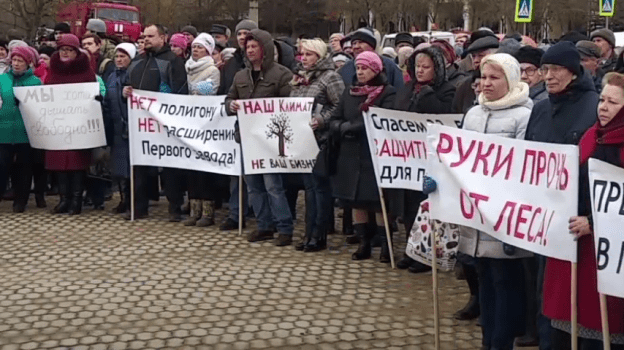
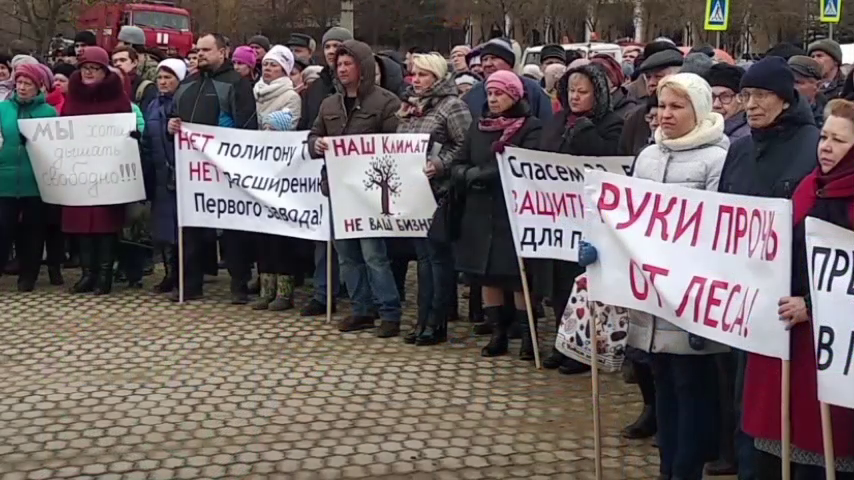
A very unlikely and unnoticed (by the media and scholars) mobilization by untypical activists against the expansion of a polluting factory

In a series of narrowly-focused posts I will talk about three aspects of my new book – 1., the use of up-close methods of long immersion – I argue there’s analytical power in ethnography to show the broader significance of neglected aspects of Russian social and political reality, 2., the part of my argument where bring together three interacting concepts: ressentiment, defensive consolidation and social striving. And 3., the evidence in the book of deep and enduring political engagement and practices which are underappreciated in a lot of coverage on Russia. In the last four chapters of the book, but also in my coverage of municipal politicians earlier on, I make claims relating to the idea of micropolitical content as it emerges in articulations and actions on the ground, and largely aside electoral politics (in a parallel relationship). (The relationship to ‘the political’ of Chantal Mouffe’s work, I defer to the end of this post as most readers are less interested in the theory stuff).

This post, though, is mostly about ‘activists’ and broadly from around 2018 to the present.

One claim is about a particular form of learning and reorientation by self-consciously ‘politically-active’ people, but also by people who deny they are political, and yet engage in ‘civicness’ nonetheless. The continual reinvention and recasting of activism is like different forms of movement – movement from electoralism to environmentalism, from in-person to online, from parties and groups to cells. This is maybe one of the most interesting ‘lessons’ of the ‘Russian case’.  Without longitudinal ethnography (which after all is just a form of immersive process tracing) it’s easy to accept the common sense that the centre has defeated nearly all forms of politically conscious actions not under its control. And I reject that. Why? Because in my book and elsewhere, I show that the gains of electoral organizing by people who were inspired by people like Navalny (but also by others) are not lost, but even now have been transformed several times over. This transformation occurs when they come into contact with new causes like environmental degradation, new conjunctural situations like military mobilization, and new situations of repressiveness, and that includes economic exploitation.

Just to unpack for a moment, I can give the example from my interviews of how Navalnyite electoral administrative ‘capacity’, for want of a better word, even after 2020, was partly resynthesized by people interested in more agitational orientation in labour activism: picketing tactics, political education through literature distribution and even just online ‘slacktivism’. People internalized lessons from one context and applied them in another. Or, more typically, the lessons ‘transmutated’ themselves. Another time this meant lessons drawn from ecological actions relating to tactical victories like Shiyes – the opposition of garbage transport to the north – were carried over into anti-war activism (decentered and devolved tasks with precautions taken to protect those on the edge and firewall them from hardcore activists).

This unpredictable and dynamic process was also shaped by the authoritarian push to remove activists from public space. As personal, but also semi-public Telegram channels and many group chats, became the only fora available for the discussion of causes, this repressive escalation actually did activists favours because it attracted a broader ‘insulted and injured’ audience, and enabled reflection and discussion on a wider range of political causes and possibilities. The irony is that ‘flattening’ the public sphere in Russia actually facilitated more intense and more fruitful sharing of experience among political actives – albeit online and in private.

But what is private? People I talked to often spoke of living the struggle as ‘more real’ even in the virtual sphere because it was experienced more intensely and with more solidarity and less loneliness. Over time this online response to repression then translated into better organized, more mobile, and more targeted and strategically-considered action – from the aforementioned Shiyes, to anti-war stickering, to small-cell sabotage (full disclosure – I have NO informants who do this nor knowledge of them).

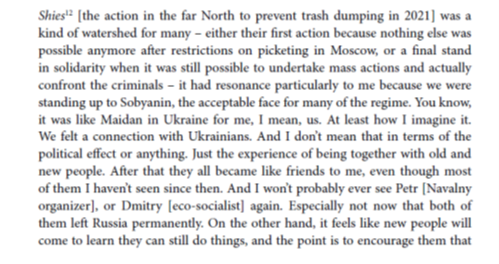
Using my own fieldwork interviews with diverse activists, most of whom remain in Russia, I build on the empirical work by other researchers like Tereshina, Slabinski and Kuzmina. They emphasise how Shyies 2018-2020 heralded a shift towards more affective connection – catalysed by exclusion from electoral and public protest in cities. A mobilizational imperative that drew a broader group of activists together from across the country and across the political spectrum. Looser politics, yet affectively closer-knit, became a widely experienced paradox. I call this ‘experiential entanglement’ and I started to explore it in my previous co-edited book with Regina Smyth and Andrei Semenov.

One of my own case studies relates to a modest campaign of opposition to rubbish dumping in Kaluga region. But in terms of organizing, and also in terms of affective connections between activists of different stripes, people reference the lessons of Shiyes, and of the success of Navalny’s electoral clusters to train and bring together activists. They even refer to Shiyes as a kind of Russian Maidan – but more narrowly in terms of how it showed to activists a glimpse of the horizontalist, accretionist, triangulatory forms of contention – and here I purposely avoid the normal terminology of political opportunity structure. At the same time, I remain mindful of the lessons from political science of how dynamic the mechanisms of contention can be. Activists are not just subjects of collective action, but the products of unpredictable combinations.

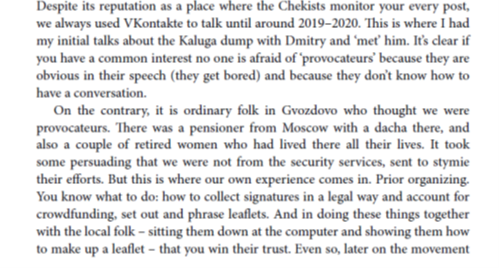
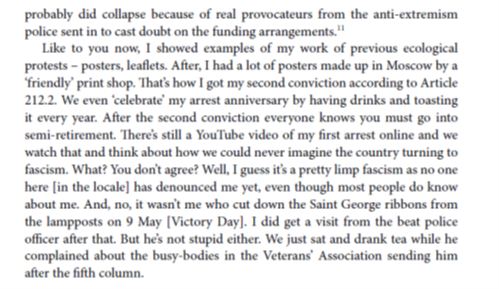
It’s worth quoting at length a rather rambling talk from the field to show the complexity of what I mean by unpredictably combinations. Polina is speaking in 2022:

As this post is already long, here I want to return to the use of the term ‘the political’. This term for me levels the ground to look at the political content of people’s lives as equal in significance to just ‘politics’. And how I use this term relates to Chantal Mouffe’s criticism of overly narrow conceptions of political relations. If ‘politics’ is institutional practices and discourses – realms from which almost all Russians are excluded, ‘the political’ is a dimension of antagonism inherent in all human society. The war on Ukraine only makes more intense Russians’ deliberations about what kind of ‘good’ society can be imagined. ‘Political’ discussions about the good are part of everyday experience, even in ‘post-democracies’, even in militarized dictatorships. Like Pierre Clastres’ (1977) classic critique of Western notions of politics, I insist that contention and negotiation, along with conflicts about the meaning of the ‘good’, can be grasped beyond the normative frames of formal politics in the public sphere. Politics exist beyond a narrow idea of ‘hierarchical subordination’ of the individual to power.

If you recall my recent review of Denys Gorbach’s work, I agree with him that an updating, or correction, of Mouffe’s concept needs to ground ‘everyday politics’ in material processes – like the experience of workplace exploitation, the broken infrastructure of towns, the way economic rents are now extracted directly from citizens via utility bills, the learning experience of people engaging with the state’s monetary offering for soldiers. From these experiences, many demands remain unsatisfied, and a chain of equivalence can be traced towards populist politics from everyday politics. Whether critical of Mouffe or not, most agree that her work should be read as a call to look more carefully and seriously at the construction of counter-hegemonic politics, and its potential for building left populism. Furthermore, Mouffe’s contribution should be a cornerstone of any critique of depoliticization, whether in the USA or Russia.

In the case of Russia, most scholars referencing Mouffe do so from the assumption that the hegemonic project of ‘strong Russia’ above all, is the successful culmination of the first two Putin terms. Nonetheless, even among those few who think seriously about the discursive construction of the new Russia note how ambiguous it is in practice: ‘shot through with intense doubts and misgivings about the very possibility of a strong Russia’ (Müller 2009). Olga Baysha implies (albeit indirectly) that discursive domination in Russia comes up against hard material limits in the miserable lived experience of so many millions of citizens and the ‘loyalty’ of citizens was mainly based of fear of losing minimal benefits rather than positive identification. In other words, like in Ukraine to 2014, the complete ‘normalization’ and naturalization of the regime remained quite weak. The liberal opposition undermined itself in 2012 when it pursued an exclusivist progressive discourse in the electoral protests against Putin (Baysha’s point, which I agree with). They were afraid of popular mobilization, not in favour of it. On the stability of the hegemonic order since 2012, people tend to forget that while the Russian constitutional arrangement has been successful in acting as if the interests and values of diverse parts of Russian society have been rationally reconciled, massive social conflicts simmer away on so many backburners that the roles of ‘chefs de partie’ (regional governors) are now a pretty thankless political posting in the Russian Federation. Too many pots are boiling over and the restaurant kitchen is open-plan. The point of my book is to say we should look at the various pots and why and how they’re simmering, rather than just looking at the rotating chefs.

The Micropolitics of Desire: Small Acts of Civic Engagement in Dark Political Times

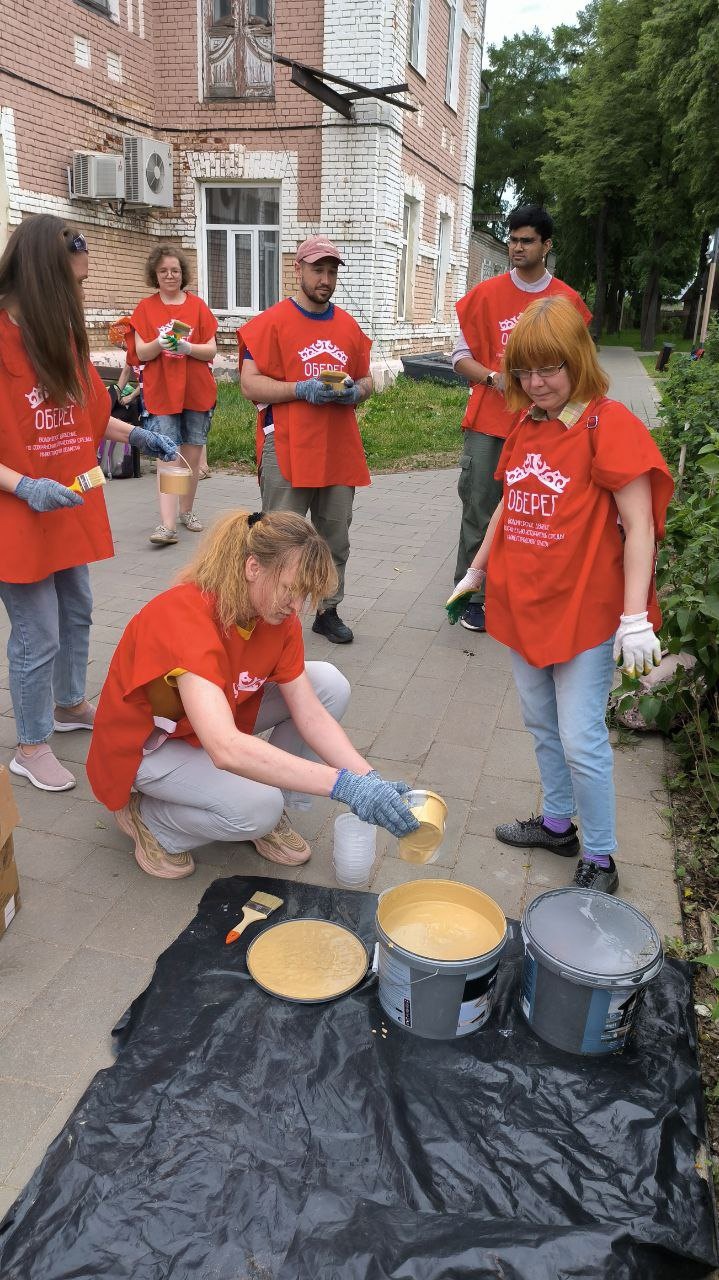
A voluntary civic heritage protection group in Nizhny Novgorod

This is a slightly different version of a piece written for OVD-Info and published here. Many thanks to this important human rights monitoring and advocacy group for publishing it.

The election of Trump might seem very distant from the realities of Russian society at war, but the reaction of many Americans to his immediate moves to take control of (or even dismantle) parts of the US state he doesn’t like speaks volumes. What should ordinary people do with their feelings of despair and helplessness in the face of naked power grabs supported by cynical figures? This is an emotional experience familiar to civic-minded Russians.

There are also dangers in these feelings. It’s easy for Americans to react further in two unhelpful ways: either the system will be robust enough to stop the descent into a kind of oligarchic dictatorship, or that the actions of individuals don’t matter, or can’t change things, so it makes no sense to put one’s head above the parapet. Often this leads to the worst kind of ‘internal emigration’ where people detach themselves from any and all forms of social solidarity or civic work, retreating into the husk of the individual.

As a Russian interlocutor put it to me about a month ago, ‘since 2022 I have benefitted from trimming my exposure to people. To stabilize myself personally, I’ve learned by heart something I say over and over to myself: that it’s purposeless to speak of politics and current events.’ And this from a formerly civically-active person in a large Russian city.

But not everyone has the luxury of turning to personal problems as a way of avoiding the social. Indeed, one of the ideas at the heart of my forthcoming book about politics in Russia is that the human drive or desire to connect to others and work on a common task is hard to fully suppress. Many researchers focus on questions of ‘legacy’ and how much the idea of what is possible or impossible for individuals in Russia is determined by their experience of the last 30+ years, by their interactions with the Russian state, and by their disillusionment with electoral politics. As a result, increasing numbers of Russians when polled express preference for a social and political system resembling the Soviet one.

In my book I talk to people from all walks of life about this problem (how the past should inform the future). But I do it indirectly. I talk to older people about what is missing from their lives now, about their ideals for the lives of their grandchildren. I talk to workers and thinkers about what kind of ‘good’ society can be imagined. Even in the darkest of times the stories mainly resemble each other: having a role which is meaningful in improving one’s social environment, enriching the lives of those around us, and having a political referent that sees the possible future as better than the present. These are all remarkably unremarkably things. Moreover, while I talk to self-avowed ‘activists’, and ‘politically-minded’ people, they are the exception to the rule of the ethnographer, who aims to capture as much as possible the socially typical, the everyman and woman depending on the time and place of the research.

However, much of the time in media and scholarly commentary on Russia, the inheritance of the period before 1991 and in the interregnum of the 1990s, is cast as providing antimodels: that it forced people into double-think, subjected them to meaningless ritual political talk turning them into cynical individualists, or on the economic level forced them to engage in corrupt or illegal forms of survival strategies, often at the expense of the weakest in society.

Perhaps some of the most dominant ideas about the social legacies operative in Russia propose a powerful framework about what 70 years of communist rule did to the Russians – they maladapted to survive, but in doing so remained civilizationally-incompetent when presented with the choice between autocracy and democracy, the liberal market economy and insider rentier capitalism. The danger here is obvious but rarely acknowledged. The maladaption frame allows all structural and complex failings in a society to be downplayed in favour of channeling guilt towards ‘the masses’; it tends towards simplistic technocratic solutions, and is profoundly anti-democratic in nature. To be fair, this anti-populist thinking is operative in most societies faced with extreme problems and rapid change. And that’s the point of rejecting the ‘maladaptive’ essentialization of national groups. Histories of countries may be more or less ‘lucky’ (Russia’s history is both!), and more or less affected by human and physical geography. But there’s little particularly unique to the political quandary of Russia, nor in the responses of mostly powerless people that would warrant the degree of exceptionalism ascribed.

If the possibility of imagining the ‘good’ as socially-connective is a powerful legacy even now, then what effects does this have beyond just an unrequited desire for change? By treating seemingly ‘apoliticals’ and ‘activists’ are equally capable, I try to give ‘noisy’ and ‘quiet’ or even insidious politics equal prominence. There are tireless yard-improvers, something quite a few researchers have written about from Riga to Vladivostok. Often conducted locally by older women, why shouldn’t beautification practices which include urban gardening, be viewed through the same political lens as the ambitions of opposition electoral work? Often the results are more successful for communities. While this is perhaps the most banal example of political virtue, it serves as a strong reminder that by taking constellations of micropolitical life seriously, we can anticipate changes at the macro level that otherwise defy explanation to those observers satisfied only with the actions of elites or the self-anointed.

My book reiterates an insight of political anthropology – that the separation of the political from the social is itself an ideological construct of mainstream social science. Nonetheless, as an ethnographer I also track down and follow many political activists who even today devote themselves to both anti-war activism and ecological projects. Indeed, the term ‘horizontalism’ is more important than ever before. Shared experiences of the repression and shrinking opportunities for openly public opposition in the last years only intensifies emotionally the ‘experiential entanglement’ of activism, as I call it.

While there are only a few who risk anti-war graffiti or even sabotage (and for ethical reasons researchers cannot engage with the latter), there are many who actively seek out niches to expand into – from therapeutic communities embracing holistic ecological and ethical ways of living in harmony with nature, to labour organizers who prefigure a future when associational protection of workers may again become possible. Through force of imagination for that future they agitate even now to protect dignity in work, and fight for better wages. Young people through collective practices of art, and even of leisure, continue prefiguring the better world they deserve: coming together to sew, paint, or just tinker with things. For some young people the most important ‘patriotism’ today is working together to care for one’s local environment, for example by taking collective hikes along river valleys to pick up litter. Even people who maintain constructive ambiguity around their loyalty to the state, are able to do meaningful civic work that is not recuperated by the regime. There are two major case studies in my book that relate to the latter: one on municipal government, the other about a group of motorcyclists. All the other examples here are taken from the book.

To return to the problem of powerlessness, Americans who feel despair at the prospect of Trump-Musk dismantling the Department of Education, or enabling the targeting of undocumented migrants (or indeed the repression of legal residents for ‘anti-american’ activities), or transgender youth can learn much from the civic and political flames that burns on despite darkness. Just look at the response to the environmental disaster in the Kerch Strait. Knowing the inadequacy and corruption of the state, ordinary people came out en-masse to clean up beaches and rescue wildlife. They did this without the prompting of charismatic leaders, without a ‘robust associational life’ of NGOs, and without a free media or ‘public sphere’: the open domain of social life where collective aims and action can be articulated.

It turns out that the common assumption to dismiss small acts, incremental thinking, and prefigurative desires is self-fulfilling. If we don’t believe in even a small politics and changes, then there will be no change. At the end of my book, I visit a housewife in a small town in Russia. At Eastertime in 2024 she gives out to neighbours some home-baked cakes decorated with icing. The icing spells out the abbreviation “XB”, which can be interpreted as representing ‘Christ is Risen’, or ‘Fuck the War’. Some of the cakes were more explicit than others. Why did she did this? Because she needed to acknowledge others and be acknowledged by them as a political actor.

Three years after the disaster: mourning and melancholia, but we should look to everyday politics and civics-from-below

Today, on the third anniversary of the full-scale invasion of Ukraine, my institution asked me to write about how my research helps provide perspective on the war. Here’s an edited version of what was posted in Danish here.

What are you researching?
My area of specialism is Russian and Global Studies – my research areas are political anthropology, working life, the informal economy, social trust and the welfare state, with a particular focus on Russia, Ukraine and Eastern Europe. I use ethnographic methods to examine everyday life and personal experiences in post-socialist societies. My book on Russia at war will come out with Bloomsbury Press in a month. In the book – the only book since the war based on first-hand and in-depth fieldwork, I look at the contours of society – both the longterm tendencies as people adapted to ‘Putinism’ and the immediate responses – often of shock and fear, since the full-scale invasion in 2022.

What perspectives does your research on the war provide?
In both Russia and Ukraine, we see that the conflict after three years of war has been normalized and incorporated into people’s life strategies in ways that are similar to each other. After the initial shock, people come to terms with the great changes that the war brings, typically in ways that try to distance them from it, even close to the frontline in Ukraine. Surveys in both countries show political support for their leaders, but at the same time there is a strong depoliticization and attempts to avoid the war and its longer-term consequences. Denial and fear are still, for me, the most important emotional contours of how people in Russia talk about the war (even when they say they don’t talk about it – which is of course a lie).

In Russia, it is becoming more and more difficult to find volunteers, and the government now has to pay huge sums of money for what are essentially modern-day condottieri: mercenaries with no ideological skin in the game. Most men of fighting age seek to avoid mobilization or volunteering for the fight, and the majority of the population does not contribute directly to the war effort even while looking for outlets for defensive consolidation of society. In Ukraine, the government avoided mobilizing young men with good reason, and after three years, war fatigue is high in the general population. As in Russia, there are major problems in finding willing soldiers.

While major wars only slowly destroy the economies or the other capacities of highly developed countries, this apparent societal resilience masks a strong aversion to wars of attrition. Those looking for parallels to the patriotism and commitment to a long-term slog evident in the two great European wars of the twentieth century should look elsewhere. Even after years, Americans, Soviets, British people and even Germans knew more or less what they were fighting for. That’s not true today. Even many Ukrainians today find it hard to articulate what (an eventual and realistic) victory would look like.

How does the war affect everyday life in Russia and Ukraine?
While taxes and other costs have risen and inflation is a significant burden, many in Russia can still turn their backs on the economic costs of the war, at least for now, and focus on their private cares, or local causes. While great emphasis was placed on the hundreds of thousands of more economically privileged Russians who chose to emigrate at the beginning of the war, their choices did not differ significantly from the majority of Russians who stayed at home. Both groups have largely tried to avoid the war – either by leaving or by remaining passive. On the other hand, many forms of grassroots civic activities continue and even grow in their significance as the state capacity of both countries is degraded. The massive volunteer-coordinated and para-state response to the oil spill in Kerch is a great example of this – very visible, but merely the tip of the iceberg. This is a major theme in my book of ‘civics from below’ – for want of a better term.

At the samet time we should be sensitive to how much cynicism there is in Russian and Ukrainian societies – towards elites, towards the ‘winners’ and the shallow self-promoters around the war efforts. In Russia there is a tendency to avoid the relatively shallow and symbolic elements of militant patriotism – most people find the endless aggressive propaganda shown on television repulsive. Apart from a few public events and locations, there is no spontaneous celebration of the armed forces or the Russian military. The minority that actively supports the war complains about the indifference and even hostility of the majority to their efforts to help the war effort.

This is why I sometimes criticize the BBC for its silly focus on militarism when its capable of much better, more human coverage (thanks to Mediazona and Chronicles). Nonetheless, any sociology of Russia should look at who and why they actively support the war, but this requires going beyond opinion polling and actually talking to people about why they knit camo nets or send donations to the front. And this is something only people like Public Sociology Lab and Aleksei Miniailo’s colleagues at Chronicles are doing – along with the interviews and observations in my own book. Chronicle’s latest field research shows that 54% of Russians are willing to admit the war negatively affected their ‘everyday lives’ and we know this is an undercount. Only 9% agree that the war improved their lives.

Of course, there remain important differences: for Ukrainians the future of their state is still immediately in question. But for Russians too, so much musing is about what started this war in the first place – the beginning of the end of Putinism. Despite what some people write about Russian war salaries, few have benefited materially from the greatest disaster of Russian statesmanship of the 21st century. Citizens of both countries feel inflation and the transition of resources from social to military purposes intensely – and with increasingly resentment. Indeed, different kinds of political resentment should be an important part of research for both countries.

If there is one insight from your research that should be clear to the public – what is it?

Despite war fatigue, and in Russians’ case, deep-seated unease about the decision to go to war, in both countries ordinary people are more civically active than ever as they try to make small changes to improve the lives of people and the environment around them. Without ethnographic (anthropological) research, it’s hard to dig down to uncover the strong forces of social connectiveness that have a life of their own beyond a focus on ‘big politics’. That’s why my book is called ‘Everyday Politics’ – because this term allows us to unpack the long-term, tectonic shifts in the social desires of people. They coalesce into small ‘intersubjective’ actions which exceed the sum of their parts and make people more than individuals or representatives of their respective nation-states.

Unmaking the Ukrainian working class, Part I

Two days ago I joined a discussion of Denys Gorbach’s new book on The Making and Unmaking of the Ukrainian Working Class at University of Bremen organized by Seongcheol Kim. This post is one part of my contribution to the discussion. Gorbach’s book partly inspired my own forthcoming book, and here I focus on those aspects which are most relevant and interesting to me.

First off, Gorbach focusses squarely on a key question about class domination in Ukraine which is of relevance in Russia too: if enterprise paternalism – both materially and symbolically – is so decayed then why aren’t workers more militant? This is a question I also ask in my book and in a spin off article about Russia. While Gorbach’s book is not really about wartime Ukraine, the question of how to coopt or placate workers during a period of unprecedented social stress is even more relevant now than it was when he completed most of his fieldwork in 2019.

Gorbach’s book is unprecedented in its range, intellectual ambition and empirical quality. He manages to do a deep dive on the roots of populism, oligarchy, the misnomered language ‘divide’ in Ukraine and even has time for a pitstop in Russian imperial colonial history in his native Kryvyi Rih (a city of iron ore production formed by Belgian, British and French capital, Polish landlords and the power of the Russian imperial state). He looks at how today, organic intellectuals are made within the Ukrainian working classes and how this consciousness is mapped onto ethno-linguistic identity in often contradictory and unpredictable ways. He even shows how the war makes some into ‘East Slavic Ukrainian patriots’, and how people hold simultaneously incommensurate views about social democracy, private property and populist politics.

Gorbach starts off with an analysis of the 2017 coordinated yet wildcat strike in Kryvyi Rih around falling wages. He illustrates that regardless of the strength and weaknesses of alliances and leaders, strikes in the postsocialist world still have the potential to trigger broader protest and act as catalysts for change – coalescence and contagion are distinct possibilities for any future labour unrest as a result of war…. or peace. And a part of this is because workers themselves are increasingly able to access a sense of their demoralized place in society and experience historical learning. However, Gorbach also illustrates that the key paradox of labour unrest in such states remains operative:  one can find militancy and class consciousness at the same time as timidity, cynicism and distrust – the partial success of an ‘anti-politics’ hegemonic discourse (later Gorbach will critically discuss both Chantal Mouffe and Nina Eliasoph).  In this way, while not developing it fully, Gorbach explains how elite reshuffle to maintain domination, ordinary people get alienated from ‘big politics’ but intense political contestation and strife still occur. Indeed, both the Zelensky and Putin phenomena are end products of the exasperation and desperation of people in this situation, of course noting the fundamental differences between regime type and political system in Ukraine and Russia. This is my view, not Gorbach’s, as he is careful not to discuss Russia, which lies beyond his empirical base – his book is based on impeccable Ukrainian fieldwork which many would envy.

Gorbach is all the more impressive for having done ethnographic work on five different factory sites in Ukraine and charts informants living in three different ‘scales’ of existence in the post-Soviet city: individual life, their embedding in value hierarches, and their use of survival strategies. This is what makes the book so rewarding to a reader who wants to get a feel for the granularity of Ukrainian life beyond the redundancy of so many Ukraine politics books (even the few very good ones) or the political science literature focused on moments such as elite contestation, or voting, or the overall political relations of Ukrainian and Russian elites.

I preserve in full Gorbach’s key questions from the intro:

Gorbach then provides a reminder of the failure of both liberal and Marxist theories about capitalist transformation; both predicted their own normative versions of transformation and both were wrong. ‘Instead of capitalist and liberal democratic normalization of the local politico-economic field, the transition produced unorthodox polarizations and populist political templates that were later exported westwards, reversing the expected direction of the flow of ideas and models (Kalb 2015)’. This was also the subject of a post from a couple of months ago about David Ost and ‘semi-peripheral innovation’.

I will summarise more of Gorbach’s book in later posts. For the time being, its worth noting that point 3 above – about how ‘personal trajectories’ tell us a lot about political shifts and how worldviews ‘from below’ exert pressure upwards on the immediate urban context, on the formal economy (because of the availability of the informal economy as a material and symbolic source of alternatives). Various ‘moral economies’ (Gorbach and I prefer the E. P. Thompson pedigree of this term) coexist and influence each other – in particular around how people relate to property relations. They acknowledge as legitimate despotic behaviour by bosses in new businesses, but refuse to pay for a tram ticket because such transport is deemed part of the state, or pay taxes on their side hustles.

Divergent economic experiences of war: The rich get richer and the rest don’t

This post was earlier published on Riddle: https://ridl.io/divergent-economic-experiences-of-war-the-rich-get-richer-and-the-rest-don-t/

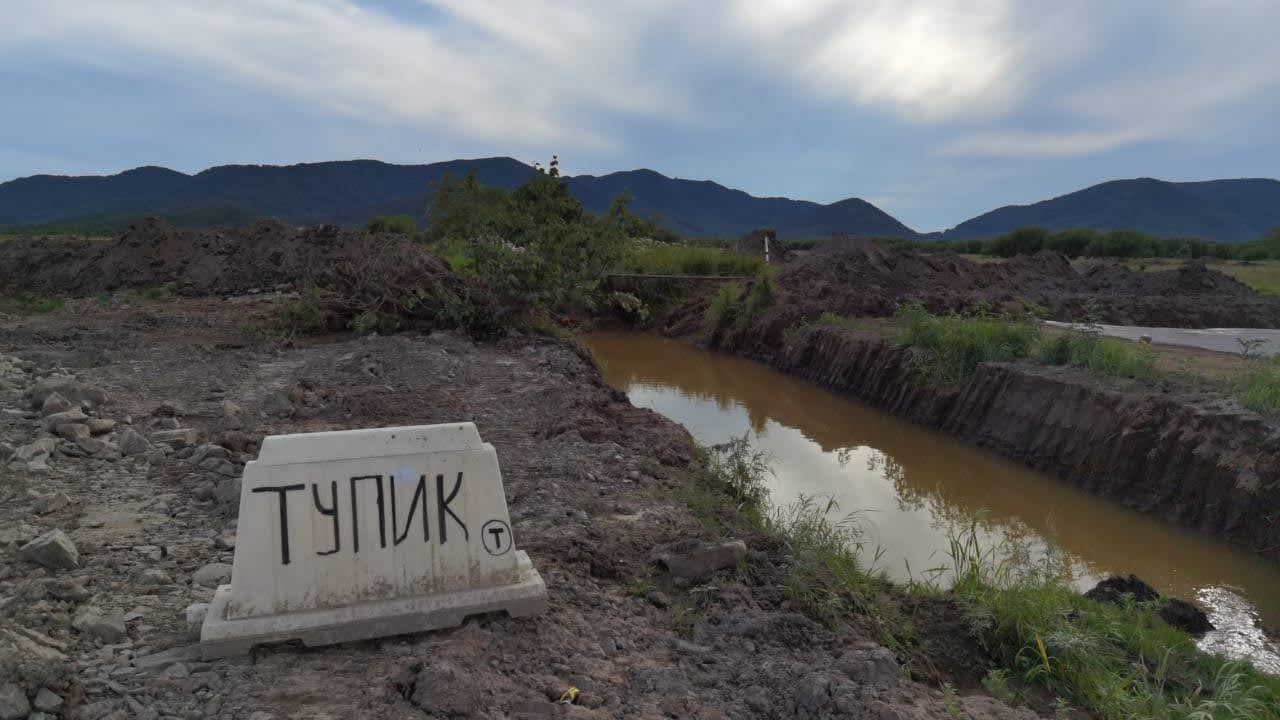
Tupik – ‘Dead end’

Discussion of the inflationary side effects of war spending in the Russian economy has been inconsistent. Even when observers note how in the long term economic decisions store up trouble, many focus on a mistaken idea that a significant segment of Russians are feeling economic benefits, or that wartime spending means real gains (as a share of GDP) for labour (i.e. that gains are redistributive).

Now it’s true that the government did signal a willingness to depart from decades of austerity when it comes to funding the war, but as Nick Trickett points out, spending more to foster growth only works if productive capacity actually expands as a result. Historically, fiscal expansion has increased demands for imports instead of domestic output. Despite recent rises in GDP, a rebound from the  economic shock of the start of the war and indeed, the long recent history of Russian underconsumption and underproduction continues.

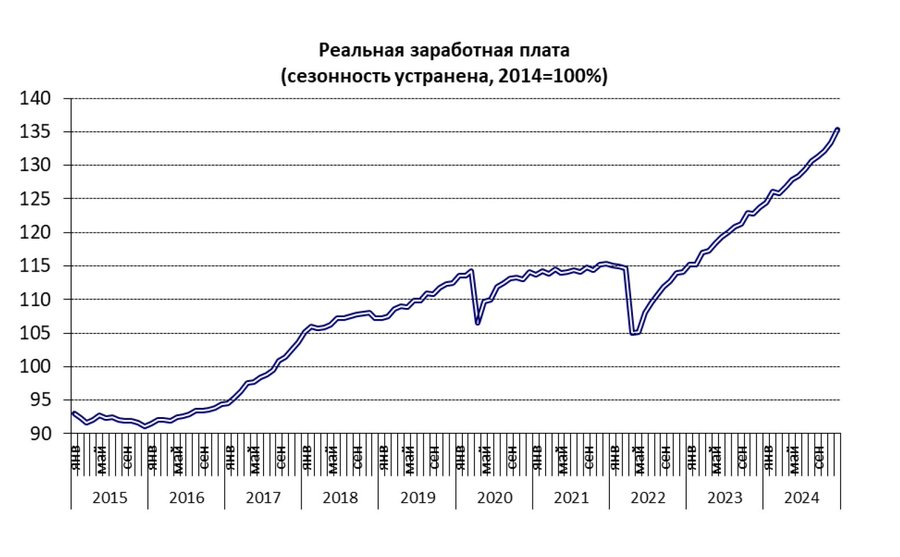
In the piece from August 2023, and in a recent follow-up piece Trickett offered a corrective to the idea that wages have seen a sustained outpacing of inflation.  Incomes are still probably lower in real terms than ten years ago, even accounting for a 9% rise in 2024 (these are the latest Rosstat figures. In 2022 real wages fell by 7% according to RLMS; in 2023 they rose slightly). In other words, Russia would need a decade-long shift in the share of income accruing to labour, and a similar period of real income (over inflation) increases to register. And the actual trend since 2017 is downwards.

The norm of low wages means that big percentage increases matter little to people

This point about the longer-term context is echoed by another granularly serious observer, economic geographer Natalia Zubarevich, who in every interview emphasizes the ‘law of small numbers’. Even a 20-40% rise in your take-home pay (which might well be experienced in well-placed blue-collar jobs over the period 2022-2024), does not mean very much if you’ve been working for subsistence wages for the last decade and set against high ‘real’ inflation.

Eurasianet discussed the manipulation of official inflation statistics in 2023, citing alternative sources which estimated real inflation at 20%. One of my better-off informants was called in to Sberbank for an interview in November. Her high level of rouble deposits was a concern for the bank worker who recommended she reinvest in gold and that the internal calculation by the bank, shared with high net-worth customers, of real inflation was 43% in 2024.

Widespread pessimism and dissatisfaction among wage earners, contrasting with optimism from business owners is what I find in my latest round of interlocutor interviews. These are taken from the same set of research participants I’ve been engaging with since 2009 in a well-placed part of Kaluga region – itself a ‘goldilocks’ zone of development near Moscow. Added to the mainly working-class men and women in my sample, I’ve extended my reach to new entrepreneurs who have expanded business since 2022, as well as more middle-class interviewees in Moscow and other large cities. Here, I condense around 20 hours of talks since early November 2024. For readability and ethical reasons, these are composited characters.

The view from the Kaluga-Moscow corridor

Gennady the small-business entrepreneur is ebullient. Patriotism and making money go hand in hand for him. The exit of Western companies allowed him to lever a wedge, going from importing and selling catering equipment via a US-based supplier to now dealing directly with the Chinese manufacturer. Gena is proud of his ability not only to markedly increase his profit margin this way, he has ‘onshored’ a small, but significant part of the production process involved. He now employs three times as many people as before and a third of those are in primary production – making components that are disposable parts for the Chinese equipment. Russians are like “sponges” when given the right opportunities to learn. They’re also like “mushrooms” – given the right conditions, they thrive and grow.

Gena likes his organic metaphors, but most of his talk is full of anglicisms taken from corporate speak. When we were chatting in Russian it took me a while to work out that when he was speaking about ‘khantil’ for able workers, he was using the Russified past-tense form of ‘hunt’: ‘I’ve been on the hunt for a good freight driver’.

At the same time, Gena says that reacting with resilience and entrepreneurialism is not about ‘patriotism’, but about the need to get ahead and make money. Nonetheless he makes it a point of patriotic principle to end our talk by saying ‘As you are recording this, let me say that we will win the war. Victory is ours’.

Misha is a technician in an industry that should have benefitted from spill-over of orders from the military industrial complex. I can’t be more specific than that, but I’ve never seen him so negative – and he is one of the classic ‘defensive consolidators’ who shifted from opposition to the war in 2022 to acceptance in 2024. Misha’s enterprise is affected by the shortage of workers. Because there aren’t enough workmen, he is not getting enough hours as a technician as not all the equipment can be utilized. The shortage of workers is not because of the war – few people in this region have volunteered for the front. The bigger picture is the one I highlighted at the outset – even with a wage increase of 60% since 2022, for many, the job is not attractive enough in comparison to lower-skill/stress/pace work in Moscow or elsewhere.

There’s also the major demographic squeeze in general – the c.1% annual fall in working people available nationally.  Misha talks to me a lot at the moment because even when his plant is up and running, his boss has to meet his demands for more flexible working hours, so sensitive is he to losing more workers. His micro-situation is a good illustration of broader processes – like the ‘work to rule’ in the Moscow metro because of a shortage of staff there but the inability to improve pay and conditions. This implies something of a negative feedback loop for productivity. The more an employer ‘sweats’ assets, be they labour or capital, the sooner they meet hard limits on increasing output, and even reversals.

Misha’s working biography features prominently in my new book, illustrating the ongoing sense of economic insecurity even for people like him who have good social, economic and other ‘capitals’ (he has a higher technical education in a good sector). I’ll merely highlight Russia’s “labour paradox” – workers can sense their structurally strengthening position – via falling demographics and specific labour shortages, while at the same time as suffering from the overall marginalized power in bargaining. In Russia, one can bargain only with one’s feet.  This paradox, viewed in aggregate, suggests that workers may be able to demand more where they are in industries serving state demand, yet eventually as the overall position deteriorates further, their bargaining power may prove transient. Whether or not some kind of authoritarian corporatism is possible (where there are real concessions to labour led by political recognition of its need) remains to be seen.

Misha is as well-educated and ‘worldly’ as Gena. He is insistent that the ‘situation’ of workers has only deteriorated, even as he makes a careful distinction in terms of class (that he’s not a worker). He’s been monitoring the job boards because at the beginning of the war he was looking to move into a job that would protect him from mobilization – perhaps metallurgy (another informant successfully made such a shift). Downshifting of work, after all, is a political strategy that goes back to Soviet times.

Misha points out that drawing conclusions based on published wages is foolish. Nowadays you’d have to look even more carefully at the hidden conditions attached to the discretionary element of the wage. Like others in my sample, he has left jobs where the published wage was higher but it required much greater self-exploitation at work. He even gives an example of a forklifter in a cement plant. Your ‘norm’ might now be 50 tonnes a shift rather than 25 tonnes, while your pay has only gone up by 25% since the beginning of the war. Working much harder not only wears you out, it’s dangerous as the risk of accidents exponentially increases.

Then there’s the continuing significance of working-class male breadwinning in what is still a society where women are paid peanuts, even if they successfully undertake what Charlie Walker described as financial independence through leveraging service work positions. Misha’s wife is one such example and yet only earns half his wage, even though on paper her job (administrative) is actually more demanding in hours, skills, responsibility.

Misha, like most of my informants is incredulous as well as quite angry at the idea anyone could take seriously the idea that wages have outpaced inflation for anyone not a soldier or metropolitan executive. He’s not the only person to say: ‘100k’ (around $1000) a month for an average regional breadwinner’s job is the new ‘40k’. In other words, that 100 roubles only buys what 40 roubles bought a few years ago. And certainly, there are still many of his peers earning a lot less than 100,000 roubles a month in blue-collar jobs.

The official ‘subsistence’ minimum for a family of four is 70,000 roubles, leaving a paltry amount left over after basic food costs. And in any case, such measures are often based on absurdly manipulated calculations: like assuming someone can buy fresh fruit for 100 roubles a kilo in winter, or undercounting real heating and utility costs by around 50% because of the assumption that a person does not occupy more than an allotted 18 metres of living space.

Misha works. His wife works. They don’t have a mortgage but own outright a three-room apartment in a nice suburb. Misha has two cars (though he wants to sell one). He complains that real inflation is much higher than reported because even someone like him spends so much of his take-home income on staple food products. For the first time since 2009, Misha has bought 100kg of potatoes to store in his garage basement for the winter. Potatoes – the main source of carbohydrate for most since rice and pasta are often more expensive, have increased in price by over 100% in 2024 due to the poor European harvest. The ‘Russian salad’ basket of goods, is now around 40% more expensive than a year ago – and remember these are just the staples of poor people (carrots, cabbage, etc. )

Inflation in the ‘real basket’ of consumables is the dominant talk among everyone, even the wealthy Muscovites who shop in premium stores. One such informant points out that her favourite discount brand of wet wipes has tripled in price since 2022 and that this is a product made in Russia, not imported. Not only are there a panoply of online calculators for one’s personal inflation rate, people also read discussions in economic Telegram channels where more independent academic works on inflation and the cost of living are popularized.

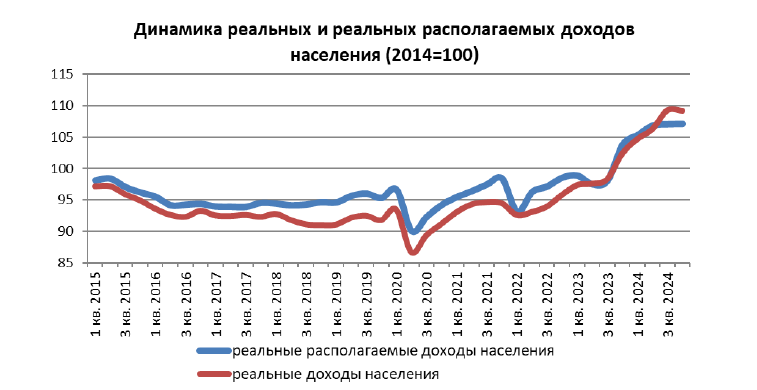
Thus, one of my informants who lives on irregular freelance work and a disability pension pointed to the Russian household longitudinal monitoring survey (RLMS) published by the Higher School of Economics. He accessed its data via a Telegram channel. While the channel itself is sensationalist and firmly aimed at discrediting the Central Bank, the research from HSE is widely discussed by the channel members, including my interlocutor.  Unlike official statistical services, the academic researchers are able to state things ‘as they are’, such as the fact that real incomes remain stagnant and indeed, have fallen in reality since the war thanks to tricks like lowering bonuses, not paying time off, etc. While RLMS confirms statistical facts like the long-term fall in poverty in Russia and even a fall in the GINI coefficient since 2022, the stark difference in measurements of real incomes stands out. RLMS records that average incomes are not higher overall than in 2013. Some of their calculations show real median incomes as less than half those recorded by Rosstat.

Tracking spending habits to calculate real inflation

Another way of looking at whether households are getting richer over time is to look at the proportion of incomes spent on different things. As people get better off they can be expected to spend much less of their income on staples and more on services and luxuries. Both Rosstat and RLMS look at this. The latter points to ongoing stagnation in services and non-perishable goods. Even today, Russians spend only 5% more on eating out than they did in 1994. By the same token, RLMS researchers point out that the sharp fall since 2020 of clothing spending is not due to a reduction in prices, but a sign of severe economic stress. Rosstat shows that households spend no greater proportion of income today on non-food purchases than in 2003. Even the richest 20% of households spend a whopping 26% of their income on food (in rich countries this figure is around 10%).

The main point of looking at the divergence in economic sentiment is to help understand whether war produces new social relations based on the relative shift in capital versus labour power. While people focus on real wage increases these need to be put in the context of the abnormally low wages in Russia, especially outside Moscow. We haven’t touched on household indebtedness and the cost of credit, the coming wage arrears crisis in multiple industries. Those are points to watch for. As mentioned earlier, for me of interest is the capacity (or not) of employers to turn to paternalistic reward as a way of dealing with the demographic-stagflationary crisis unfolding in Russia and which peace (at any price) will not solve.

Towards non-repressive research in Area Studies

This post summarizes a forthcoming talk at a roundtable on Russian civil-society/indi media/researcher dialogue.

The war disrupts academic practices and that’s a good thing. It give us an ‘opportunity’ to rethink extractive practices, to undo methodological and disciplinary siloing, to decolonise our epistemological foundations (how we know what we know). It forces us to confront problems of how knowledge is made public.

Here’s my summary of the problems and a set of examples follow after.

  1. Extractive practices perpetuate injustice – these include the invisible labour of local scholars, researchers and ‘partners’. How to equalize the attention given to knowledge produced locally?
  2. Siloing. Public and media attention to the war has jolted some colleagues out of the disciplinary narrowness that plagues academia. How to sustain this? Pluralising area journals? Activist scholarship (camping on lawns of other journals)? Entryism to scholarly associations?
  3. ‘Decolonization’ begins when paradigms produced to fit Western disciplinary traditions and structures are questioned by the those themselves who work within those core institutions. How to sustain critical conversations that promote insider interpretive perspectives?
  4. What to do with the dominance of public intellectuals interfacing with media? Can they be leveraged for good, or do they require better ‘education’ to avoid them repeating banalities or discredited ‘truths’? What is a sustainable basis for better communication and learning between researchers – who may still have good contact with ‘the ground’ in Russia – and media?

The four points serve as a starting point for discussion, but here I offer some elaboration.

Inclusive, not extractive knowledge production:

This ethical challenge is made starker by the more difficult sourcing of empirical data from Russia (and Ukraine). In my Post-Soviet Affairs article from 2022, I talked about the invisibilization of local gatekeepers, fixers and data gatherers. I used the example of a Central Asian scholar working on contentious politics where her local knowledge was extracted, but she was not credited or legible as a producer of knowledge. Even in my own work I am forced to reflect on how tempting it is to present insights from fieldwork as spontaneously my own when in fact they come from interlocutors who are not ‘colleagues’. Provocation: while lab-based science is notoriously hierarchical and autocratic, why do we not adopt the practice of having more co-authors on papers? Why shouldn’t organic intellectualism be made more visible systematically?

Digging out the prisoners of Silos:

I had an uncanny experience recently when I was reading back issues of journals in three related subject areas to look at how a particular concept is discussed and contextualized. It reinforced for me a topic no-one likes to talk about, but everyone is aware of: how publication practices in particular mean that one can be blissfully unaware of a parallel treatment of a topic or concept and that there are no incentives to engage with it. It seems to me that the relative receptiveness of Area journals is inadequate to the task. Is the answer to argue more collectively for dissemination solutions that surpass the twentieth-century model of the disciplinary journal? Is the problem deeper – in the institutional barriers to collaboration across departments, faculties?

Decolonization as epistemologically-open research practice:

Decolonizing knowledge is partly related to desiloing. Only by better dialogue between intellectual traditions and epistemological positions can we hope to avoid falling into the same traps where research ends up essentializing or emphasising deficiency. There are good examples of interdisciplinary discussions that kick this discussion off, but how do we invigorate these and spread the word. I’m thinking of two recent examples.

Myron Aronoff and Jan Kubik in 2013 wrote about how social science repeatedly falls into the trap of imputing civilizational incompetence to populations because of the intellectual bias in research due to the political disappointments of liberal researchers since the 1990s. There are plenty of other examples. Gulnaz Sharafutdinova and Samuel Greene have developed similar critiques and tried to use interdisciplinary insights to reinvigorate political sociology (they draw much more on social psychology). A common call seems to be for vernacular knowledge to be taken seriously as filling the gaps of a social science that is too naturalistic (supposedly we’re all game-players) too positivist (only the disaggregated individual builds bigger data), and too unidirectional (theorizing ‘down’ based on larger contexts: globalized, national, regional) (Aronoff and Kubik 2013: 281).

A more systematic focus on this kind of approach to vernacular knowledge can be found in David Ost’s writing (2018) on ‘semi-peripheral’ innovation. Ost argues that decolonising means research moving away from ‘discovering’ the East for itself, instead taking seriously its origin as a source of ideas. He notes also that semi-periphery is a nested concept – W Ukraine is semi-periphery for Poles, and so on. His examples of Eastern innovation are brands of autonomism (work self-management), the reinvention of civil society via Solidarność and V. Havel, who ‘returned’ ‘active civic resistance’ to the West, which of course then theorized it (because the East is allowed innovation but is not systematic or theoretical). In Ost’s view, reimportation reinvigorated antistate ‘common sense’ in the West. Relatedly there are twin innovation engines bequeathed to us from the East which dominate social relatiy: the radical-conservative resentful Right, and the spatial idea of neoliberal weapon-testing ground. Ost muses that if the radical Right eventually does win big in the West it will be in part thanks to the work of the semi-periphery.

‘Perspectival’ rather than juxtapositional-comparative research avoids the normative positioning of ‘this (political system) is like or unlike that (superior political system)’ (Schaffer 2021). Juxtaposition is to naturalize our own categories without admitting it. Categories that may end up misleading us as to the relevance of the object in the ‘other’ context. The classic example is how anthropology ended up questioning the whole concept of ‘kinship’ in the 1970s, even though it was the ordering concept of comparison of political orders up to that point. The original ‘perspectival’ comparativist was probably Max Weber on capitalism and religion. In short, analogical reasoning might serve us better moving forward. This is reflected in my own use of Deleuze to explain deterritorialized political activism in Russia today. This approach seems unlikely to elucidate the situation of Russian politics, but I argue it does so thanks to perspectivism. Schaffer’s example is instructive in Ost’s examples: political loyalty in the East is not just about transactionalism – that’s an American comparative imposition that ‘may not travel well’.

On furthering communicative exchange:

I’ve written before that academics are often too busy to talk to journalists or fear being misrepresented and that this is a shame. In my view, journalists are in general open to learning and adjusting. They are, in fact, less extractive than academics themselves. What is more problematic is the inevitable tendency of public intellectuals to become overconfident and start to hold forth on matters they are not qualified to comment on. Similarly, the extractive work is visible here too, when public intellectuals do not acknowledge their reliance on particular sources, especially when they themselves have no claim to knowledge in an area. On this last point I have no real suggestions, beyond the observation that war coverage at least among Russophones, increasingly looks narrowly framed. Take the example of Strana i Mir (Country and World) international conference in Berlin in November 2024. Now, a number of cutting-edge scholars, but the greater weight of analysis is unequivocally that of the entrepreneur pundit class.  Some of these do a great service in popularising science, but the few speakers with evidence-based social science approaches to contemporary Russia will be hard-pressed to be heard. Could a discussion between scientists and journalists be better imagined? You tell me. Popular science is needed more than ever before, but should it be popular because it tell us what we want to hear (and indeed have already heard many times) or should it aim to instil an uncomfortable sense of alternative sociological imaginations in the audience?

What can we learn about Russia-Ukraine from the longest interstate war of the twentieth century?

March 1986. Revolutionary Guards celebrate their victory after capturing the al-Faw peninsula. One year later the Battle of Basra would end in a bitter Iranian defeat.

I’d been meaning to read this book for a long time and finally got around to it. I’ve repeatedly said that historical parallels are problematic, but what the heck, here goes. Iran-Iraq, from 1980-1988, saw a regional war between unequal powers threaten to spiral out of control, involved energy dependence as a weapon, a lot of miscalculations about opponents, ideological blinkeredness, swinging fronts and stalemate, and human-wave attacks after one belligerent’s technological base for waging modern war was almost exhausted.

Pierre Razoux’s 2015 book is really readable, though a little weaker on Iran because he focusses on the better sources about Saddam’s reasoning, thanks to the US-captured audio cassettes spanning much of his time in power. It’s genuinely refreshing to read an author who is not afraid of confronting his own country’s rapacious and cynical mercantilism in the war, and the horrible cost to French citizens. One can hardly imagine so penetrating an account from an Anglo-Saxon pen. Indeed, the Americans come out of it the worst – completely rudderless and reactive in their responses to Iraqi aggression, and also Iranian desires for recognition to cement their new revolutionary regime.

What else? While 8 years is a long time to be at war, Razoux is able to show how each side had to reinvent its approach to waging war again and again and that the technology, and also metis, of war had become unrecognizable by the end – not least thanks to the flooding of the battlefield with newer Western tech and newer aircraft. At the same time, the old chestnut of generals fighting the last war is given stark illustration in the way the Iraqis partially drew on a 1941 plan by the British as a model for their initial (not very successful) ground assault. So despite the war beginning as a poorly coordinated mid-20th-century regional conflict and ending as essentially a 21st-century war (because of the entry of modern aircraft and ballistic missiles) belatedness is a key experience: not being up to date on all the resources needed to fight a big war; not considering current economic reality; dismissing basic military theatre requirements like air superiority and logistics; not having the right weapons in the right place at the right time. Some of it does ‘recall’ the disastrous Russian improvision of 2022 after the rush to Kyiv had failed.

Along with belatedness (and attrition of capacity which led to devolution of the Iranian effort into human waves) there is incompetence and purposeful ignorance: failure to acknowledge on the Iraqi’s part the force needed for the task of invading Iran (a massive country with lots of natural obstacles like mountains), a lack of coordination (Iran’s obtuseness regarding its superior airpower), delegation in a negative sense by Saddam (‘just get on with it and bring me results’). Saddam was remarkably ignorant about how his campaign would destabilize the region and affect the US and USSR, even if he was smart in blackmailing and playing Arab countries. However, this ignorance pales in comparison to the Americans’ massive intel failure and woeful response: they were completely wrong in seeing Iraq as Soviet-aligned; the US had no Iranian expertise (no one with Farsi or knowledge of the revolution was allowed anywhere near policy) and misunderstood that the Iranian revolution was not just about religion (ideology) but about state-making and regional recognition. At every turn, Western powers made belated decisions based on poor rationalization, political expediency, and worse.

Like Putin, Saddam quickly realized he’d bitten off more than he could chew. His recourse to terror and war crimes backfired and the war ‘made’ the Iranian post-revolutionary nation and state. A state that is quite capable of reproducing itself today and still strongly shaped by the experience of that war. Of course, it would be a mistake to map Russia-Ukraine onto Iraq-Iran for many, many reasons, not least size, religion, geography, outside aid, etc.

Razoux concludes with something we should pay attention to much more than tech, strategy, tactics, esprit de corps, or demography. After 500+ pages of battles, intrigue and horrible accounts of child soldiers and chemical weapons, he curtly turns to the reader to say that what’s of cardinal importance is none of that stuff, but instead the economic war. Only when Iran’s capacity to make money from oil was significantly degraded (they had no access to credit), and only when Iraq was mortgaged to the hilt and also threatened with significant economic repercussions, did the conflict end. Pretty much where it started.

Once again, most historical comparisons are downright dodgy. However, the Iran-Iraq war certainly led to the destabilization of the whole region and untold damage to both countries whose societies became exhausted by war. Certainly, Charles Tilly was right: “war makes the state”. (what he actually meant was that war transforms states in quite unpredictable ways) But which one is Ukraine? Is it Iraq – which transitioned to a hyper-modern, and quite effective militarized state where even the leader was in some respects beholden to the army? [spoilers, the US couldn’t put up with that, even as it had recently turned a blind eye to Iraq committing some of the worst atrocities since WWII]. Or is it Iran? Steeled in blood, collective suffering defines national identity and leads to consolidation around what is a factionally-divided revolutionary government (and not universally legitimate at that). Iranian domestic politics today is still the politics of a war that ended 36 years ago.

Childfree for me, but not for thee; Putin as Saddam; overheating Russian economy; the end of Area Studies as we know it

Parents of quadrobers, ‘kvadrobery’, are to be fined according to proposed new laws

Another post this week reviewing some goings-on in the Russia-sphere.

Biopolitical entrepreneur Katya Mizulina and head of the ‘Safe Internet League’, who is the daughter of politician Elena Mizulina – herself a pioneer in socially conservative legislation –  was asked at an event by a brave journalist why she rails against Western ‘child-free’ ideology while not having any children of her own. ‘Child-free ideology’ (sic) is just the latest addition to the not-very convincing attempt to consolidate Russian identity around the message that ‘we’re the protectors of the real Judeo-Christian tradition unlike the decadent Ukraine-nazi-supporting West’.

My new book (announcement forthcoming) opens with a look at the imposition of a new kind of civics lessons on school children. The very first ethnographic scene features a middle-aged male Life Skills and Personal Safety teacher who implores a room of teenagers to read the bible and recant of their pro-Western attitudes. Let’s just say these unwelcome distractions from the curriculum by unqualified and under-prepared instructors don’t go down very well with children and parents alike. Unlike the new social conservatism, there is an audience for patriotic education classes, where they are accompanied by genuine social and economic resources like preferential places at university. Young people are just as entrepreneurial as politicians in using political agendas in education to get ahead.

I’m not much of a fan of podcasts, but the Meduza Russian-language ones are often hidden gems. Like this talk with Maksim Samorukov about the informational isolation and blinkered world-views which ‘informed’ Saddam Hussein’s decisions to invade Iran and Kuwait. In making links to Putinism, Maksim stressed how subsequent endless uprisings were easily put down, even after military defeat… And that society’s dissatisfaction just isn’t part of regime calculus once elites get used to the idea of supposedly limited wars as a substitute for domestic programmes and legitimacy.

Maksim also emphasized the irrelevance of ‘new’ or contradicting information for these leader-types. Revelations that to you and me could challenge our priors (like the effect on US foreign policy of an election year – very topical) is merely incorporated into the existing world-view of the isolated person (Mr Putin, or Saddam). This podcast prompted me to finally start reading this book about the Iran-Iraq war. Some day I’ll do a post on the parallels between that war and the current Russo-Ukraine conflict. An interesting note about Saddam’s decision-making: some argue we have a really good idea of this because he recorded himself so much on audiotapes which were subsequently captured by the Americans.

There’s so much being written right now about the looming problems in 2025-26 for the Russian economy and I can’t fit it all into this short post. In 2019 I discussed neo-feudalization of Russia’s political economy (“people as the new oil”). Many others have takes on this, from the idea of a new caste-like society with state bureaucrats as an aristocracy, to a more nakedly transactional ‘necropolitics’ where blood is exchanged for money (death payments for volunteer troops). Nick Trickett’s piece in Ridl argues against the ‘hydraulic Keynesianism’: that military spending boosts economic growth. Demographic decline and war are like a Wile E. Coyote cliff-edge for growth, a precipice towards which the Russian war stimulus merely accelerates the economy. Monetary policy like a 20% bank rate, ‘cannot tame what’s driving inflation’.

One of my informants on a very good blue-collar supervisor wage played ‘jingle-mail’ recently and moved back in with his parents. He’s 39 with no children and working in a booming manufacturing sector. He’s also working double-shifts to keep up with demand, but there’s a human limit to over-working in place of capital investment. Nick’s piece points to the stagnation in productivity in Russia.

Another sign of the endless war to make citizens fiscally-legible to the state is this story about ratcheting up penalties for Russian drivers who obscure or hide their number plates. Traffic cameras are, to an absurd and unpopular degree, relied upon to raise tax revenue in Russia. I’ve written about this many times on this blog.  The details this time are not so important, but the story illustrates a number of things – penalties are still pretty low for all kinds of avoidance and ‘resistance’; Russians are ingenious in making their fiscal radar-signature as small as possible; the technocratic approach (blocking an AliExpress webpage selling revolving number plates) of the government is wholly ineffective because the state is losing capacity due to the drain of the war.

Does this shorter and more frequent posting by me signal a trend (a move towards the style of Sam Greene’s excellent, short-form weekly posting)? We’ll have to see. Though the news from my Dean of Faculty that she proposes closing all language-based Area Studies degrees may indicate I will have more time on my hands in the future. At Aarhus University we’ve developed unique programmes where students attain a high competency in one language out of Russian, Chinese, Japanese, Hindi, Brazilian Portuguese, and then can go on to a Masters degree where they are team taught by experts beyond their region. So a Russian student gets exposed to expertise in Chinese politics, Brazilian environmental studies, and so on, regardless of their continuing focus on a single language. We also just began to expand Ukrainian studies and have two Ukrainian scholars working with us now. ‘Dimensioning’ [Danish Orwell-speak for cuts to staff and student numbers] of Area Studies will likely mean no language teaching in these areas in the future. We live in a time of narrowing horizons for students, unfortunately.  

I leave you with this advertisement for war-time intimacy from Rostov: ‘If you’re at war I can provide a service to support you. We’ll communicate as if we love each other and support each other. Photos and video for an additional fee. Agreement about price subject to personal negotiation.’

Russian expert media monitoring – September 2024

This will be a short review (well, actually not short) of some Russian media commentary (A. Pliushev, E. Schulmann, N. Zubarevich) and my reactions. If you think this kind of post is useful, let me know. It is often the case that informed discussion in Russian language on YouTube never really cuts through to anglophone audiences for Russia content. I don’t ‘endorse’ the persons or positions of any of these public intellectuals and journalists, but this kind of content is important for non-Russian speakers to get access to.

Virtual Autocracy?

At the beginning of September there were simultaneous elections of various kinds throughout Russia. The results were not very interesting but the strong push to ‘virtualize’ voting as much as possible is. Why not continue to rely on the physical and very visible power expressed in falsifying actual ballot papers and busing in people to vote on pain of losing benefits? The resort to a virtual electoral autocracy shows the authorities have a good idea of their genuine unpopularity and the continuing risks, even now, of all kinds of upsets. Not only that, they also understand the advantages of digitized authoritarianism (I’m hoping to do a big write up of this soon). You can geolocate voters in the app they use and this exerts a coercive power of its own.

But, as Ekaterina Schulmann pointed out in her review of the elections, getting rid of the spectacular in-person falsification reduces two powerful indirect effects: the visible demonstration of loyalty by voters to the state (which goes back to Soviet times) and which speaks to the main reason for elections in autocracies – the idea that legitimization still needs a public audience. Secondly, in the Russian case, virtualization means that the army of state workers – mainly schoolteachers and local council employees– are ‘let off the hook’ they’d previously been sat on: being implicated as ‘hostages’ in the falsification process as counters and electoral polling workers. Cutting out the middleman is interesting and perhaps reveals a real buy-in among the elite to the idea of “full-fat digital autocracy” maintained by technocratic management of populations. But, thinking sociologically, normalization of involving the morally-important category of teachers in illegal compliance with the diktats was the strongest spectacular effect of Putinism. Here, I’m also reminded of the big conflicts even now between parents and teachers over the disliked patriotic education lessons, with the latter stuck in the middle and largely unhappy at carrying out this task (more on this in my forthcoming book).

The election also revealed other indirect information about the emerging post-2022 Putinism ‘flavour’. There’s no sign of the much-expected ‘veteran-politician’ wave. Special Mill Op vets are not getting elected positions – many supposed examples of this in the media are just low-level bureaucrats who had to go to the ‘contact zone’ (frontline) to exculpate some disgrace and then came back. A big thing to watch for in 2025 also related to the war is the fact that on paper, the proportion of the national budget devoted to defence is due to fall according to the Finance Ministry. Watch this space.

The non-appearance of the Great Russian Firewall

On media use, Alexander Pliushev looked into VPN usage, and estimated that around 50% of internet users in Russia are now forced to use these services to access content, but probably not because they’re looking for subversive information. But there are plans afoot to root out VPN usage, along with the slow-down on services like YouTube. However, it is estimated to take years to root out VPNs, and this doesn’t take into account measures to develop new forms of avoiding blocks. Pliushev feels confident in this because while number of views of his content fell a lot from Russia, the overall picture is unchanged – meaning people just switching to VPNs. He should know: the ex-Moscow Echo journo has an audience of 300k viewers on Bild, and 700k viewers on his own channel. Already we see the emergence of IT service providers of ‘partisan’ packages to customers which improve the speed of YouTube.

Television as domestic wallpaper

A good accompanying piece on TV and media use came out in July by Denis Volkov of Levada.  In this piece he claims TV as a source of information is still really important, and I have some questions about that. It’s true, as he says, that the TV news is always on in the background of people’s homes, but other sources have reported that TV ad revenue has ‘followed’ the decline in audiences since 2022 because people are generally turned off by the very visible war coverage on main channels. Indeed, at one channel I know intimately, worker’s contracts are not being renewed and people are not getting the pay increases they expect. What’s more interesting about the Volkov piece is how rapidly the coverage of social media has changed – the rise in Telegram: readers of ‘channels’ there (mainly news and current affairs) has gone from 1% to 25% of the population since 2019. This is a sobering reminder to be cautious about state’s capacity to control informational dispersal. The unparalleled rise in the onlineness of Russian means we should also avoid too many historical parallels (Vietnam war, Afghanistan, WWI, WWII). We really do live in a different age.

There’s a lot I don’t agree with in the Volkov piece, but it’s worth a read. As I’ve frequently written here, if you’re attentive then stuff like this from Levada people reveals deep-seated ideological assumptions about Russian society that can surely be questioned. I don’t agree with his insistence on uncritical media consumption and the simplistic ideas about how TV shapes views. Nonetheless we get more interesting points – like that 28% of people don’t watch TV at all, that the audience for Twitter and Facebook is tiny at 2%. Late in the article we get the statement that the share of television as a news source fell by 33% in the last 15 years, somewhat undercutting Volkov’s insistence on the relevance of TV as a regime-population conduit for propaganda.

“It’s the regional economy, stupid!”

Moving on to Natalya Zubarevich’s frequent and detailed online talks (with Maxim Kurnikov here in mid-Sept) about regional economy and demography in Russia, she lets slip some interesting observations beyond her usual scrupulous (and self-censoring) focus on the ‘facts and figures’ from official documents. She talks about how noticeable it is that in military recruitment in Moscow there are few young faces and a preponderance of ethnic minorities. She talks about the current ‘hostile migration environment’ led to harassment of gig workers in taxi-apps (Yandex). But not due to war-recruitment pressure, rather to increase bureaucratic monitoring of taxi drivers in the capital, reiterating the point above about the government staking more on digital control. She says we have good evidence for this squeeze because of the rising visibility of Kyrgyz drivers for whom there are fewer migration hurdles. (Gig workers from Kyrgyzstan represent a case study about the gig-economy in my forthcoming book).

Zubarevich makes the point that low paid blue-collar workers are being sucked dry by the war machine. If we accept the national soldier replacement rate target is 30,000 recruits a month then yearly Russia is losing around 1% of the available male workforce – but it hits harder in logistics, warehousing, manufacturing, and so on and hardly at all in, for example, local government. She also provides good examples of agency within the state: where the Agriministry was able to get the enlistment offices to back off men who work as mechanics for farms.

Some criticise Zubarevich for her insistence on talking only about published statistics. Here, without openly saying it, she pours cold water on the idea of sustained income rises keeping pace with inflation. She doesn’t believe the figures of high annual percentage rises in salaries as sustained or ‘real’ (net effects). She also points to clear slowing in wage inflation in 2024. This then allows her to demolish part of the military Keynesianism argument. Low incomes have seen big increases but from very low base starting points (an apple plus an apple is two apples for the blue-collars; but the people in white collar jobs were already earning 10 apples. If you given them one more apple do the blue-collars feel less unequal?). Periphery growth (in regions including war factory locales) is not significant because it does not begin to affect the overall level of inequality in society.

What conclusions do we draw from Zubarevich’s dry statistical analysis? It’s a paradox that in Russia’s ‘necrotopia’, where multiples of annual wages can be earned for surplus people by offering themselves as victims to the death machine, the overall value of blue-collar labour has increased to a degree that alters the bargaining power of workers who remain uninvolved directly in the business of dying for cash. Nonetheless, productivity, whether in military or other parts of the economy has not increased at all because of human and technological limits. You can introduce another shift, pay people 30% more, but that doesn’t mean that the output/hour of tanks, or washing machines or nuts and bolts (another case study in my book) goes up. Zubarevich comes around to a quite conservative position. It might seem like the war has the potential to break a pattern of decades of very high income inequality and massive underpayment of ‘productive’ people, but the inflationary effects of war are already bringing the pendulum back to ‘normality’. She also reminds us that inflation and the isolation of the Russian economy mean that ‘veteran’ incomes will never have significant levelling effects on inequality either.

On the Russian Defence Ministry shake out

Back to Schulmann in conversation here with Temur Umarov. The purges in the Defence Ministry are like the Malenkov-Khrushchev pact after Stalin’s death. A new deal: not only will you not be physically exterminated in the war-of-all-against-all where there are no institutions to regulate political life, we won’t punish your relatives either.

What’s happening in the Defence Ministry is a Putin-style purge: not based on ideology, one could even call them ‘nihilistic arrests’, supporting the idea of nihilism at the heart of Putinism. And as Schulman says, this only serves to destroy any idea of narrative structure to the war aims. Umarov: it is Stalinist in the one sense that it’s a structural process of social mobility: unblocking of avenues for advancement for sub-elites. This should also give us some ideas about ‘where we are’ in the maturing or even autumnal days of this regime. Are these arrests signs of sub-elite impatience for more radical regime transition (in terms of personnel, not necessarily politically)? Stalin-Khrushchev-Brezhnev? It is probably a mistake to interpret this in terms of anyone thinking that these new faces will be ‘better’ at the job of war. Schulmann asks: are these repressions for the war, or repression instead of war? What she means is that instead of the fantasy that the overturn of corrupt military elites will allow real competence and patriotic leaders from the ‘ranks’ to emerge, in reality we just get new clients and relatives of those still at the top.

Schulmann reveals perhaps more than usual in this ‘academic’ talk setting. Her view now is that the core hawkish elite really did want to go to war in 2020 and only Covid intervened. There was a test run of an alternative ‘institutionalization’ of elite wealth and status transference in the 2020 constitutional amendment. It was a groping towards cementing the ‘rules of the game’ to lock in elite self-reproduction. But in reality few could believe that this this compact would survive Putin.  For Schulmann the rejection of this compact as unworkable, and subsequent turn to war as a ‘solution’ for the problems of elite consolidation really, shows the genuine narrowness of political imagination in Russia – no one really believes institutionalization is possible, and that even in the West it must also somehow be a ‘show’ or ‘fake’.

Russians: We don’t know what the war is for

One final nugget is the latest Russian Academy of Sciences’ sociology centre monitoring report from April 2024.  There are many surprises, but one stat stands out. People are asked, towards the end of a questionnaire containing sometimes absurdly slanted questions, about the Special Military Operations’ “solution”. They don’t get to choose their own answer, only pre-selected ‘options’.

Comparing the mid 2022 version with mid-2024, the results are interesting:

What should be the aim of the SMO on demilitarization of Ukraine and liberation from nationalists?

Liberate all Ukraine: 2022: 26%, 2024: 16%

Liberate Donbas: 2022: 21%, 2024: 19%

Liberate ‘Malorossiia’: 2022: 18%, 2024: 20%

Liberate UA minus west: 2022: 14%, 2024: 20%

Other opinion: 2022: 3%, 2024: 1%

Difficult to answer: 2022: 18%, 2024: 25%

There we have it: the plurality are ‘don’t knows’. The ‘other opinion’ includes the possible selections, destroy fascism, destroy Nazism, end Ukraine as a state, destroy Banderism, preserve Russian territory, keeping only Crimea. (A bit ambiguously worded, that. Did they mean to write: ‘keep Ukraine as it was, but leave Crimea to Russia?) Who knows. As my interlocutor writes: likely this document was heavily ‘curated’ and then the sociologists tried to rewrite it to make sense while not annoying the powers-that-be. Imagine a guy in epaulettes standing behind the bozo writing the report.  

Imagining Kursk. On Russia’s metaphorical blockade economy

The sign reads: ‘no-through-road’

I had been meaning to write a ‘roundup’ summer post, but didn’t get around to it. The Ukrainian push into a part of Russia’s Kursk region was obviously the most relevant event to write about, but even now there’s questionable value in trying to interpret. Here, though, I try to offer a number of quick summaries of events. And then some more speculative stuff. If you think this more topical genre worth reading, let me know.

Kursk is a kind of nowhere region in the Russian imagination (1943 tank battle not withstanding). It is not quite steppe country, not Cossack country, but neither is it core European territory either. Nikita Khrushchev was born here, but his formative years were in Donbas. Today, Kursk is a landscape of relatively successful black soil farming broken up by river ravines. I went on a road trip there in the late 2010s and one of my key interlocutors is going there next month for a family visit. When we visited together, despite the agricultural pride of the region, our hosts asked us to bring processed meats and cheeses (too expensive locally for poor people to afford), and essential medicines. The final leg from Kursk city took nearly as long as the one from Kaluga-Kursk along the highway.

In some ways Kursk’s dismal demographics and patchy economic geography are quite comparable to other regions – population depletion everywhere but the capital; agroholding expansion into spaces vacated by surplus populations; some economic specialization (iron and agri) despite not really having a competitive advantage; neglect from the centre and the pitiless poverty of rural life reminiscent of 19thC novels. Kursk is kind of representative in size too of many ‘central’ Russian regions. Kursk, Jutland (where I work), Maryland, and Belgium cover similar areas but compare populations. Jutland – 2.5m, Maryland – 6m, Belgium – 12m. Kursk, by comparison, is almost empty (well below 1 million inhabitants – and probably less given that population stats are inflated for budgetary reasons by the local authorities). Nearly 45% of the region lives in the single large city.

“What to say about Kursk?”

No, that’s actually the response my Russian interlocutors would likely say, if I was guileless enough to bulldoze them into talking about it. I did an experiment. I purposefully didn’t mention it to them for the whole of August (recall incursion began 6th August). By now, most people have had time to digest, but it still doesn’t have a political shape in Russian society. This is not because of propaganda, nor ‘indifference’. To some degree it illustrates the normalization of sequentialness of ‘externalities’ of the Russo-Ukrainian war. Invasion, routing of ‘our’ forces, war crimes, missile strikes on the mother of ‘Russian’ cities (Kyiv), counterattacks, drone strikes by Ukraine. Most ‘real’ is the indirect effect of inflation, loan terms and percentages, labour shortages, ‘opportunities’ for those able to relocate jobs. A handful of people reference Kursk. They’re not callous. They mention, wryly, the conspicuous absence of it on TV. They talk about helping displaced persons. They collect money and send it on. They bring collections of food, clothing and money to the temporary accommodation points (summer camps, ‘sanitorii’, disused student halls). Part of the story is one of the belatedness of meaning. It’s too early to say what the meaning of Kursk is on any level. We’ll incorporate it into the ‘meaning’ of 2024 probably long after New Year’s eve of this year.  

“There aren’t enough men”; alarm versus calm

“There aren’t enough men”, was heard from that most loyal source. A ‘security-adjacent true believer’. Don’t ask me what that means, for now. Certainly ‘throughput’ or ‘flow’ of meat (because that’s what it is, and on the Ukraine side too) is inadequate. Something, somewhere will break. Or is right now breaking. Concerning a new mobilization wave I have many contradictory thoughts. On the mobility and ‘small tricksterness’ of post-socialist populations. On the tiredness of ordinary Ukrainians and Russians alike. Could mobilization just mean continuity? Yes, but continuity of what? Would it accelerate tectonic changes. Yes, that too. But that’s the point. We stand, as sociologists, reading a seismograph that’s too far from the epicentre to make predictions.

Ekaterina Schulmann in one of her August podcasts: ‘deprivatization and transfer of property in Russia is far more alarming to the elites than any loss of bits of Russian land, whether that land is canonical or non-canonical’. Schulmann in the same broadcast warned that direct measuring of public opinion is futile, but even the official pollsters can’t hide a real fall in the confidence of people in the centre.

‘It is better to look at proxies’ for public opinion, is pretty much what everyone says now. There’s media consumption, internet search terms, politically ‘safer’ polls like the one about Russians’ biggest ‘fears’. But even here, Kursk does not register as much as one would expect. Schulmann gives a nice history of the relationship between ‘things are alarming/things are calm’ polling. In Feb. 2022 the split between alarming/calm was 55/39; Mobilization in late 2022: 70:26; Moscow drone strikes: 53/42. Now, post-Kursk: 46/46.

calm is green, fearful is orange

You can’t imitate Schulmann’s ironic style. She points out that when you ask Russians about the ‘Special Military Op’ they invariably speak like “schizos”: ‘Everything is going great… Let’s make peace right now!’ For Schulmann, we can compare Russian society to a person being smothered with a cushion while around them the world burns. In some sense they want to be smothered.

Viacheslav Inozemtsev, the Russian economic observer, covered the Kursk incursion in an interesting way. He notes that Kursk and Belgorod are centres of pork, poultry and milk production – 25% of pork production, in fact. Inozemtsev is more forthright than usual in the piece, arguing that new mobilization might be forced on the Kremlin by events like those in Kursk and that this would entail the defacto dismantling of Putinism. What he means by this is the ability of people to detach themselves from political life in the country, content that they will be largely left alone. If mobilization is needed, he seems to say, the system would have to fundamentally change, in order to survive.

Alexei Levinson, of Levada argues that Russians are indifferent to what’s happening in Kursk, citing, as usual, his brand of Wizard of Oz sociology: ‘focus group data showed that there was no significant concern’. He cites emotional anesthesia and numbness in the population, who seek denial and escape. This is a long interview and some readers will know I criticize Levada-type sociology on methodological grounds and more. Objection here, here, and here. But you don’t have to listen to me. Here are the words of Professor Gulnaz Sharafutdinova of KCL in her latest book on Rethinking Homo Sovieticus. Writing about the obsession of Levada with the totalitarian paradigm and the accusation of moral failure of the Russian people, ‘such a mixing of the political, the ethical and the analytical created “a blind spot” that many scholars did not see’ and that ‘labelling an entire society with the use of ideas from the 1950s is lamentable’. Why do observers like Levinson remain so wedded to the idea of inertia and atomization? (Rhetorical question. The answer is here)

That Levinson comes out with such a strong claim reveals more about the universe of ideas he lives in, than any empirical reality. I can’t help but mention a different ‘data point’ –  vox pops that BBC’s Steve Rosenberg did in Aleksin after the Kursk incursion. Even though people knew they were talking to a foreign journalist with a camera, a very different, and charged atmosphere was evident (the subtitles are a bit misleading, by the way). And that chimes well with what I hear from people who are able to speak without restrictions to their friends, colleagues and relatives.

Holy war falls flat

One interlocutor noted that people struggle to connect with WWII tropes (resisting invasion as holy war) as a useable emotional catalyze, and that this has destabilizing effects, even as they are forced into using some of those same limiting tropes: heroism, sacrifice, faithfulness to the fatherland. Does this mean that through war, via ‘dialogic’ interaction of old tropes which are inadequate with the ‘new’ reality, a novel orientation towards the future might emerge? I can’t help think of a different kind of belatedness, this time relating to hegemonic cultural orders. In a society like Russia we must be doubly sensitive to the notion that organic crises (which we can argue Russia has been in for at least 15 years, or longer) eventually culminate with such unpredicted rapidity, that they overtake even the key actors involved. Indeed, this isn’t about the end of the Russian state or Putin – they may both ‘continue’ seemingly in their present form, even while overall the system transitions to a new steady-state and new forms of ‘common sense’ take over. Essentially the crisis might even resolve itself before we know it has, and be recognizable as such only much later. ‘Everything must change, so that everything remains the same’. Is this so different from Andrei Pertsev’s musings here on the cross-over in trends for relative popularity of Head of State and government

But back to those vox pops and my own interactions: when people use familiar tropes of heroism, these is a strange hybrid of sacredness and meaninglessness and also criticism of the army and civilian authorities.

If emotions performed publicly are political performances, then Kursk shows that the mechanism of performance itself is broken. This is even visible in the comments about it from people like Kara-Murza. Because rationality and emotion collide in his answer, his usually eloquent expression is literally blocked. He has to go off on a long tangent to get to the point of saying, rather tiredly, that he doesn’t like seeing Russians being killed just as he doesn’t like seeing Ukrainians murdered. ‘Strashno… strashno…. Strashno… bol’… strashno.’ [horror, horror, horror, pain, horror] overtake his whole commentary for a while. Until he comes out with the trite: ‘all they that take the sword shall perish with the sword.’

In the end there can be neither rationality nor affectivity: things that the surveys like Levinson’s are aimed at measuring, as if they can be extracted as distilled fractions. Instead, there is a large (or small), depending on the person, black hole, about which there is nothing to say. Because the blockage of different orders of expression and feeling is right inside you. You can only shout into a void. But this too is not normalization of war, but like an explosion in the deep and dusty places where different available hegemonic discourses are stored.

For a while now the sociological person has ‘died’; it’s not that they are traumatized, which might be more true of Ukrainian victims. It means they are living in what Irina Sandomirskaya calls a ‘blockade economy’ a ‘powerful proving ground for the testing of technologies of power’. One in which money and power, and death and destruction overwhelm the capacity to gather together one’s own circulating and contradictory thoughts as meaningful currency.