Introducing Everyday Russian Politics: 1. Entangled Activism and Agonism

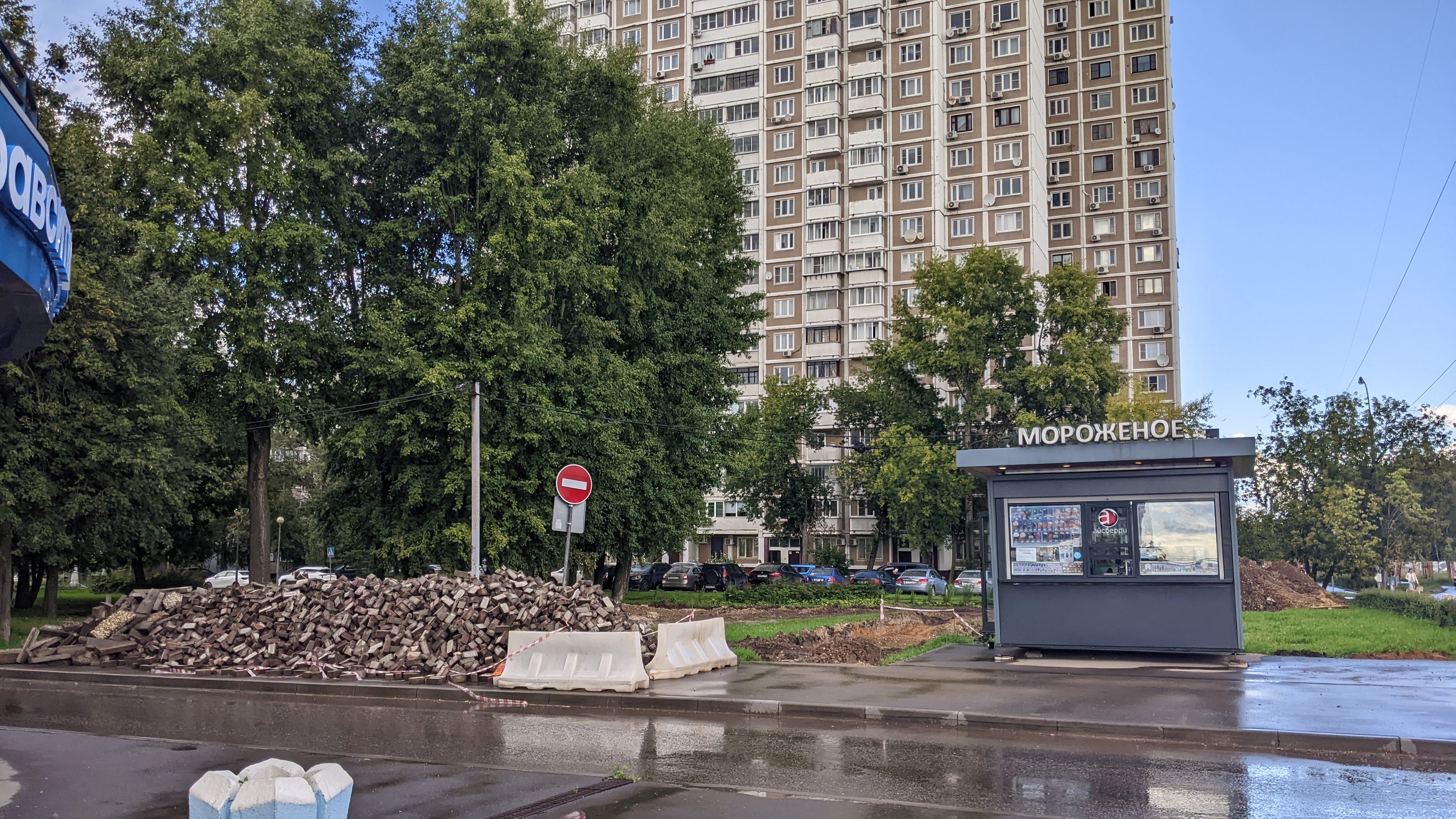
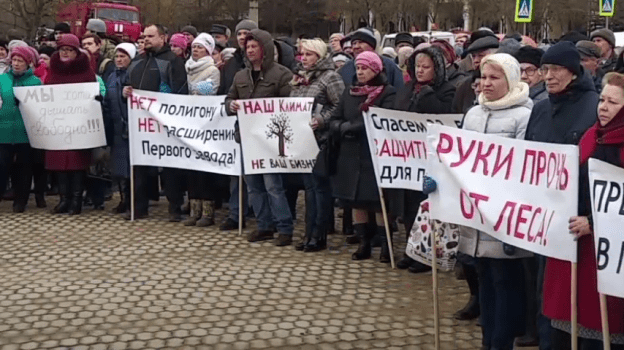
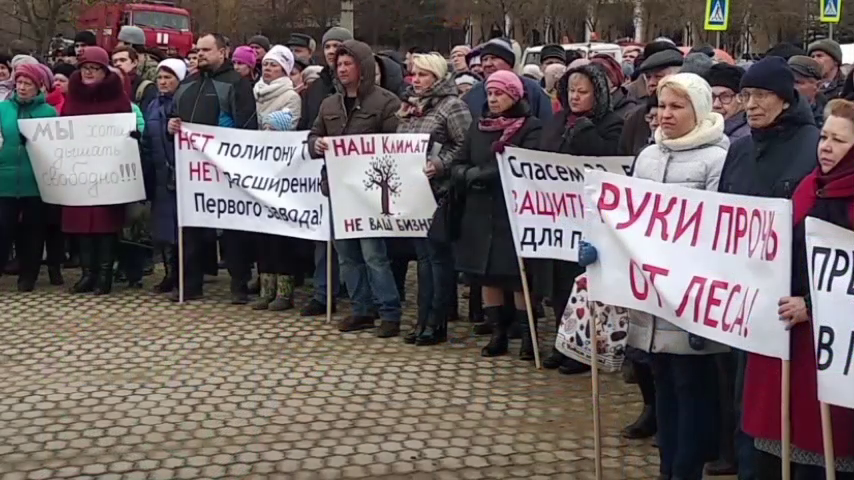
A very unlikely and unnoticed (by the media and scholars) mobilization by untypical activists against the expansion of a polluting factory

In a series of narrowly-focused posts I will talk about three aspects of my new book – 1., the use of up-close methods of long immersion – I argue there’s analytical power in ethnography to show the broader significance of neglected aspects of Russian social and political reality, 2., the part of my argument where bring together three interacting concepts: ressentiment, defensive consolidation and social striving. And 3., the evidence in the book of deep and enduring political engagement and practices which are underappreciated in a lot of coverage on Russia. In the last four chapters of the book, but also in my coverage of municipal politicians earlier on, I make claims relating to the idea of micropolitical content as it emerges in articulations and actions on the ground, and largely aside electoral politics (in a parallel relationship). (The relationship to ‘the political’ of Chantal Mouffe’s work, I defer to the end of this post as most readers are less interested in the theory stuff).

This post, though, is mostly about ‘activists’ and broadly from around 2018 to the present.

One claim is about a particular form of learning and reorientation by self-consciously ‘politically-active’ people, but also by people who deny they are political, and yet engage in ‘civicness’ nonetheless. The continual reinvention and recasting of activism is like different forms of movement – movement from electoralism to environmentalism, from in-person to online, from parties and groups to cells. This is maybe one of the most interesting ‘lessons’ of the ‘Russian case’.  Without longitudinal ethnography (which after all is just a form of immersive process tracing) it’s easy to accept the common sense that the centre has defeated nearly all forms of politically conscious actions not under its control. And I reject that. Why? Because in my book and elsewhere, I show that the gains of electoral organizing by people who were inspired by people like Navalny (but also by others) are not lost, but even now have been transformed several times over. This transformation occurs when they come into contact with new causes like environmental degradation, new conjunctural situations like military mobilization, and new situations of repressiveness, and that includes economic exploitation.

Just to unpack for a moment, I can give the example from my interviews of how Navalnyite electoral administrative ‘capacity’, for want of a better word, even after 2020, was partly resynthesized by people interested in more agitational orientation in labour activism: picketing tactics, political education through literature distribution and even just online ‘slacktivism’. People internalized lessons from one context and applied them in another. Or, more typically, the lessons ‘transmutated’ themselves. Another time this meant lessons drawn from ecological actions relating to tactical victories like Shiyes – the opposition of garbage transport to the north – were carried over into anti-war activism (decentered and devolved tasks with precautions taken to protect those on the edge and firewall them from hardcore activists).

This unpredictable and dynamic process was also shaped by the authoritarian push to remove activists from public space. As personal, but also semi-public Telegram channels and many group chats, became the only fora available for the discussion of causes, this repressive escalation actually did activists favours because it attracted a broader ‘insulted and injured’ audience, and enabled reflection and discussion on a wider range of political causes and possibilities. The irony is that ‘flattening’ the public sphere in Russia actually facilitated more intense and more fruitful sharing of experience among political actives – albeit online and in private.

But what is private? People I talked to often spoke of living the struggle as ‘more real’ even in the virtual sphere because it was experienced more intensely and with more solidarity and less loneliness. Over time this online response to repression then translated into better organized, more mobile, and more targeted and strategically-considered action – from the aforementioned Shiyes, to anti-war stickering, to small-cell sabotage (full disclosure – I have NO informants who do this nor knowledge of them).

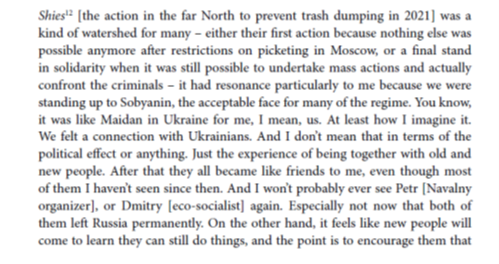
Using my own fieldwork interviews with diverse activists, most of whom remain in Russia, I build on the empirical work by other researchers like Tereshina, Slabinski and Kuzmina. They emphasise how Shyies 2018-2020 heralded a shift towards more affective connection – catalysed by exclusion from electoral and public protest in cities. A mobilizational imperative that drew a broader group of activists together from across the country and across the political spectrum. Looser politics, yet affectively closer-knit, became a widely experienced paradox. I call this ‘experiential entanglement’ and I started to explore it in my previous co-edited book with Regina Smyth and Andrei Semenov.

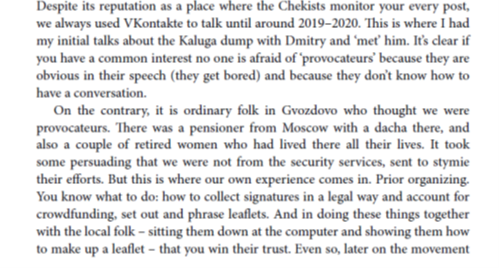
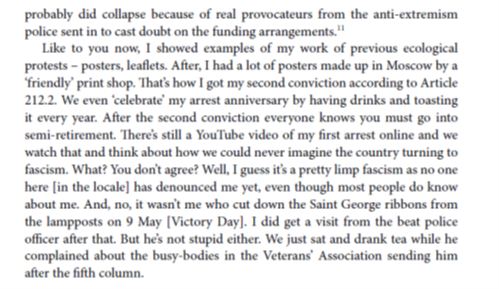
One of my own case studies relates to a modest campaign of opposition to rubbish dumping in Kaluga region. But in terms of organizing, and also in terms of affective connections between activists of different stripes, people reference the lessons of Shiyes, and of the success of Navalny’s electoral clusters to train and bring together activists. They even refer to Shiyes as a kind of Russian Maidan – but more narrowly in terms of how it showed to activists a glimpse of the horizontalist, accretionist, triangulatory forms of contention – and here I purposely avoid the normal terminology of political opportunity structure. At the same time, I remain mindful of the lessons from political science of how dynamic the mechanisms of contention can be. Activists are not just subjects of collective action, but the products of unpredictable combinations.

It’s worth quoting at length a rather rambling talk from the field to show the complexity of what I mean by unpredictably combinations. Polina is speaking in 2022:

As this post is already long, here I want to return to the use of the term ‘the political’. This term for me levels the ground to look at the political content of people’s lives as equal in significance to just ‘politics’. And how I use this term relates to Chantal Mouffe’s criticism of overly narrow conceptions of political relations. If ‘politics’ is institutional practices and discourses – realms from which almost all Russians are excluded, ‘the political’ is a dimension of antagonism inherent in all human society. The war on Ukraine only makes more intense Russians’ deliberations about what kind of ‘good’ society can be imagined. ‘Political’ discussions about the good are part of everyday experience, even in ‘post-democracies’, even in militarized dictatorships. Like Pierre Clastres’ (1977) classic critique of Western notions of politics, I insist that contention and negotiation, along with conflicts about the meaning of the ‘good’, can be grasped beyond the normative frames of formal politics in the public sphere. Politics exist beyond a narrow idea of ‘hierarchical subordination’ of the individual to power.

If you recall my recent review of Denys Gorbach’s work, I agree with him that an updating, or correction, of Mouffe’s concept needs to ground ‘everyday politics’ in material processes – like the experience of workplace exploitation, the broken infrastructure of towns, the way economic rents are now extracted directly from citizens via utility bills, the learning experience of people engaging with the state’s monetary offering for soldiers. From these experiences, many demands remain unsatisfied, and a chain of equivalence can be traced towards populist politics from everyday politics. Whether critical of Mouffe or not, most agree that her work should be read as a call to look more carefully and seriously at the construction of counter-hegemonic politics, and its potential for building left populism. Furthermore, Mouffe’s contribution should be a cornerstone of any critique of depoliticization, whether in the USA or Russia.

In the case of Russia, most scholars referencing Mouffe do so from the assumption that the hegemonic project of ‘strong Russia’ above all, is the successful culmination of the first two Putin terms. Nonetheless, even among those few who think seriously about the discursive construction of the new Russia note how ambiguous it is in practice: ‘shot through with intense doubts and misgivings about the very possibility of a strong Russia’ (Müller 2009). Olga Baysha implies (albeit indirectly) that discursive domination in Russia comes up against hard material limits in the miserable lived experience of so many millions of citizens and the ‘loyalty’ of citizens was mainly based of fear of losing minimal benefits rather than positive identification. In other words, like in Ukraine to 2014, the complete ‘normalization’ and naturalization of the regime remained quite weak. The liberal opposition undermined itself in 2012 when it pursued an exclusivist progressive discourse in the electoral protests against Putin (Baysha’s point, which I agree with). They were afraid of popular mobilization, not in favour of it. On the stability of the hegemonic order since 2012, people tend to forget that while the Russian constitutional arrangement has been successful in acting as if the interests and values of diverse parts of Russian society have been rationally reconciled, massive social conflicts simmer away on so many backburners that the roles of ‘chefs de partie’ (regional governors) are now a pretty thankless political posting in the Russian Federation. Too many pots are boiling over and the restaurant kitchen is open-plan. The point of my book is to say we should look at the various pots and why and how they’re simmering, rather than just looking at the rotating chefs.

The Micropolitics of Desire: Small Acts of Civic Engagement in Dark Political Times

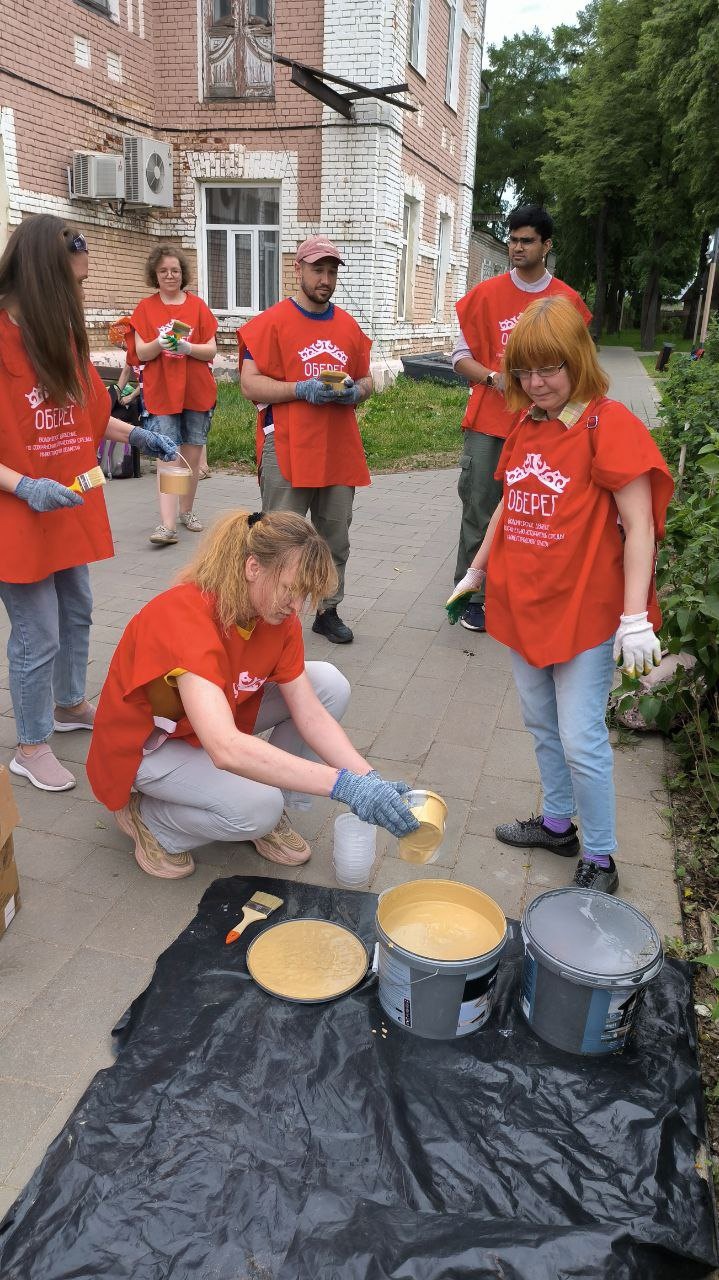
A voluntary civic heritage protection group in Nizhny Novgorod

This is a slightly different version of a piece written for OVD-Info and published here. Many thanks to this important human rights monitoring and advocacy group for publishing it.

The election of Trump might seem very distant from the realities of Russian society at war, but the reaction of many Americans to his immediate moves to take control of (or even dismantle) parts of the US state he doesn’t like speaks volumes. What should ordinary people do with their feelings of despair and helplessness in the face of naked power grabs supported by cynical figures? This is an emotional experience familiar to civic-minded Russians.

There are also dangers in these feelings. It’s easy for Americans to react further in two unhelpful ways: either the system will be robust enough to stop the descent into a kind of oligarchic dictatorship, or that the actions of individuals don’t matter, or can’t change things, so it makes no sense to put one’s head above the parapet. Often this leads to the worst kind of ‘internal emigration’ where people detach themselves from any and all forms of social solidarity or civic work, retreating into the husk of the individual.

As a Russian interlocutor put it to me about a month ago, ‘since 2022 I have benefitted from trimming my exposure to people. To stabilize myself personally, I’ve learned by heart something I say over and over to myself: that it’s purposeless to speak of politics and current events.’ And this from a formerly civically-active person in a large Russian city.

But not everyone has the luxury of turning to personal problems as a way of avoiding the social. Indeed, one of the ideas at the heart of my forthcoming book about politics in Russia is that the human drive or desire to connect to others and work on a common task is hard to fully suppress. Many researchers focus on questions of ‘legacy’ and how much the idea of what is possible or impossible for individuals in Russia is determined by their experience of the last 30+ years, by their interactions with the Russian state, and by their disillusionment with electoral politics. As a result, increasing numbers of Russians when polled express preference for a social and political system resembling the Soviet one.

In my book I talk to people from all walks of life about this problem (how the past should inform the future). But I do it indirectly. I talk to older people about what is missing from their lives now, about their ideals for the lives of their grandchildren. I talk to workers and thinkers about what kind of ‘good’ society can be imagined. Even in the darkest of times the stories mainly resemble each other: having a role which is meaningful in improving one’s social environment, enriching the lives of those around us, and having a political referent that sees the possible future as better than the present. These are all remarkably unremarkably things. Moreover, while I talk to self-avowed ‘activists’, and ‘politically-minded’ people, they are the exception to the rule of the ethnographer, who aims to capture as much as possible the socially typical, the everyman and woman depending on the time and place of the research.

However, much of the time in media and scholarly commentary on Russia, the inheritance of the period before 1991 and in the interregnum of the 1990s, is cast as providing antimodels: that it forced people into double-think, subjected them to meaningless ritual political talk turning them into cynical individualists, or on the economic level forced them to engage in corrupt or illegal forms of survival strategies, often at the expense of the weakest in society.

Perhaps some of the most dominant ideas about the social legacies operative in Russia propose a powerful framework about what 70 years of communist rule did to the Russians – they maladapted to survive, but in doing so remained civilizationally-incompetent when presented with the choice between autocracy and democracy, the liberal market economy and insider rentier capitalism. The danger here is obvious but rarely acknowledged. The maladaption frame allows all structural and complex failings in a society to be downplayed in favour of channeling guilt towards ‘the masses’; it tends towards simplistic technocratic solutions, and is profoundly anti-democratic in nature. To be fair, this anti-populist thinking is operative in most societies faced with extreme problems and rapid change. And that’s the point of rejecting the ‘maladaptive’ essentialization of national groups. Histories of countries may be more or less ‘lucky’ (Russia’s history is both!), and more or less affected by human and physical geography. But there’s little particularly unique to the political quandary of Russia, nor in the responses of mostly powerless people that would warrant the degree of exceptionalism ascribed.

If the possibility of imagining the ‘good’ as socially-connective is a powerful legacy even now, then what effects does this have beyond just an unrequited desire for change? By treating seemingly ‘apoliticals’ and ‘activists’ are equally capable, I try to give ‘noisy’ and ‘quiet’ or even insidious politics equal prominence. There are tireless yard-improvers, something quite a few researchers have written about from Riga to Vladivostok. Often conducted locally by older women, why shouldn’t beautification practices which include urban gardening, be viewed through the same political lens as the ambitions of opposition electoral work? Often the results are more successful for communities. While this is perhaps the most banal example of political virtue, it serves as a strong reminder that by taking constellations of micropolitical life seriously, we can anticipate changes at the macro level that otherwise defy explanation to those observers satisfied only with the actions of elites or the self-anointed.

My book reiterates an insight of political anthropology – that the separation of the political from the social is itself an ideological construct of mainstream social science. Nonetheless, as an ethnographer I also track down and follow many political activists who even today devote themselves to both anti-war activism and ecological projects. Indeed, the term ‘horizontalism’ is more important than ever before. Shared experiences of the repression and shrinking opportunities for openly public opposition in the last years only intensifies emotionally the ‘experiential entanglement’ of activism, as I call it.

While there are only a few who risk anti-war graffiti or even sabotage (and for ethical reasons researchers cannot engage with the latter), there are many who actively seek out niches to expand into – from therapeutic communities embracing holistic ecological and ethical ways of living in harmony with nature, to labour organizers who prefigure a future when associational protection of workers may again become possible. Through force of imagination for that future they agitate even now to protect dignity in work, and fight for better wages. Young people through collective practices of art, and even of leisure, continue prefiguring the better world they deserve: coming together to sew, paint, or just tinker with things. For some young people the most important ‘patriotism’ today is working together to care for one’s local environment, for example by taking collective hikes along river valleys to pick up litter. Even people who maintain constructive ambiguity around their loyalty to the state, are able to do meaningful civic work that is not recuperated by the regime. There are two major case studies in my book that relate to the latter: one on municipal government, the other about a group of motorcyclists. All the other examples here are taken from the book.

To return to the problem of powerlessness, Americans who feel despair at the prospect of Trump-Musk dismantling the Department of Education, or enabling the targeting of undocumented migrants (or indeed the repression of legal residents for ‘anti-american’ activities), or transgender youth can learn much from the civic and political flames that burns on despite darkness. Just look at the response to the environmental disaster in the Kerch Strait. Knowing the inadequacy and corruption of the state, ordinary people came out en-masse to clean up beaches and rescue wildlife. They did this without the prompting of charismatic leaders, without a ‘robust associational life’ of NGOs, and without a free media or ‘public sphere’: the open domain of social life where collective aims and action can be articulated.

It turns out that the common assumption to dismiss small acts, incremental thinking, and prefigurative desires is self-fulfilling. If we don’t believe in even a small politics and changes, then there will be no change. At the end of my book, I visit a housewife in a small town in Russia. At Eastertime in 2024 she gives out to neighbours some home-baked cakes decorated with icing. The icing spells out the abbreviation “XB”, which can be interpreted as representing ‘Christ is Risen’, or ‘Fuck the War’. Some of the cakes were more explicit than others. Why did she did this? Because she needed to acknowledge others and be acknowledged by them as a political actor.

Three years after the disaster: mourning and melancholia, but we should look to everyday politics and civics-from-below

Today, on the third anniversary of the full-scale invasion of Ukraine, my institution asked me to write about how my research helps provide perspective on the war. Here’s an edited version of what was posted in Danish here.

What are you researching?
My area of specialism is Russian and Global Studies – my research areas are political anthropology, working life, the informal economy, social trust and the welfare state, with a particular focus on Russia, Ukraine and Eastern Europe. I use ethnographic methods to examine everyday life and personal experiences in post-socialist societies. My book on Russia at war will come out with Bloomsbury Press in a month. In the book – the only book since the war based on first-hand and in-depth fieldwork, I look at the contours of society – both the longterm tendencies as people adapted to ‘Putinism’ and the immediate responses – often of shock and fear, since the full-scale invasion in 2022.

What perspectives does your research on the war provide?
In both Russia and Ukraine, we see that the conflict after three years of war has been normalized and incorporated into people’s life strategies in ways that are similar to each other. After the initial shock, people come to terms with the great changes that the war brings, typically in ways that try to distance them from it, even close to the frontline in Ukraine. Surveys in both countries show political support for their leaders, but at the same time there is a strong depoliticization and attempts to avoid the war and its longer-term consequences. Denial and fear are still, for me, the most important emotional contours of how people in Russia talk about the war (even when they say they don’t talk about it – which is of course a lie).

In Russia, it is becoming more and more difficult to find volunteers, and the government now has to pay huge sums of money for what are essentially modern-day condottieri: mercenaries with no ideological skin in the game. Most men of fighting age seek to avoid mobilization or volunteering for the fight, and the majority of the population does not contribute directly to the war effort even while looking for outlets for defensive consolidation of society. In Ukraine, the government avoided mobilizing young men with good reason, and after three years, war fatigue is high in the general population. As in Russia, there are major problems in finding willing soldiers.

While major wars only slowly destroy the economies or the other capacities of highly developed countries, this apparent societal resilience masks a strong aversion to wars of attrition. Those looking for parallels to the patriotism and commitment to a long-term slog evident in the two great European wars of the twentieth century should look elsewhere. Even after years, Americans, Soviets, British people and even Germans knew more or less what they were fighting for. That’s not true today. Even many Ukrainians today find it hard to articulate what (an eventual and realistic) victory would look like.

How does the war affect everyday life in Russia and Ukraine?
While taxes and other costs have risen and inflation is a significant burden, many in Russia can still turn their backs on the economic costs of the war, at least for now, and focus on their private cares, or local causes. While great emphasis was placed on the hundreds of thousands of more economically privileged Russians who chose to emigrate at the beginning of the war, their choices did not differ significantly from the majority of Russians who stayed at home. Both groups have largely tried to avoid the war – either by leaving or by remaining passive. On the other hand, many forms of grassroots civic activities continue and even grow in their significance as the state capacity of both countries is degraded. The massive volunteer-coordinated and para-state response to the oil spill in Kerch is a great example of this – very visible, but merely the tip of the iceberg. This is a major theme in my book of ‘civics from below’ – for want of a better term.

At the samet time we should be sensitive to how much cynicism there is in Russian and Ukrainian societies – towards elites, towards the ‘winners’ and the shallow self-promoters around the war efforts. In Russia there is a tendency to avoid the relatively shallow and symbolic elements of militant patriotism – most people find the endless aggressive propaganda shown on television repulsive. Apart from a few public events and locations, there is no spontaneous celebration of the armed forces or the Russian military. The minority that actively supports the war complains about the indifference and even hostility of the majority to their efforts to help the war effort.

This is why I sometimes criticize the BBC for its silly focus on militarism when its capable of much better, more human coverage (thanks to Mediazona and Chronicles). Nonetheless, any sociology of Russia should look at who and why they actively support the war, but this requires going beyond opinion polling and actually talking to people about why they knit camo nets or send donations to the front. And this is something only people like Public Sociology Lab and Aleksei Miniailo’s colleagues at Chronicles are doing – along with the interviews and observations in my own book. Chronicle’s latest field research shows that 54% of Russians are willing to admit the war negatively affected their ‘everyday lives’ and we know this is an undercount. Only 9% agree that the war improved their lives.

Of course, there remain important differences: for Ukrainians the future of their state is still immediately in question. But for Russians too, so much musing is about what started this war in the first place – the beginning of the end of Putinism. Despite what some people write about Russian war salaries, few have benefited materially from the greatest disaster of Russian statesmanship of the 21st century. Citizens of both countries feel inflation and the transition of resources from social to military purposes intensely – and with increasingly resentment. Indeed, different kinds of political resentment should be an important part of research for both countries.

If there is one insight from your research that should be clear to the public – what is it?

Despite war fatigue, and in Russians’ case, deep-seated unease about the decision to go to war, in both countries ordinary people are more civically active than ever as they try to make small changes to improve the lives of people and the environment around them. Without ethnographic (anthropological) research, it’s hard to dig down to uncover the strong forces of social connectiveness that have a life of their own beyond a focus on ‘big politics’. That’s why my book is called ‘Everyday Politics’ – because this term allows us to unpack the long-term, tectonic shifts in the social desires of people. They coalesce into small ‘intersubjective’ actions which exceed the sum of their parts and make people more than individuals or representatives of their respective nation-states.

Unmaking the Ukrainian working class Part III

The location of the future city of Kryvyi Rih on a 1769 map

This is the final post about Denys Gorbach’s new book on Ukraine: The Making and Unmaking of the Ukrainian Working Class. The first post is here. The second post is here.

In the previous post I focussed on how Gorbach treats populism as merely a ‘morbid symptom’ and distracting to the purpose of getting into the vibrant ‘everyday politics’ of Ukrainian cities. Gorbach early in the book shifts to ‘ordinary’ political actions and talk of Ukrainians as codetermining the scope and contours of ‘big’ politics. Using the example of the German tradition of microhistory allows Gorbach to stake a claim for the very ‘apolitical’ withdrawal from the public sphere and ‘familism’ in Ukraine and Russia as deeply political phenomena because they are a collectively shared and reflected upon. Gorbach doesn’t go quite that far here, but we can add that the often bemoaned ‘privatism’ is often misunderstood. Withdrawal provides space and time for alternative forms of organization and world-making to emerge – something I expand on in my book.

The summary of ‘moral economy’ is rather perfunctory here, although in a footnote Gorbach provides the nugget that after Tilly and Thompson, the ‘moral economy’ frame shows that claims-making from below implies the recognition by elite actors of the legitimacy of non-market-based rights. Furthermore claims are inherently political in terms of recognition – as when, for example, property laws are enforced or not enforced (e.g. as forms of recognition of customary rights among peasants and working-class folk). Wartime nationalization – even when it tends to prebendalism is also genuinely popular for the same reasons.

Gorbach gives more room to the breadth of ‘informality’ as applied to Post-Soviet politics – from Hale’s patronalism, to Matveev’s bureaucratic neopatrimonialism developing into Bonapartism. Here, Gorbach criticizes the application of Weberianism to the Ukrainian state, which can only result in seeing it as a ‘backwards’ essentialized ‘uncivilized’ polity and, indeed, plays into views that bifurcate into ‘good Ukrainian’ values (of and emanating from the West), and Bad Soviet values in the East. This will be a major target of Gorbach’s work and one that won him numerous enemies among established mainstream liberal scholars embedded in the West for whom it is beneficial to maintain this fiction.

Like in my own work, however, Gorbach insists that informality in the microscale of people’s lives is just as important as patrimonialism. This is because the informal pacts and agreements, including the invisible ones like turning a blind eye to informal employment, represent a key political arrangement of life in contemporary Russia and Ukraine. These include ‘paternalism’, a key referent of Gorbach’s book. His overview is helpful in thinking of paternalism, clientelism and patrimonialism as all nested concepts (Gorbach credits me with coining informal ‘imbrication’ but others have found this term a bit pretentious). Forms of informal obligations comprise an overall mutualist web. Importantly there are coercive, exploitative but also solidaristic, empathetic and – as I expand in my book – fictive kinship relations which may be more or less enduring and binding. As Gorbach mentions – this perspective offers a sharp critique of rational actor/methodological individualist economy and political science approaches.

Chapter Two asks: Why does awareness of inequalities and class domination not prompt workers to contest this through collective political action in Ukraine? One answer is the informal alliances of old and new elites, and at first the Ukrainian nationalist project was weak. Here we have a great breakdown on the legitimation of the ‘fatal civilizational divide’:

The failure of Ukrainian ethnic nationalism to muster its case outside its Western heartland led to its radicalization as documented by Andrew Wilson. The heterogeneous Ukrainian elites trod a fine line and their attempts to achieve social peace contributed to ongoing proverbial state weakness. Symbolic capital of the ‘national democrats’ competed with the ‘clanlike’ structural capital of the industrial cluster elites. I’m not going into detail about this part of the book, but it represents a welcome corrective to the usual blinders that pass as political history on 1990s Ukraine, notwithstanding the more impartial work done by scholars like Wilson and D’Anieri. Shout out to the use of the Marx’s ‘potatoes in a sack’ metaphor to describe the fragmented-yet-tied bloc of budget workers and city-making enterprises. What follows is a good account of the Orange Revolution, coming on the back of the rise of the resources of the ‘second-rank bourgeoisie…which grew strong enough to dare challenge the “closed access order” controlled by oligarchs’.

Gorbach ends this chapter by showing how political changes reflected economic ones – the failure of Euromaidan was mirrored by the downgrading of the Ukrainian economy from higher value chains to commodity export.

In the next chapter Gorbach masterfully recounts the actual colonial history of the steppe country around his city. In Chapter 4 he expertly uses the example of mass transit to illustrate the maintenance of moral economic regimes and the unwilling acquiescence by elites to the expectations of ordinary people. This chapter is about both the ‘privatization’ of minibuses but also the ‘resovietization’ of residual ‘public’ transit as a social good. Later Gorbach also identified three property regimes around housing: personal property where state intrusion is seen as illegitimate; private property where capital accumulation is seen as legitimate (here drawing on C. Humphrey’s work); and public property whose poor state is a result of normalized austerity. Finally, Gorbach talks about the moral economy of heating provision.

In chapter 5 – on Informality and the Workplace, Gorbach argues that instead of suc­cumbing to anomie, Ukrainian workers implicitly gravitate towards a residual social project that owes a lot to Stalinist modernity, built upon the ultimate Fordist principles of enterprises as nodes of civi­lization. If this is so, the shopfloor should be a privileged fieldsite, likely to shed light on non-verbalized shared assumptions about hierarchy and social order. Of course researchers like me bemoan our marginalization as our colleagues focus on much more ‘sexy’ projects. Gorbach continues this focus in the follow chapter 6 on Paternalism in Decay. “Unable to accomplish the real subsumption of the labour process, the enterprises remain stuck in an extensive mode of economic devel­opment instead of a Toyota-like intensive mode based on technical innovations. However, such a shift would entail risks, costs and dis­ruptions that are unacceptable to new enterprise owners. Instead of launching classic neoliberal managerial transformations, they chose to tacitly introduce new power configurations that ensured a residual paternalist consent, an undisturbed production process on the old technological and material basis, and the extremely low costs of capi­tal upkeep. These low costs allow owners to preserve the machinery of the social wage and thereby help to protect their property rights in the case of a politico-corporate conflict.”

In Chapter 7, Gorbach looks at politicized embeddedness and disembeddedness in two profoundly different, yet quite typical business outfits in the post-Soviet city. “For Charles Tilly (2007: 78), authoritarian patronage pyramids are an important medium through which subaltern groups can be involved in macro-level political pro­cesses and discussions. This is one of the possible developments for the neo-Fordist factory regime. However, the atomized nature of these configurations in Kryvyi Rih, which remain more individualist than classic patronage politics, lead to a different kind of politiciza­tion: passive resentment, politicization of identities or striving for individual distinction.”

In Chapter 8, Gorbach shifts to a focus on everyday politics beyond the world of work, looking at strategies of self-valorization via class distinction. Here, he references Andrew Sayer, Bev Skeggs, Don Kalb, and of course Olga Shevchenko and Oleg Kharkhordin.

Chapter 9 maps Lay Virtues on the National Political Landscape. While in places like France and Britain, working classes have (more or less successfully) made use of ‘national(ist)’ or indigenous capitals to promote their marginal social position, things in Ukraine are different because of the valorization of particularized Ukrainianness after 2014 (and before).

At the end of this chapter, Gorbach makes the comparison of ‘internal’ orientalization, like that observed in Turkey and elsewhere.

In the final empirical chapter 10, Gorbach applies the findings of Nina Eliasoph’s well known ‘avoidance of politics’ work to the Ukraine context. To be ‘authentic’ in lay discourse is to devalue what is seen as ‘ideological’ as dishonest. It’s ok to be a ‘volunteer’, but it’s important to mask one’s politics. There is ‘frontstage’ avoidance of ‘politics’. There are also ‘cynics’ who have strong and informed opinions but who cultivate disengagement. All of these positions are recognizable in postsocialist contexts. As in Don Kalb’s pioneering work, this reasoning produces the ‘neo-nationalist’ outlook well-known in other contexts.

What follows is a useful discussion of the Zelenskyi phenomenon explained as a the outcome of this structural situation in Ukrainian lay politics. Gorbach is refreshingly balanced, not willing to preach to the choir, as other treatments of the ‘Zelensky effect’ have.

Subsequently, Zelensky’s channeling of the desires for ‘technopopulism’ and ‘valence populism’ (rejecting consistent ideologies in favour of vague overtures to morality, transparency, etc), sustained him nationally up the invasion in 2022, after which Zelensky successfully transitioned as a war leader.

In the last twenty or so pages, Gorbach concludes with a discussion of the ‘incomplete’ hegemonic rule in Ukraine. This is the same case as in Russia – but there we have the unambiguous move towards Bonapartism. What remains in Ukraine is the inability of national elites to claim moral leadership and the growing distance between subalterns and the institutions of representative democracy. So far, so Gramsci. But beyond that framework, Gorbach makes space for looking via the lens of Uneven and Combined Development.

And on wartime mobilization, Gorbach asks:

Unmaking the Ukrainian working class Part II

Rest In Power, Michael Burawoy

This is the second post about Denys Gorbach’s new book on Ukraine: The Making and Unmaking of the Ukrainian Working Class. The first post is here.

In the period between writing the first post and this one, Michael Burawoy has died. Burawoy was one of the formative influences on both Gorbach and me. Here’s a short excursus on how he influenced our approaches to writing a novel (in the Ukraine and Russia contexts) form of political-economy-ethnography. I hadn’t intended to focus on Burawoy (because there’s so much else of interest in the book), but here goes.

Both Gorbach and I try to synthesise our cases from what Gorbach calls ‘participant truth’ and ‘sociological truth’ – and here he cites Burawoy’s 2017 piece. Burawoy there argues that ethnography needs to be liberated from the naïve empiricism that still plagues anthropology and sociology and which is continuously re-invented by scholars unwilling (or afraid) to confront the political implications of their own work. Burawoy uses this opportunity to make the case again for bringing structure and comparison to any micro-level work. Only by linking specific ethnography cases to the broader structural constraints (oligarchic capitalism in Ukraine/authoritarian neoliberalism in Russia) can research do justice to the ‘common sense’ of interlocutors. This is what Gorbach and I attempt. The social ‘facts’ of cases do not  speak for themselves. And this, via Bourdieu, is a point Burawoy hammers home in his robust writing. At the risk of overshadowing the discussion, it’s worth citing Burawoy further (here reviewing contemporary ethnography of Wisconsin):

While there’s much more to say about Burawoy’s influence, I want to turn to Gorbach’s very extensive discussion of politics in his second chapter (and the empirics of Chapter Nine). As I wrote previously, Gorbach makes a pitch for those interested in Ukraine to take more seriously ‘everyday politics’ and ‘moral economies’. Having said that, he starts off with a welcome ‘intervention’ – one highly topical to the ascent of Trump 2.0: to paraphrase – to take populism seriously we need to move beyond discourse analysis (MAGA, get rid of woke, etc), and use empirical tools like ethnography to uncover the material basis for populists’… popularity. I’ve mentioned in this blog many times Arlie Russell Hochschild who wrote two books on the Tea Party and Trumpism, but it’s indicative of the timidity of indigenous US political sociology/anthro that this barely scratches the surface and does not qualify as ethnography in way that Gorbach’s or my work does. Gorbach has lived and worked with his interlocutors, as have I. One can barely imagine this possibility in the class-fractious society of the USA. Yes there are some exceptions, but they still amount to general handwringing, or poverty porn.  The truth is, an intersectional yet working-class ethnography is just not going to be interesting to the scions of Anthro in the US who get to do PhDs by virtue of precisely that privilege that would make it unthinkable for them to do the necessary work. (For a good general anthro account of Trumpism, see Gusterson who rightly says it ain’t all about class, yet…. ‘Trump’s victory confronts US anthropology with an incompleteness in the project of repatriated anthropology. While anthropologists of the United States have been busy studying scientists and financial traders at one end of the social scale and crack dealers and immigrant communities at the other, we have not had so much to say about the middle ground, the people who supported Trump—people we tend not to like.’ Shout out here to someone who HAS done this work, only in the UK context: Hilary Pilkington. Shout out to, to Christine Walley

Gorbach reminds readers that the best work on postsocialist populism emphasizes its shadow relationship to democracy, avoiding the normative stance that opposes democracy and populism and which is so frequently deployed to show how ‘defective’ Eastern Europe is by mainstream observers. Gorbach, following the work of Tarragoni and Canovan, argues that populism, while expressing a crisis of representative liberal democracy, is not a ‘thin ideology, but contains a radical democratic critique of representative government. But what’s missing is what Gorbach and others aim to provide – the material basis of populism’s rise which ‘aspires to distribute income and, nourishing illusions about the function of the state, is politically disorganized (Boito 2019: 135.)’. In an abrupt turnaround though, Gorbach’s innovation is to relegate populism as just a Gramscian ‘morbid symptom’ of the crisis of capitalism. Parapolitical processes that themselves are generative of populist ‘supply’ are more important to look at and these are perfectly adequately grasped using the long-standing terms ‘moral economy’ and ‘everyday politics’. The ‘crisis of representation’ that populism reflects is then doubled in scholarship: mainstream liberal political science has no tools with which to move towards a diagnosis of the disease (it ignores those that Gorbach offers here), instead offering ‘game theory’ or the pseudoscience that is ‘mass’ social psychology and which includes bizarre claims about whole ‘national groups’ on the basis of dubious experiments conducted on American undergraduates which cannot be replicated and remain ‘WEIRD’.

Gorbach returns to his problematizing of ‘populism’ in the empirical chapter on language politics in Ukraine. There’s an enlightening discussion of how pro-Ukrainian language narratives align with upwardly mobile citizens after Maidan, how the far right may find allies in LGBT organizations in opposing ‘vatniks’. A ‘thin patriotic identity’ (before 2022) emerges that papers over deep ideological differences among liberals and nationalists (p. 224). Uniquely in Ukraine, language affiliation plus civic involvement then serves as a way of denying (or exiting) a stigmatized working-class identity. But, as Gorbach continues:

At the end of the same chapter, Gorbach shows how ‘East Slavic’ Nationalism acts no less powerfully (and does not necessarily conflict with) the ‘ethnic’ Ukrainian model. Indeed, in a place like Kryvyi Rih (recall, Zelensky is from this city), Gorbach uncovers an inversion of the ‘vatnik’ theme – ‘stupid nationalists’ and ‘civilized Soviet-type people’.

After a long discussion of the mayorship of O. Vilkul who would later become a key figure that confounds stereotypes about the political views of Eastern Ukrainians, Gorbach concludes this section:

However, ‘One must take seriously the words of many adherents of both camps when they say they are not ethnic Ukrainian or Russian nationalists. The root of the political cleavage is the per­ceived moral difference between the self and the other rather than ethnic animosity.’ And in a subsequent final post about this book we will return to that topic of moral economy how it expresses everyday politics.

Unmaking the Ukrainian working class, Part I

Two days ago I joined a discussion of Denys Gorbach’s new book on The Making and Unmaking of the Ukrainian Working Class at University of Bremen organized by Seongcheol Kim. This post is one part of my contribution to the discussion. Gorbach’s book partly inspired my own forthcoming book, and here I focus on those aspects which are most relevant and interesting to me.

First off, Gorbach focusses squarely on a key question about class domination in Ukraine which is of relevance in Russia too: if enterprise paternalism – both materially and symbolically – is so decayed then why aren’t workers more militant? This is a question I also ask in my book and in a spin off article about Russia. While Gorbach’s book is not really about wartime Ukraine, the question of how to coopt or placate workers during a period of unprecedented social stress is even more relevant now than it was when he completed most of his fieldwork in 2019.

Gorbach’s book is unprecedented in its range, intellectual ambition and empirical quality. He manages to do a deep dive on the roots of populism, oligarchy, the misnomered language ‘divide’ in Ukraine and even has time for a pitstop in Russian imperial colonial history in his native Kryvyi Rih (a city of iron ore production formed by Belgian, British and French capital, Polish landlords and the power of the Russian imperial state). He looks at how today, organic intellectuals are made within the Ukrainian working classes and how this consciousness is mapped onto ethno-linguistic identity in often contradictory and unpredictable ways. He even shows how the war makes some into ‘East Slavic Ukrainian patriots’, and how people hold simultaneously incommensurate views about social democracy, private property and populist politics.

Gorbach starts off with an analysis of the 2017 coordinated yet wildcat strike in Kryvyi Rih around falling wages. He illustrates that regardless of the strength and weaknesses of alliances and leaders, strikes in the postsocialist world still have the potential to trigger broader protest and act as catalysts for change – coalescence and contagion are distinct possibilities for any future labour unrest as a result of war…. or peace. And a part of this is because workers themselves are increasingly able to access a sense of their demoralized place in society and experience historical learning. However, Gorbach also illustrates that the key paradox of labour unrest in such states remains operative:  one can find militancy and class consciousness at the same time as timidity, cynicism and distrust – the partial success of an ‘anti-politics’ hegemonic discourse (later Gorbach will critically discuss both Chantal Mouffe and Nina Eliasoph).  In this way, while not developing it fully, Gorbach explains how elite reshuffle to maintain domination, ordinary people get alienated from ‘big politics’ but intense political contestation and strife still occur. Indeed, both the Zelensky and Putin phenomena are end products of the exasperation and desperation of people in this situation, of course noting the fundamental differences between regime type and political system in Ukraine and Russia. This is my view, not Gorbach’s, as he is careful not to discuss Russia, which lies beyond his empirical base – his book is based on impeccable Ukrainian fieldwork which many would envy.

Gorbach is all the more impressive for having done ethnographic work on five different factory sites in Ukraine and charts informants living in three different ‘scales’ of existence in the post-Soviet city: individual life, their embedding in value hierarches, and their use of survival strategies. This is what makes the book so rewarding to a reader who wants to get a feel for the granularity of Ukrainian life beyond the redundancy of so many Ukraine politics books (even the few very good ones) or the political science literature focused on moments such as elite contestation, or voting, or the overall political relations of Ukrainian and Russian elites.

I preserve in full Gorbach’s key questions from the intro:

Gorbach then provides a reminder of the failure of both liberal and Marxist theories about capitalist transformation; both predicted their own normative versions of transformation and both were wrong. ‘Instead of capitalist and liberal democratic normalization of the local politico-economic field, the transition produced unorthodox polarizations and populist political templates that were later exported westwards, reversing the expected direction of the flow of ideas and models (Kalb 2015)’. This was also the subject of a post from a couple of months ago about David Ost and ‘semi-peripheral innovation’.

I will summarise more of Gorbach’s book in later posts. For the time being, its worth noting that point 3 above – about how ‘personal trajectories’ tell us a lot about political shifts and how worldviews ‘from below’ exert pressure upwards on the immediate urban context, on the formal economy (because of the availability of the informal economy as a material and symbolic source of alternatives). Various ‘moral economies’ (Gorbach and I prefer the E. P. Thompson pedigree of this term) coexist and influence each other – in particular around how people relate to property relations. They acknowledge as legitimate despotic behaviour by bosses in new businesses, but refuse to pay for a tram ticket because such transport is deemed part of the state, or pay taxes on their side hustles.

Divergent economic experiences of war: The rich get richer and the rest don’t

This post was earlier published on Riddle: https://ridl.io/divergent-economic-experiences-of-war-the-rich-get-richer-and-the-rest-don-t/

Tupik – ‘Dead end’

Discussion of the inflationary side effects of war spending in the Russian economy has been inconsistent. Even when observers note how in the long term economic decisions store up trouble, many focus on a mistaken idea that a significant segment of Russians are feeling economic benefits, or that wartime spending means real gains (as a share of GDP) for labour (i.e. that gains are redistributive).

Now it’s true that the government did signal a willingness to depart from decades of austerity when it comes to funding the war, but as Nick Trickett points out, spending more to foster growth only works if productive capacity actually expands as a result. Historically, fiscal expansion has increased demands for imports instead of domestic output. Despite recent rises in GDP, a rebound from the  economic shock of the start of the war and indeed, the long recent history of Russian underconsumption and underproduction continues.

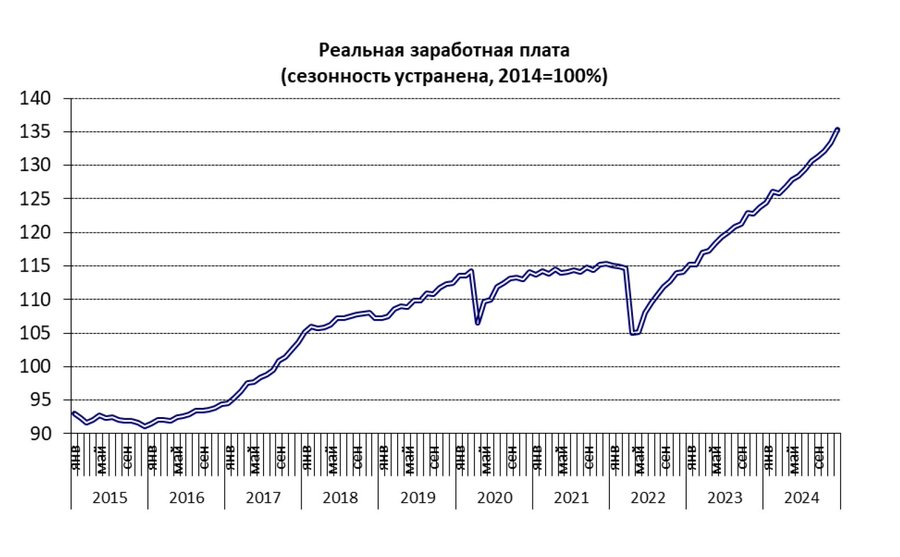
In the piece from August 2023, and in a recent follow-up piece Trickett offered a corrective to the idea that wages have seen a sustained outpacing of inflation.  Incomes are still probably lower in real terms than ten years ago, even accounting for a 9% rise in 2024 (these are the latest Rosstat figures. In 2022 real wages fell by 7% according to RLMS; in 2023 they rose slightly). In other words, Russia would need a decade-long shift in the share of income accruing to labour, and a similar period of real income (over inflation) increases to register. And the actual trend since 2017 is downwards.

The norm of low wages means that big percentage increases matter little to people

This point about the longer-term context is echoed by another granularly serious observer, economic geographer Natalia Zubarevich, who in every interview emphasizes the ‘law of small numbers’. Even a 20-40% rise in your take-home pay (which might well be experienced in well-placed blue-collar jobs over the period 2022-2024), does not mean very much if you’ve been working for subsistence wages for the last decade and set against high ‘real’ inflation.

Eurasianet discussed the manipulation of official inflation statistics in 2023, citing alternative sources which estimated real inflation at 20%. One of my better-off informants was called in to Sberbank for an interview in November. Her high level of rouble deposits was a concern for the bank worker who recommended she reinvest in gold and that the internal calculation by the bank, shared with high net-worth customers, of real inflation was 43% in 2024.

Widespread pessimism and dissatisfaction among wage earners, contrasting with optimism from business owners is what I find in my latest round of interlocutor interviews. These are taken from the same set of research participants I’ve been engaging with since 2009 in a well-placed part of Kaluga region – itself a ‘goldilocks’ zone of development near Moscow. Added to the mainly working-class men and women in my sample, I’ve extended my reach to new entrepreneurs who have expanded business since 2022, as well as more middle-class interviewees in Moscow and other large cities. Here, I condense around 20 hours of talks since early November 2024. For readability and ethical reasons, these are composited characters.

The view from the Kaluga-Moscow corridor

Gennady the small-business entrepreneur is ebullient. Patriotism and making money go hand in hand for him. The exit of Western companies allowed him to lever a wedge, going from importing and selling catering equipment via a US-based supplier to now dealing directly with the Chinese manufacturer. Gena is proud of his ability not only to markedly increase his profit margin this way, he has ‘onshored’ a small, but significant part of the production process involved. He now employs three times as many people as before and a third of those are in primary production – making components that are disposable parts for the Chinese equipment. Russians are like “sponges” when given the right opportunities to learn. They’re also like “mushrooms” – given the right conditions, they thrive and grow.

Gena likes his organic metaphors, but most of his talk is full of anglicisms taken from corporate speak. When we were chatting in Russian it took me a while to work out that when he was speaking about ‘khantil’ for able workers, he was using the Russified past-tense form of ‘hunt’: ‘I’ve been on the hunt for a good freight driver’.

At the same time, Gena says that reacting with resilience and entrepreneurialism is not about ‘patriotism’, but about the need to get ahead and make money. Nonetheless he makes it a point of patriotic principle to end our talk by saying ‘As you are recording this, let me say that we will win the war. Victory is ours’.

Misha is a technician in an industry that should have benefitted from spill-over of orders from the military industrial complex. I can’t be more specific than that, but I’ve never seen him so negative – and he is one of the classic ‘defensive consolidators’ who shifted from opposition to the war in 2022 to acceptance in 2024. Misha’s enterprise is affected by the shortage of workers. Because there aren’t enough workmen, he is not getting enough hours as a technician as not all the equipment can be utilized. The shortage of workers is not because of the war – few people in this region have volunteered for the front. The bigger picture is the one I highlighted at the outset – even with a wage increase of 60% since 2022, for many, the job is not attractive enough in comparison to lower-skill/stress/pace work in Moscow or elsewhere.

There’s also the major demographic squeeze in general – the c.1% annual fall in working people available nationally.  Misha talks to me a lot at the moment because even when his plant is up and running, his boss has to meet his demands for more flexible working hours, so sensitive is he to losing more workers. His micro-situation is a good illustration of broader processes – like the ‘work to rule’ in the Moscow metro because of a shortage of staff there but the inability to improve pay and conditions. This implies something of a negative feedback loop for productivity. The more an employer ‘sweats’ assets, be they labour or capital, the sooner they meet hard limits on increasing output, and even reversals.

Misha’s working biography features prominently in my new book, illustrating the ongoing sense of economic insecurity even for people like him who have good social, economic and other ‘capitals’ (he has a higher technical education in a good sector). I’ll merely highlight Russia’s “labour paradox” – workers can sense their structurally strengthening position – via falling demographics and specific labour shortages, while at the same time as suffering from the overall marginalized power in bargaining. In Russia, one can bargain only with one’s feet.  This paradox, viewed in aggregate, suggests that workers may be able to demand more where they are in industries serving state demand, yet eventually as the overall position deteriorates further, their bargaining power may prove transient. Whether or not some kind of authoritarian corporatism is possible (where there are real concessions to labour led by political recognition of its need) remains to be seen.

Misha is as well-educated and ‘worldly’ as Gena. He is insistent that the ‘situation’ of workers has only deteriorated, even as he makes a careful distinction in terms of class (that he’s not a worker). He’s been monitoring the job boards because at the beginning of the war he was looking to move into a job that would protect him from mobilization – perhaps metallurgy (another informant successfully made such a shift). Downshifting of work, after all, is a political strategy that goes back to Soviet times.

Misha points out that drawing conclusions based on published wages is foolish. Nowadays you’d have to look even more carefully at the hidden conditions attached to the discretionary element of the wage. Like others in my sample, he has left jobs where the published wage was higher but it required much greater self-exploitation at work. He even gives an example of a forklifter in a cement plant. Your ‘norm’ might now be 50 tonnes a shift rather than 25 tonnes, while your pay has only gone up by 25% since the beginning of the war. Working much harder not only wears you out, it’s dangerous as the risk of accidents exponentially increases.

Then there’s the continuing significance of working-class male breadwinning in what is still a society where women are paid peanuts, even if they successfully undertake what Charlie Walker described as financial independence through leveraging service work positions. Misha’s wife is one such example and yet only earns half his wage, even though on paper her job (administrative) is actually more demanding in hours, skills, responsibility.

Misha, like most of my informants is incredulous as well as quite angry at the idea anyone could take seriously the idea that wages have outpaced inflation for anyone not a soldier or metropolitan executive. He’s not the only person to say: ‘100k’ (around $1000) a month for an average regional breadwinner’s job is the new ‘40k’. In other words, that 100 roubles only buys what 40 roubles bought a few years ago. And certainly, there are still many of his peers earning a lot less than 100,000 roubles a month in blue-collar jobs.

The official ‘subsistence’ minimum for a family of four is 70,000 roubles, leaving a paltry amount left over after basic food costs. And in any case, such measures are often based on absurdly manipulated calculations: like assuming someone can buy fresh fruit for 100 roubles a kilo in winter, or undercounting real heating and utility costs by around 50% because of the assumption that a person does not occupy more than an allotted 18 metres of living space.

Misha works. His wife works. They don’t have a mortgage but own outright a three-room apartment in a nice suburb. Misha has two cars (though he wants to sell one). He complains that real inflation is much higher than reported because even someone like him spends so much of his take-home income on staple food products. For the first time since 2009, Misha has bought 100kg of potatoes to store in his garage basement for the winter. Potatoes – the main source of carbohydrate for most since rice and pasta are often more expensive, have increased in price by over 100% in 2024 due to the poor European harvest. The ‘Russian salad’ basket of goods, is now around 40% more expensive than a year ago – and remember these are just the staples of poor people (carrots, cabbage, etc. )

Inflation in the ‘real basket’ of consumables is the dominant talk among everyone, even the wealthy Muscovites who shop in premium stores. One such informant points out that her favourite discount brand of wet wipes has tripled in price since 2022 and that this is a product made in Russia, not imported. Not only are there a panoply of online calculators for one’s personal inflation rate, people also read discussions in economic Telegram channels where more independent academic works on inflation and the cost of living are popularized.

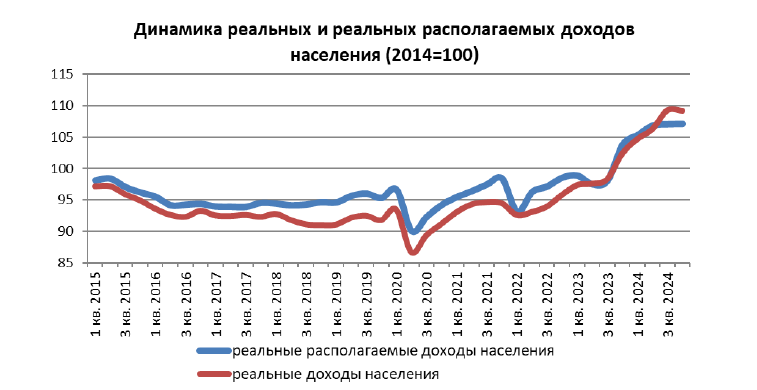
Thus, one of my informants who lives on irregular freelance work and a disability pension pointed to the Russian household longitudinal monitoring survey (RLMS) published by the Higher School of Economics. He accessed its data via a Telegram channel. While the channel itself is sensationalist and firmly aimed at discrediting the Central Bank, the research from HSE is widely discussed by the channel members, including my interlocutor.  Unlike official statistical services, the academic researchers are able to state things ‘as they are’, such as the fact that real incomes remain stagnant and indeed, have fallen in reality since the war thanks to tricks like lowering bonuses, not paying time off, etc. While RLMS confirms statistical facts like the long-term fall in poverty in Russia and even a fall in the GINI coefficient since 2022, the stark difference in measurements of real incomes stands out. RLMS records that average incomes are not higher overall than in 2013. Some of their calculations show real median incomes as less than half those recorded by Rosstat.

Tracking spending habits to calculate real inflation

Another way of looking at whether households are getting richer over time is to look at the proportion of incomes spent on different things. As people get better off they can be expected to spend much less of their income on staples and more on services and luxuries. Both Rosstat and RLMS look at this. The latter points to ongoing stagnation in services and non-perishable goods. Even today, Russians spend only 5% more on eating out than they did in 1994. By the same token, RLMS researchers point out that the sharp fall since 2020 of clothing spending is not due to a reduction in prices, but a sign of severe economic stress. Rosstat shows that households spend no greater proportion of income today on non-food purchases than in 2003. Even the richest 20% of households spend a whopping 26% of their income on food (in rich countries this figure is around 10%).

The main point of looking at the divergence in economic sentiment is to help understand whether war produces new social relations based on the relative shift in capital versus labour power. While people focus on real wage increases these need to be put in the context of the abnormally low wages in Russia, especially outside Moscow. We haven’t touched on household indebtedness and the cost of credit, the coming wage arrears crisis in multiple industries. Those are points to watch for. As mentioned earlier, for me of interest is the capacity (or not) of employers to turn to paternalistic reward as a way of dealing with the demographic-stagflationary crisis unfolding in Russia and which peace (at any price) will not solve.

The radical pessimism of Russian émigré experts

“when leaving, turn extinguish everyone” – a play on ‘turn the light out when you leave’

Can we trust surveys? We once again were shoved as unwilling passengers onto this merry-go-round with the publication of a report by Maria Snegovaya entitled The Reluctant Consensus. In it, Snegovaya tries to put to bed many of the criticism I and (much better qualified) others have made of the usefullness of survey polling in Russia. She paints a depressing picture, arguing that young people increasingly align with conformist and conservative views, due to exposure to propaganda and the normal process of ageing. Further, she emphasizes the view that alignment with regime narratives due to cognitive dissonance is the norm. She also argues for a strong ‘rally-round-the-flag’ effect in Russia.

A lot of the report reads like a defence of Western-based academics reliance on Levada – a ‘foreign agent’ sociological centre that nonetheless is able to carry out research in Russia.  I am not going to rehearse the objections I have made in detail and based on good evidence: that methodologically and philosophically, political surveys need to be taken with a large pinch of salt. Snegovaya in the report emphasizes that all kinds of polls beyond Levada (though revealingly, she relies almost entirely on their data-visualization) show comparable results, are representative, have acceptable response rates, etc.

Once again, as I have argued before though, this defence is itself reveals more about the ecosystem of knowledge among favoured Western expertise on Russia than it does anything about Russian societal mood.  That such a report was commissioned by Atlantic Council shows the cracks in the edifice of the construction of knowledge about Russia: that the artefact of public opinion is based on a narrow and opaque machine to produce sentiment as raw and binary numbers (and one that’s largely acceptable to the Kremlin). That at no point should we step back and show reflexivity that numbers are only as good as the honesty of those collecting and collating them. That ‘opinion-as-choice’ (between war and peace) is an absurd starting point to talk about complex societies subject to the kind of coercion, monitoring and conformism (‘social desirability bias’) that Russia is.

Alexei Titkov of Manchester University put together a summary of the subsequent discussion Snegovaya’s report provoked. While Titkov raises philosophical objections to polling, he also defends their overall objectivity. “The difficulty is that the meaning of these useful and objective data is not as obvious as we would like […] Of course, you understand the wording of the questions. But what the answers mean, what their distributions mean – is better seen as a black box in which the owls are not what they seem.”

Titkov (in seven posts to date, in fact) goes on to faithfully reproduce the essence of the arguments of both sides (Snegovaya subsequently joined in online debate with Aleksei Miniailo – associated with Khroniki). In his fifth post on the topic, Titkov contrasts the nitty-gritty of the technical-methodological debate (which I’ve edited here):

“the coincidence of values (across difference surveys showing high war support) gives confidence in Snegovaya’s argument that ‘something’ was measured, and not just a random artifact. Checking the results of different surveys for ‘convergence/non-convergence’ is a useful procedure. But there is a flip side, which is revealed by the episode with the Khroniki data. If the results can be distorted due to the wording of questions and answers, this is a systematic error and it does not depend on the number of times a poll is carried out.” I.e. if a department of cops use speed detectors that are all badly calibrated, should we be reassured they are all showing similar readings? Miniailo essentially comes along and says he’s got a better calibrated detector and the drivers were not speeding after all.  

Titkov in his sixth post: ‘Snegovaya suggests dividing into segments: “Hawks” (20%-30%), “Loyalists + Uncertain” (40%-50%), “War Opponents” (20%-30%). The dispute, she says, is about how to interpret the intermediate group, whether to add it to the “hawks” (“Support = Loyalists/Uncertain + Hawks”). Snegovaya explains why she adds it: the middle group “tends to support everything Putin proposes.”

But “Loyalists” do not coincide with Putin in their opinions and desires, – argues Miniailo. According to him, those who answer “I trust Putin” simultaneously want, for the most part, peace with Ukraine, normal relations with the West, and a redistribution of spending from the military to social spending. In this sense, “support” is not obvious.

However, Snegovaya does not argue that the mood of the “loyalists” is the same; she herself writes in the report that, according to polls, citizens are more concerned with the economy and social issues. She explains that by “support” she means not opinions, but practice. The idea is that Putin’s policy “does not meet resistance.” Instead of protesting, citizens remain silent and adapt, thereby “giving Putin the green light.”

Miniailo’s answer to this is that the “green light” argument does not take into account that today’s Russia is a consolidated autocracy, in which citizens have no leverage to influence policy. Accusations should be made to the political establishment, not ordinary Russians.

The conversation reaches a point where the details of the polling technique fade into the background. Political and ethical arguments begin. All the demons of hell are ready to flock to the favourite delicacy of “collective guilt and responsibility.”’

It seems like Snegovaya has the upper hand here: even if in private people have diversity of opinions, in public there is either approval or silence, and no public contestation. Miniailo’s short answer is simple: that in an autocracy, citizens know they have no leverage to influence politics, thus, Snegovaya’s implication of passivity or connivance is has no political or sociological value.

But here we depart from Titkov’s useful summary and try to zoom out – which is what Rossen Djagalov does: “I understand that positions like theirs (the latest iteration of Levada Center’s Homo Sovieticus thesis, i.e. Russia’s underlying problem is not Putin or his regime, but the Russian people, of which Putin and that regime are just an accurate reflection) can be psychologically helpful in washing one’s hands “from that,” appearing pitilessly honest, harshly prophetic. They find eager audiences among Western media and academic publics these days, facilitating publications, earning positions, etc. But in as much as politics is about constructing majorities, working with and winning over people outside of your narrow elite, offering the population visions beyond “you are not only dumb and poor; you are also morally deficient,” they also signify a principled refusal to fight Putinism, a refusal that has long predated the full-scale invasion and that in fact paved the way to Putin’s rise to power.”

Djagalov in turn cites Kirill Medvedev’s Despair and Civism Telegram channel. To summarise, Medvedev sees observers like Snegovaya as ‘radical pessimists’, wedded to an ideological position where, for various reasons, they find it necessary to prove that Russians fully accept Putin’s actions. Medvedev indicates an upward trend in polarization, where Russian liberals in emigration radicalize themselves into a position where they adopt absurd sociological contortions to fit all political events in the last 30 years to a simple narrative that hardly differs in essence to that of the Russian elite: ‘the wrong, bone-headed sheeple’.

However, as Medvedev points out, while we would be foolish to subscribe to unfounded optimism or pride, actual Russian politics over the Putin 2.5 decades are equally a progressive history: of antiwar and prodemocratic actions in the 90s, 2000s, 2010s and 2020s. Of protests against the rolling back of the social state, against ecological degradation, and in support of the fundamental dignity of the people living in the Russian Federation. This is essentially the witness I bear in my new book, focusing on how much this everyday politics in search of dignity has been intentionally obscured because so many observers choose to use faulty instruments, or subscribe to the group-think of what Medvedev calls here the ‘demotivitors’: an infantile liberal tradition that devalues a genuine civics-from-below tradition among fellow Russian citizens.

К нерепрессивной повестке региональных исследований

[Russian version of this recent post]

Война подрывает академические рутины. И это неплохо. Она дает нам возможность переосмыслить экстрактивные практики, отменить (преодолеть) методологическую и дисциплинарную замкнутость, деколонизировать эпистемологические основания наших знаний. Война заставляет нас столкнуться с проблематичностью того, как знание становятся публичным.

Вот мой список этих проблем, дополненный рядом примеров.

  1. Экстрактивные практики производства знания увековечивают несправедливость. Среди прочего я имею в виду невидимость труда местных экспертов, исследователей и партнеров. Как обеспечить равное внимание знаниям, производимым на местах?
  • Ученые сплошь и рядом возделывают собственные делянки в науке. Внимание публик и медиа к войне заставило некоторых коллег освободиться от дисциплинарной узости, преследующей академию. Как закрепить и усилить этот тренд? Расширяя эпистемологическую палитру профильных журналов и демократизируя доступ к ним авторов из негегемонных сред?  Развивая научный активизм и осваивая соседние журнальные площадки?  Включаясь во все новые  научные ассоциации и поддерживая гетерогенные связи?
  • Деколонизация» начинается тогда, когда парадигмы, спроектированные в соответствии с западными дисциплинарными традициями и структурами, ставятся под вопрос изнутри ключевых институтов производства знания на местах. Как поддерживать критические разговоры, стимулирующие развитие и расширение  интерпретативных перспектив акторов?
  • Что делать с доминированием публичных интеллектуалов во взаимодействии экспертных сообществ с медиа? Могут ли они приносить общественную пользу  или для начала должны повысить свою квалификацию , чтобы не повторять банальности и дискредитированные истины? На что опираться для улучшения взаимодействия исследователей, еще не утрAтивших связи с полем, с медиа?

Используя эти положения в качестве отправного пункта для дискуссии, я бы хотел сделать ряд пояснений по каждому из них.

Инклюзивное производство знания взамен экстрактивного:

Этические вызовы, с которыми сталкивается исследователь и эксперт по Восточной Европе, нарастают по мере нарастания трудностей со сбором эмпирических данных в России (и Украине). В статье для PostSoviet Affairs опубликованной в 2022 году, я говорил об усилении невидимости местных проводников, фиксеров и сборщиков данных. В качестве примера я приводил случай исследовательницы из Центральной Азии, изучающей ‘contentious politics’. Ее знания локального эксперта были извлечены Западными коллегами, но ее саму так и не упомянули в качестве равноправной участницы процесса производства знания. Я сам вынужден признавать, сколь соблазнительно было бы представить полевые находки  как свои собственные достижения, тогда как на деле они исходят от моих собеседников, которых не принято рассматривать в качестве коллег. И хотя лабораторные естественные науки печально известны своей иерархичностью и автократичностью, почему бы нам – поинтересуюсь я провокативно – не перенять у физиков и химиков практику расширения числа соавторов за счет включения в их число широкого круга участников? Почему бы не позаботиться о систематическом выявлении оснований и обеспечении видимости органического интеллектуализма?

Освобождение заложников собственных делянок:

Недавно я мониторил последние выпуски профильных журналов, относящихся к трем смежным предметным областям, чтобы отследить, как осмысляется и контекстуализируется интересующее меня понятие. Тут я получил лишнее подтверждение тому,  что все осознают, но никто не любит говорить: допустимо не знать о параллельном рассмотрении темы или концепции в соседних дисциплинарных полях, а стимулы к выходу в эти области отсутствуют. Относительная восприимчивость профильных журналов по Area Studies, как мне представляется, недостаточна для того, чтобы решить эту задачу. Может, стоит объединять усилия для распространения информации способами, превосходящими и преодолевающими модель дисциплинарного журнала ХХ века? Или же проблемой становятся институциональные барьеры встающие на пути сотрудничества, выходящего за границы кафедр и факультетов?

Деколонизация как эпистемологически открытая исследовательская практика:

Деколонизация знания отчасти связана с отрывом от собственных делянок. Только через налаживание диалога между разными интеллектуальными традициями и эпистемологическими позициями мы можем избежать старых ловушек, когда исследование завершается эссенциализацией. Есть хорошие примеры междисциплинарных дискуссий, которые дают старт этому обсуждению. Но как их оживить и распространить? Я думаю о двух свежих примерах.

Майрон Аронофф и Ян Кубик описали ловушку, в которую раз за разом попадают социальные исследователи, когда приписывают местному населению цивилизационную некомпетентность в силу своей либеральной разочарованности результатами 1990-х На постсоветском пространстве.  Есть и другие примеры. Гульназ Шарафутдинова и Сэмюэл Грин, развивающие сходную критику, используют междисциплинарные находки в области социальной психологии для оживления политической социологии. К чему нам стоит отнестись серьезно, так это к вернакулярному знанию, позволяющему заполнить пробелы в социальной науке, которая все еще остается слишком натуралистичной (исходит из того, что мы все в игре), слишком позитивистской (утверждает, что большие данные генерируются на основе сведений от дезагрегированных единиц) и слишком однонаправленной (верит, что теоретизирование ведется сверху вниз – из перспективы глобального, национального, регионального контекстов (Aronoff and Kubik 2013: 281).

Более последовательную фокусировку на вернакулярном знании можно найти в работе Дэвида Оста (2018) о полупериферийных инновациях. Ост утверждает, что деколонизация означает дрейф исследователей от открытия Востока для себя к переосмыслению его происхождения как источника идей. Его примерами восточно-европейских инноваций стали бренды автономии  (рабочее самоуправление «Солидарности») и переизобретения гражданского общества В. Гавелом, вернувшим «активное гражданское сопротивление» Западу. Потом Запад теоретически осмыслил это сопротивление, исходя из того, что Восток еще может порождать инновации, но никак не систематизировать и теоретически осмыслять их. По мнению Оста, этот ре-импорт оживил антигосударственный здравый смысл на Западе. Здесь должны быть упомянуты два инновационных движка, доставшихся нам от Востока и  доминирующих сегодня в социальной реальности. Это консервативный поворот рассерженных правых радикалов и полигоны для испытания неолиберальных технологий. Ост размышляет о том, что если радикальные правые в конце концов одержат большую победу на Западе, то это произойдет отчасти благодаря работе, идущей на полупериферии.

Перспективные компаративные исследования (в отличие от исследований сопоставительных) избегают нормативного позиционирования «эта (политическая система) похожа или не похожа на ту (превосходящую политическую систему)» (Schaffer 2021). Сравнение – это инструмент натурализовать наши собственные категории, не признавая этого. Категории, которые могут ввести нас в заблуждение относительно уместности объекта в другом контексте. Классический пример – то, как антропология в 1970-е годы поставила под сомнение всю концепцию «родства», на которую прежде опиралась в сравнении политических порядков. Оригинальным перспективным компаративистом был Макс Вебер, соположивший капитализм и религию.

Работа по выявлению стратегических сходств может помочь нам в дальнейшем продвижении. Ее отражение можно найти в использовании мною Делеза для объяснения детерриториализованного политического активизма в современной России. Кажется, что подход, ориентированный на работу с гетерогенностями, едва ли прояснит что-то в политической жизни авторитарной России. Однако, делая ставку на перспективизм, я доказываю обратное.  

Содействие коммуникативному обмену

Ученые часто слишком заняты для того, чтобы общаться с журналистами, или избегают контактов с медиа из страха, что те опозорят их, переврав слова и выдернув отдельные цитаты. Исходя из моего опыта,  журналисты по большей части открыты для обучения и подстройки под эксперта из академии. На деле они куда менее экстрактивны, чем сами ученые. Куда более проблематичной представляется мне возросшая  самоуверенность публичных интеллектуалов, высказывающихся по вопросам, где не признают своей зависимости от источников, на основе которых они делают свою заключения. Здесь у меня есть не конкретные предложения, но наблюдение:  освещение войны, по крайней мере то, что ведется по-русски, приобретает все более узко конфессиональные рамки.

Возьмем, к примеру, международную конференцию «Страна и мир» в Берлине в ноябре 2024 года. В ней участвует несколько передовых ученых, но основную массу составляют эксперты, промышляющие аналитикой в медиа.  Некоторые из них делают большое дело, выступая в качестве популяризаторов. Однако докладчики, имеющие научно обоснованные подходы  к изучению современной России, остаются в меньшинстве и едва ли будут услышаны. Можно ли лучше вообразить актуальное состояние взаимодействия между учеными и журналистами? Как полагаете? Популярное знание сегодня необходимо, как никогда. Но должна ли политическая наука о России быть популярной и востребованной в силу того, что рассказывает нам то, что мы хотим услышать (и уже много раз слышали)? Или она все же должна содействовать становлению у аудитории альтернативного социологического воображения, не гарантируя эпистемологического (идеологического, аффективного) комфорта?

Trump and the Russians (vernacular politics again)

old memes about the count in Michigan are best

In 2016 I asked: what have Trump and Russia got in common? At that time there was a debate – still visible – about a revolt against ‘the elites’. But electorally, there has never been a consistent way for Russians to express similar sentiments – although in 2016 I tried to show how the many Russians still meaningfully cast ‘social’ protest votes. One observation at the time was the ‘insiderness’ of figures like Nigel Farage, Trump, and indeed Zhirinovsky, was irrelevant to voters. Such figures channelling of impotent and inchoate anger was much more animating. While Russians still have no meaningful way of expressing discontent electorally, surely, in 2024, emotional resentment as a global political vernacular fully come of age.

More than a few people note the misunderstanding about Trump’s undeniable ‘charisma’ among a swathe of people who’d like to stick it to the ‘man’. Or among those who misguidedly think he can improve their material lot by deporting illegals and imposing tariffs. What’s surprising was the number of observers puzzled by the Biden-Harris punishment for an economy than on paper is supposedly booming. This for me is indicative of the tyranny of ‘presentism’ as revealed in the pundit’s favourite type of analysis. We’ve had growing consumer spending, growing wages, falling inflation – surely voters would thank Biden-Harris for that? What this ignores is that people have a feel for the longer-term rises in inequality and increases in economic insecurity, the very real hollowing out of the middle-class, not to mention lower-middle. There’s good evidence that the latter are core to Trump’s support. Russian (not quite) parallels too: the big war spending by the government hardly fools people. They know that they are net losers from the war. And this sentiment is growing ever larger.

Another point of connection (between vernacular politics in Russia and America) is the substitution of muscular foreign policy in the absence of meaningful policies addressing domestic crisis. In the liberal Twitter bubble we see endless expressions that Harris lost part of her ‘base’ because of her business-as-usual attitude towards Israel. But more open-ended group studies have found that, unprompted, some opted for Trump because of anxiety about the USA’s loss of prestige and ‘face’ in the world. Rings any bells in the Russian context? Is this another ‘resentment’, or an ‘anxiety’? Is it a sublimation of domestic fears? Or deep-seated imperial thinking? It’s getting to the point where we might have to unpack these words a bit better.

In my 2016 work I pondered the paradox of ‘outsider-loyalty’ identity among Russian voters. This was my ethnographic version of the ‘Crimea consensus’ view among my political science colleagues. That people might harbour deep resentment about elite corruption, social decay, and the hegemonic discourse of social Darwinism that reigns in domestic politics, but that geopolitical victory over adversity had the potential to consolidate diverse people around the symbol of the leader. But this consolidation, like the current Ukraine-war-based one is hollow and brittle because it offers no satisfaction beyond the immediate distraction from worldly cares.

Another topic back in 2016 was that of competing ‘structuring feelings’. If the political histories weren’t so different, it might be worth comparing Russia to the Jacksonian world-view of middle- and lower-class Americans that is argued swung Trump’s 2016 and 2024 elections. Jacksonian tradition is not an ideology, but a political ‘feeling’ of self-reliance, opposed to big federal government and in favour of the 2nd amendment. It’s a ‘folk belief’ opposed to the other Jeffersonian and Wilsonian traditions when it comes to foreign policy, channeling atomized and lonesome feelings about a hostile world (of ‘chaos and darkness’) in which the US needs to act tough merely to maintain its position. If you object to this rather gauche characterization of Americans, pause for a minute to think about the broad strokes painted about Russian historical (or maybe even ‘genetic’) ‘disposition to tyranny’ that a respectable scholar near you is pitching as we speak.

But we can turn this around another way. Stories about national values are also about who has the right to tell them. And we’re all affected by the fact that Americans tell the best stories about themselves. Jacksonians are ‘rugged individualists’ and all about ‘self-reliance’. Surely that’s a good thing? Once again, turn that around and it maps uncannily on to a set of values that scholars have imposed on post-1991 Russians but negatively: focussed on a ‘cult of the winner’, ‘aggressive pursuing of self-interest’, seeing ‘personal independence as the new ideology’. Or, from a different school of thought, Russians are like Trump voters in another deficient way: they are ‘unable to adapt to liberal values’, lack empathy for those unlike them, are cultural incompatible with contemporary modernity and all its complexities.  Does every (post-) imperium have its intersectional politics that allow domestic hurt to be sublimated into resentment of the Other? Or are so many of these deficiencies actually symptoms of our own search for a too simple answer to the question: ‘why Trump?’ Like in Russia, America must just have the wrong kinds of people (ne tot narod).  

[I could say more about the Jacksonian tradition and foreign policy: skip this if you like. As one observer pointed out back in the Bush era: it is not so much that the US public takes pride in the overwhelming superiority of firepower at the disposal of the United States, it needs to see it demonstrated from time to time. ‘Realist’ emotion is also a thing. (Proxies in Isreal don’t cut it – if anything they make it seem like the MIC is not acting in the interests of the United States). If it’s not clear what the point of a digression about US ‘values’ is, then perhaps you haven’t been paying attention to what this blog is about.]

The inadequacy of an interpretation of Trump as ‘white working-class’ identity politics writes off more intersectional and structurally feeling-based approaches relating to resentment. Again, Arlie Russell Hochschild’s Strangers In Their Own Land: Anger and Mourning on the American Right (2016) should be getting renewed attention. Hochschild links anti-establishment voting and ‘deep story’ – internalised emotional value systems. Deep story for lower middle-class white Americans, for Hochschild, is a story of resentment of being overtaken by Others, of exclusion and neglect. Hochschild followed this up later with another book more squarely focussed on Trump voters.  

To revisit a point made in 2016: whether we’re looking at Russia or the US, we must move closer to the social worlds that quantitative social science largely fails to adequately represent.  How to plot the intersection of ‘unfairness’ and ‘prospectlessness’ as a representation of resentful values? These are, essentially, the Hochschildean ingredients for Trump’s (mercurial) popularity. Whatever else he is, he can channel dark desires of the moment.

Dominant narratives attempting to explain the war continue to focus binaries (pro- or anti-war) which continue the ‘pro or anti Putin’ tales we’ve been subject to for a long time. But thinking again about the adequacy of interpretation, unfairness and prospectlessness, the long-term structuring of feelings of hurt are intersectional ‘deep stories’ which animate the Russian people in my research. And war only exacerbates them. More on this soon.