Tag Archives: Academia

Towards non-repressive research in Area Studies

This post summarizes a forthcoming talk at a roundtable on Russian civil-society/indi media/researcher dialogue.

The war disrupts academic practices and that’s a good thing. It give us an ‘opportunity’ to rethink extractive practices, to undo methodological and disciplinary siloing, to decolonise our epistemological foundations (how we know what we know). It forces us to confront problems of how knowledge is made public.

Here’s my summary of the problems and a set of examples follow after.

  1. Extractive practices perpetuate injustice – these include the invisible labour of local scholars, researchers and ‘partners’. How to equalize the attention given to knowledge produced locally?
  2. Siloing. Public and media attention to the war has jolted some colleagues out of the disciplinary narrowness that plagues academia. How to sustain this? Pluralising area journals? Activist scholarship (camping on lawns of other journals)? Entryism to scholarly associations?
  3. ‘Decolonization’ begins when paradigms produced to fit Western disciplinary traditions and structures are questioned by the those themselves who work within those core institutions. How to sustain critical conversations that promote insider interpretive perspectives?
  4. What to do with the dominance of public intellectuals interfacing with media? Can they be leveraged for good, or do they require better ‘education’ to avoid them repeating banalities or discredited ‘truths’? What is a sustainable basis for better communication and learning between researchers – who may still have good contact with ‘the ground’ in Russia – and media?

The four points serve as a starting point for discussion, but here I offer some elaboration.

Inclusive, not extractive knowledge production:

This ethical challenge is made starker by the more difficult sourcing of empirical data from Russia (and Ukraine). In my Post-Soviet Affairs article from 2022, I talked about the invisibilization of local gatekeepers, fixers and data gatherers. I used the example of a Central Asian scholar working on contentious politics where her local knowledge was extracted, but she was not credited or legible as a producer of knowledge. Even in my own work I am forced to reflect on how tempting it is to present insights from fieldwork as spontaneously my own when in fact they come from interlocutors who are not ‘colleagues’. Provocation: while lab-based science is notoriously hierarchical and autocratic, why do we not adopt the practice of having more co-authors on papers? Why shouldn’t organic intellectualism be made more visible systematically?

Digging out the prisoners of Silos:

I had an uncanny experience recently when I was reading back issues of journals in three related subject areas to look at how a particular concept is discussed and contextualized. It reinforced for me a topic no-one likes to talk about, but everyone is aware of: how publication practices in particular mean that one can be blissfully unaware of a parallel treatment of a topic or concept and that there are no incentives to engage with it. It seems to me that the relative receptiveness of Area journals is inadequate to the task. Is the answer to argue more collectively for dissemination solutions that surpass the twentieth-century model of the disciplinary journal? Is the problem deeper – in the institutional barriers to collaboration across departments, faculties?

Decolonization as epistemologically-open research practice:

Decolonizing knowledge is partly related to desiloing. Only by better dialogue between intellectual traditions and epistemological positions can we hope to avoid falling into the same traps where research ends up essentializing or emphasising deficiency. There are good examples of interdisciplinary discussions that kick this discussion off, but how do we invigorate these and spread the word. I’m thinking of two recent examples.

Myron Aronoff and Jan Kubik in 2013 wrote about how social science repeatedly falls into the trap of imputing civilizational incompetence to populations because of the intellectual bias in research due to the political disappointments of liberal researchers since the 1990s. There are plenty of other examples. Gulnaz Sharafutdinova and Samuel Greene have developed similar critiques and tried to use interdisciplinary insights to reinvigorate political sociology (they draw much more on social psychology). A common call seems to be for vernacular knowledge to be taken seriously as filling the gaps of a social science that is too naturalistic (supposedly we’re all game-players) too positivist (only the disaggregated individual builds bigger data), and too unidirectional (theorizing ‘down’ based on larger contexts: globalized, national, regional) (Aronoff and Kubik 2013: 281).

A more systematic focus on this kind of approach to vernacular knowledge can be found in David Ost’s writing (2018) on ‘semi-peripheral’ innovation. Ost argues that decolonising means research moving away from ‘discovering’ the East for itself, instead taking seriously its origin as a source of ideas. He notes also that semi-periphery is a nested concept – W Ukraine is semi-periphery for Poles, and so on. His examples of Eastern innovation are brands of autonomism (work self-management), the reinvention of civil society via Solidarność and V. Havel, who ‘returned’ ‘active civic resistance’ to the West, which of course then theorized it (because the East is allowed innovation but is not systematic or theoretical). In Ost’s view, reimportation reinvigorated antistate ‘common sense’ in the West. Relatedly there are twin innovation engines bequeathed to us from the East which dominate social relatiy: the radical-conservative resentful Right, and the spatial idea of neoliberal weapon-testing ground. Ost muses that if the radical Right eventually does win big in the West it will be in part thanks to the work of the semi-periphery.

‘Perspectival’ rather than juxtapositional-comparative research avoids the normative positioning of ‘this (political system) is like or unlike that (superior political system)’ (Schaffer 2021). Juxtaposition is to naturalize our own categories without admitting it. Categories that may end up misleading us as to the relevance of the object in the ‘other’ context. The classic example is how anthropology ended up questioning the whole concept of ‘kinship’ in the 1970s, even though it was the ordering concept of comparison of political orders up to that point. The original ‘perspectival’ comparativist was probably Max Weber on capitalism and religion. In short, analogical reasoning might serve us better moving forward. This is reflected in my own use of Deleuze to explain deterritorialized political activism in Russia today. This approach seems unlikely to elucidate the situation of Russian politics, but I argue it does so thanks to perspectivism. Schaffer’s example is instructive in Ost’s examples: political loyalty in the East is not just about transactionalism – that’s an American comparative imposition that ‘may not travel well’.

On furthering communicative exchange:

I’ve written before that academics are often too busy to talk to journalists or fear being misrepresented and that this is a shame. In my view, journalists are in general open to learning and adjusting. They are, in fact, less extractive than academics themselves. What is more problematic is the inevitable tendency of public intellectuals to become overconfident and start to hold forth on matters they are not qualified to comment on. Similarly, the extractive work is visible here too, when public intellectuals do not acknowledge their reliance on particular sources, especially when they themselves have no claim to knowledge in an area. On this last point I have no real suggestions, beyond the observation that war coverage at least among Russophones, increasingly looks narrowly framed. Take the example of Strana i Mir (Country and World) international conference in Berlin in November 2024. Now, a number of cutting-edge scholars, but the greater weight of analysis is unequivocally that of the entrepreneur pundit class.  Some of these do a great service in popularising science, but the few speakers with evidence-based social science approaches to contemporary Russia will be hard-pressed to be heard. Could a discussion between scientists and journalists be better imagined? You tell me. Popular science is needed more than ever before, but should it be popular because it tell us what we want to hear (and indeed have already heard many times) or should it aim to instil an uncomfortable sense of alternative sociological imaginations in the audience?


The End of Area Studies, or a Brand New Beginning?

The Aleksanteri Institute in conjunction with the University of Helsinki and other funders asked me to take part in a Plenary Roundtable at their annual conference entitled “The End of Area Studies, or a Brand New Beginning?” Tune in here on Wednesday 25 October at 17.00 EEST (one hour ahead of most of Europe)

The discussion will start along the lines of these question from the Chair:

  1. About area studies:  how is the understanding of what we considered as area studies changing? What are the main reasons for this? How do you perceive concepts that emerged lately like a) decolonization of area studies; b) the Global East?  

While many think that the war will bring big changes to Area Studies, I believe the biggest problem is the general defunding of the humanities and the almost preternatural aversion to genuine interdisciplinary studies. These are ‘secular’ (i.e – long-term structural) trends working against holistic models of knowledge production. I am lucky to have worked for most of my professional life in genuinely interdisciplinary departments but this is the exception not the rule. Tellingly, they were always ‘in the shade’ of better funded and respected disciplinary units.

How do I know these are long term problems? Because every year of my professional life I have experienced the threat of defunding, downgrading, or the like. Area Studies was a Cold War child. Does this mean we will ‘benefit’ from the war? Hardly. We can see that expertise best received comes from think-tanks – particularly those embedded in foreign policy networks and the defence establishment.

Regarding decolonization and the related phenomena. Decolonization is (inter alia) a process where we shift focus to the subaltern, or contexualize (or rethink) the centre by focusing on the experience of the periphery. And as I’ve written elsewhere, it is wrong to blame ‘Russian Studies’ for people in the West who support Putin or who do not sufficiently support Ukraine. Some of the best decentering works of scholarship are decades old. The best scholars who continue this shift are those who combine novel (or underused) methods, theories and ‘territories’ to improve understanding. And the key here is that these territories might initially look really familiar. But the best scholars are able to ‘make them strange’ and thereby make us look at them anew.

So, just to take a counterintuitive example, Moscow the global city could be at the heart of a decolonizing agenda – by looking at, for example, the way the subaltern peoples who run its cooking, cleaning and digitized transport systems act upon the urban space in new and solidary ways (obligatory plug for my co-edited book). How, for example, economic and social imperatives in Fergana Valley have a real effect in Moscow and are not just ‘one-way’. This obviously requires a novel method (well, novel to some mainstream scholars in particular disciplines). Theoretically too, while scholars have tended to ‘apply’ or adapt theoretical concepts from the anglophone academy to Russia, a counterprocess which I think will accelerate is the insistence on taking more seriously and giving more space to what some call ‘indigeneity’, others, the ‘idiographic’ and yet others, ‘emicness’. Another area where this has been going on for some time in the area I work on is in sexuality and gender studies. For example in the work on queer identities and looking beyond the ‘global gay’.

As Claudia Snochowska-Gonzalez pointed out long ago, the danger with the ‘levelling’ effect of the call for postcoloniality is that it ceases to be a theory to apply, instead it becomes dogma that actually reinforces a monochrome view of human diversity and striving. Once again, think about the image of the ‘global gay’ as representing subaltern sexualities. In reality he is only made legible if he is actually a safely white, middle-class American-lifestyle gay. The danger is that what Snochowska-Gonzalez calls the ‘hysterical’ mode of postcoloniality reproduces in even starker terms social and cultural divides within a decolonized polity (the example she works with is Poland but it is easily mapped on to any country you wish to choose). Snochowska-Gonzalez warns us well that we risk co-creating neocolonial discourses of eurocentrism and orientalism if we replace the former colonial positioning with our selection of new subalterns within our midst (typically cast as ‘enemies of progress’).

Global East is a tricky one. Numerous people propose this as a recovery term to avoid the problems of ‘PostSoviet’, ‘postsocialism’, ‘Eastern Europe plus or minus’, and ‘Eurasia’. Martin Müller makes a powerful case for Global East to avoid the binary of North-South. It might help replace the Second World, which of course did not actually vanish in 1991 but did quickly disappear from discourse. For him, East is an epistemic space. Müller is absolutely right to see the problem as more than branding, but he inevitably comes up against the problem of self-identity. The war just accelerates the volume of protests from Balts to Bulgarians that they have nothing to do with this ‘East’, however sexy we might want to try to make it sound to students. Müller also notes correctly that the biggest problem is the fact that our geopolitical framing itself is a product of our privileged positioning in the core. The anglophone world produced these artificial ranking (1st-2nd-3rd) divisions, as Madina Tlostanova pointed out long ago. Perhaps the war will reinvigorate the political distinctions used in the Cold War and, ironically the ‘totalitarian’ world will reappear as a highly flawed, yet deployable definition (not least because those aforementioned think-tanks require Washington’s MIC money). I hope not.

I still remain wedded to the now unfashionable term ‘postsocialism’ because it refers to the legacy in social and economic organization of life across vast spaces. And we can (I would add, not too quickly) collectively forget the ‘socialism’ part of it while the ‘post’ has this stubborn habit of remaining visible – whether in the build environment of the microraion, in the prominence of informal economic relations as part of social reproduction, grassroots local civicness, or in so-called ‘paternalistic’ modes of social hierarchy. To me this is a more useful ‘strategic essentialism’ than the one Müller proposes in the ‘Global East’. I accept that I am probably in a minority now.

For Elena Trubina et al., Global East would be a statement about the willingness to decolonize knowledge. It forces us to acknowledge the right of the ‘East’ to be the source of theorizing and producing knowledge about itself, for itself without the ‘approval’ of Western gatekeepers. However, Trubina’s proposal also comes up against the wartime reality – the very people (mobile and international Easterners) who could break the gatekeeping of Westerners are now forced to choose. They can become those very ‘Westerners’ and assimilate to the market in knowledge as it circulates in anglophone (and German and Scandinavian) rich universities, or they can entrench behind the new Cold War curtain.

  • About ethics: what is the role of ethics in an increasingly polarized world, polarized societies and polarized academia?

Hopefully the reader can see that the answer to the question of ethics in the academy is indivisible from the question of who gets to produce knowledge that is read and cited – as the example of the Global East debate shows. Whoever the winner is in the refocus or reorientation of Area Studies this process will produce losers. As I have pessimistically said, if we think of a rebooting of Cold War scholarship then we can see that those who offer enticing tales of missile gaps (perhaps drone gaps now) and ‘mentalities’ might well be net beneficiaries. Especially if they happen to be accessible to our newly minted military industrial managers.

My cynicism aside for a moment, for different audience I was recently asked to reflect on the irony of a situation where there is higher ‘demand’ for all kinds of knowledge about Russia at a time when those producing that knowledge are selected from an increasingly narrow band. Specifically in demand as knowledge producers are those Russian citizen-experts who have left Russia, while those who remain in the country are largely the object of secondary interpretation via polls. Any questioning of the de-facto ban on institutional contact with Russian colleagues is an ethical issue, but one that gets very little attention for obvious reasons. A further irony is the reality that Ukrainian-based scholarly voices are hardly heard in comparison to their Western-based colleagues and public intellectuals.

In the Russian-Western academic community, in reality of course, there are vibrant one-to-one and unofficial contacts, but the mere fact of the ban on institutional contacts with Russia means that the ethical question is even more acute. In many cases Western scholars are using the same fixers and collaborators they have always used, only now they are not even allowed to acknowledge them. As my historian colleague put it me rhetorically: are we to regard dead, historical Russians as valid interlocutors while living ones are off limits? Are we entering a deglobalized community of scholarship and a return to speaking for the others because we deem them unfit to speak for themselves?

Finally, I intentionally say little about Ukraine in this piece, but the performative pressure of Ukraine-based scholars is, in fact, no less than that burden imposed on Russian citizens. I have seen more than once the ‘wrong kind of answer’ from a Ukrainian colleague and the effect it has on how her knowledge is received in ‘the core’.

  • About methodology: What are the challenges to do research in times like this? We are restricted to travel, we have difficulties to access sources, we have grave concerns about the reliability of sources. How does these affect or limit the scholarly gaze, the methodology and the theoretical development?

 I have perhaps a unique insight and interest in this question. But this question is largely covered in the previous answers I’ve given. Indeed, I wrote about this already last year where I discussed how the preexisting problem of extractivist scholarship (where ‘local’ scholars do not get enough credit for their contribution) will likely get worse. Only a minority of active and critical scholars actually left Russia. Many remain and contribute/submit scholarship to their colleagues in the West/do fundamental social, cultural and historical research. The restrictions on travel and collaboration exacerbate existing inequalities of all kinds (think about the difference between Russian citizens with second passports, with money, etc), and of course this affects what scholarship does and does not get published. This situation could last a long time.

For similar reasons there might well be a retreat to core disciplinarity – because of the lack of access, because of political and practical reasons. But this would be a terrible mistake and retrograde step. My own hobbyhorse is about arguing that interdisciplinarity was never really taken very seriously, but is more useful than ever. Think about, for example, the benefit of sociologists of the armed forces working with ‘hard’ war studies people and with economists working on sanctions. I know this already exists, but usually it is not built into the institutional structure of research.

  • About the future of area studies: What are the new approaches or new paradigms taking shape? What is your vision of your field of study? How do we tackle the challenges we now face?    

Area Studies always depended on broader largess from governments and from institutions. I think that despite the war there are tectonic changes in student interests and socialization that mean universities increasingly will not even be willing to argue for the relevance of ‘language-based area studies’. The only hope is in genuine interdisciplinary research institutes which have the respect of the policy community (itself a cliché) and, possibly, better and more flexible pathway provision for undergraduate students. Even in the anglophone world, in conditions of falling enrolments, there is some resistance to actually allowing students to be more omnivorous. Even if language provision is reduced further (which is regrettable but probably inevitable), there is no reason why the model of ‘research institute plus satellite language centre’ cannot serve well into the future.

But of course all this requires intellectual foresight, leadership, courage and maturity to look past the myopic and cyclical decision-making processes in higher education everywhere. In my own university I am lucky enough to work in a Global Studies department which could also serve as an innovative and vibrant model of the future of area studies, but only if barriers to student mobility and research collaboration within the university are reduced.

And that, off the top of my head, is how I’d answer some of these questions. Many more things could be said, given greater or less weight. However, as an Area Studies academic I have a significantly higher teaching workload than many of my disciplinary colleagues and my students are waiting for me.

Public intellectuals in a bathhouse full of spiders

18399ae00f76b03115f02bce922a91d9

An urban banya or bathhouse

We’re all public intellectuals now. I don’t mean the traditional idea of a public intellectual – like Bertrand Russell. Or Isaiah Berlin, whose death was reported on the front page of the New York Times. On the contrary, it’s a good thing that because of the democratisation of the ‘public sphere’, those who previously would have remained unchallenged having built ‘an entire career … on the trick of contrariness’, can instantly be called out.

Nor do I mean the idea of academics as necessarily critical (which is more than the ‘illiberal practicality’ of ‘impactful’ research), politically engaged in the ‘real world’ in an organic way (in a labour movement or immigrant rights organisation), as argued by Michael Burawoy.

What I’m talking about is the taped-down ‘transmit’ button of social media. [The irony of writing this in a blog post is not lost on me]. The problem is that while social media has enabled us all at the same time to broadcast, few are listening. Or rather, they are ‘hearing’ what they want, often from those least knowledgeable. Perhaps all this proves is the critique of Habermas’ public sphere – that such a ‘bourgeois’ idea of communication always excludes, and cements existing power-imbalances.

And these musings arise from three typical experiences of ‘doing academic social media’ in the last weeks.  Number One requires little explanation to those acquainted with Twitter. Since the Trump election meddling theories began, a number of ‘Russia experts’ have garnered huge Twitter followings and a lucrative career in op-eds. They have three things in common: simple ‘enemy’ message: ‘Trump is Russia’s weapon’, few Russian language skills, and, (this was what came up this week) no record of every having visited Russia. According to Sean Guillory’s definition, these pundits often qualify as Russophobes.

Hau about open access?

Number Two started with the resurgence of #hautalk. The return of a publically criticised academic to editing an important open access venture in anthropology provoked rage among understandably indignant precarious scholars on the same Twitter platform. The latest Hau episode reveals a ‘wood for the trees’ issue – alternatively known as ‘more heat than light’. While scholars highlighted how their precarious positions had enabled their alleged mistreatment by an editor, there is less attention to bigger structural inequalities. (For a more positive recent story about open access and ‘flipped’ peer review but with similar reservations about power imbalances in academia see this blog post – hint: it’s all about more transparency and accountability).

The fact that this individual had been ‘caught out’ merely underlines the inherent and toxic hierarchical power of academia. The case only came to light because the editor himself is clearly a marginal, perhaps desperate figure. He’s never held tenure (despite being middle-career). He’s not Anglo-Saxon. He’s clearly had to make his way as a journeyman researcher, serving at the favour of powerful intellectual patrons. What’s also missing from this story is the wholesale delegation of grunt journal work from the ‘Board’ to this individual. Now some senior figures involved are allegedly covering their tracks by deleting social media posts or retreating into privileged silence (with the exception of David Graeber, who supported the whistleblowers from the outset).

None of this excuses the allegations made. (See how even microscopically public-facing intellectuals are forced to caveat?) However, the free-riding on this project by senior scholars is another example of the pernicious free labour – ‘trickle up’ that we all provide to the more powerful. We often bemoan the assumption that we must perform free labour, like peer-review, but also we miss out that the main beneficiaries are not just publishers and universities, but our senior colleagues (often indirectly, like courtesy citation of a big name).  Also, as pointed out, the Hau project tended to reproduce academic hierarchies as much as existing journals.

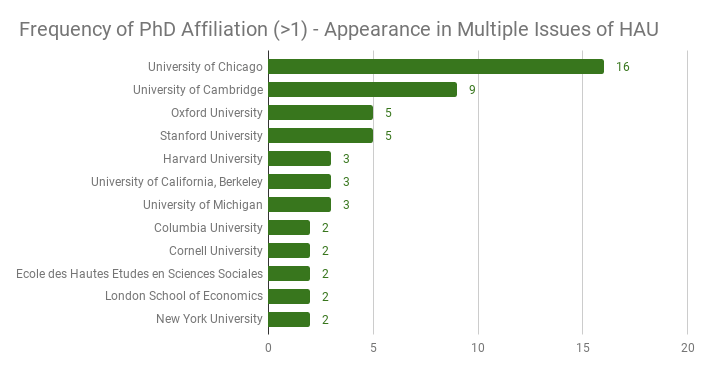
Frequency-of-PhD-Affiliation-_1-Appearance-in-Multiple-Issues-of-HAU

some stats about Hau authors, from footnotesblog.com contributor Jules Weiss

The diminishing returns of Twitter dialogue

I found a reinforcement of the Hau  experience (more heat than light) closer to home (Russian studies). This week a thoughtful tweet was made about the racial profiling of Central Asians by the Russian police.  Thoughtful, because the author and others were reflecting on the selective solidarity and wilful blindness towards racism by the privileged, particularly academics. So far so good. However, anyone coming to this tweet-conversation might be forgiven for thinking that police stop Central Asians because Russians are ‘merely’ racist. They would not learn that this is due to a structural racism built into immigration laws that enables the extortion of money from Central Asians that serves as part of the scaffold of the corrupt law-enforcement system. I’m not convinced that the causes of this form of racial profiling makes the Russian police more racist in practice than their counterparts in the US or UK for that matter.

Don’t get me wrong, I’ve learnt a huge amount from interacting on social media with academics and ‘public intellectuals’ since 2014, when I started using Twitter. However, I too am increasingly setting social media to ‘broadcast’ rather than receive.  Is this a metaphor for our times? Certainly, a fellow blogger thinks so: ‘the relentless jeering, preening and snark is evidence of the platform’s humanity.’

DqseFy0XcAorssc

A common experience for Russian studies twitterers

Counter publics and proletarian public spheres?

When I was writing about how ordinary Russians use social media a few years ago, I engaged not only with Habermas, but also Negt and Kluge (on the proletarian public sphere) and Nancy Fraser’s counterpublics “where members of subordinated social groups invent and circulate counter discourses to formulate oppositional interpretations of their identities, interests, and needs”. At some point I’d like to return to the PPS works, for the obvious parallels with the democratising and oppositional potential of social media. Negt and Kluge argue that the latter could potentially oppose the organized interests of the bourgeois public sphere through its organization of human needs and interests. On the other hand talk about the PPS is not million miles away from the banya full of spiders that is Twitter and other social media, in that they are evidence of “the “excluded”, vague, unarticulated impulses of resistance or resentment. The proletarian public sphere carries the subjective feelings, the egocentric malaise with the common public narrative, interests that are not socially valorized.” To my knowledge, Negt and Kluge’s ideas have not been applied to internet as a public sphere, (they wrote on public television and radio). Mark Poster’s piece still seems to be the main way-marker here.

So, what positives can we take forward? Well, strange as it may sound, I’m increasingly turning from Twitter to YouTube as a creaky, yet good-enough model for public intellectuals. And ironically, Russia leads the way here precisely due to academics’ exclusion. Deprived of airtime on traditional media, political oppositionists have long worked hard on building audiences in alternative media spaces. I’m still blown away by the slick, controlled operation that is Navalnyi. YouTube is a medium made for this. However, academics are catching up and using it for a unique ‘long-form’ dialogue. Because of the low ‘cost’ (I mean time and effort as much as financial) YouTube is ideally suitable for a real dialogue between people with an enthusiasm for and in-depth knowledge of a topic. Two almost random examples. The genuine public intellectual and recently sacked from MGIMO Valerii Solovei talks to Boris Kagarlitskii about the disintegration of the ‘ruling party’ system in the Russian regions and the bigger question of social or political ‘revolution’  in Russia. A little stilted, a little forced, but nonetheless some kind of dialogue between a ‘socialist’ and a ‘liberal’. Solovei already had a huge media following of course, so now he’s persona non grata it’s disappointing that he does not link back to the original version of the talk, hosted by Kagarlitskii. We still have academic hierarchies reproducing themselves. A less visible and possibly more rewarding example:  Alexander Dmitriev and Viacheslav Morozov in an accessible version of the their work on Russia as part of Europe, indigenous knowledge, postsocialist trauma and the ‘spritual bonds’ of Putin’s Russia. While this video was produced by Gleb Pavlovskii’s Gefter project, there’s nothing to stop scholars from more DIY collective approaches. Indeed, by involving students and colleagues they might get more traction than the under-appreciated Gefter videos.  I come back to the spiders in the bathhouse analogy (which is apt if we think of social media as an external punishment of confinement and the nearness of others). If spiders are inevitable company, any old bathhouse will do. They’re there in the corners, for eternity, but it’s who is sitting on the plank with us that matters.

banya

The reopening of my local public bathhouse


On the hegemony of the marketized university and the anglocentric view of knowledge production

Uppsala Lecture Hall

Lecture hall in the illustrious Uppsala Universitetshuset, next to what is thought to be the oldest university building in Scandinavia: the Gustavianum

It’s cold and dark (and that’s just inside the academy). And this post kinda reflects that January feeling of doom.

This piece in Aeon by David Labaree, ‘Gold among the dross’, has much to offer in helping non-insiders understand US academia, and the perverse incentives pertaining to an academic job more generally (that academics are driven less by fear and greed and more by ‘token’ marks of ‘glory’). But it raises more questions than it answers when it comes to comparing the merits of the US (and similar UK) system and other ways of organising universities.

And that’s to ignore what in my view is the untenable, but widespread view, that scholarship is an ‘internal good‘ a lá Alisdair MacIntyre. (An ‘internal good’ is the result of a practice within an ‘institution’ – i.e. where there are understood rules of the game – where that practice is undertaken according to a moral principle of excellence. One pursues excellence for its own sake – hence being ‘internal’ to that practice).

I’ve been thinking about the ‘internal good’ element of certain social practices for a long time, particularly via Russell Keat’s interpretations of MacIntyre’s ideas. In my research, I examined how Russian blue-collar workers engaged in DIY activities in ‘competition’ with each other for ‘sport’. The internal good is ‘expert’ peer recognition of the skill and excellence performed in constructing DIY-decorative-but-useful domestic pieces, such as fish tanks and metal furniture. Crucially, there is no ‘prize’ beyond that recognition, in marked contrast to how an academic career operates. (actually there’s a bit of a wobble here in defining the ‘good’ as it could be seen as both/either the value in the practice itself ‘means’, rather than ‘ends’, or/and the peer recognition in a community of practitioners – Keat does address this problem in his reading of MacIntyre).

Thinking about academic institutions in this way, many subscribe to a view of the ‘nobility’ of intellectual work,  They do so in a way that recalls the idea of MacIntyrian practices and goods. Perhaps because I’m not quite smart enough, I’ve always found it very surprising that smart people could think in this unsociological way. I can’t quite disassociate this belief with other ‘hegemonic’ yet flawed ideas. And not least this is because of the deep and pervasive anti-intellectualism I perceive that underpins so much academic practice (actually that’s the initial bee I had in my bonnet, but will have to wait for another time).

To be fair to Labaree, he argues that academics are motivated more by ‘fame’ than intellectual curiosity or the belief in furthering understanding. What I think he underplays is that the very pursuit of academic prestige is inseparable from other motivation such as vanity, greed, or fear. Possibly all of them at the same time!

His topline argument (in favour of the US system) is this: ‘Maybe it’s worth tolerating the gross inefficiency of a university system that is charging off in all directions, with each institution trying to advance itself in competition with the others. The result is a system that is the envy of the world, a world where higher education is normally framed as a pure state function under the direct control of the state education ministry.’

I can’t help but reflect on this in comparison with my own institution in Scandinavia, which more or less is described using Labaree’s phrase: ‘under direct control of the state education ministry’. The author assumes that where there are purer market incentives, like in the US, then entrepreneurial academics lead to the best outcomes (albeit with a lot of waste).

Leaving aside whether this it is really true that market incentives rule, I think it underplays how different (and diverse) non-US contexts are. This in turn illuminates the problem with the piece’s argument: that the ‘market’ is best (of all possible worlds) even if it is wasteful and pernicious in large part. My main problem then with the piece is another kind of hegemonic logic – almost a self-congratulatory social darwinism. A good reposte to this sort of thing was recently published by some Finns who reflected on the experience of publishing with British colleagues. They found their findings were relegated somewhat upon publishing as less relevant. They framed their argument in this way: “Drawing on Laclau and Mouffe’s (1985) political theory of discourse, we argue that institutions of academic publishing are constantly reproduced through hegemonic practices that serve to maintain and reinforce core-periphery relations.”

Perhaps the hegemony of the “university-as-market” idea is just one of a number of Anglophone-world assumptions. Another might be that ‘tenure’ in Europe works like in the US and I think inattentive readers of the Aeon piece might also make that assumption (because the piece begins by talking about endowed chairs). A fundamental difference is that ‘tenure’ in the non-US is largely linked to the institution’s, or ministry’s evaluation of the utility of the subject taught (not researched) by the academic in question. Thus in some places even ‘full’ professors can lose their jobs (as they have done even in the UK in less research-active universities).

Overall though, I think the Aeon article (and those who share its sunny perspective, particularly within academia itself) wilfully ignores the hidden ‘network’ of clientalism and patronage. Especially when Labaree resorts to statements like this: ‘As a grad student, you need to write your way to an academic job.’ Hmmm, can we really say that’s true, now or in any period? This is not a market based on merit. This is, like so much of the global moment, about hidden cartels, backhanders and networks of ingratiation (not grace) and favour.

(Aside)

Also, is it really true, as Labaree states based on a previous study, that Liberal Arts (economics) academics only publish 5 peer-reviewed article in their entire careers? (Is this a misrepresentation because they’re more likely to publish books and chapters?) And then there’s this: “lowest end of this top sliver of US universities has faculty who are publishing less than one article every five years. The other 80 per cent are presumably publishing even more rarely than this.” Perhaps I’m only surprised because I know little of the US system.

If that’s the case then what’s interesting is now metric-led requirements have invaded even less research-intensive universities in Europe in comparison to the Liberal Arts system in the US. Or is this just an artefact of the huge number of small LA institutions in the US versus the vast majority of state unis in Europe that have to show ‘value for money’ in research? It’s ironic that many of my UK colleagues think that I have fewer research pressures in Denmark than under the REF regime in the UK, and largely that is true. However, if looked at purely through the lens of ‘quantity’, a Danish academic in Humanities or Social Sciences is expected to produce two ‘higher-tier’ outputs a year, which is more than the average a UK academic is likely to produce for consideration in the REF cycle. And this is in an institutional environment where research time (whether as annual number of hours or as a percentage of time) is not officially counted. Food for thought.

(Aside ends)

Okay, let me get back to the essence of my gripe. Articles of this type ignore the broader question of power. In my (humanities/social science restricted, though diverse) experience of academia, the pursuit of power (institutional, financial, situational) motivates many (tenured or middle- to high-ranking academics). I would not put the ‘practice’ of the pursuit of knowledge even in the top three motivations. Autonomy in work, financial security, sure. Name whatever you like as a third.

Of course, personally I am bound to argue that I am ‘not like that’. I.e. driven more by the intellectual ‘practice’ that results in ‘internal goods’ – recognition of a contribution to knowledge, some new, some old, some wrong, some right (after all, only in the long term is it possible to say with any certainty). But it’s not for me to judge myself. What I will say, and what motivated this post, is the long-term observation that one meets few people so lacking in intellectual curiosity as career academics. And this is not just a question of overspecialisation – as is sometimes argued. Many are disturbingly uninformed not only about the world ‘in general’ and even basic social facts, but also about related disciplines that should have purchase on their thinking. (One colleague often points out that this is generally not so much the case in the former Eastern Bloc where the idea of the rounded intellectual worker remains). And this is despite the language of ‘interdisciplinarity’ gaining ground if not substantive meaningfulness. Then there are the snake-oil scholars, the empty echo equation solvers (where social or humanist knowledge is divorced from the world, is it knowledge?), not to mention the types one finds in all organisations – office-holders.

This brings us back to the ‘institutional design’ of universities. No one should be under the illusion that they actively foster ‘internal goods’ such as the pursuit and peer-recognition of intellectual excellence (MacIntyre scholars here may say I stretch the meaning of internal goods too far, but the point should be clear). These are at best happy coincidences and thanks to the minority – those naïve souls, often never getting tenure or even institutional recognition. While you may say this is too pessimistic I would argue that only by acknowledging this can we start to change it. All the more so because, As Keat observes:

“internal goods, are not only virtue- (or morality-) dependent; they also depend on institutions, and hence on the use of external goods such as money, status and power. [… ] External goods must serve the integrity of practices and their internal goods; internal goods must not be subordinated to external goods, but the latter to the former.”

Of course my criticism of marketised hegemony in the university is nothing new. Keat references Jerome Revetz’s work from the early 1970s. His Scientific Knowledge and Its Social Problems examined issues of the ‘industrialization’ of science and the need to reinvigorate the idea of ‘critical science’. The risk with increasing specialisation in science is of course the difficulty in detecting in a timely manner various kinds of ‘degeneration’, or shoddy science. We can see this at the root of the mistargeted ‘grievance studies hoax’. (See my brief response to this weasel defence of the bad faith fraud) By all accounts, fake science and flawed science is fundamentally the problem in much heftier disciplines than gender studies and queer theory (where the fraudsters have uncovered weak peer review and the failure to call out poor argumentation). As Craig Pirrong points out, the reproducibility crisis in psychological research is acute (50 percent of psychological studies being non-replicable). And most involve relatively simple experiments.

As Revetz might argue, the ‘cleaning up’ and outright falsification of data is partly the result of a relentless focus on entrepreneurial science, “where a scientist becomes more concerned with research grants and power than with the quality of his scientific research”.[2] The wiki for Revetz’s book continues in MacIntyrian fashion: “The need for ‘good morale’, i.e. for an ethos of science upheld by a community of peers is mentioned in relation to the danger that such an ethos may not survive ‘industrialized science’.”

To ground this in reality I offer my example of Russian working-class men making fish tanks. They were pursuing ‘internal goods’ – the recognition of excellence in practice. These practices were wholly divorced from power, money or fame (beyond the institution of the practice – their social circle of confreres). By contrast, the university sees internal goods (the production of knowledge) subordinated to more ‘worldly’ ones. This isn’t any answer to the problem, just a call to think more about how one’s own research (in places as distant as former Soviet factories) can inform an understanding of the institutional world that academics inhabit.