Tag Archives: navalny

Everyday Politics in Russia 2: How do we know the ‘average wage’? Plus: the bits of the book that engage with social movement theories

In the last post I mentioned….polsci. I don’t talk about much contemporary political or sociological theory in the book, but I am interested in a moment from early 2000s where Douglas McAdam and his co-authors Tarrow and Tilly appear to countenance a ‘poststructuralist’ way of looking at social movements

Following Tilly et al, I pick up on the call from more than 20 years ago by these authors to better integrate cognitive, relational and environmental factors pertaining to the submerged reality of political movements and networks. To reiterate – we’re looking at sums of effects of the flattened public sphere by criminalizing protest, the beheading of movements’ charismatic leaders. This, I argue, forced on activists a more democratic and grassroots focus; Putin’s 2020s Russia produces a new and in some respects dynamic activism, as much as activists’ ideological commitment or material resources do. This is the conundrum of social movement studies – the gap between foundations of action and action itself – how does a ‘process’ of activism occur or not occur in the presence of network and commitment? Again, this is something I started exploring in a direct response to Tilly’s work in my previous co-edited book. In this new book, I look more broadly at how much in common anti-war activism has with labour organizing, ecology work, and even grassroots patriotic activism in support of Russian soldiers. What I find are related processes of dispersed, nomadic activism. But there is a long gestation and formation of political positions that then informs action. Once again, that is the value of a ‘submerged organizational level of analysis’ (Tilly) – and one I aim to provide.

I follow a detailed process-tracing of anti-war stickering in 2022 in the case of ‘Polina’ in my book. To do something like this, most researchers need to start with the formative experience of 2011-12 around Bolotnaia, but also acknowledge the ambivalence of that experience. It has an affective hardening effect against Putinism, but also set up tensions around the question of electoral v. other politics, committees v. charismatic leaders, the centre v. periphery, talk v. action. It would be culturally reductive to say Bolotnaia radicalizes, or sets in motion a series of learning points in a predictable way that results in where we are now. Just to take the composite characters again from my book: ‘Polina’ becomes attuned to a genre of public protest opposition despite Bolotnaia’s failure, and despite the inflation in repression after 2018. Indeed, she goes against the advice of her allies among Navalny organizers when she stages a spectacular protest with others about Shiyes and gets her second arrest. At the same time, the stratum she ‘represents’ learns a lot from Navalny’s electoral strategy and how it involved regional capacity building: essentially, political education in organizing. But this for Polina occurs in parallel with her learning from socialist labour union work that’s mainly ‘indigenous’ to her locale.

But contrary to what you might expect, this is not taking place slowly, or gradually because it is occurring at the same time as an explosion of private (not public) social networking capacity. This means temporary alliances are possible between regional Navalnyites and ecologists and labour/socialist organizers. And these alliances are horizontal and nothing to do with the actual leaders of the Navalny movement. Indeed, it was funny when I interviewed a prominent person formerly connected to FBK and they had no idea of the capacity they had really built regionally because it was invisible to their own, centre-focussed and civic-electoral political aims.

In a sense, this process is frustratingly fuzzy to the social scientist; it remains very contingent, situational, refutes to a degree simplistic findings about the driving forces of identity politics or rights-based discourses for the emergence of social movements.  In that sense, my argument is not novel. Activism is opportunistic and, indeed, in a marginalized positioning. At the same time, the relative field of possible causes/actions/political orientations with which to align or ally expands in a noticeable ecumenical and pluralist manner – even to a degree which people are uncomfortable with in reality – like in joining members of the (regional) Communist Party in actions despite their prior mistrust and continuing unhappiness with the leadership of that party. As a result, there’s certainly merit in thinking about activism in Russia as an example of dispersed, pluralistic, and flexible political contestation.

But there’s also merit in thinking about how to put the ‘social’ back into the idea of social movements. Alain Touraine in the early 1990s remarked that post-social movements were heralded by consumerism and individualism and the abandonment of grand political aims based on class-consciousness. Movements base on identities threatened to pacify ‘social’ claims like a greater share of national wealth. But now we can think of the socialness of activism in a different way. What was interesting to me is how the actual differences and relations in communities of action are naturally visible and reflected upon by participants. And this carries over into relations between activists – so it was telling that while Polina didn’t like Navalny’s politics (too metroliberal and cryptonationalist) – she recognized the importance of her relation to the former Navalny organisers. At the same time, she didn’t like the anticapitalist socialist position of some unionists, but admired their actionist stance and picketing tactics. So, in a sense what I’m arguing for here is that the ‘social’ after the virtualization of opposition remains an important part of political engagement. The social as solidary and mutual learning still serves as glue and trumps political differences. Of course, the extreme turn of Putinism only helps this.

However, it’s also not that simple as having a common enemy. The war has forced people to confront the necessity of engaging with, or just listening to, those who support minimizing the damage to the Russian Federation while still broadly opposing Putinism. And in the last part of the book, I show this drama play out. Died-in-the-wool anti-war people are forced to acknowledge the legitimacy of activists who want to protect Russian soldiers even while those don’t support the actual war aims. Just a few days ago there was the case of a prominent anti-Putin socialist activist who was killed fighting in Ukraine. Oppositional activism is really only a small part of the book, but the tectonic social impulse that allows me to legitimately compare anti-war and patriotic activists is a recurring theme that provides the master theory underpinning all my ethnography. I turn to that in the following post.

Coda: What’s in the news? I read this article today about how only 10% of men in Russia admitted that they would feel awkward if a woman earned more than them. A linked article notes that the general gender pay gap in Russia is 43% (average salary for men 1000 USD and for women 720 USD). In turn this reminded me of a chart that Maria Snegovaya and Janis Kluge posted on social media showing a strong uptick in ‘real wages’ since the war began. Snegovaya sees this as support for the idea that the ‘population is loyal’. Kluge wrote that it shows why the war has been a ‘golden era’ for many. People assume that when I criticize these stats I am saying that they are ‘faked’. I’m not saying that, though I do think out of desperation at the poor quality of data they get that people in Rosstat have to process it a lot and that this alone is ‘dodgy’ – but something all statistical agencies do. What I’m really saying is: how reliable are the sources of this data in the first place when we know that what people actually get paid in Russia is one of the most notoriously opaque and painful data points in any statistics.
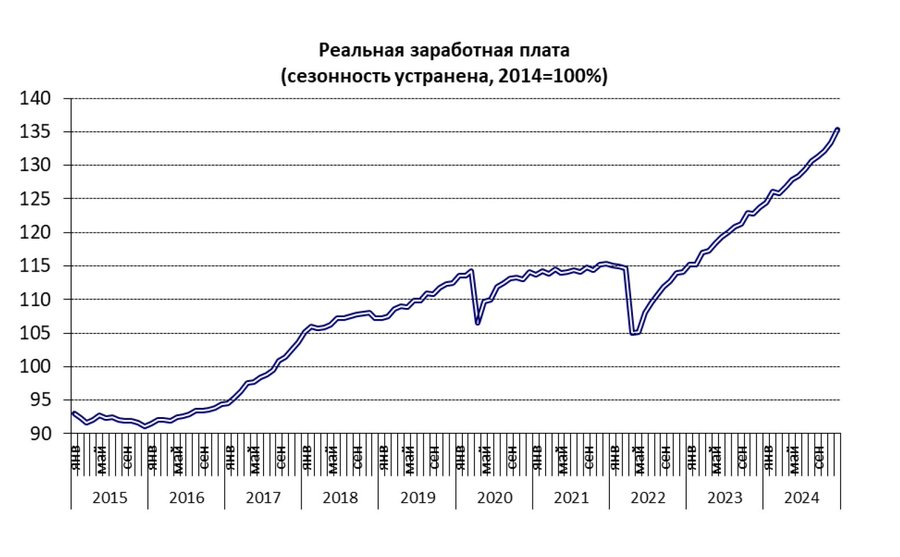
Anyway, to illustrate how silly it is to rely on one dataset like this (which in the original has no explanation of source), I just posted another graph from the same source. This is ‘real incomes’ (red line) and real disposable incomes (blue line). Details aside of the difference between incomes and wages, what’s perhaps most remarkable is the incredible stagnation of incomes between 2014 and 2023.
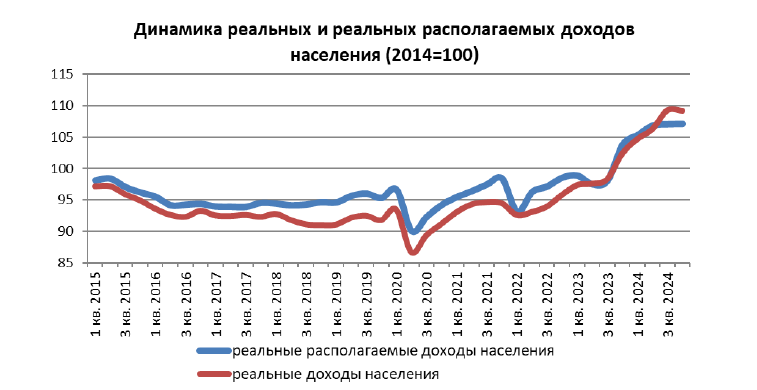
Axes of evil, or just normal chart crimes? The discussion in Russian to M. Snegovaya’s post is interesting. As is a follow-up post by Nikolai Kul’baka. He gives details on how wage data is collected from firms. As one can surmise, such data is not collected from small and most medium businesses. State enterprises we know do not reliably report salaries. A few v. high salaries distorts the average. The methods of calculation have changed a lot. Kul’baka: ‘there’s no major rise in salaries in Russia’. He also notes that protest frequency and changes in wages have no statistical correlation, something Sam Greene and Graeme Robertson explored many years ago in this excellent article.
Introducing Everyday Russian Politics: 1. Entangled Activism and Agonism

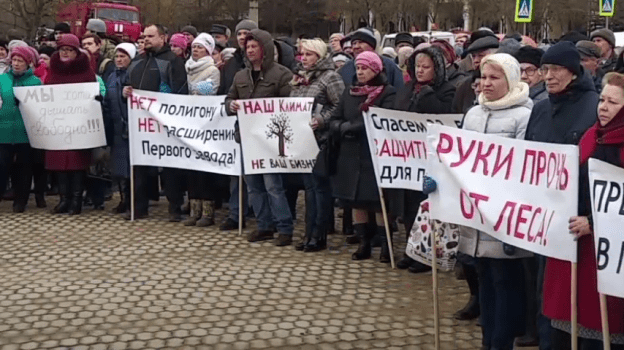
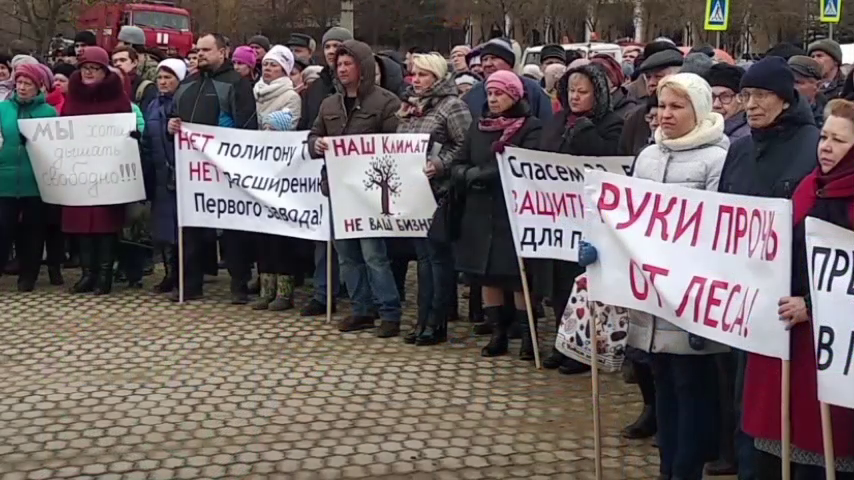
A very unlikely and unnoticed (by the media and scholars) mobilization by untypical activists against the expansion of a polluting factory

In a series of narrowly-focused posts I will talk about three aspects of my new book – 1., the use of up-close methods of long immersion – I argue there’s analytical power in ethnography to show the broader significance of neglected aspects of Russian social and political reality, 2., the part of my argument where bring together three interacting concepts: ressentiment, defensive consolidation and social striving. And 3., the evidence in the book of deep and enduring political engagement and practices which are underappreciated in a lot of coverage on Russia. In the last four chapters of the book, but also in my coverage of municipal politicians earlier on, I make claims relating to the idea of micropolitical content as it emerges in articulations and actions on the ground, and largely aside electoral politics (in a parallel relationship). (The relationship to ‘the political’ of Chantal Mouffe’s work, I defer to the end of this post as most readers are less interested in the theory stuff).

This post, though, is mostly about ‘activists’ and broadly from around 2018 to the present.

One claim is about a particular form of learning and reorientation by self-consciously ‘politically-active’ people, but also by people who deny they are political, and yet engage in ‘civicness’ nonetheless. The continual reinvention and recasting of activism is like different forms of movement – movement from electoralism to environmentalism, from in-person to online, from parties and groups to cells. This is maybe one of the most interesting ‘lessons’ of the ‘Russian case’.  Without longitudinal ethnography (which after all is just a form of immersive process tracing) it’s easy to accept the common sense that the centre has defeated nearly all forms of politically conscious actions not under its control. And I reject that. Why? Because in my book and elsewhere, I show that the gains of electoral organizing by people who were inspired by people like Navalny (but also by others) are not lost, but even now have been transformed several times over. This transformation occurs when they come into contact with new causes like environmental degradation, new conjunctural situations like military mobilization, and new situations of repressiveness, and that includes economic exploitation.

Just to unpack for a moment, I can give the example from my interviews of how Navalnyite electoral administrative ‘capacity’, for want of a better word, even after 2020, was partly resynthesized by people interested in more agitational orientation in labour activism: picketing tactics, political education through literature distribution and even just online ‘slacktivism’. People internalized lessons from one context and applied them in another. Or, more typically, the lessons ‘transmutated’ themselves. Another time this meant lessons drawn from ecological actions relating to tactical victories like Shiyes – the opposition of garbage transport to the north – were carried over into anti-war activism (decentered and devolved tasks with precautions taken to protect those on the edge and firewall them from hardcore activists).

This unpredictable and dynamic process was also shaped by the authoritarian push to remove activists from public space. As personal, but also semi-public Telegram channels and many group chats, became the only fora available for the discussion of causes, this repressive escalation actually did activists favours because it attracted a broader ‘insulted and injured’ audience, and enabled reflection and discussion on a wider range of political causes and possibilities. The irony is that ‘flattening’ the public sphere in Russia actually facilitated more intense and more fruitful sharing of experience among political actives – albeit online and in private.

But what is private? People I talked to often spoke of living the struggle as ‘more real’ even in the virtual sphere because it was experienced more intensely and with more solidarity and less loneliness. Over time this online response to repression then translated into better organized, more mobile, and more targeted and strategically-considered action – from the aforementioned Shiyes, to anti-war stickering, to small-cell sabotage (full disclosure – I have NO informants who do this nor knowledge of them).

Using my own fieldwork interviews with diverse activists, most of whom remain in Russia, I build on the empirical work by other researchers like Tereshina, Slabinski and Kuzmina. They emphasise how Shyies 2018-2020 heralded a shift towards more affective connection – catalysed by exclusion from electoral and public protest in cities. A mobilizational imperative that drew a broader group of activists together from across the country and across the political spectrum. Looser politics, yet affectively closer-knit, became a widely experienced paradox. I call this ‘experiential entanglement’ and I started to explore it in my previous co-edited book with Regina Smyth and Andrei Semenov.

One of my own case studies relates to a modest campaign of opposition to rubbish dumping in Kaluga region. But in terms of organizing, and also in terms of affective connections between activists of different stripes, people reference the lessons of Shiyes, and of the success of Navalny’s electoral clusters to train and bring together activists. They even refer to Shiyes as a kind of Russian Maidan – but more narrowly in terms of how it showed to activists a glimpse of the horizontalist, accretionist, triangulatory forms of contention – and here I purposely avoid the normal terminology of political opportunity structure. At the same time, I remain mindful of the lessons from political science of how dynamic the mechanisms of contention can be. Activists are not just subjects of collective action, but the products of unpredictable combinations.

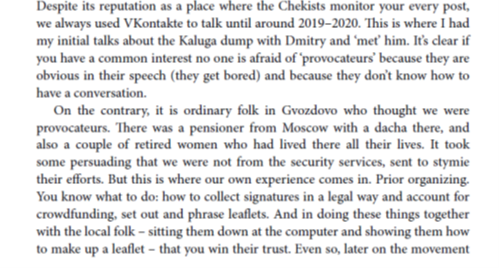
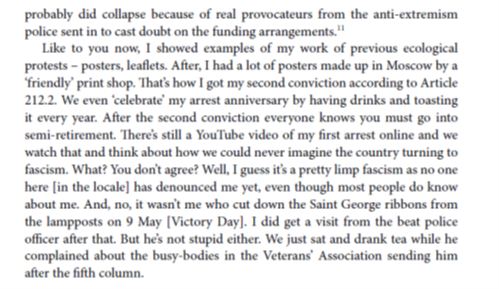
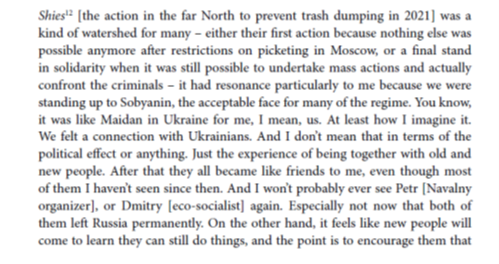
It’s worth quoting at length a rather rambling talk from the field to show the complexity of what I mean by unpredictably combinations. Polina is speaking in 2022:

As this post is already long, here I want to return to the use of the term ‘the political’. This term for me levels the ground to look at the political content of people’s lives as equal in significance to just ‘politics’. And how I use this term relates to Chantal Mouffe’s criticism of overly narrow conceptions of political relations. If ‘politics’ is institutional practices and discourses – realms from which almost all Russians are excluded, ‘the political’ is a dimension of antagonism inherent in all human society. The war on Ukraine only makes more intense Russians’ deliberations about what kind of ‘good’ society can be imagined. ‘Political’ discussions about the good are part of everyday experience, even in ‘post-democracies’, even in militarized dictatorships. Like Pierre Clastres’ (1977) classic critique of Western notions of politics, I insist that contention and negotiation, along with conflicts about the meaning of the ‘good’, can be grasped beyond the normative frames of formal politics in the public sphere. Politics exist beyond a narrow idea of ‘hierarchical subordination’ of the individual to power.

If you recall my recent review of Denys Gorbach’s work, I agree with him that an updating, or correction, of Mouffe’s concept needs to ground ‘everyday politics’ in material processes – like the experience of workplace exploitation, the broken infrastructure of towns, the way economic rents are now extracted directly from citizens via utility bills, the learning experience of people engaging with the state’s monetary offering for soldiers. From these experiences, many demands remain unsatisfied, and a chain of equivalence can be traced towards populist politics from everyday politics. Whether critical of Mouffe or not, most agree that her work should be read as a call to look more carefully and seriously at the construction of counter-hegemonic politics, and its potential for building left populism. Furthermore, Mouffe’s contribution should be a cornerstone of any critique of depoliticization, whether in the USA or Russia.

In the case of Russia, most scholars referencing Mouffe do so from the assumption that the hegemonic project of ‘strong Russia’ above all, is the successful culmination of the first two Putin terms. Nonetheless, even among those few who think seriously about the discursive construction of the new Russia note how ambiguous it is in practice: ‘shot through with intense doubts and misgivings about the very possibility of a strong Russia’ (Müller 2009). Olga Baysha implies (albeit indirectly) that discursive domination in Russia comes up against hard material limits in the miserable lived experience of so many millions of citizens and the ‘loyalty’ of citizens was mainly based of fear of losing minimal benefits rather than positive identification. In other words, like in Ukraine to 2014, the complete ‘normalization’ and naturalization of the regime remained quite weak. The liberal opposition undermined itself in 2012 when it pursued an exclusivist progressive discourse in the electoral protests against Putin (Baysha’s point, which I agree with). They were afraid of popular mobilization, not in favour of it. On the stability of the hegemonic order since 2012, people tend to forget that while the Russian constitutional arrangement has been successful in acting as if the interests and values of diverse parts of Russian society have been rationally reconciled, massive social conflicts simmer away on so many backburners that the roles of ‘chefs de partie’ (regional governors) are now a pretty thankless political posting in the Russian Federation. Too many pots are boiling over and the restaurant kitchen is open-plan. The point of my book is to say we should look at the various pots and why and how they’re simmering, rather than just looking at the rotating chefs.

Russia lost its greatest, and most naïve optimist*. A curmudgeon’s obituary of Alexei Navalny

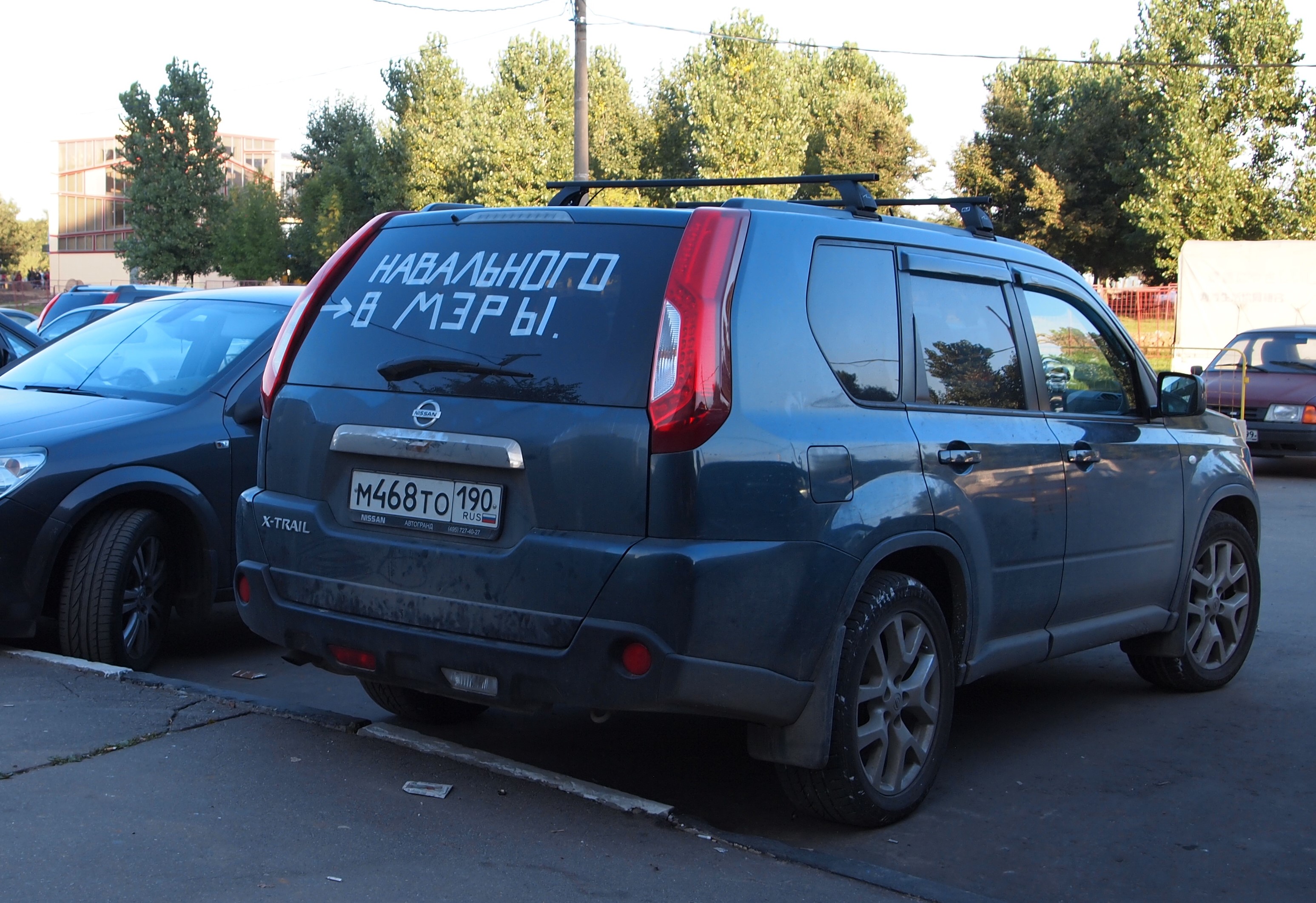
Navalny for mayor (2013)

Charismatic and intelligent. But too keenly aware of himself as both these things. Angry, frustrated – for good reason. Perhaps reckless, lacking strategic thinking. Narrow-minded and naïve. Who could better represent an entire group? The bright and irrepressible liberal middle-class.

Yes, more than all the other things, Navalny was a talisman – he had magical powers over his people, but was hardly stimulating to others. To some he represented hope for a different Russia. He represented incarnate individual responsibility, competition (‘fair’ elections are ‘competitive’ ones), self-actualization. A personal antidote to apathy. He was in earnest, fired up – something to aspire to. An anachronism ( ‘out of time’) in a system designed to disempower and demotivate, close ranks and watch your back… in the end he transcended his actual views to become a symbol of Russia’s inability to find a way out of personalist politics.

Martyrdom was a choice. People won’t say it – but he would have been better off saving himself. His was a stance both more principled than many others, but which also reveals the personalized nature of his appeal and his politics – he was ‘anti-Putin’ and positioned himself that way on purpose. And clearly Putin felt personally challenged on some level – hence his refusal to even name him.

But the anti-Putin contains many ingredients of Putin himself – as numerous people point out (privately, of course) even now. The style over substance. The cultivated charisma which stems from a rather overweening masculine pitch to authority (very, very few feminists are given any airtime to express their deep-seated discomfort with his language). The temporary and fickle try-out of different ideas and slogans. The super-narrow political imagination – one might even say ‘anti-political’ imagination (anti-corruption is not politics).  

After building his career as a blogger and activist, in 2013 Navalny stood for mayor in Moscow (he could have won in a fair fight). Less internet savvy Russians were barely aware of him at this point, beyond a name. A measure of how the ratcheting up of repression makes time elastic in Russia is that it feels as though 2013-2020 (to his poisoning) was a short period, but that an absolute age elapsed between his return to Russia in Jan 2021 and his death nearly exactly 3 years later.

People in the West paid oversized attention to Navalny because they believed he captured a kind of Russian ‘zeitgeist’ in the 2010s. But the true zeitgeist was a general misrecognition on the part of that liberal middle-class: they were just as invested in maintaining the unequal system of crony networked capitalism as the elite. Navalny campaigned against electoral and political corruption and his fatal success was investigating the personal self-enrichment beyond measure of the leaders. But his most ardent supporters were also among the main beneficiaries of the system.

It is a misunderstanding to think that his (anyone’s) ‘liberal opposition’ excluded nationalism, chauvinism even. A model of individualism in a hostile environment, a self-made man who believe in the invisible justice of the market makes one myopic and prone to blame others for their misfortune. Here in Russia, liberalism is about protection from the rapacious state and personal responsibility for one’s actions. But being for ‘fair competition’ can also code as protecting ‘ethnic’  Russians from ‘immigrants’.

Navalny was pointedly hostile to people who have every right to live and work anywhere they like in Russia – Russian citizens in fact, who happen to be Muslim and racialized as such. It’s mistaken to see him as ‘cannily’ channelling nationalist sentiment in an acceptable way to urban Russians. Instead, we should read this as an essential script of liberal failure; in a country with millions of Muslims and rich diversity – and where inequality and ethnicity go hand-in-hand – playing the race card shows political immaturity at best and was ominous.

Thirdly, he was lauded for his supposed turn to ‘social issues’ (sic) in 2018 as if this was a smart pivot. In fact, it was years too late, and because it was too late it failed to resonate. The ‘social sphere’ for Navalny was hardly visible except in a negative sense – that corruption makes the state and the individual poor. He represented everything that is naïve about liberals in Russia – ‘if only we could just get on with being a normal country like the USA, everything else will fall into place’. In a sense, he traces an ideological line back to the Komsomol boys who privatized opportunity in the late Soviet Union and deluded themselves they were building a market where all would prosper.

His honest and principled disgust with corruption never led to diagnosis of root causes. Corruption was a byproduct of total social transformation that the elite and a large part of the Soviet nomenklatura had actively chosen and supported since 1990. Corruption exacerbated inequality, but the original sin of economic looting and wholesale destruction required more radical politics to mend. Way back in 2009-11, I did many political interviews with ordinary voters. They really disliked Navalny because of his naivety and smugness (seeing the problem as merely replacing ‘crooks and thieves’ with ‘honest’ representatives). His achievement in mobilizing the middle class to actually try to do politics was laudable but also doomed to failure. It should be seen in the light of similarly well-meaning people in democratic societies who think they can break cartel politics from the inside, through the ballot box or a more appealing offering in electoral politics.

Navalny as a political phenomenon is a warning. Like any charismatic project it shows that without a movement that can connect different kinds of people and show them that they have common material interests, clever slogans, social media, and urban youth organizing isn’t enough. The media write ups (just like the exaggeratedly glowing scholarly accounts) showed what an exceptional individual he was and how an individual can become symbolic of change for many people… but exceptional people do not really change history – despite what a popularized view of “great men” pretends to show. Churchills, Stalins, Trumps are ultimately just part of the structures of feeling that dictate their eras. Navalny was, despite everything, an anachronism not so different to Putin: out of step with what most Russian people want.

*title partly stolen from the genuinely great A.A.

Navalny, rights discourses in, and on Russia, and the missing pro-social policy platform

Quick follow-up to this piece on Amnesty and Navalny that I wrote for the Moscow Times last week.

Some people wanted me to clarify this bit:

“the case brings into focus long-standing debates about the outsized role western NGOs play in how Russia is perceived, and whether the retreat of the U.S. as a global hegemon has the effect of rendering “liberal” ideas of human rights less credible. Yet the problems of unequal access to palpable measures of human flourishing with which these same NGOs grapple — be they free elections, the rule of law or decent working conditions — are more pressing than ever.”

others thought I was unfair on Navalny’s programme, or that I was vague:

“As narrow and short-sighted as the dissidents of the Soviet past. The competitive, transparent elections and a “fair” and functioning market economy that Navalny advocates are not the same thing as a truly “universalist” approach to human rights — the right to human flourishing and full and equal development of human potential.”

You can see I repeat the phrase – ‘human flourishing’. I chose this phrase because it’s a way of broadening the rights perspective – to social and cultural conceptions of rights. It’s also a topic I close my book with – a rhetorical question about what we mean when people say Russia lacks something we (in the imagined West) take for granted, or as an ideal good – be it political rights, personal autonomy, social safety nets, or economic freedom. In the book, one of my points is that measuring by comparative yardsticks to say that human development in Russia is ‘lower than it should be’, is important (for example we can argue that many people in Russia lack access to economic security, a clean environment, healthcare and other goods that ensure an adequate life expectancy at birth). However, this metric ignores wider and equally important ways of thinking about human potential via what I call ‘habitability’. In the book, I identify these in concepts like ‘meta-occupational communities’, mutual aid practices, but also communities of craft and labour. There is also what others would call ‘social capital’, but I call local ‘authority’, autonomism, and reciprocal dignity based in webs of social ties of ‘extent, commitment and deep content’.

Similarly, with ‘human rights’, do we focus on trying to establish international public law predicated on an idea of an international order where such rights can be protected, or do we widen the debate to talk about how to defend wider perspectives of ‘human potential’ based on maximising people’s ability to take autonomous action? Now Amnesty already does this by including campaigning on biopolitical rights like the right to abortion, children’s rights, and racial justice. But, there remains a big gap between awareness raising and action that translates into enforceable legal mechanisms. This relates to a debate about the limits of legal positivism that underpins the global human rights industry.

The weakness of this version of ‘universality’ is that it tends to disconnect ‘rights’ from the social context of actual historical development and in particular the role of social movements in altering what we consider ‘rights’, and in moving forward agendas to realise them. We focus on the ‘ends’ of the claims, and not enough on the ‘means’ – in particular the historical non-legal and pre-institutional forms of fights against injustice. Today, the human rights agenda as pursued by organisations like Amnesty, is despite its claim to universalism, mainly focused on ‘negative rights’: political and civil rights rather than ‘positive rights’, like economic and social rights. Amnesty, as an international NGO, is ironically highly state-centric and ‘realist’ (it is the Russian state hailed in the plea to free Navalny and has a ‘duty’ to comply). At the same time, as I hinted in the article, the legalist model also relies on a model of unequal inter-state relations where via realpolitik, offenders are forced to comply. These are not my ideas – but mainstream debates in the social constructivist approach to rights discourses and the turn towards social movements as engines of change, along with the need for institutional democratisation. (Side note) – my current research is interested in the transition from new social movements to ‘social non-movements’. But that’s a post for another day.

How does this relate to Navalny himself? Well, at the back of my mind were various misgivings about his chameleon populist appearance – that his social populism was merely that – convenient rhetoric. What does he himself think about Russians’ social rights? (we know what he thinks about cultural rights – that beyond the ethnic ‘russkie’ they should be limited). My hunch on social rights is that he remains an incorrigible (neo)liberal, which would be understandable given his biography. But is that fair? Well, after writing my piece, I thought I’d better actually review my prejudices! My conclusion is based on a trawl of high-visibility interviews – with Yuri Dud’ and Sergei Guriev, as well as his campaigning materials.

Firstly – his ‘social programme’. People talk about his shift to focus on inequality, but really, I’m quite shocked they are so easily satisfied by pretty sparse detail and empty rhetoric (in fact, as empty of the ‘social guarantees’ rhetoric of the state itself). While many laud his anti-corruption campaign, his message of ‘better social equality via higher living standards’ relies on a kind of magical thinking related almost exclusively to removing corrupt elites. This will supposedly allowing lowering taxes and raising the minimum wage to… a paltry 25000rb. Navalny was fast to attempt to co-opt the pension protests from 2018, but as critics point out, prior to that he was quite consistent on the need to raise the retirement age.

As we dig a bit we find some unguarded comments about Singapore as a model (!) and the merits of ‘complete deregulation’ – whatever that means. Again, if he wasn’t so prominent an opposition figure his naïve voluntarism married to his moist-eyed belief in markets might even be charming. He’s learned the word ‘deregulation’, but it doesn’t appear he’s thought of what the end point looks like for a country like Russia (that, by the way, isn’t a city-state in South Asia – followers of the Brexit debate on Britain’s future may be getting déjà vu here).

Should a future Russian leader revisit the corrupt and deeply flawed privatisation processes from the 90s? Largely, the answer is no. Yes, he talks about the fundamental problem the ‘loans-for-shares auctions’ of being that its injustice meant that the institution of private property does not exist (because the illegitimacy of the process meant that later state confiscation could always be justified). But, Navalny’s answer is mainly about windfall taxes on privatised companies ‘like in the UK’. So we get a good idea that his ideas about public goods are horribly atrophied. He’s a ‘realist’: you can’t put the toothpaste back in the tube – which is fair enough on one level. However, again it’s kind of funny that the rhetoric of his support and his own message is ‘idealist’ (We can change Russia), yet the policy is somewhere economically to the right of Rishi Sunak (UK’s finance minister). It is telling that his talk about privatisation – probably the one issue that still encapsulates unfairness, corruption and inequality in Russia today– even shocks the orthodox economist Sergei Guriev. (Here’s an old evaluation by Guriev of Navalny’s economic policy positions).

De-monopolize the media in Russia? Firewalls of ownership. Impartial judges? Pay them a lot (and professionalise them). Taxes up, taxes down. Taxes to pay for this and that. ‘It’s easy in the world now’ – as if even the state of California hadn’t failed to address monopolies (this time Uber). As if off-shoring would stop after Putin. Everything is either a technical-legal solution or…. you guessed it: ‘taxes’ (sometimes up, sometimes down). ‘Vot etogo byt ne dolzno’, – ‘that shouldn’t happen’! I had to laugh when this was his response about quasi monopolies in new tech as if one could flick a regulatory switch. What to do with Oligarchs? ‘Get him to pay a tax, not confiscate or shoot him’.

Now this is mean of me. Who am I to criticise? Well on the one hand, yes it is unfair to carp like this. (Although I am by no means the first to view the programme as wafer thin). Navalny remains a ‘not-yet’ politician – untried, with limited resources to develop a detailed policy position. On the other, my point is not about politics or politicians in Russia, but instead about how skewed to the right the ‘Overton window’ is –especially when it comes to the idea of social and economic rights. Outsiders forget that, as Olga Shevchenko has investigated – especially among better off Russians there’s a brand of common sense in matters economic that align with ‘neoliberal rhetoric’, or at least right libertarianism and often extreme forms of social Darwinism. If you want another illustration of this with reference to Navalny, check out the rebuke to him from a patriotic right libertarian perspective from Yuri Dud’: “I get the feeling you don’t respect capitalism – all these demands that people make restitution payments for privatisation.”  Cue, Navalny spluttering that Russia has many good capitalists. The point is the Navalny is wholly unexceptional with regard to views among the tiny group of ‘winners’ in Russia. As I keep pointing out, that also means there is a reasonable objection to his politics from the left, and from the majority of Russians who have experienced economic stagnation for the last ten years.

Putin and property – a ‘boss’ but not an owner

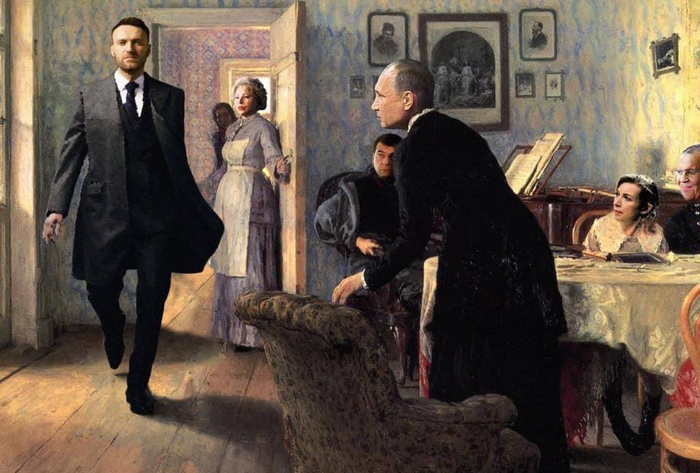
After Repin. ‘They weren’t expecting him’.

I was reluctant to write about Navalny’s return to Russia. Partly because so much attention devoted to this figure in the ‘West’ does neither him, nor the breadth of political opposition in Russia any real favours – witness some of the naval-gazing attempts to tie Russian protests to BLM and other issues in the US that really have little to do with the Russian context and even less to do with Navalny’s case. Anyway, what did catch my attention was Putin’s unprecedented response (in that normally he pretends that N. does not exist) after the YouTube expose of what is alleged is Putin’s Black Sea palace. Second, I thought it worth underlining a point I’ve made before in this blog – that Navalny still fails to cut through as a national political figure, even though his videos and campaigning have fundamentally changed the political atmosphere. Also, unlike even at the time of the Moscow mayoral election in 2013 (which he should have rightfully won), pretty much all my research participants (in deindustrializing Kaluga Region) are now aware of him.

So the post is in two parts –today, on the fickle meaning of ‘private property’ in Russia and later I will talk about some ‘on-the-ground’ responses to Navalny’s arrest and the 23rd January protests.

So, Oliver Carroll tweeted the strange phrase from the short interview Putin gave rebutting the allegations: ‘“Nothing described as my property belongs to or ever belonged to me or my close relatives. Ever” [ничего из того, что там указано в качестве моей собственности, ни мне, ни моим близким родственникам не принадлежит и никогда не принадлежало.]

Carroll commented: ‘A strange turn of phrase that doesn’t deny existence of palace resort or the fact that it was being guarded by the presidential security service.’ Then Timothy Frye responded that ‘Property rights are often seen as three separate rights: rights to use, to obtain income from, and to transfer an asset. Better to ask did you use the property or allow others use it than did you own it on paper.’ Frye has a book on property rights in Russia that I’m looking forward to reading. From a quick browse Frye asks the chicken and egg question about property rights – do people in developed economies abide by contracts because of social trust, social networks or effective courts? Interestingly he’s implying that our understanding of ‘good institutions’ in ‘the West’ is too simplistic and that social norms play more of a role than we would be comfortable admitting. Frye goes on to talk about the importance of informal institutions in Russia that provide their own ‘rules of the game’ in terms of widely understood sanctions for actions like reneging on informal agreements. In some business contexts, the rule of law can sometimes be a worthwhile recourse – legal dualism results. Later in the book I can see Frye has collected interesting survey data on the prevalent feelings of illegitimacy surrounding privatisation even 25 years on – particularly linked to perceptions about benefits to private individuals and the loss of public goods. “In a word, everyone hates privatization”, but not private property, write Frye.

My own research has not really looked much at property rights – only obliquely do I talk about corporate raiding (reiderstvo) and how its violence in Russia affects ordinary people. What was clear is that uncertainty and disputes of ownership of plant and land continues to create high levels of palpable risk even for ordinary people as it can result in catastrophic ‘externalities’ like pollution, violent crime, and the disruption of utility supply (p. 236 in the Conclusion linked above). It also results in a particular Russian anomaly – property that doesn’t belong to anyone. Famously the lack of ownership of graveyards has been widely discussed, but less well studied is the problem of roads and utility networks that jurisdictions fight over in order NOT to take responsibility for them. This was a running theme in my research on Izluchino in my book and many informal solutions of ‘devolved’ governance were found that would confound any traditional perspective on property relations.

In response to Carroll’s comment on Putin’s language – his disavowal of ownership of the palace – I was reminded of the literature on ‘private property’ in the USSR and in particular a discussion in a forthcoming book by Xenia Cherkaev that contains long discussion of ongoing significance of Soviet ‘property’. Usufruct looms large – ‘use’ stressed over ‘possession’ (vladenie) in the Soviet system where ‘private’ property was taboo, but still a reality, and thus had to be fudged in various ways. Putin is probably telling the truth that there isn’t a deed of property with his name on it. But that’s of course disingenuous because Navalny makes the point about endless intermediaries himself (and points out that they are quite revealing of the relative narrowness of Putin’s trust circle).  By relying on old acquaintances from St Petersburg, if anything Putin is shown in quite a sorry light – he doesn’t have very extensive social capital – revealing his rather parvenu origins and unimpressive career prior to the later 1990s!). But I guess the point here is, how much ‘capital’ does Navalny really have – in Russia? Maybe by his public act of self-sacrifice this will be his moment to become at least a powerful political symbol – if not political leader. Or will this gamble mean that he’ll eternally be known domestically as an ‘avantiurist’ or traitorous dupe. That’s for a later post.

Now, Cherkaev’s book is not in print yet and I don’t want to steal its thunder. However, some of the book’s arguments are visible in two articles – unpaywalled here  and here.

Cherkaev writes: “Coming from the study of Soviet civil law (see Cherkaev 2018 [Russian text]), I am especially interested in nonprivate ownership, in what happens to the idealized triad of full and complete ownership rights—usus (to manage), fructus (to benefit from), abusus (to dispose of)—when property is collectively held.” In the 2018 Russian article, Cherkaev discusses ‘dignity’ as personal property in the USSR. In the book, Cherkaev builds on the distinctions between personal and private to show how the former served as a substitute for the impossibility of the latter in the realm of ownership. The Soviet solution of “Personal property” posed no threat to the Soviet monopoly on property “because it was essentially usufruct: the right to use and benefit from a share of socialist property, without alienating it from the commons”. This led me to reflect further on another discussion – linked to ownership, that Cherkaev makes – that of ‘хозяйство’ – (khoziaistvo)  – which can translate economy, household, property, house, establishment.  Traditionally, ‘the economy’ in Russian is essentially ‘narodnoe khoziaistvo’ and more recently ‘natsionalnaia ekonomika’.

Cherkaev draws on Stephen Collier who notes that khoziaistvo actually refers to any nexus of production, so is not just ‘the economic’ – “as a noun, [it] can refer to a farm, a household, or virtually any nexus of production and need fulfilment—that is, to almost any unit of substantive economy. But khoziaistvo can not imply the formal meaning of ‘economic’” (Collier, 2011. Post-Soviet Social: Neoliberalism, Page 81). This led me to reflect about Putin as the ultimate ‘khoziain’ – an owner-in-charge contrasted to owner-as-possessor – and that this also captures his managerialism, as opposed to entrepreneurialism as leader. Russia’s economy is also easily seen as a khoziaistvo rather than a legal-contractual system of possessions exchanged. Khoziaistvo as dominion shows both the strengths and weaknesses of Russia’s ‘sistema’ (informal governance system) as it relates to the economic. From this meaning of khoziaistvo, Cherkaev marks Russia’s relationship to property as different to that of the ‘market economy’ . ‘Ekonomika’ is a formal space of circulation with equal and self-interested actors. But Putin as ‘khoziain’, shows the ‘substantive’ — in anthropological terms — meaning of his clientelist regime. We normally think ‘substantivism‘ as a ‘positive’ thing (after Polanyi), but why not avoid psychologising Putin as ‘avaricious’ (which may be true) and instead see him as product of a ‘self-provisioning’ system where actors are embedded (actually trapped) in a personalistic webs of mutual aid.

This is what Navalny’s vid shows very clearly – remarkably even – the same young-old faces at St Pete City Hall who start off writing bribe amounts in the 10s of thousands of dollars sheepishly on bits of paper and then – almost by accident – end up running a petro-economy where the opportunities for graft are endless. Ironically, Putin is entirely unremarkable and his ‘khoziaistvo’ also. What’s clear is that his version of ‘gosudarstvennost’ (stateness – building a strong state) is subordinate to his ‘feeding’ system (the devolved form of governance allowing levying tribute and keeping part of it inherited from the Mongols). In some respects he’s never evolved from Soviet manager mindset – his idea of ‘initiative’ is personalised negotiation and accumulation – not according to market utility maximisation or even profit motive, but as a defensive and even ‘ethical’ protection of the team (this self-justification of course is part of Alena Ledeneva’s explanation of how ‘connections’ known as ‘blat’ in Russia work – by misrecognition as part of one’s ethical self that helps others out – Cherkaev also discusses this at length).

Of course in 90s/2000s this ‘mindset’ (that trust is personalised, limited in scope, conditional, and that there is no alternative to embedding oneself in a chain of mutual ‘aid’) spirals out of control and creates obscene wealth and inequality. Nonetheless the tacit (or not so tacit) acknowledgement of Putin as ‘khoziain’ of Russia Inc. means even Navalny’s latest will not cut through quite as well as we might think. No one likes obscene wealth in Russia, but most people have lowered their expectations after 30 years of no one wealthy really getting their just deserts (Khodorkovsky excepted – in that most people do think he got what was coming to him). Envy-culture (hatred of real entrepreneurs) is real. But again, this plays to Putin – as he’s not an ‘oligarch’, but khoziain. Despite Navalny’s revelations, Putin is still implicitly compared (by ‘ordinary Russians’) to another ‘khoziain’ who famously lived frugally – Stalin. He too secured resources through formal and informal means, determined entitlements according to a different kind of ‘economy’. Now I don’t agree with these people, but you have to admit Putin is successful (for now) in projecting himself as the arbiter of national khoziaistvo. In part because most people’s individual wealth is derived from personalised networks of trust no less than Putin’s own.

Final points – the irony of the Kremlin today saying they cannot name the true owners of the palace as they are entrepreneurs and therefore their transactions in the sphere of private property are to be respected.

People are much more critical of the authorities than ever before. People are cynical. People – thanks to Navalny – cannot ignore the vast scale of corruption in their own country, BUT! They were really uncomfortable with the ultimate upping of the anti by Navalny – maybe it was true – that the corruption extended to Putin himself? However, Putin’s response reassured them. If he was denying it then it required less cognitive dissonance to believe stories about Navalny being a stooge of the West and the whole story as some kind of slander on Russia. From there it’s not so hard to believe the current propaganda – that ‘foreign elements’ are paying protesters, etc, etc, to explain the Saturday protests in support of Navalny. Interestingly here, the message coincides with another one – of protecting youth from bad influences – which also gets a very sympathetic hearing among a majority of Russians.

Next post will offer some wide-ranging reflections on Navalny by my research interlocutors – young, old, rich and poor. Has his time passed – ironically at the time of the greatest international attention to him? Does he have a message beyond anti-corruption that is wide enough to cut though? Is his ‘reach’ to ordinary Russians over-rated to the Twitterati? Can there really be an opposition leader in Russia while Putin is in charge – or is that to miss the point – that Navalny’s strength is to serve as a hybrid figure who can channel various political imaginations that have been repressed for so long?