D’Anieri on history, security dilemmas, democratization and European divergence after 1991
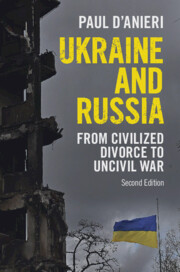
In this post I want to share with you why I think Paul D’Anieri’s updated Ukraine and Russia: From Civilized Divorce to Uncivil War is the single best book you can read to understand the domestic and geopolitical causes of the current war. Originally published in 2019, he updated it in 2023. I’m not saying it should replace wider reading, and in this blog I have often made mention of other sources on both Ukraine and Russia which are indispensable – particularly to socialists. So, disclaimers: it’s not the only good book, but it covers most bases for the casual, non-specialist reader. I use it to teach an elective course, along with a long reading list of other authors.
It’s main merits are that it keeps sight of the actual relationship between Russia and Ukraine, the domestic and international factors, and the longer historical context. In the introduction, D’Anieri argues that the typical approaches to understanding the conflict contradict each other: on the one hand we have a focus on Russian revanchism. Others focus on the war as a result mainly of the domestic logics of autocracy. A third ‘school’ blames the West for expansion of NATO, and partly Ukrainian nationalism. We looked at the ‘West is to blame’ approach and its flaws in a previous post.
D’Anieri’s main strengths then are in looking at long-term trends as well as short-term triggers. These in turn can be explained as part structural and part ‘normative’. What would be a mistake is to focus too much on individual leaders who were always to an extent carried along by the underlying conflicts evident even in the early 1990s when mutual trust was still high. That isn’t, however, to let Putin of the hook. Ultimately the escalatory decisions in 2014 and 2022 were his alone. Would Medvedev, or Ziuganov, have acted differently? Maybe less so than people think. D’Anieri’s argument boils down to the contention that ‘as long as Russia’s definiton of its great power status included controlling Ukraine, Russia and Ukraine would be at odds’ (3). The ‘security dilemma’ meant that each action Russia and Ukraine individually took was perceived as undermining the or even threatening the ‘vision’ of each country’s future secure place in the world.
Secondly, processes of democratization, regardless of their real results, undermined Russian elites perceived national interest. This was a normative conflict from at least 1993 onwards, but especially after 2004. In the author’s view you cannot disaggregate NATO, European normative rules, and EU membership from this process of growing Russian ‘resentfulness’. Without consolidation of democracy in Russia (which began to fail in 1993 accelerated in 1996, and became inevitable after 1999), and the embracing of a post-imperial idea of its relations with neighbours (arguably also unlikely after 1999, and especially 2008), it was increasingly likely that sooner or later Ukraine would be the unlucky territory upon which Russia’s unfinished normative and revanchist politics would meet in their final conjunction.
Loss aversion is better than blame
It might seem here, that D’Anieri is going to follow so many observers and assign blame – presumably to Russia, just as we saw with Sakwa the apportionment of blame mainly with the West. As the author notes, even ‘excellent scholars have resorted to simplistic renderings of blame: John Mearsheimer stated that “the Ukraine Crisis Is the West’s Fault,” while Andrew Wilson wrote that “the Russians went ape.” For D’Anieri though, this approach ignores all kinds of constraints and sets out further his focus: security dilemma plus democratization pressures, and the multiplier of domestic politics. Both Putin and Zelensky had much less agency than some observers would admit.
D’Anieri takes to task both ‘defensive’ and ‘offensive’ realism. The former can inadvertently lead to assigning blame to the West if an author is sympathetic with Russian perspectives. The latter sees the international system as inevitably riven by conflict. Here the author notes that even if you don’t see Russia’s concerns about Ukraine as ‘legitimate interest’, the latter’s gravitation towards even just an EU normative order would naturally be perceived as a loss. Loss aversion then while not inherently leading to aggression, has to be taken seriously as potentially leading to conflict. Furthermore, solely looking through the lens of realisms, ignores that international and domestic goals may reinforce each other – certainly the case for Putin who was coming under significant pressures at home by 2014 and again by 2018.
Domestic politics loom large
Along with the security dilemma and democratizing pressures, it’s important to remember that in domestic politics ‘there was almost always more to lose and less the gain […] from taking a conciliatory policy than from taking a harder line’. And this is true of the USA and EU. Furthermore, perceived state capacity is another variable – both in terms of real hard power recovery in Russia, and the wrong calculus, also on Russia’s part, that it could quickly decapitate a ‘weak’ Ukraine in 2022. Here we can make a minor concession to an idea that some kind of visionary leadership might have made a difference. But would it really? How could another version of Clinton/Bush, or Medvedev, or Schröder/Merkel really have overcome both structural inertia and domestic distractions to really change things? The end of the Cold War, ironically, reduces the likelihood for conciliatory policies to actually get traction beyond rhetoric and countries failed to account for the continuing gulf between their different understandings of what the status quo was.
Perhaps most importantly, we can look at the example of Crimea here for Russia. D’Anieri gives the examples of how even leading intelligentsia or ‘liberal’ figures, bitterly disparaged Ukrainian independence, or reiterated the ‘historical justice’ of returning Crimea to Russian control. The foundation myth that Russian statehood can be traced back to the Rus civilization inflected strongly part of Russian normative thinking in relation to Ukraine. Loss aversion again looms large in calculus. As is known from psychology, loss aversion leads to disproportionate risk taking even in supposedly risk-averse individuals. Crimea was invested with magical meaning for Russian statesmen in a way that gamblers think about good luck totems. Nonetheless, Crimea alone would never have become a sufficient factor for war to occur. Overall, D’Anieri here returns to his understanding of the particular security dilemma in play. Even at peace, unintentionally, action and inaction have the effect of increasing stresses between states. Concessions which could have been made, were not – for example, more forthright telegraphing by Russian elites to Russian constituencies that ‘Ukraine was lost’. Alternatively, EU calculus that would have acknolwedged Ukrainian and Russian economic interdependence and a modified form of Eastern policy was always missing.
The dangers of democratic peace theory
Here D’Anieri takes to task the implicit assumption underlying democratic peace theory. War between democracies was supposedly impossible so expanding democracy promoted security. On this, realists and liberals could agree. In terms of their different normative assumptions, there was little different between the Clintons, Talbotts and the Brzezinskis and Kissingers when it came to resulting policy – a push to the East. Kennan of course is the usual exception. See the recent interesting article in NLR: “There was need for a realistic accommodation with them about the future of Europe,” (writing about how Containment after 1945 would also require a real engagement with the USSR afterwards). What Westerners fatally downplayed were the geopolitical implications of democratization. They saw the implications of Russian objections as irrelevant and thought they’d found a magic elixir in the form of colour revolutions: isolate, support internal elite defection to democratic forces. Rinse and repeat. While Russia saw a democratic Georgia or Ukraine as inevitably rejection Russian control and therefore inadmissible to Russia’s own security and stability. From 2004 democratic overturn of regimes and geopolitical competition becomes impossible to separate for both West and Russia.
All of that said, we shouldn’t lose sight of Ukrainian agency. Any account of ‘cause’ that doesn’t foreground Yanukovych’s actions in precipitating internal and then external conflict is going to be suspect. As D’Anieri says, how ‘international factors interacted with internal forces within Russia, Ukraine… has been underemphasized in most analyses of the conflict.’ (17). Yanukovych is important because his government threatened to upset the three sources of internal balance in Ukraine: political pluralism through regional diversity, foreign policy balancing between Russia and the West, and oligarchic, or clan pluralism. All of these fulcrums that made Ukraine unlike Russia were under threat after 2010. His actions threated to autocratize Ukraine via presidentialism as had happened in Russia. In turn Ukraine might have gained an ascendent oligarchic elite group drawn from his particular regional clients. As it is, the Maidan led to a restoration of 2004 Ukrainian constitutional arrangements and free and fair elections – by post-Soviet standards.
On the Russian side too, D’Anieri notes provocatively asks – would a more democratic Russia have prevented a Russian president from opportunistically seizing Crimea in 2014? Trump 2.0 shows that this assumption is naïve. Furthermore, domestic politics in Europe and the USA are also important. A new ‘Marshall Plan’ was untenable politically in the US – Bush senior lost on the economy – how could he (or Clinton) have sold massive aid to Russia? Finally, the status quo in the 1990s of economic interdependence of Ukraine and Russia also prevented domestic developments that might have changed the later calculus. The Ukrainian state also remained remarkably weak and corrupt, just as the Russian state after 1999 regained some capacity. Why didn’t Russia attack sooner then? Because it took until 2022 for it to fully develop a sufficient number of battle tactical groups for the mission envisaged.
Overall then, one of the strengths of D’Anieri is to continually remind readers of the ‘underlying’ (historical/structural), ‘proximate’ and ‘contingent’ factors. Without all of them coinciding or reinforcing each other, ‘violent conflict was never inevitable’ (21).
Was full-scale war inevitable after 2014?
Fast forward to the conclusion of the book, D’Anieri starts by focussing on Putin’s echoing of George Kennan’s assertion in his June 2022 remarks about there being no ‘in-between, no intermediate state’ between sovereign power and colony. Kennan: ‘There is no border zone of Russian power. The jealous and intolerant eye of the Kremlin can distinguish, in the end, only vassals and enemies, and the neighbors of Russia, if they do not wish to be one, must reconcile themselves to being the other’ (308).
For D’Anieri, questions worth considering are: is 2022 inevitable after 2014 or was it always inevitable? In his view 2022 present greater challenges for interpretation even if the ‘causes’ look similar. Timing is one challenge, the other is rationalism versus the question of groupthink and personal traits.
It could be that Russia only felt strong enough for all-out-attack in 2022, but that alone is likely an insufficient explanation, according to D’Anieri. Similarly, Ukraine’s reassertion of independence after 2004 and 2014 doesn’t necessarily mean compromise was impossible. What’s needed is a ‘historical’ and ‘conceptual’ answer rooted in the long-term driver of Russia’s relations with Ukraine: its elite’s opposition to Ukrainian independence dating to 1991 when Yeltsin believed that the creation of the CIS would tie the two countries in defence and economic matters and thus limit Ukraine’s sovereignty. This is ‘historical’ disjuncture number one. The second ‘disagreement’ was between Russia and the West. Thirdly, Ukraine’s consensus about independence regardless of varying relations with Russia was only cemented by a lack of conciliatory policies from Russia. Even presidents called ‘pro-Russian’ like Kuchma and Yanukovych strongly rejected formal integration with Russia.
Along with ‘historical and conceptual’ causes, there are ‘events’ – or contingencies. These span the period in question: from 1993 elections in Russia which had the effect of focussing the minds of Ukrainians about seeking alternative security arrangements, to Kosovo in 1999, the financial crisis in Russia in 1998, and of course the ‘acrimonious’ relations due to NATO expansion. US invasion of Iraq was ‘aggravating’ and ‘corrosive’. As were the Arab Spring and Syria. Efforts to improve relations were weak. Opportunities by changes in leaders were lost. Even sincere efforts like the deferring of a NATO action plan for Ukraine and Georgia – a major concession to Russia, was seen by them as a provocation, arguably leading to the invasion of Georgia that year.
These contingencies though, need to be connected to the underlying structural constraints: the security dilemma, democratization pressures, and domestic politics. D’Anieri writes that ‘while one can argue that the real problem was Russian imperialism, the security dilemma created problems independent of Russian imperialism. Russia’s dissatisfaction would have been easier to manage if every effort to insure against renewed aggression did not make Russia feel less secure as well as insulted.’ (314-15). But this works in reverse for Russian potential concessions to a Ukraine with some free trade with the EU. Russia could have continued with a friendly president in Yanukovych even if he’d signed the Association Agreement.
D’Anieri particularly emphasises Russian domestic politics, perhaps surprisingly given, as we’ve seen, some experts on Russia do the opposite – focussing much more on the security dilemma. He reminds us that looking weak in domestic politics on the ’national’ question was never going to go well for Russian leaders.
Was war inevitable then?
No, writes D’Anieri. The Cold War was more intense in terms of relations and yet was managed over four decades. Similarly, in the run up to 2022 it looked like Russia had time on its side to consolidate its power over Ukraine. It had choices and leverage. Thus the personal decision-making must inevitably come into focus. But nonetheless assigning ‘blame’ is probably not very useful for analysis of actual causes because it ‘obscures the extent to which leaders see themselves as having much less freedom of action than later analysts ascribe to them.’ (319).
The prospects for peace
Europe cannot have a high level of security if a state as powerful as Russia remains dissatisfied with the status quo, concludes, D’Anieri. Should it be accommodated or appeased? Russia wants a veto on European security affairs and some control over much former Soviet territory. Its regime also wants broad geopolitical recognition as legitimate by Western states. ‘It is hard to see most of Europe being willing to grant these things’ (320). But what if it had these things? Would that end conflict or aggravate it further? D’Anieri is pessimistic about resolution – both of the actual war and the broader conflict. The relationship now ‘embodies both a conflict of values and conflict of interest’ (321).
The final part of the conclusion is understandably more sketchy – questions about Ukrainian devastation and depopulation, the decoupling of Russia from Europe both economically and existentially. The question of Russians’ support for the war and more importantly, the future foundations of Russian leaders’ legitimacy beyond war and petrorents.
Realists argue that the West ‘should not particularly care what happens to Ukraine’. But D’Anieri argues that Russian control over Ukraine would not make Russia a ‘status quo power’. But this extends to the West too. It would be unlikely for the West to completely renormalize relations to a victorious Russia. Maybe there is no European order that is consistent both with western norms and with Russia’s great power aspirations, ponders D’Anieri. ‘In the absence of any better strategy, the West will likely be left with a policy of containing Russia, dissatisfying as many find that’ (331).
D’Anieri’s final paragraph: ‘To return to the book’s epigraph (Lev Tolstoy – War and Peace), “our idea is that the wolves should be fed and the sheep kept safe.” We want Russia to be satisfied and Ukraine kept independent and whole. Achieving even one of these goals has proven elusive. Achieving both now appears impossible.’
 Postsocialism